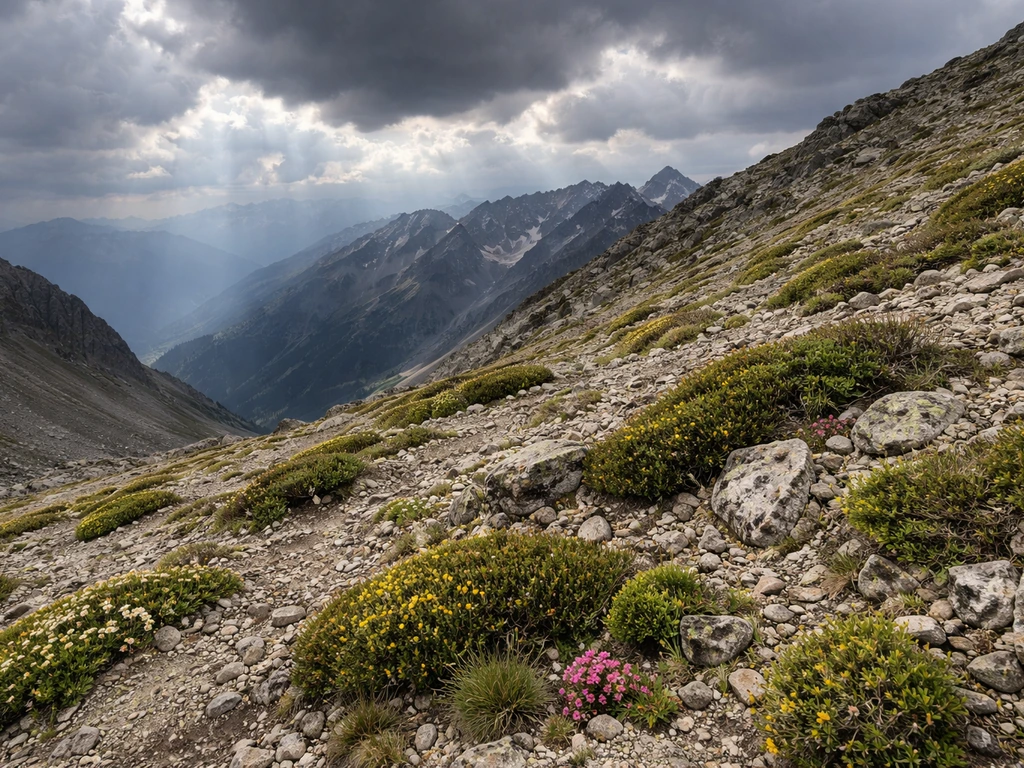
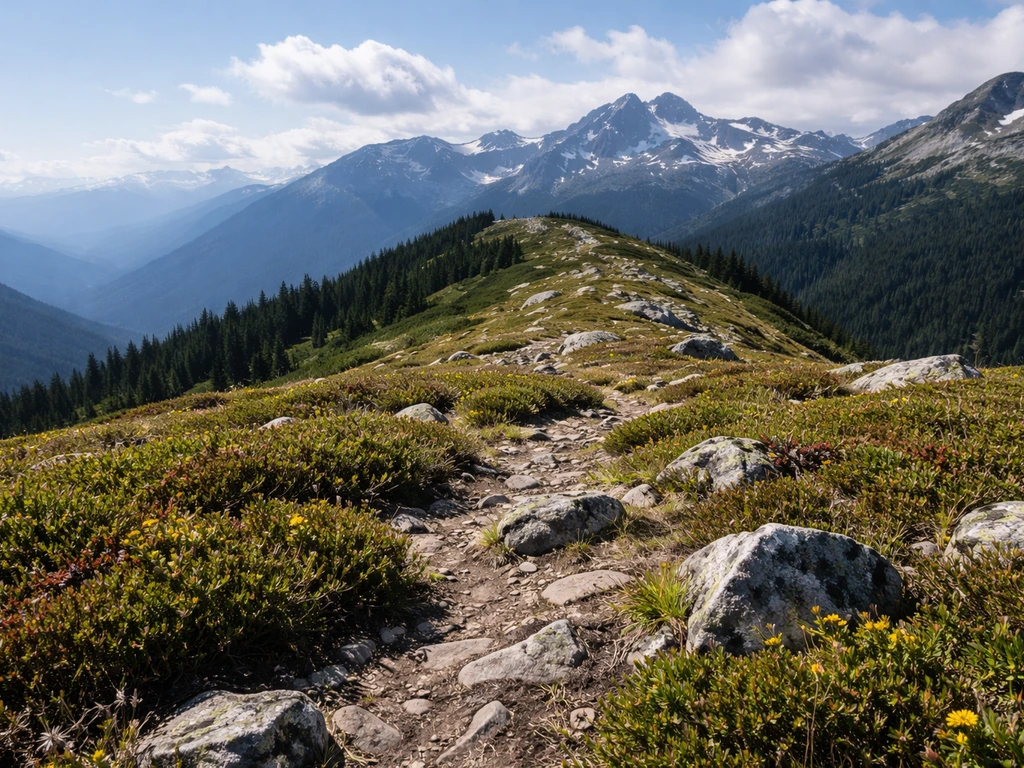
Plants that grow on mountains are called alpine plants. More specifically, the term "alpine" refers to plants growing above the treeline, the elevation at which trees can no longer survive. Below that boundary but still well up the slope, you're in the subalpine zone. Together, these two zones cover most of what people picture when they think of mountain vegetation: low-growing wildflowers, cushion plants, sedges, dwarf shrubs, mosses, and lichens clinging to rocky, wind-scoured terrain.
Plants That Grow on Mountains Are Called Alpine Plants
Dr. Marcus Weatherby
6 May 2026
What "alpine" actually means in ecology
The word alpine comes from the Alps but long ago expanded to describe a specific ecological condition rather than a specific place. Merriam-Webster defines it as "of, relating to, or growing on upland slopes above the highest elevation where trees grow." Cambridge and Oxford use nearly identical language: alpine plants grow naturally in high mountain areas where trees are unable to grow. That upper treeless zone is the true alpine zone.
In practice, ecologists recognize three closely related mountain zones, and it helps to know all three. The boreal zone is the dense conifer forest lower on the slope. Above it sits the subalpine zone, a narrow transitional band where trees become sparse, stunted, and eventually stop growing altogether. The US Forest Service describes subalpine as the stretch between the boreal forest and the true alpine, and the USDA notes that this transition can happen over as little as 350 feet of elevation gain depending on slope, aspect, and shading from neighboring ridges. Then comes the alpine zone proper: open tundra, fell fields, rock, and snow, where the plants are fully adapted to living without tree cover.
The treeline elevation itself shifts considerably by latitude and moisture. In the central Rockies and Sierra Nevada it sits around 3,500 meters (roughly 11,500 feet). Rocky Mountain National Park puts the alpine tundra start at about 11,000 to 11,500 feet, depending on exposure. In the Andes the line sits at different elevations entirely. The key takeaway: "alpine" is a condition defined by temperature and growing-season length, not a fixed number on a map.
Why mountains are so hard on plants (and how plants respond)
When I'm above treeline, the thing that hits you first is the wind. Then the cold. Then you look down and realize the soil under your boots is basically gravel. Every one of those factors directly shapes which plants survive and what they look like.
Temperature drops fast with altitude
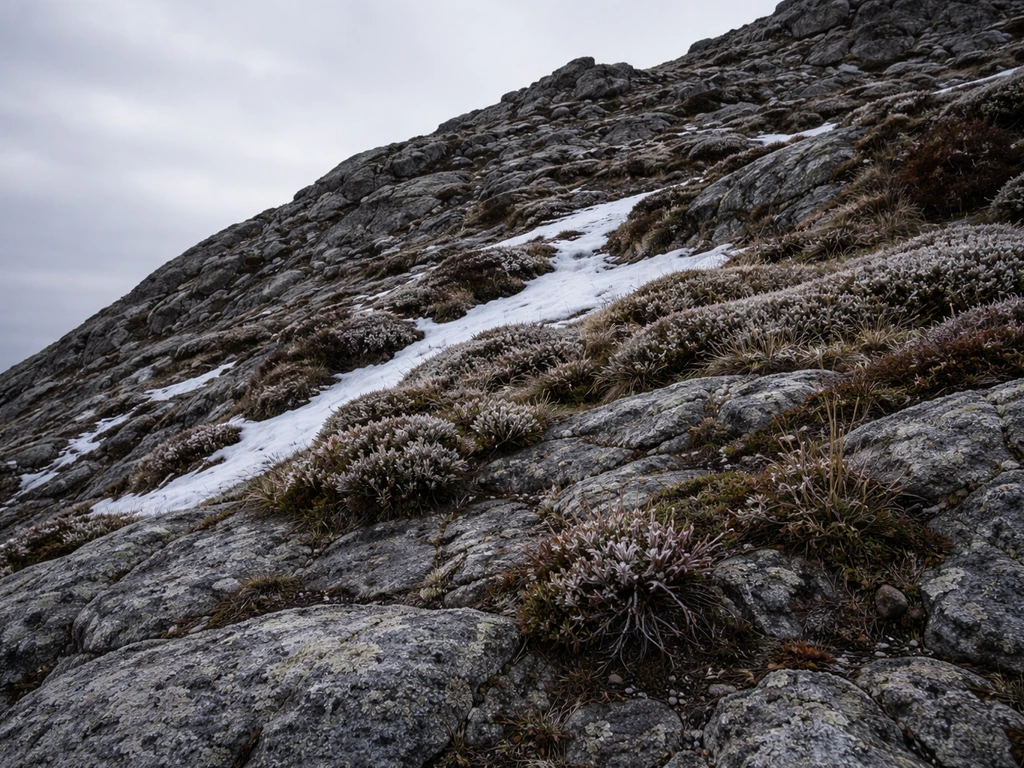
Temperature falls roughly 0.5 to 0.6 degrees Celsius for every 100 meters of elevation gain. That's a steep gradient. By the time you're 1,000 meters above the valley floor you've lost 5 to 6 degrees of average temperature. Summer can be measured in weeks rather than months, and freezing temperatures are possible on any night of the year. Plants that thrive here have to complete their entire reproductive cycle, germination through seed set, inside that brief window.
Wind is the real shaper
Wind does two things that determine plant distribution. First, it desiccates: exposed plants lose moisture faster than roots can replace it from frozen or rocky soil. Second, it redistributes snow. This sounds minor until you realize that in alpine terrain, snow cover is insulation. Where wind scours ridges bare, plants face brutal cold with no protection. Where snow drifts deep in hollows, it stays into summer, shortening the already tiny growing season. The US Forest Service notes that alpine soils are also regularly disturbed by freeze-thaw cycles, which heave roots and break down soil structure constantly.
Thin, rocky, and often dry soils
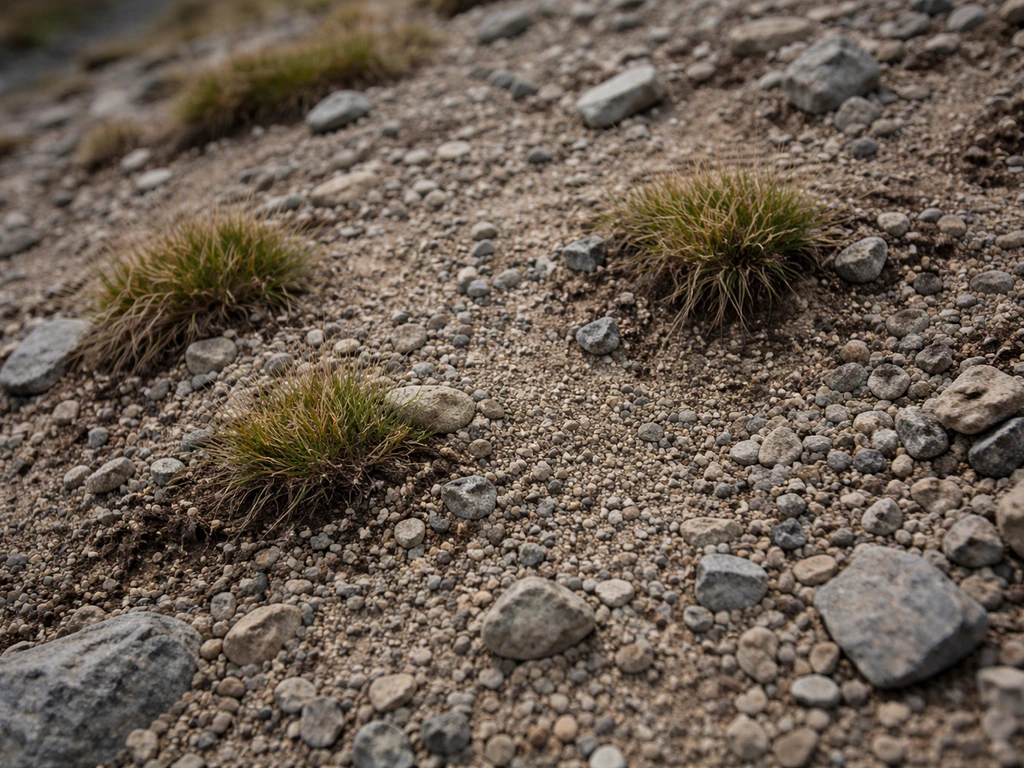
Alpine soils tend to be shallow, rocky, low in nutrients, and highly variable over short distances. A patch of well-developed soil might support grasses and sedges; a few feet away, bare talus or frost-sorted gravel might have almost nothing. Tall grasses that grow around plants and trees are called sedges. Species distributions in these zones are determined by temperature, water availability, and snow-cover duration, all interacting with topography and wind. Soil temperature and air temperature work together with precipitation and plant cover, so the vegetation itself influences the conditions that future plants will experience.
Aspect changes everything at the local level
North-facing slopes receive less sunlight, hold snow longer, and support more lush, moisture-loving communities. South-facing slopes are drier, warmer, and ripen earlier. On a single mountain, you can find dramatically different plant communities within a few hundred meters of each other simply because one face catches afternoon sun and the other stays in shade. This is why the alpine zone starts at different elevations depending on exposure, something Rocky Mountain National Park explicitly points out.
The main plant groups you'll find on mountains
Mountain vegetation isn't random. Once you know the zone and conditions, you can predict the general groups you're likely to encounter. Here's how they break down:
| Plant Group | Typical Zone | Why They Grow There | Examples |
|---|---|---|---|
| Cushion plants | Alpine (above treeline) | Low dome form traps warm air; temps inside cushion can be 10°C above ambient, giving a head start on the growing season | Moss campion, cushion phlox |
| Dwarf shrubs | Subalpine to alpine | Woody stems persist through winter; low profile avoids wind damage and stays under snow cover | Heather, dwarf willow, crowberry |
| Grasses and sedges | Alpine tundra with developed soil | Deep taproots and clumping forms handle freeze-thaw disturbance; spread vegetatively | Alpine Blue Grass, Pyrenean Sedge, Spreading Wheatgrass, Spike Wood-Rush |
| Forbs (broadleaf wildflowers) | Subalpine meadows and fell fields | Short-season bloomers that complete cycles fast; found in sheltered microhabitats | Asters, penstemons, sedges in fell fields |
| Mosses | Moist alpine areas, rock faces | Tolerate freeze-dry cycles; extensive patches in wet hollows and snowmelt zones | Abundant in arctic-alpine parks; over 100 species at Glacier NP |
| Lichens | Rock surfaces, exposed ridges | No true roots; absorb moisture from air; survive on bare rock where nothing else can | Fruticose lichens on ridges; dozens of species at Glacier NP |
| Subalpine conifers | Subalpine zone near treeline | Stunted, often flagged or krummholz form; mark the transition between forest and open alpine | Engelmann spruce, subalpine fir, whitebark pine |
To give you a sense of real diversity: Glacier National Park's alpine vegetation includes over 350 species of vascular plants, more than 100 species of moss, and dozens of identified lichens. Mount Rainier's alpine zone is divided into fell fields, talus slopes, snow beds, and heather communities, each with its own characteristic species mix. Denali's alpine tundra blankets ridges above roughly 3,500 feet with dwarf shrubs and fruticose lichens. These aren't sparse, boring habitats. They're dense with adapted life, just compressed close to the ground.
The cushion growth form deserves special mention because it's the most visually distinctive alpine adaptation. A cushion plant lies flat and dense, keeping itself below wind level. The microclimate inside the cushion can be 10°C warmer than the surrounding air, which matters enormously when you're trying to flower and set seed in a six-week summer. Moss campion is the classic example: tiny pink flowers on a dome-shaped pad, growing in rocky alpine habitats across the northern hemisphere.
How to figure out what grows in your mountain area
If you're trying to identify actual plants from a specific mountain area, or figure out which alpine species are native to a region you're studying or working in, the process comes down to three overlapping questions: what elevation and zone are you in, what's your climate hardiness, and what's the aspect and microclimate of your specific site?
Start with elevation and zone
Knowing your elevation relative to local treeline is the single most useful starting point. If you're above treeline, you're in alpine territory. If you're in the band just below where trees thin out and become stunted, you're subalpine. USGS topographic maps and the National Map platform give you precise elevation data along with slope and aspect, which lets you layer in the microclimate factors described above. USGS TopoView also lets you look at historical topographic maps for a region, which can be useful for comparing past vegetation observations to current terrain.
Use the USDA hardiness zone map as a baseline
The USDA Plant Hardiness Zone Map is based on average annual extreme minimum winter temperatures over a 30-year period, shown in 10-degree Fahrenheit zones with 5-degree half-zones. It's not perfect for alpine use (since alpine plants often care more about summer length than winter lows) but it gives you a cold-tolerance baseline for any site. The interactive map on the USDA site can be zoomed to roughly half-mile scale, which is useful for distinguishing conditions across short distances on a mountain slope.
Account for aspect and local microclimate
Once you have zone and elevation, think about which direction the slope faces. North-facing aspects hold moisture and snow longer, favoring shade-tolerant, moisture-loving species. South-facing slopes warm earlier and dry out faster, supporting more drought-adapted plants. Even in the same hardiness zone and at the same elevation, these two aspects can support almost completely different plant communities. Field observation of what's actually growing on comparable slopes nearby is the most reliable shortcut.
Practical next steps for finding and choosing mountain-suited plants
Whether you're a student trying to understand mountain ecology, a gardener looking for plants adapted to high-elevation conditions, or someone who just saw something growing above the treeline and wants to know what it was, here's a practical sequence to follow:
- Identify your elevation and whether you're above, at, or below treeline for your specific mountain range and latitude. This tells you whether you're in alpine, subalpine, or upper montane territory.
- Look up the USDA hardiness zone for your site using the interactive USDA map. Even if zone alone doesn't define alpine plants, it filters species that can survive your winter low temperatures.
- Check the aspect of your site. North-facing or south-facing changes moisture, snowmelt timing, and sun exposure dramatically, and will determine which specific plant communities are most likely present.
- Search by habitat type within your zone: fell fields, talus slopes, snow bed communities, and heather communities each have characteristic species lists. National Park Service plant resource briefs for parks in your mountain range are some of the most accessible and well-organized references available.
- Cross-reference with regional flora databases filtered by elevation range and life zone. When searching, use terms like "alpine tundra," "subalpine zone," and "above treeline" alongside your specific mountain range or state to get regionally accurate results.
- If you're gardening at elevation, prioritize plants native to your specific mountain range over generic "alpine" selections from catalogs. Local provenance plants are adapted to your exact snow-cover patterns, soil chemistry, and temperature swings in ways that imported alpine species often aren't.
One last thing worth noting: mountain plants share some of the same adaptive strategies as other plants growing in challenging environments. The low-to-ground growth form that helps cushion plants survive alpine wind is related to adaptations you'll find in plants that grow horizontally or parallel to the ground in other exposed habitats. And while alpine plants grow above tree level, there are fascinating parallels with plants that grow on tall trees to access light in completely different biomes. Plants that grow horizontally are called prostrate growth forms, and they help reduce wind stress and maintain heat near the ground. And while alpine plants grow above tree level, there are fascinating parallels with plants that grow on tall trees to access sunlight in completely different biomes plants that grow on tall trees to access light. Mountain ecology is its own world, but the underlying logic of how plants solve extreme-environment problems runs through all of these growth strategies.
The bottom line: when someone asks what plants that grow on mountains are called, "alpine plants" is the correct and ecologically meaningful answer. But the real value is in understanding what that label actually means: a specific set of conditions, a set of plant adaptations shaped by those conditions, and a framework you can use to predict and identify what's growing anywhere on a mountain, from treeline to summit.
FAQ
Are all plants above treeline considered “alpine,” or can there be exceptions?
Most of the time, yes. “Alpine” is defined by the ecological treeless zone above treeline, but local exceptions happen when trees are stunted, patchy, or recently disturbed (for example, after avalanches or fires). In those cases, look at actual vegetation presence and conditions like snow duration and exposed wind, not just whether trees are completely absent on a map.
What’s the difference between alpine and subalpine if both are above the lower forests?
Subalpine is the transitional band where trees still exist but become sparse, stunted, or stop growing altogether. Alpine is the upper, fully treeless zone dominated by tundra, fell fields, rock, snow, and plants adapted to extreme exposure and a very short growing season. The transition can be steep, sometimes over only a few hundred feet depending on slope and aspect.
Do alpine plants live only at very high elevations, like in meters above sea level?
They’re strongly linked to temperature and growing-season length rather than a single elevation number. Treeline elevation shifts with latitude, moisture, and regional climate, so “alpine” can occur at lower elevations in colder or wetter regions and at higher elevations where the climate stays mild longer.
Why do alpine plants look so low to the ground, is it only about wind?
Wind is a major driver, but the low, compact forms also help reduce heat loss, protect buds and flowers, and maintain a more stable microclimate near the soil surface. Cushion growth forms create warmer, less drying conditions inside the mat, which helps plants complete reproduction during brief summers.
How can I identify alpine plants from a specific mountain if I can’t measure temperature or snow cover?
Start with elevation relative to local treeline, then note slope aspect (north versus south exposure), and finally observe the microhabitat (rocky ridge, snow bed, fell field, talus, or sheltered hollow). Even without instruments, these cues narrow likely species groups because snow retention and moisture availability tend to be predictable by topography.
Is the USDA Plant Hardiness Zone Map reliable for choosing alpine plants?
It helps as a rough baseline for winter cold tolerance, but it’s not designed for alpine decision-making. Alpine plants often respond more to summer length, snow cover timing, and wind exposure than to average extreme minimum temperatures. For selection, prioritize site conditions like drainage, wind protection, and the likelihood of short growing windows.
If I see the same elevation on two different slopes, will the plant species always match?
Not necessarily. Aspect and exposure can change snow persistence and sunlight, which shifts moisture and the length of the growing season. Two sites at similar elevation can support very different communities if one slope warms earlier and dries out while the other stays shaded and retains snow longer.
What are freeze-thaw cycles doing to alpine habitats, and should I worry about them for gardening or fieldwork?
Freeze-thaw repeatedly disturbs alpine soils by heaving roots and breaking down soil structure, which affects where plants can establish and how stable the ground is. For fieldwork, expect patchy, unstable substrate; for gardening, poor drainage and frequent temperature swings can mimic stressors by damaging roots and seedlings.
Are alpine plants “rare,” or can they be surprisingly dense?
They can be dense, just low-growing. Because resources like warmth and insulation are limited, many species grow close together or form mats and cushions that occupy small patches efficiently. The appearance can look sparse from far away, but up close many alpine areas contain tightly packed, highly adapted vegetation.
How should I handle it if I’m unsure whether I’m in the alpine zone or just below it?
Use multiple cues. Check whether trees are clearly absent or only exist as stunted, scattered individuals, then compare evidence of exposure and snow behavior, such as drift persistence in hollows versus scoured ridges. Also confirm elevation against local treeline information rather than relying on a single spot’s altitude.