
Plants that grow in air are called air plants, and the correct botanical term for the group they belong to is epiphytes. More specifically, when people say 'plants that grow in air,' they almost always mean Tillandsia, a genus in the bromeliad family whose members pull water and nutrients directly through their leaves using tiny, scale-like structures called trichomes. Their roots exist mainly to anchor them to a surface, not to absorb anything. No soil required, no connection to the ground needed.
Plants That Grow in Air Are Called What? Easy Guide

Dr. Marcus Weatherby
2 May 2026
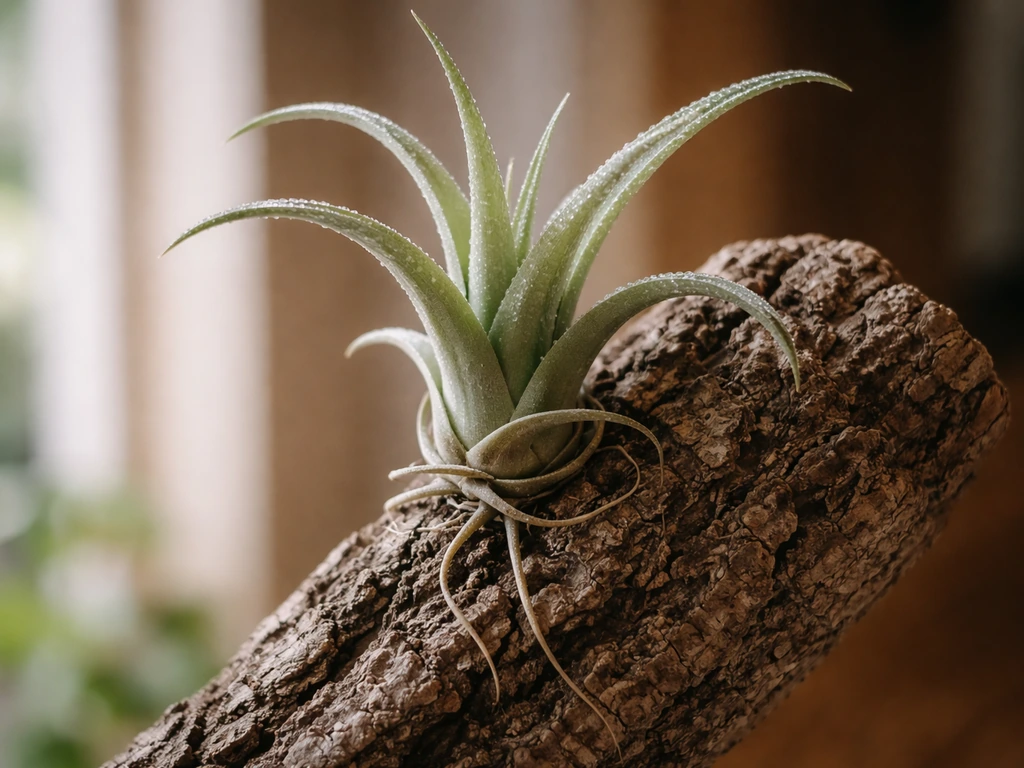
How growing in air actually works
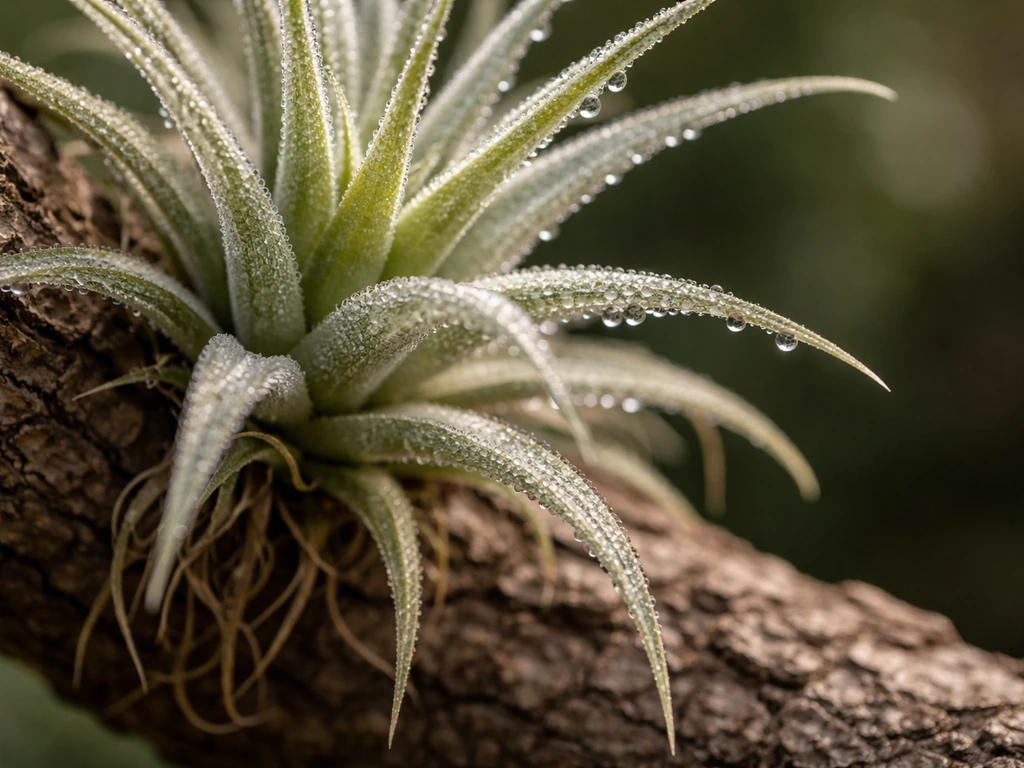
The mechanism is genuinely unusual compared to almost every other plant you've encountered. A typical terrestrial plant pulls water and dissolved nutrients up through its root system from the soil. Tillandsia flips that completely. The leaves are covered in trichomes, which are minuscule hair-like or scale-like structures that increase surface wetting and help the plant capture moisture from dew, fog, rain, and humid air. Once water collects on the leaf surface, the trichomes help move it inward for absorption. Research on fog-dependent Tillandsia communities has shown that the rate at which these plants intercept fog water from passing air is comparable to purpose-built fog-catching mesh structures.
The roots on a Tillandsia are essentially crampon-style holdfasts. They grip a branch, a rock face, or even a telephone wire and keep the plant from blowing away. Studies on foliar trichomes in epiphytic Tillandsia confirm that the root structures are incapable of water absorption for whole-plant use, so everything the plant needs has to come in through the leaves. This is why airflow, humidity, and light all matter so much for keeping these plants alive, and why watering method looks completely different from anything you do with a potted houseplant.
Air plants, epiphytes, and plants growing on trees: clearing up the confusion
This is where most of the terminology confusion happens, and it's worth untangling carefully. 'Epiphyte' is a growth habit, not a plant family. It describes any plant that physically attaches to another plant or object for support without rooting in the ground and without feeding on its host. That last point matters: epiphytes are not parasites. They don't extract nutrients from the tree they're sitting on. They're just using it as a perch, the same way a bird does.
Epiphytes span a huge range of plant families. Orchids, ferns, mosses, and bromeliads (including Tillandsia) can all be epiphytic. So while all atmospheric Tillandsia are epiphytes, not all epiphytes are air plants in the specific Tillandsia sense. A pothos growing up a moss pole is not an epiphyte. A staghorn fern mounted on a board and watered at its base is an epiphyte, but it's not a true 'air plant' the way Tillandsia is, because it still needs substrate moisture and doesn't rely purely on foliar uptake from humid air.
Then there's the phrase 'grows on trees,' which can describe anything from a parasitic mistletoe (which does steal nutrients from its host) to blank" rel="noopener noreferrer">Spanish moss (Tillandsia usneoides, which is a true air plant just draping over a branch) to a regular climbing vine. If you see a plant growing on a tree and want to know what category it falls into, the key question is whether its roots are in soil anywhere and whether it's pulling nutrients from the host. If the roots are only anchoring and the plant feeds itself through its leaves and the surrounding air, you're looking at an epiphyte, and if it's also in the Tillandsia genus, it's specifically an air plant.
| Term | What it means | Soil needed? | Feeds on host? | Example |
|---|---|---|---|---|
| Air plant (common name) | Usually refers to Tillandsia; absorbs water/nutrients through leaf trichomes | No | No | Tillandsia ionantha, T. usneoides |
| Epiphyte | Grows on another plant/object for support; broad category | No (anchors only) | No | Orchids, staghorn ferns, Tillandsia, mosses |
| Parasite | Feeds on host plant tissue for nutrients | Not required | Yes | Mistletoe, dodder |
| Lithophyte | Grows anchored to rocks; may still absorb some nutrients from rock surface | No | No | Some bromeliads, certain ferns |
| Terrestrial bromeliad | A bromeliad that grows in soil like a normal plant | Yes | No | Ananas comosus (pineapple) |
Examples to look for and how to identify them
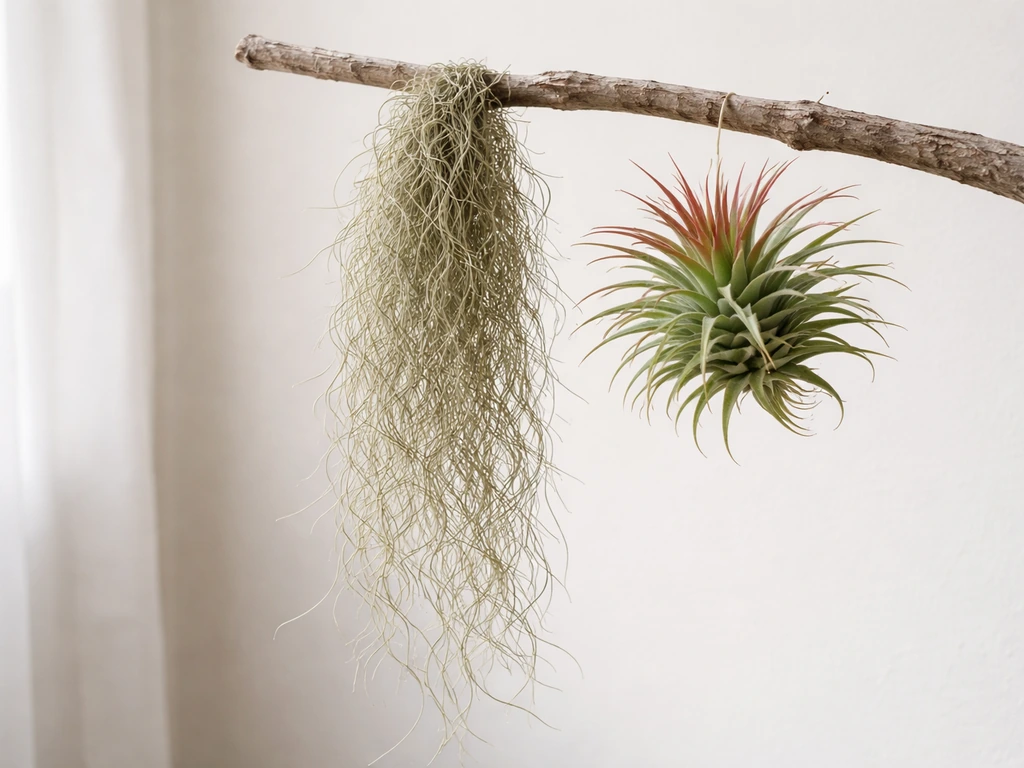
Tillandsia usneoides, better known as Spanish moss, is probably the most recognizable air plant in North America. It drapes in long silvery-grey strands from tree branches across the southeastern United States. There are no visible roots at all, just cascading leaf filaments coated in trichomes. If you've driven through the Gulf Coast or the Carolina lowcountry, you've seen it. It thrives in humid, subtropical conditions where there's enough ambient moisture in the air to keep it fed without any attachment to soil.
Tillandsia ionantha is a compact, rosette-forming species that's widely available and a good starting point for anyone new to air plants. The leaves form a tight spiral, and when the plant is stressed by drought or approaching bloom, the inner leaves flush red or pink. That color change is a useful visual cue. Tillandsia landbeckii is an extreme example worth knowing about: it grows in the Atacama Desert in South America, one of the driest places on Earth, and gets virtually all of its water from coastal fog rather than rainfall. Entire ecosystems of this plant exist in places that receive almost zero annual precipitation.
To verify you're actually looking at a true atmospheric air plant rather than a regular epiphyte, check these things:
- Roots, if present, are thin and wire-like with no root hairs; they grip surfaces but don't spread into a substrate looking for water
- Leaves feel slightly rough or fuzzy due to trichome coverage, especially on species from drier habitats (xeric Tillandsia tend to be silvery-grey and heavily scaled)
- The plant shows no connection to soil at any point in its attachment
- Mesic (higher-humidity) Tillandsia tend to be greener and smoother-leafed; xeric species are paler and more heavily trichomed
- When you soak the plant in water, trichomes flatten and the leaves may appear temporarily greener as they absorb water
Practical care: what these plants actually need
Because air plants get everything through their leaves, your care routine has to reflect that. The three things that kill most Tillandsia in home settings are rot from sitting wet, drought from never being watered at all, and stale air with no circulation. All three are easy to avoid once you understand the logic.
Watering
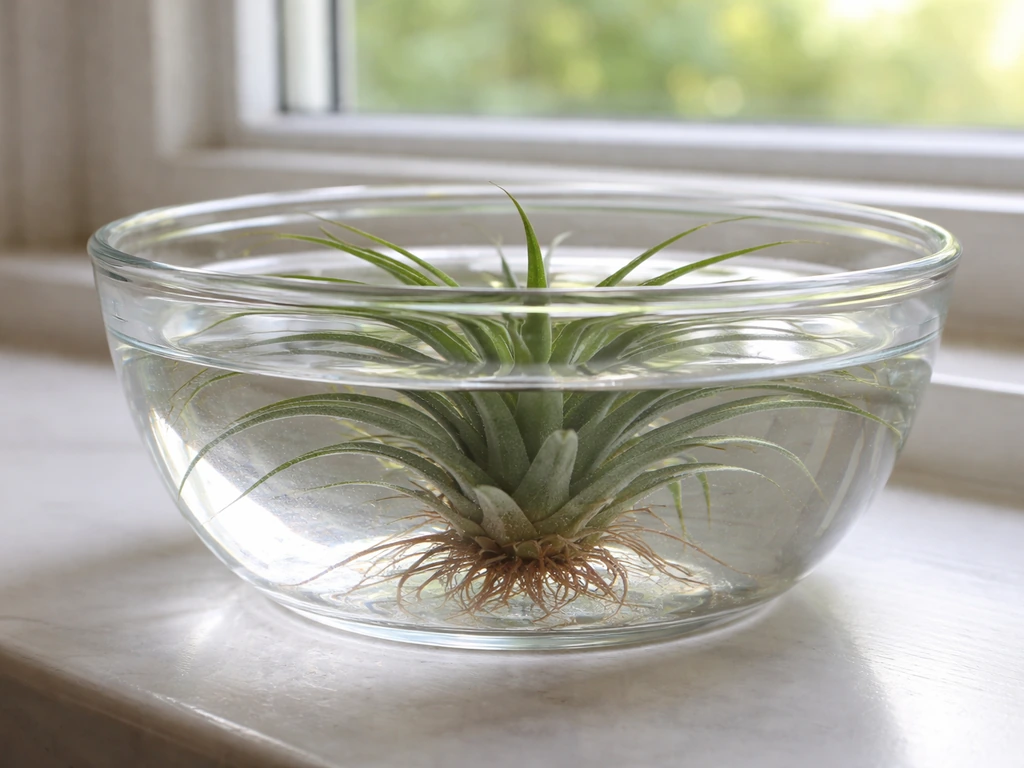
The standard method is a soak: submerge the plant in room-temperature water for 20 to 30 minutes roughly once a week, though in very dry indoor environments you might do this every five days. After soaking, shake off the excess water and let the plant dry completely within a few hours. Drying upside down helps water drain away from the base rather than pooling there. A cupped rosette that stays wet at the center for more than a few hours is a rot risk. Misting can supplement soaking in a humid environment but usually isn't sufficient as the only water source.
Airflow and humidity
Air circulation is non-negotiable. These plants need to dry out after watering, which means a sealed terrarium with no ventilation will kill them through rot even if you're watering correctly. A bathroom with a window works well because you get humidity from showers plus airflow from the opening. In drier climates, more frequent soaking compensates for lower ambient humidity. Aim to keep them somewhere with moving air rather than a stagnant corner.
Light
Most Tillandsia do best in bright, filtered light. Think a spot near a window with indirect sun rather than direct midday sun beating through glass. In their natural habitat, they're often shaded by tree canopy or hanging at angles that limit harsh direct exposure. Temperatures in the range of around 50 to 60 degrees Fahrenheit at night and up to 80 to 90 degrees during the day suit most species, which reflects the warm, humid environments where they naturally occur.
Where air plants naturally thrive
Tillandsia are native to the Americas, ranging from the southeastern United States down through Central and South America. Their natural habitats are diverse but share one common thread: reliable access to atmospheric moisture. The most successful wild populations are found in tropical and subtropical forests where humidity is high, in coastal areas where marine fog provides a daily moisture source, and in some desert regions like the Atacama where fog (not rain) is the primary water delivery system.
Seasonality matters in these ecosystems. Fog-dependent Tillandsia communities in coastal Peru, for example, are tied to seasonal fog patterns driven by cold ocean currents. When fog seasons are strong, the plant communities expand. During El Niño years when rainfall patterns shift and fog decreases, these communities can decline significantly. This is a useful frame for thinking about what your indoor air plant actually needs: it evolved to capture moisture from passing humid air, not to tolerate dry heated indoor air without any intervention.
Compare this to plants that grow on dry land, which have the opposite water-access strategy: deep root systems hunting for soil moisture. The plants that grow on land are called terrestrial plants, and they rely on roots to pull water from soil plants that grow on dry land. In contrast, the plants that grow on dry land are typically those with deeper roots that can access soil moisture. Air plants essentially turned that strategy inside out, trading root infrastructure for leaf-surface absorption tuned to atmospheric water sources. Understanding that ecological trade-off tells you a lot about how to keep them happy indoors.
Picking the right air plant for your environment
The most useful first step is to honestly assess the humidity level in your space. If you live somewhere with naturally humid summers and good airflow, almost any Tillandsia will work. If your home is dry year-round because of forced-air heating or air conditioning, stick with xeric species like Tillandsia xerographica, T. tectorum, or T. stricta, which evolved for lower ambient humidity and tolerate drier conditions between waterings. Mesic species like T. bulbosa or T. streptophylla need more consistent humidity and do better in bathrooms, kitchens, or near a humidifier.
For light, match the species to your window exposure. Southern or eastern window exposures with indirect bright light suit most species well. If your only option is a north-facing room with dim light, look for shade-tolerant species and consider supplementing with a grow light placed 6 to 12 inches away for a few hours a day.
If you're sourcing plants, look for Tillandsia with trichomes that are intact and leaves that are firm, not shriveled. A shriveled, papery leaf means the plant has been water-stressed, though most recover with a good soak. Avoid plants with black or mushy spots at the base, which indicate rot that's likely already moved into the core. Reputable bromeliad nurseries and specialist growers will give you much more consistent quality than big-box retailers, especially for less common species.
Once you have the right species for your humidity and light conditions, the rest is fairly simple: soak, drain, dry, repeat. Air plants are genuinely low-maintenance once you stop treating them like conventional houseplants and start thinking of them as the fog-adapted, leaf-drinking organisms they actually are.
FAQ
Are all epiphytes the same thing as air plants?
No. “Epiphyte” is a broad growth habit (plants that attach for support and do not feed from the host). “Air plant” usually means Tillandsia specifically, because they rely primarily on leaf uptake from humid air and dew, and their roots mainly anchor.
Do air plants need to be soaked, and how do I know how often?
They do best on a soak-and-dry cycle. Frequency depends on your ambient humidity and airflow, not a fixed calendar schedule. In dry homes, shorter intervals between soaks are usually needed, but never skip the drying step, since staying wet at the base is a common rot trigger.
Can I keep an air plant in a closed terrarium?
Usually not. Closed terrariums reduce airflow and trap moisture, which raises the chance of rot, especially in cupped rosettes. If you must use a container, choose one with ventilation and you still need to ensure the plant dries fully after every watering.
Why does my air plant look fine right after watering but decline over the next week?
This often means it is drying too slowly, usually because water is pooling in the center or because the plant sits in stagnant air. After soaking, shake off excess water and dry it in good airflow, ideally upside down so water drains away from the base.
What water should I use for soaking, tap or distilled?
Use room-temperature water that is low in salts if your tap water is hard. Hard water residue can accumulate on leaf surfaces and interfere with nutrient uptake through trichomes. If you see crusty buildup over time, switch to filtered or low-mineral water.
How can I tell the difference between drought stress and rot?
Drought stress typically causes drying, wrinkling, or shriveled outer leaves, and the plant often perks up after a thorough soak. Rot shows up as black or mushy tissue, often near the base or core, and it usually does not reverse once it spreads.
Do air plants need fertilizer, and when should I add it?
They can benefit from light feeding, but they should never be treated like soil-grown plants. If you fertilize, use a bromeliad or air-plant fertilizer diluted to a weak concentration and apply it mainly during or after watering when the plant is hydrated, then ensure full drying afterward to prevent lingering wetness.
Is misting alone enough for air plants?
Usually not. Misting can supplement humidity, but as a sole watering method it often does not fully hydrate the plant and can leave moisture trapped in the center. Soaking is the more reliable approach, especially for rosette-type Tillandsia.
My air plant is growing new leaves, but it is not blooming. What’s the cause?
Many Tillandsia bloom after they mature and under the right light level and environmental conditions. If light is too dim, the plant may grow slowly and delay flowering. Also note that some species respond strongly to seasonal changes, and bloom triggers can include periods of slightly drier conditions followed by proper soaking.
Can I mount or attach Tillandsia, and where should the roots go?
Yes, you can mount them on wood or other surfaces for display. The roots should be used only to anchor, not to bury in substrate. If the mounted area stays wet for long periods, that can slow drying and increase rot risk, so choose mounting spots with good airflow.
Are there safe places in a home to put air plants besides windowsills?
Yes. Bathrooms and kitchens can work well because humidity is naturally higher and daily airflow occurs when doors open. Just avoid sealed corners, poorly ventilated shelves, or places where the plant will remain damp after watering.
What should I do if water gets trapped in the center of a rosette?
Dry it immediately. Shake off excess water, then tip the plant upside down and let it air-dry until the center is no longer wet. If the center stays wet for hours, rot becomes more likely, especially in cooler conditions.
How do I choose a species if my home is very dry?
Look for xeric (drier-adapted) Tillandsia varieties. The article notes examples like T. xerographica, T. tectorum, and T. stricta for drier conditions, while mesic types typically need more consistent atmospheric moisture and do better with a humidifier or higher-humidity rooms.