Yes, plants do grow over dead bodies, and the ecology behind it is surprisingly well-documented. Decomposing remains create a localized zone of enriched soil called a cadaver decomposition island (CDI), where nutrients like nitrogen, phosphorus, and potassium spike, pH shifts, and moisture levels change dramatically. The first visible plant response typically shows up within weeks to a few months, depending on climate, season, and what plant species are already nearby. What you actually see growing depends entirely on local conditions: a wet temperate forest will produce a different set of colonizers than an arid grassland or a frozen northern site in January. What plant grow on land depends on the local climate, soil type, moisture, and available nutrients.
What Plants Grow Over Dead Bodies and Why
Can plants really grow on dead bodies? Myths vs. reality
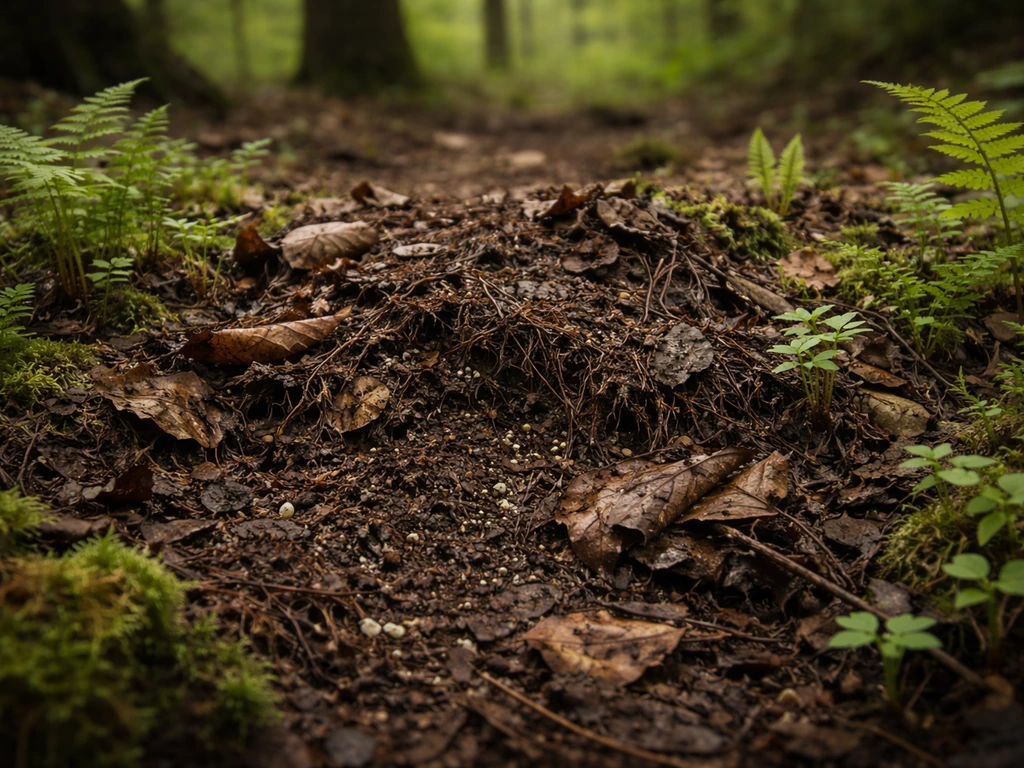
The short version: plants don't grow directly out of a body, but they grow remarkably well in the soil directly above and around one. Plants that grow on other plants are called epiphytes plants don't grow directly out of a body. The misconception usually comes from horror-movie imagery of plants sprouting from corpses. What actually happens is more interesting ecologically. A decomposing body releases enormous quantities of carbon, nitrogen, and other nutrients into the soil below and immediately around it. That flush of fertility changes the local growing conditions so dramatically that it functions like a fertilizer bomb, triggering visible changes in whatever plants are already in the vicinity and encouraging new colonizers to establish.
Another common myth is that decomposition poisons the soil and nothing grows. The opposite is closer to the truth. Studies mapping cadaver decomposition islands describe them as zones of concentrated fertility, not sterility. The soil can become temporarily hypoxic during active decay as microbial activity spikes and consumes available oxygen, but this is transient. Once decomposition slows into the advanced decay and dry/skeletonized stages, the soil stabilizes and plant growth accelerates noticeably.
What decomposition actually does to the soil
Vertebrate decomposition follows five broadly recognized stages: fresh, bloat, active decay, advanced decay, and dry or skeletonized. Each stage produces different effects on the surrounding soil, and the timeline varies considerably with temperature and moisture. In warm, humid summer conditions, pig carcasses used in forensic research can move through fresh to active decay in under two weeks. In winter, decomposition slows dramatically and remains can hold a relatively fresh appearance for extended periods.
The most important soil changes for plant growth happen during and after active decay. Fluid from the body enters the soil beginning roughly around day 12 in warm conditions, marking the start of what researchers call the active decay phase. By around day 16 to 17, the soil under the body starts showing measurable increases in soluble elements including sodium, potassium, phosphorus, and sulfur.
By day 17, one study reported the beginning of “active decay,” and it described expansion of “wet” cadaver decomposition island chemistry across subsequent day ranges (days 28 to 42) in their donor timelines [active decay phase](https://pmc. ncbi. nlm. nih.
gov/articles/PMC10263346/). Soil pH and electrical conductivity shift noticeably too, reflecting the chemical complexity of what's entering the soil matrix. Nitrogen levels, particularly ammonium and nitrate forms, rise substantially, with gravesoil nitrogen peaking at around two to three months post-death before gradually declining. This nitrogen pulse is the key driver of the plant response you'll eventually see above ground.
Soil microbial communities go through two major successional waves: one during the bloat-to-active decay transition when body fluids first saturate the soil, and another during the active-to-advanced decay period. Vertebrate remains are nitrogen-rich compared to plant litter, so decomposer microbes work faster and more intensively. If the local soil already has an active microbial community (which most natural soils do), decomposition is further accelerated, which means the soil chemistry changes faster and the window for plant establishment opens sooner. The CDI itself can remain detectable in soil chemistry for three to seven months after the body is gone.
Plants most likely to colonize decomposing remains
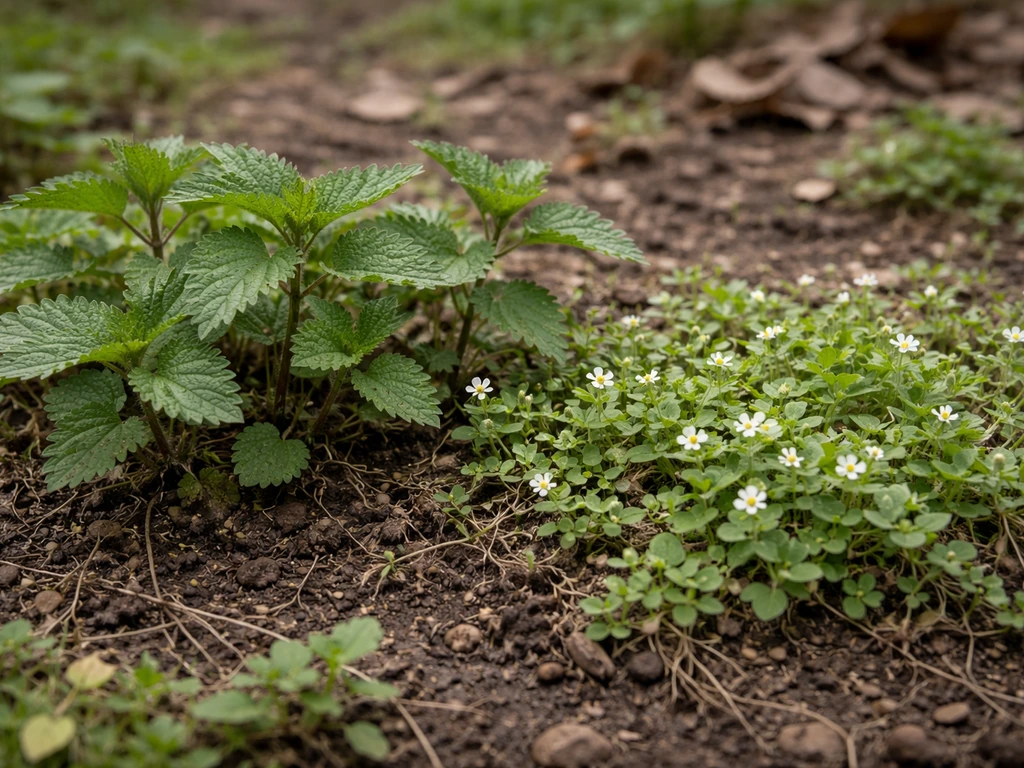
Which plants show up first depends heavily on what's growing in the surrounding area and what seeds are in the soil seed bank, but certain ecological types consistently respond to the conditions a CDI creates. High nitrogen availability, disturbed soil, and elevated moisture (from decomposition fluids) favor fast-growing, nitrogen-hungry species. In most temperate environments, these are the groups you'll see establishing first:
- Nitrophilous weeds and ruderals: Species like nettles (Urtica dioica), chickweed (Stellaria media), fat hen (Chenopodium album), and dock (Rumex spp.) are classic nitrogen-lovers. They respond quickly to nutrient flushes in disturbed soil and are among the first colonizers across temperate Europe and North America.
- Annual grasses: Fast-germinating annual grasses like annual bluegrass (Poa annua), barnyard grass (Echinochloa crus-galli), and crabgrass (Digitaria spp.) exploit disturbed, nutrient-rich patches efficiently. In warmer climates, these can establish within weeks of soil enrichment.
- Mosses and liverworts: In cool, moist environments (think Pacific Northwest, British uplands, or boreal zones), mosses can colonize the moisture-enriched zone around remains quickly, especially on the shaded forest floor where vascular plants are slower to respond.
- Ferns: In humid temperate and subtropical forests, fern species including bracken (Pteridium aquilinum) can spread vegetatively into enriched gaps, particularly where the canopy remains closed.
- Opportunistic perennials: Elderberry (Sambucus spp.), pokeweed (Phytolacca americana in North America), and various thistles (Cirsium spp.) are known nutrient-gap colonizers that establish readily in CDI conditions once the soil chemistry stabilizes.
- Native grassland forbs: In open grassland and savanna settings, forb species adapted to nitrogen-rich microsites (including some Asteraceae and Lamiaceae) establish in the CDI zone as grasses may temporarily die back during peak decomposition and then recover.
In arid and semi-arid environments, the picture is different. Decomposition itself is slower, especially in winter, and the soil enrichment is less dramatic because fluid dispersal is limited. Desert annual species that track nutrient pulses (many in the Brassicaceae and Boraginaceae families) may colonize CDI zones, but the signature is subtler and slower to develop than in moist climates. In heavily managed agricultural land, whichever weed species dominate the local flora will respond fastest, because they're already adapted to exploiting soil disturbance.
It's worth noting that some forensic botany work focuses specifically on the vegetation regrowth interval over CDIs. Research presented at the American Academy of Forensic Sciences has shown that a CDI can still be detected in soil and vegetation patterns three to seven months after remains are removed, which means the plant community response persists well beyond the decomposition event itself. This is ecologically significant: the nutrient legacy shapes what grows in that spot for months, sometimes longer.
Environmental factors that control what actually grows
The CDI creates the nutrient opportunity, but local environmental conditions determine which species can actually capitalize on it. Think of it as a job listing that gets posted, but only candidates already in the area with the right traits can apply.
| Factor | How it shapes colonization | Key variation |
|---|---|---|
| Temperature / Season | Warm seasons accelerate decomposition and shorten the timeline to plant establishment. Cold winters dramatically slow both. | Summer CDI can show plant response in weeks; winter CDI may take until spring thaw. |
| Moisture / Rainfall | Decomposition fluids need water movement to disperse nutrients through soil. Dry conditions concentrate and slow the process. | Humid temperate zones show faster, denser plant colonization than arid zones. |
| Soil type | Sandy soils drain nutrients quickly, reducing CDI intensity. Clay soils retain nutrients longer but may become temporarily waterlogged. | Loam soils in temperate zones typically produce the most pronounced CDI plant response. |
| Sunlight / Canopy cover | Open sites favor fast-growing weeds and annual grasses. Shaded forest floor favors mosses, ferns, and shade-tolerant forbs. | Forest CDIs often show different colonizers than open-field CDIs even in the same climate. |
| Existing plant community | Seeds in the local seed bank determine what can germinate. CDIs don't create plants from nothing — they shift competition. | Agricultural fields vs. old-growth forest floors produce completely different colonizer communities. |
| Soil pH | Decomposition can shift pH up or down depending on stage and soil buffering capacity. Extreme pH changes limit some colonizers. | Most observed CDIs return toward baseline pH as decomposition ends, broadening colonizer options. |
Season at the time of death matters a lot. A body that enters active decay in midsummer (high heat, microbial activity at peak) will produce a CDI much faster and more intensely than one that begins decomposing in January. The 2025 forensic entomology research tracking pig carcasses across summer and winter placements shows clearly that decomposition stage timing is compressed in summer and extended significantly in winter. This has a direct downstream effect on when plants can respond: summer remains may produce a visible plant growth signature within one to two months, while winter remains may not show a clear plant response until the following spring.
Moisture stress is another underappreciated factor. Research on microbial decomposition in drought-prone forests shows that soil biological communities respond to moisture availability as much as to nutrient inputs. In a dry summer, even a nutrient-rich CDI may not trigger fast plant colonization if germination conditions are poor. The interaction between nutrient opportunity and water availability is what ultimately determines whether you see a lush patch of nettles or a relatively bare spot of disturbed soil. USDA FEIS notes that stinging nettle generally grows on deep, rich soils and can colonize wetland sites when water levels are high.
How to read what's growing and when it means something
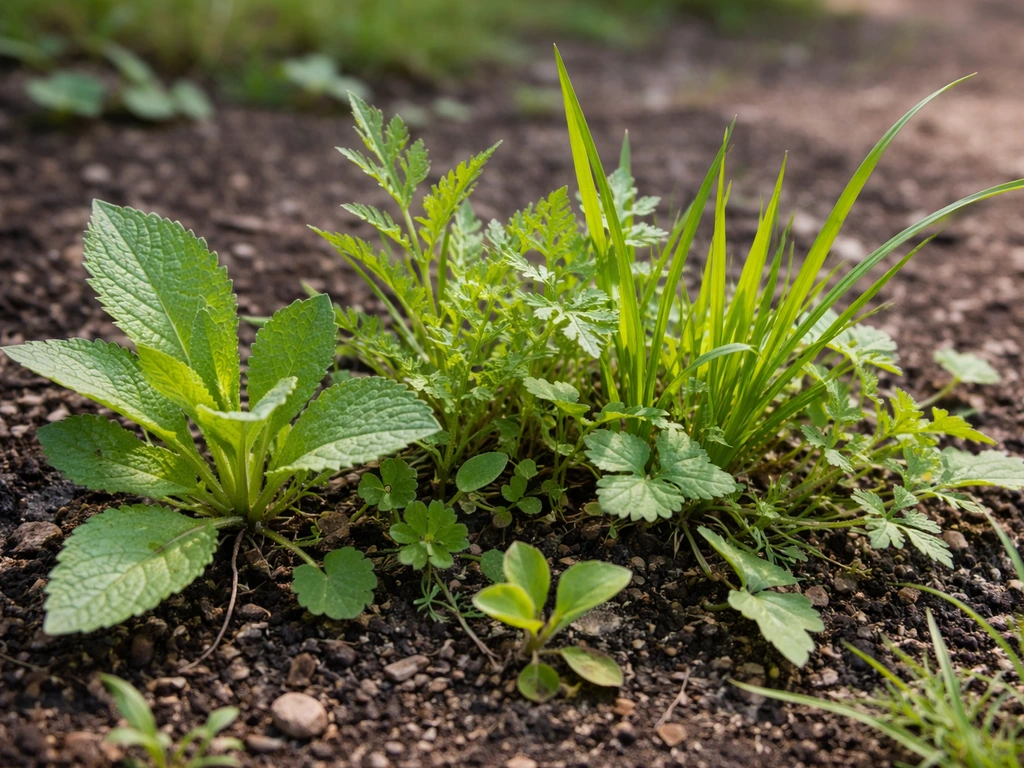
If you're a gardener or land manager and you've noticed an unusual patch of lush, weedy, or distinctly different vegetation in an otherwise uniform area, it's worth understanding what's ecologically normal versus what might warrant attention. CDI-associated plant growth has a recognizable signature: it's localized (roughly body-sized or slightly larger), often denser and taller than surrounding vegetation, and typically dominated by nitrophilous species rather than whatever surrounds it.
Natural explanations for similar patches are common and should be ruled out first. Animal latrines, old compost or manure piles, buried organic waste, storm drain outflows, and old fire pits all create localized nutrient anomalies that produce similar-looking vegetation patches. If the patch is associated with any of these, you have a straightforward ecological explanation. The CDI signature becomes more notable when the patch appears without an obvious surface explanation, when the outline is roughly oval and body-sized, and when you're in an area where animal or human death could plausibly have occurred.
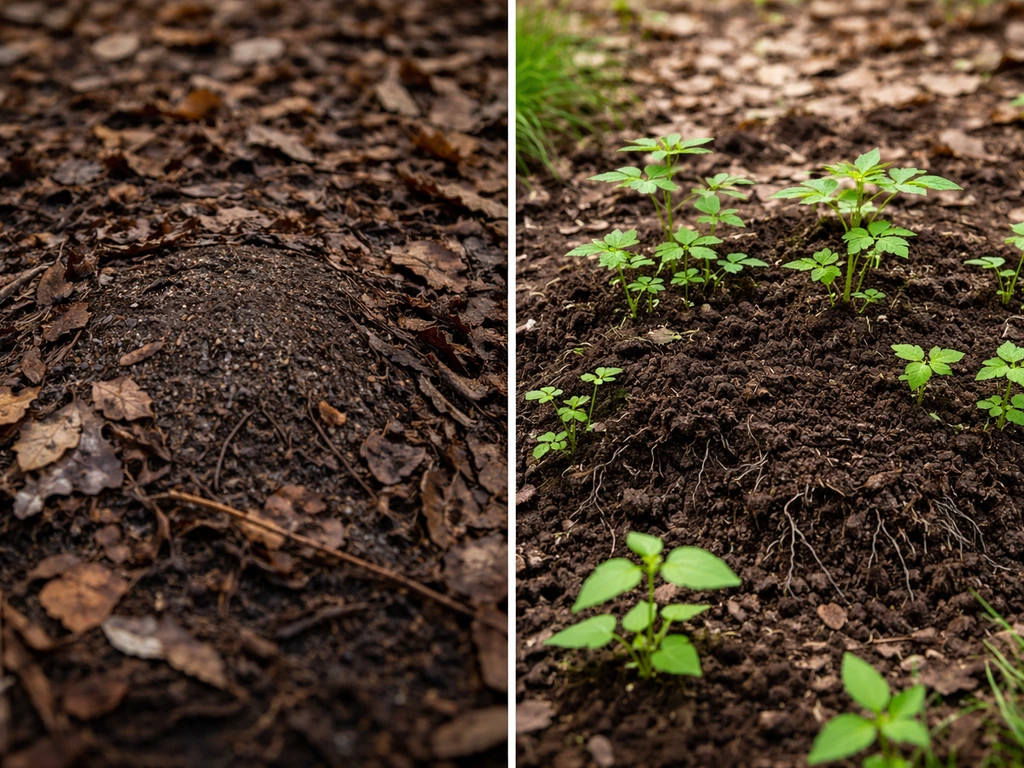
Timing gives additional clues. A patch that appeared and intensified over the course of two to four months, started as a die-back zone (temporarily bare or discolored soil), and then transitioned to lush weed growth is consistent with the known CDI timeline. The initial die-back or discoloration of grass overlying the site corresponds to the hypoxic, high-fluid phase of active decay. The subsequent lush growth corresponds to stabilization and nitrogen availability becoming accessible to plant roots.
A concern for human remains is a different situation entirely. If you find what appears to be bone, clothing, or other material suggesting human remains, the ecology of what's growing nearby is secondary to the legal and safety obligations you have. Don't attempt to investigate further yourself.
Safety, legality, and what to do if you suspect human remains
If you encounter what you believe may be human remains, whether in a natural setting, on agricultural land, or in an urban or suburban context, the immediate legal obligation is clear: stop what you're doing, don't disturb the area further, and contact local law enforcement. Washington State law, for example, explicitly requires notification of the Medical Examiner or County Coroner and local law enforcement when suspected human remains are found, and this requirement is broadly consistent with laws across U.S. states and most countries. Florida's Division of Historical Resources similarly directs people to contact law enforcement first, before anything else.
From a safety standpoint, decomposing human remains carry potential biohazard risks. Blood, body fluids, and associated soil can contain pathogens even when the death was not caused by an infectious disease. OSHA guidance for personnel who handle human remains recommends appropriate personal protective equipment including gloves, eye protection, and respiratory protection in some contexts. CDC infection prevention standards emphasize that standard precautions apply whenever blood or body fluids may be present. For an untrained member of the public, the practical takeaway is simple: don't handle anything, don't disturb the soil or vegetation, and let trained personnel manage the scene.
If you're a land manager dealing with a confirmed animal mortality site (not human remains), the legal obligations are different and typically much simpler, though local regulations on carcass disposal vary. The soil and vegetation management considerations below apply to both animal CDI sites after appropriate clearance and to any formerly contaminated ground that has been legally cleared for work.
Practical next steps for gardeners and land managers
Once a site has been cleared by appropriate authorities (for human remains) or after an animal mortality event has resolved naturally, you'll likely be dealing with a patch of disturbed, nutrient-altered soil that's colonized by weedy or invasive species. Here's how to manage it practically.
- Test the soil before doing anything. A basic soil test (available through most cooperative extension services) will tell you current pH, nitrogen, phosphorus, and potassium levels. CDI soils can be significantly out of balance for normal planting, often high in nitrogen and with shifted pH. Knowing your starting point prevents you from over-amending a soil that's already nutrient-rich.
- Address pH if needed. Lime raises pH in acidic conditions; sulfur lowers it in alkaline soils. CDI-associated pH changes are typically temporary, but in heavy clay soils they can persist longer. NPS cemetery landscape guidance notes that maintaining appropriate soil pH is fundamental to supporting healthy vegetation rather than invasive colonizers.
- Remove established weedy colonizers before they set seed. Nitrophilous species like dock, nettles, and fat hen produce large quantities of viable seed. Hand-pulling or cutting before seed set prevents the next generation from establishing. Wear gloves, and if the mortality was recent, consider more protective gear as a precaution.
- Avoid heavy soil disturbance if possible. Turning the soil repeatedly brings up new weed seeds from deeper layers and extends the weedy colonization phase. A single, careful removal followed by mulching and replanting with desired species is more effective than repeated tillage.
- Replant or overseed promptly. A bare or disturbed CDI site is an open invitation for further weed colonization. Seeding with locally adapted native grasses, groundcovers, or desired garden plants quickly fills the niche before opportunistic weeds return. Choose species suited to your specific climate zone, moisture regime, and light conditions.
- Monitor for regrowth for at least one full growing season. CDI soil chemistry can remain elevated for three to seven months after remains are removed, meaning the nutrient-rich conditions that favor weedy growth persist well beyond the initial event. Plan for active management across at least one full season.
- If contamination is a concern, consult an environmental professional. EPA guidance on soil remediation at sites with potential biohazard or chemical contamination describes a range of approaches from containment to ex-situ treatment. For most animal mortality sites, natural attenuation combined with active revegetation is sufficient. For sites with confirmed human remains or known chemical contamination, professional soil assessment is the appropriate step.
One thing worth keeping in mind: the CDI effect is, in ecological terms, a natural and important part of how nutrients cycle through ecosystems. In forests and grasslands, large animal deaths create localized fertility patches that support plant diversity and provide resources for scavengers and decomposers alike. The same process that makes a CDI a forensic curiosity also makes it an ecologically significant event.
Understanding what grows where and under what conditions, whether that's on a nitrogen-rich decomposition island or on any other kind of nutrient-disturbed soil, is really just understanding how plant communities respond to the specific mix of resources their environment offers. That principle connects this topic to the broader question of what grows in a given place and why, which is what good ecological literacy is really about.
FAQ
Do any plants grow directly out of a body, or is it always just the soil getting fertilized?
It is almost always soil-driven. Plants typically sprout from seeds in the surrounding soil seed bank or from nearby plants, not from the body itself. The corpse mainly changes soil chemistry and moisture, creating conditions that let certain species establish more easily.
How long after remains are gone can you still see a plant growth signature?
The nutrient and chemistry changes can persist for months. In many cases, the cadaver decomposition island remains detectable in both soil chemistry and vegetation patterns for roughly three to seven months after removal, and the exact persistence depends on temperature and rainfall.
Why do some cadaver sites show lush growth while others look bare or only mildly disturbed?
Because plant establishment requires more than nutrients. Germination depends on moisture, light, and soil aeration. If a site stays too dry, if surface conditions prevent seeds from taking hold, or if hypoxic conditions last longer than usual, you may get delayed or sparse regrowth.
Can insects or animal activity change what plants show up?
Yes. Scavengers and burrowing animals can move seed, disturb soil, and redistribute organic material, which can make vegetation look different from what decomposition alone would predict. This is especially noticeable in open areas where animals can access the site easily.
Would compost piles, manure, or old trash create similar plant patches to a decomposition island?
They can. Any concentrated nutrient or nitrogen source, even if it is nonhuman, can create localized nitrophilous weed growth. That is why the article recommends checking for surface explanations like old manure, compost, buried organics, storm drain outflows, or fire pits.
Are there any plant families or “tell-tale” species that reliably indicate a corpse-related patch?
No single species is reliable by itself, because local climate and existing seed banks dominate outcomes. What is more consistent is the pattern: a body-sized to slightly larger localized area, often denser and taller than surrounding vegetation, with nitrophilous tendencies and changes that intensify over weeks to a few months.
How does burial depth affect what plants grow and when you see it?
Depth changes timing and intensity. Deeper remains generally mean weaker, slower nutrient influence on the surface root zone, so visible plant response can be delayed or less dramatic. Shallow placement usually leads to earlier, stronger surface effects.
If a patch of weeds looks “oval and body-sized,” does that confirm it is a decomposition island?
No. Shape and scale can be suggestive, but they are not proof. Ground-based nutrient anomalies from animals, human activities, or buried waste can create similar footprints. Confirmation requires professional context, and if human remains are suspected you should contact authorities instead of investigating.
What should land managers do if they find an unusual nutrient patch but are not sure what caused it?
Start with benign explanations and document safely. Look for obvious sources (manure, compost, drainage points, buried organics) and note timing and extent. If there is any possibility of human remains, do not disturb the area and contact law enforcement.
If human remains are suspected, is it okay to move soil or pull plants to inspect?
No. Disturbing soil, vegetation, or any materials can create safety risks and can also interfere with legal and forensic processes. The appropriate next step is to stop work, keep others away from the area, and contact local law enforcement or the designated authority.