The first plants to grow on land were almost certainly bryophyte-like organisms: small, non-vascular, moisture-dependent pioneers that resembled today's mosses, liverworts, and hornworts. They had no roots, no leaves, and no woody tissue, but they had spores, simple anchoring structures called rhizoids, and just enough tolerance for air exposure to creep onto wet, bare ground at the edge of ancient water bodies. That's the short answer. The longer answer requires separating what the fossil evidence actually shows from what scientists reasonably infer, because those two things don't always land on the same date.
The First Plants to Grow on Land Were Pioneer Colonizers

Dr. Marcus Weatherby
22 Apr 2026
What 'first plants on land' actually means
This question sounds simple but it hides a real ambiguity in the science. 'First' depends entirely on which kind of evidence you're looking at, and the three main types give you three different answers.
- Microfossil evidence: dispersed spores and spore tetrads preserved in rock. These are tiny, often ambiguous, but they appear earliest in the record.
- Megafossil evidence: actual body fossils of plants with recognizable structures like stems, sporangia, and cuticle. These are harder to misidentify but show up later.
- Unequivocal vascular plant evidence: fossils with confirmed water-conducting tissue. These are the clearest proof of true land plants but represent an even later stage of terrestrial colonization.
The microfossil record shifts noticeably in the late Llandovery (late Early Silurian, roughly 440 million years ago), when distinctive spore configurations including dyads, hilate monads, and trilete tetrads become relatively abundant in rock formations. These are called cryptospores, and their configurations differ from later trilete spores in telling ways. A record of early Silurian spore tetrads from the Vila Maria Formation in Paraguay's Paraná Basin is one example of how geographically widespread this signal is. The earliest unequivocal land plant body fossils, by contrast, appear in the Wenlock (early Late Silurian), represented by small, simple forms called rhyniophytoids. The famous Cooksonia, the earliest unquestionably vascular land plant, comes from the Late Silurian. So depending on your definition of 'first,' the answer ranges from roughly 470 to 420 million years ago.
The likely first colonizers and what made them survivors
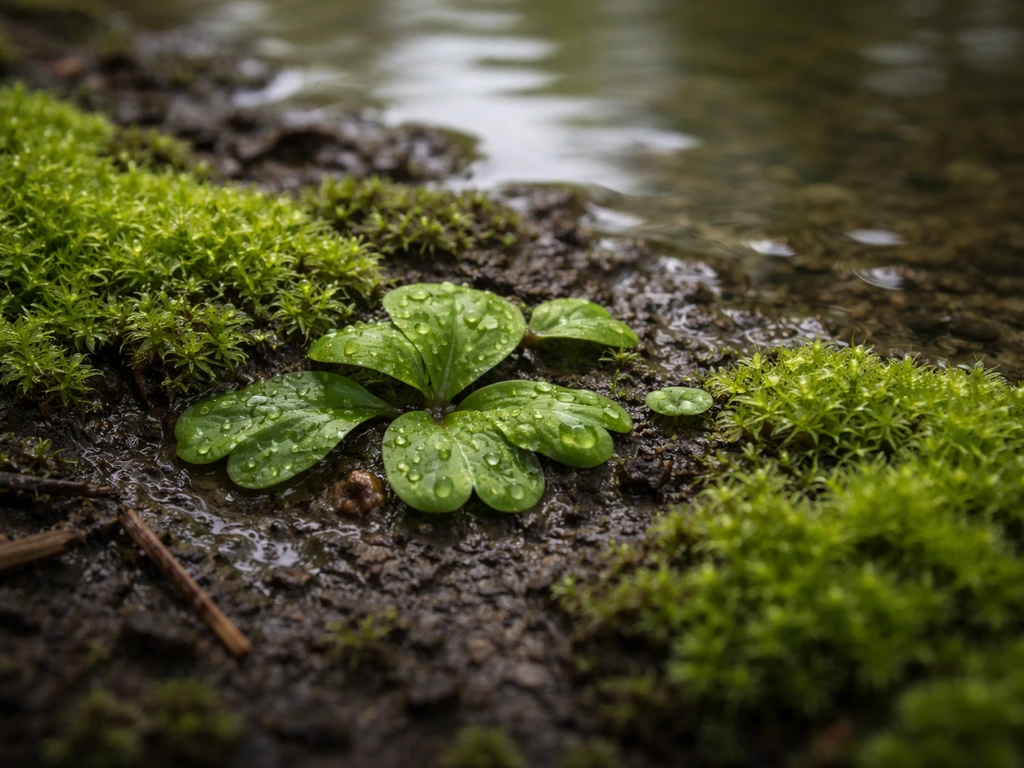
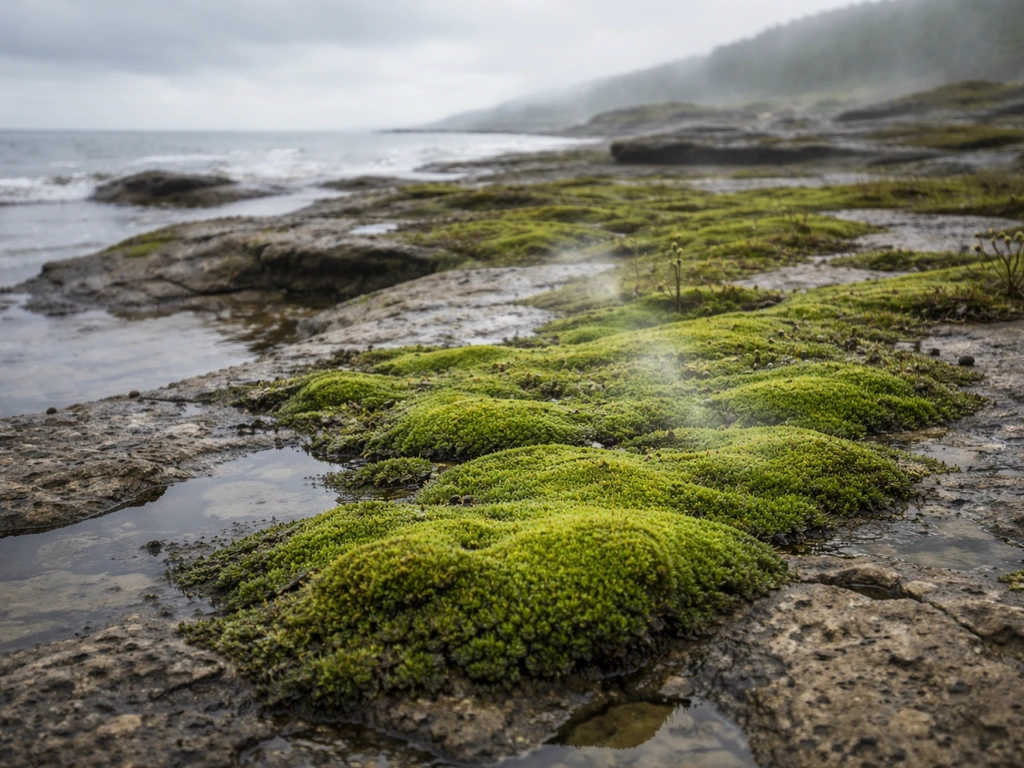
The cryptospore evidence strongly suggests that bryophyte-like plants, ancestors or close relatives of today's liverworts, mosses, and hornworts, were the first organisms to establish on terrestrial surfaces. They didn't conquer land so much as wade onto it. These plants required moisture for reproduction because their sperm needed water to swim to eggs, so they were constrained to wet margins: flooded shorelines, streambanks, intermittently wet rock surfaces, and seasonally saturated ground.
Their survival toolkit was minimal but effective. Instead of roots, they used rhizoids: tiny hair-like growths that anchored them to substrate and absorbed water by surface contact. Instead of a vascular system, they relied on diffusion across thin tissues. Instead of seeds, they released spores that could tolerate drying out and disperse across bare ground. That spore-based life cycle is exactly why microfossils are such useful evidence. Spores are durable, they preserve well, and their morphology signals their biological origin.
A bit later in the fossil record, the rhyniophytes appear. These were small, leafless, rootless plants with simple branching stems topped by sporangia (spore capsules). The Rhynie Chert in Scotland, dated to the early Devonian (roughly 407 million years ago), preserves them in remarkable detail inside ancient hot spring deposits. Plants like Rhynia, Aglaophyton, and Asteroxylon are all found there, and the chert captures not just their body structure but their ecological context: a wetland community growing in intermittently wet, volcanically influenced ground.
Cooksonia, the earliest confirmed vascular plant, appears in the Late Silurian record. Exceptionally preserved Cooksonia fossils show stomata and thick-walled supporting tissue, even though confirming vascular tissue directly proved harder. The presence of stomata is significant: it means these plants were already managing water loss from their surfaces, a key innovation for surviving terrestrial exposure. In Rhynie Chert plants, stomata are typically found on the axis just below the sporangium, which tells us something about where gas exchange mattered most in those early architectures.
What the fossil and spore evidence actually shows (and where it gets murky)
The fossil record for early land plants is genuinely exciting but also genuinely messy. Cryptospores (the early spore-like microfossils) have been found in Ordovician rocks as old as roughly 470 million years in some studies, which would push land plant colonization well before the Silurian. But there's a real interpretive challenge: some of these cryptospore-like structures have been reinterpreted as fragments of other organisms, including graptolites. Stratigraphic context matters enormously. A spore tetrad only tells you about land plants if you can rule out every other explanation for its presence in that layer.
The Wellman and Gray framework for thinking about this is useful: microfossils provide the earliest signal, but inferring affinity and timing requires watching how spore assemblages change across geological time and comparing them to later, unambiguous body fossils. It's detective work with partial evidence. The Rhynie Chert remains one of the clearest windows we have into early terrestrial plant communities precisely because it preserves anatomy, ecology, and fungal associations together. The Rhynie and Windyfield cherts are renowned for exceptional preservation, including soft tissues around stomata and rhizoids, which enables more detailed reconstructions than compression fossils Rhynie Chert remains one of the clearest windows we have into early terrestrial plant communities precisely because it preserves anatomy, ecology, and fungal associations together.. The Natural History Museum's work on Windyfield-style fossils from the same chert deposit has even documented the rhizoid structures directly, linking plant anchoring to the wet, silica-rich substrate those plants lived on.
| Evidence Type | Approximate Date | What It Shows | Reliability |
|---|---|---|---|
| Ordovician cryptospores | ~470 Ma | Spore-like microfossils possibly from bryophyte-like plants | Debated; some records contested |
| Late Llandovery spore assemblages | ~440 Ma | Shift in dyad/tetrad spore types suggesting land plant presence | Strong but indirect |
| Wenlock rhyniophytoid megafossils | ~430 Ma | Small body fossils of early land plants | Unequivocal land plant evidence |
| Late Silurian Cooksonia | ~420 Ma | Earliest confirmed vascular plant with stomata | Unequivocal vascular plant evidence |
| Early Devonian Rhynie Chert | ~407 Ma | Exceptional preservation of whole plant communities with anatomy | Best-resolved early terrestrial ecosystem |
The conditions early land plants had to deal with
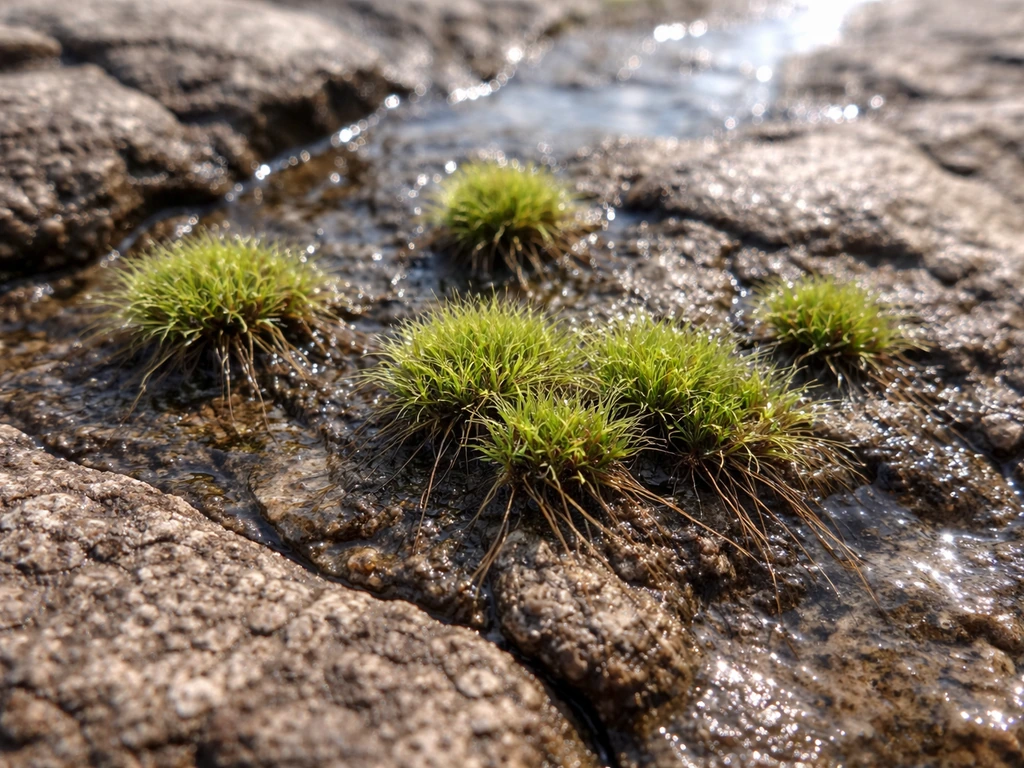
Stepping back to think about what early land actually looked like helps explain why those particular plant traits mattered. Before land plants arrived, terrestrial surfaces were essentially bare rock and mineral sediment, exposed to UV radiation with no soil layer in any meaningful sense. There was no organic matter being cycled, no stable moisture-retaining substrate, and nothing buffering temperature swings. The only reliably hospitable zones were wet margins where moisture from water bodies kept surfaces saturated or at least periodically wet.
Lichens (technically a fungus-algae symbiosis rather than a plant) are often described as nature's pioneer organisms because they can colonize bare, exposed rock and begin breaking it down through chemical weathering, slowly building the mineral basis for soil. The US National Park Service describes them as typically the first organisms to establish on newly exposed surfaces in many environments today. This process likely played a role in creating the thin, wet substrate films that early bryophyte-like plants then colonized. The progression from bare rock to lichen crust to thin organic mat to early non-vascular plant is a pattern you can still observe on freshly exposed surfaces in modern environments.
For the first true plants, survival depended on being small (less water loss, easier diffusion), staying close to moisture, anchoring with rhizoids rather than deep roots, and reproducing via wind-dispersed spores that could colonize new wet patches whenever they appeared. Every structural adaptation in the early land plant toolkit points back to the same environmental constraint: access to water was everything.
Modern analogs: where to see early land plant conditions right now
You don't need a time machine to get a feel for early terrestrial plant communities. The wet, disturbed, low-soil niches that early land plants first exploited still exist, and the organisms best adapted to them today are often the same lineages: mosses, liverworts, and hornworts. The Missouri Department of Conservation explicitly describes hornworts, liverworts, and mosses as likely 'first colonizers' on eroded streambanks, flooded areas, and other barren, disturbed soils, which is a remarkably direct echo of the ecological role their ancestors played 440 million years ago.
When I've walked along the margins of rocky streams after high water recedes, the pattern is almost always the same: bare mineral substrate at the edge, then a thin film of algae and cyanobacteria, then the earliest bryophyte colonizers creeping in from slightly more stable ground. Liverworts tend to show up first on the wettest surfaces because they lack stomata and depend on thin, moist tissues for gas exchange. Mosses follow on surfaces that dry out slightly but still retain enough moisture for sperm movement. The U.S. National Park Service also describes mosses and liverworts as non-vascular bryophytes, with reproduction that depends on moisture blank" rel="noopener noreferrer">Mosses follow on surfaces that dry out slightly but still retain enough moisture for sperm movement.. Hornworts tend to prefer finer sediment on floodplains and stream margins where nutrients accumulate.
If you want to find these analogs in the field, look for:
- Rocky streambanks after flooding, where bare mineral substrate has been freshly exposed
- Shaded, moist cliff faces and rock outcrops in temperate and humid climates
- The spray zones around waterfalls and seeps, where constant moisture mimics early land margins
- Disturbed, compacted soil on forest tracks and eroded slopes where nothing else has yet established
- Peat bog edges and raised bog surfaces, where poor nutrient conditions favor non-vascular plants over vascular competitors
These environments share the defining characteristics of early terrestrial habitats: minimal competing vegetation, high moisture availability, low or thin soil development, and frequent disturbance that resets succession. The fact that bryophytes dominate them today is not a coincidence. They are essentially still playing the same ecological role their ancestors pioneered.
It's also worth noting that other plant types have developed relationships with their substrates in ways that echo early land ecology. Plants that grow on other plants (epiphytes) and plants that colonize bare ground without soil preparation occupy niches that parallel, in different ways, the challenges those first terrestrial colonizers faced. Plants grow not only over bare rock and other plants, but also across decaying organic matter, which is why vegetation can appear over remains in the right conditions grow over decaying organic matter. The broader pattern of 'which plant establishes where, and under what minimal conditions' is a thread that runs from the Silurian right through to the streambank you can walk along this weekend.
How to verify these claims and go deeper

If you want to check the science yourself rather than take any summary at face value (which is the right instinct), a few reliable sources are worth bookmarking. For the fossil and microfossil record, the Wellman and Gray review of the microfossil record of early land plants is the clearest scientific treatment of the spore evidence and its interpretation. For body fossils and vascular plant evolution, Britannica's coverage of the Devonian Period and Rhynie plant entries are well-sourced and accessible. For museum-grade visual context, the Smithsonian NMNH's 'Fossil Plants and Animals: The Conquest of Land' exhibition materials connect early plant adaptations to the fossil dioramas and explain what the evidence shows in plain language.
For identifying modern analogs in the field, the British Bryological Society's Species Finder is one of the best tools available for matching bryophyte species to habitat and distribution data, particularly in the UK and Europe. For occurrence data across wider geographies, GBIF (Global Biodiversity Information Facility) hosts datasets like 'NNI Riverbase: Mosses and Liverworts' that let you explore where these plants actually occur in relation to specific habitat types, which is genuinely useful for connecting evolutionary history to real distributions you can visit.
When verifying plant identity in low-soil, wet habitats, the most reliable approach is habitat-first: confirm that the environment matches the known requirements (moisture availability, substrate type, disturbance regime, light level) before narrowing to species. Bryophytes in particular are highly sensitive to microhabitat conditions, so a plant growing on a wet, shaded sandstone outcrop is a very different identification problem from one on a dry limestone wall, even if they look superficially similar. Habitat conditions are your first filter, morphology is your second.
The quick summary to carry forward
The first plants to grow on land were almost certainly bryophyte-like organisms, appearing in some form by the late Ordovician or early Silurian (roughly 470 to 440 million years ago) based on cryptospore evidence, with the first unequivocal body fossils appearing in the Wenlock around 430 million years ago. Cooksonia, the first confirmed vascular land plant with stomata, follows in the Late Silurian around 420 million years ago. The Rhynie Chert gives us our best look at what early terrestrial plant communities actually looked like: small, rootless, leafless, spore-bearing plants living in wet, volcanically influenced ground with rhizoid anchoring and stomata for limited water control. Their modern equivalents, mosses, liverworts, and hornworts, still colonize the same kinds of wet, bare, disturbed substrates today, which makes them the closest living window into what the first terrestrial vegetation might have looked like in practice. plants that grow on their own are called self-growing plants, which is a useful adjacent idea when thinking about how early colonizers established without complex soil.
FAQ
Why do estimates for the first land plants differ so much (for example, late Ordovician vs. Silurian)?
If you mean “first land plants” as in the earliest organisms that truly belonged to the plant lineage, body fossils are the strongest anchor. Cryptospores are earlier signals, but they can be confused with traces from other organisms, so many studies treat the late Ordovician to early Silurian as suggestive rather than definitive for true land plants.
Does the presence of early cryptospores mean we should already have body fossils by the same time?
To reconcile “cryptospores first” with “body fossils later,” think in terms of detection. Spores preserve more easily and spread widely, so microfossils can appear before anatomically preserved plant bodies show up in the record. It also takes time for conditions that preserve body fossils to become common at the right places.
How can scientists tell cryptospores came from land plants rather than from other organisms in seawater or brackish zones?
Marine or nearshore sediment does not automatically mean the spore was produced on land. The key is stratigraphic context (what the layer represents) and whether the spore assemblage shows a consistent shift over time. Even when spores occur in older rocks, researchers still test competing explanations for the structures before calling them plant evidence.
What does it mean when scientists say “cryptospore evidence” is ambiguous?
The “cryptospore-like” label matters. Some reports start with structures that resemble spore tetrads, then later work reinterprets them as fragments of other taxa (including organisms not associated with land plants). That is why the best-supported timings rely on assemblages that can be traced and interpreted consistently across multiple rock units.
Were lichens actually the first to grow on land before bryophyte-like plants?
If “first” means the first organisms to colonize bare rock, lichens are often considered the best modern analogue for the initial breakdown stage because they chemically weather surfaces and build thin substrate films. But if “first” means first true plants with a spore-based life cycle and plant-like adaptations, bryophyte-like lineages are the better match, appearing after or alongside those earliest surface colonizers.
Did early plants have roots, or is “rhizoids instead of roots” a complete explanation?
Rhizoids anchor early, non-vascular plants, but they do not replace roots in terms of depth or long-distance water access. In early terrestrial settings, most water availability was near the surface, so anchoring and surface water uptake could be sufficient even without extensive vascular tissues.
What is the specific significance of stomata in the earliest vascular plant fossils?
Stomata are a strong clue for vascular plant evolution, but for the earliest groups the key is “water management” rather than the invention of complex plumbing. Even limited stomatal control suggests an ability to tolerate periods of drying compared with plants that rely entirely on consistently wet tissue surfaces.
Can I use modern bryophyte habitats as evidence for what the first land plants experienced?
Yes, modern habitat patterns can help you form a testable expectation, but they are not a direct time machine. The closest matches are wet, disturbed margins with thin soil or surface films. Still, species are different, and modern bryophytes may exploit ecological factors that were not identical to Silurian environments.
What’s the best way to identify “early colonizer” bryophytes in the field without misidentifying species?
For field identification, don’t start with shape alone. Do a habitat-first check (wetness, substrate type, light, disturbance, and how quickly the surface dries) and only then use morphology. Two bryophyte-looking species can require very different microconditions, especially regarding shade and desiccation timing.
What quick checklist should I use to judge which “first” claim is most reliable?
If you want to connect the timeline to evidence types, use a simple decision rule. Prefer the earliest secure body fossils for “first plant bodies,” prefer well-validated assemblages for “first plant signals,” and treat single or poorly contextualized microfossil claims as hypotheses until stratigraphy and alternative interpretations are ruled out.