
Climbers that grow in rainforests are called lianas (sometimes spelled lianes). More specifically, a liana is a long-stemmed, woody vine that germinates on the forest floor, roots itself in the soil, and then climbs up through the vegetation using host trees for physical support until its leaves reach the sunlit canopy. That combination of ground rooting plus woody stem plus climbing habit is what separates a true liana from other climbing plants you might encounter.
Climbers That Grow in Rainforest Are Called Lianas

Dr. Marcus Weatherby
7 May 2026
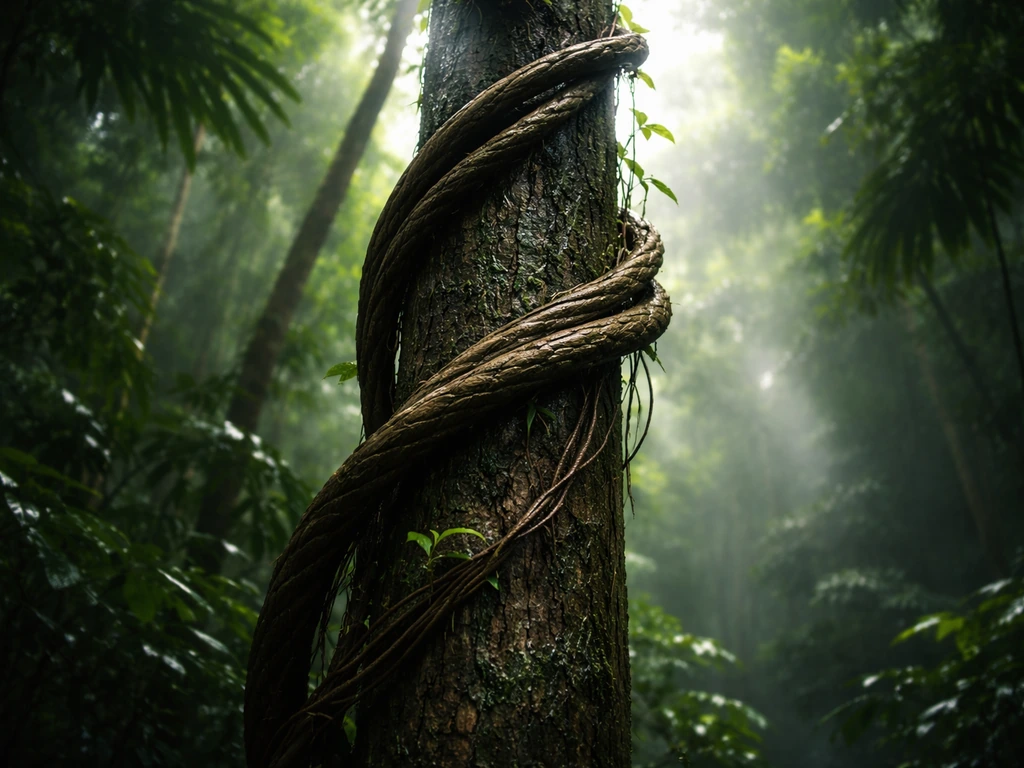
What lianas actually are and how they grow
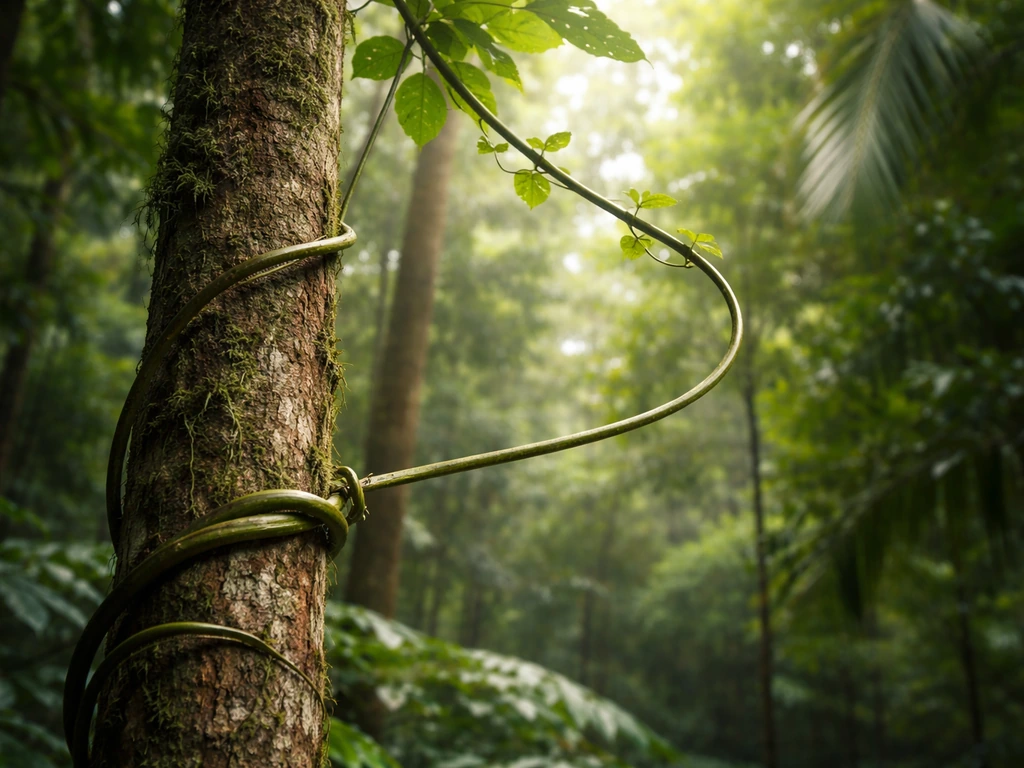
The defining feature of a liana is its growth strategy: instead of investing energy in building a thick, self-supporting trunk, it invests in length. Lianas grow long, flexible stems that depend entirely on neighboring trees, shrubs, or snags for structural support. They start life on the forest floor, germinate in the soil like any ground-rooted plant, and then spend their energy racing upward through the understory toward the canopy where light is abundant.
To get there, lianas have evolved a range of attachment mechanisms. Depending on the species, a liana might twine its stem around a host branch, grab on with tendrils, hook into bark with thorns, or anchor itself using adhesive roots that grip into bark crevices. Once established in the canopy, a single liana can drape its leaves across multiple host trees, forming the tangled hanging networks you see dangling between trunks in tropical forest photos. One individual can involve multiple stems looping to the ground, which is part of what makes them so visually distinctive.
In many Spanish-speaking regions, climbing plants are commonly called "bejuco," and the term is often used interchangeably with liana. It's worth knowing the distinction though: bejuco can include herbaceous or only slightly woody climbers, while "liana" in an ecological sense specifically refers to the woody, ground-rooted, canopy-reaching life form. If you're trying to communicate precisely about rainforest climbers, liana is the more accurate term.
Lianas vs epiphytes vs other rainforest climbers
Rainforests are full of plants that appear to be climbing or growing high off the ground, and it's easy to confuse them. The key differences come down to where the plant is rooted and how it reaches the canopy.
| Plant type | Where it roots | How it reaches the canopy | Woody or herbaceous |
|---|---|---|---|
| Liana | In the soil (ground level) | Climbs using host trees as physical support | Woody |
| Epiphyte | On a host plant (aerial) | Starts in the canopy, no ground connection needed | Variable |
| Herbaceous vine / general climber | In the soil | Climbs, but lacks a woody persistent stem | Herbaceous |
| Scandent shrub | In the soil | Leans or sprawls, may climb opportunistically | Woody but shrub-like |
Epiphytes like bromeliads and many orchids are the most commonly confused group. An epiphyte establishes itself on a host plant, often in the canopy, and absorbs moisture and nutrients from rainfall, humid air, and decomposing debris that collects around it. blank" rel="noopener noreferrer">It has no ground connection at all. Tiny plants that grow in moist places are called epiphytes. A liana, on the other hand, always starts at the ground. There is one legitimate grey area though: some climbing plants lose their ground connection over time and behave like epiphytes, and some epiphytes develop long roots that extend downward. When you encounter a climber, confirming the rooting point at ground level is the practical test for calling it a true liana.
Scandent shrubs are another close relative. They share some traits with lianas but are generally considered a distinct form: they may lean against or scramble over other vegetation rather than committing fully to a climbing strategy from the start. Research comparing lianas, scandent shrubs, and canopy trees has found that lianas sit at the "fast" end of a growth strategy continuum, investing quickly in stem length and leaf deployment rather than long-term structural investment.
Why rainforests produce so many lianas
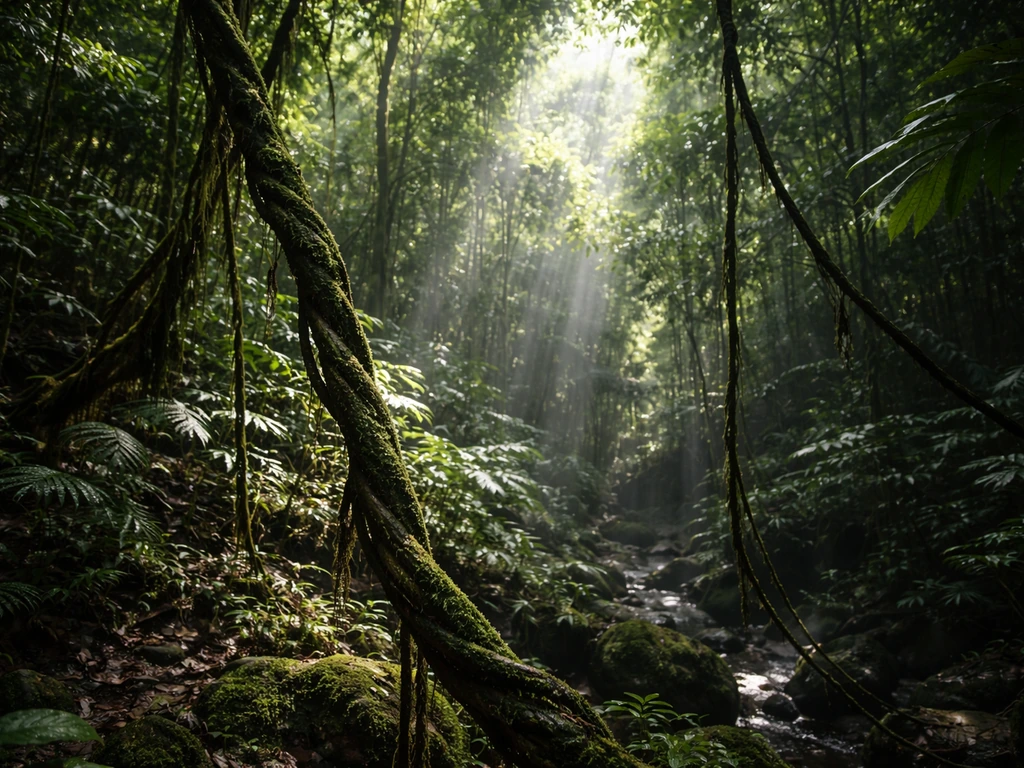
Rainforests are the global hotspot for lianas, and the reason comes down to light and competition. In a mature tropical rainforest, the canopy can block 95% or more of incoming sunlight. The forest floor is dim. Any plant that wants to photosynthesize efficiently needs to get its leaves up into the canopy, and doing that by building a massive self-supporting trunk takes decades and enormous resources. Lianas found a shortcut: use someone else's trunk.
This makes lianas what ecologists sometimes call structural parasites of trees. They don't take nutrients directly from the host tree the way a true parasite would, but they do exploit the tree's physical structure to position their leaves in prime sunlit spots, often spreading their canopy over the tops of the very trees supporting them. The result is that lianas compete intensely with their host trees for light, water, and nutrients at the canopy level, while their roots compete below ground too.
Liana abundance is closely tied to disturbance and light availability. They thrive in forest gaps created by fallen trees, along forest edges, and in secondary forests recovering from clearing or damage. Studies have found that lianas can be especially dominant where annual mean temperatures exceed roughly 27.8°C, rainfall drops below about 1,614 mm per year, or seasonal drought creates stress on competing trees. Elevated atmospheric CO2 and increased forest fragmentation are also associated with rising liana abundance in tropical regions. In secondary forests, liana populations can build for 30 to 70 years after disturbance before eventually declining as the canopy closes again.
Where in the rainforest lianas actually grow
Lianas are distributed vertically across the entire rainforest profile, but their abundance and diversity vary considerably by layer and by disturbance history.
- Understory: Young lianas and smaller-stemmed species (under 1 cm diameter) are actually most diverse here. The understory holds more liana species and individuals than the subcanopy or canopy in many studied forests, partly because this is where new liana growth originates and where seedlings establish.
- Subcanopy and canopy: Larger, older lianas with thicker woody stems reach the upper layers. Their leaves spread across canopy tree crowns, sometimes entirely draping the host. Research using canopy cranes has confirmed that liana canopy cover doesn't correlate neatly with ground-level stem counts, meaning what you see from below underestimates their upper-canopy presence.
- Forest edges and gaps: This is where lianas are most visually obvious. When a tree falls and opens a gap, any lianas in the fallen crown can resprout vigorously, rapidly colonizing the newly lit space and climbing back toward the canopy. Edge habitats in fragmented forests consistently show the highest liana abundance and diversity.
- Interior primary forest: Lianas are present but generally less dense in undisturbed interior forest with a closed canopy. They persist along stems of established trees, waiting for a gap opportunity.
On a single 50-hectare research plot in Panama's Barro Colorado Island, researchers counted over 67,000 rooted liana stems representing 162 species. That gives a sense of just how structurally important these plants are across the forest mosaic, not just as occasional curiosities dangling from a few trees.
How to spot and verify a rainforest climber in the field
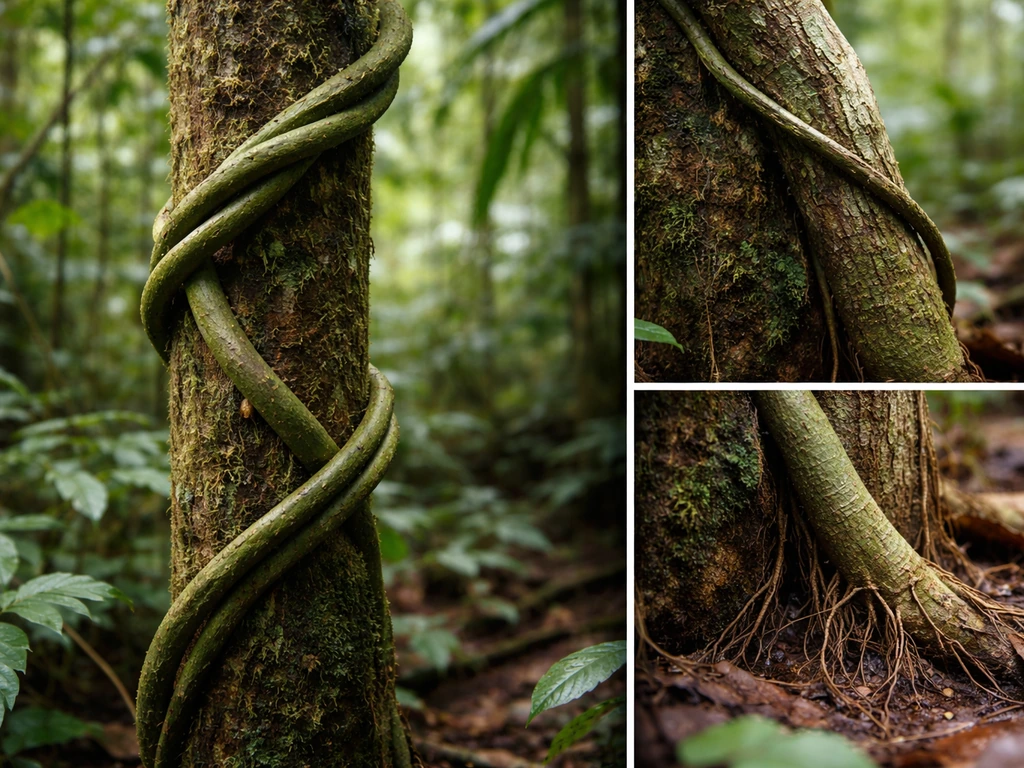
If you're visiting a tropical rainforest or studying images and want to confirm whether a climbing plant is a true liana, there's a practical checklist that works well in the field.
- Find the rooting point: Trace the stem downward. A true liana roots in the soil at ground level, not on a tree branch or in a crevice mid-canopy. If you can't find a ground root, you may be looking at an epiphyte or a hemiepiphyte.
- Check the stem: Lianas have woody, persistent stems, not soft green herbaceous growth. If the stem is stiff, bark-covered, and thick, you're likely looking at a liana. Soft, fleshy stems suggest a general herbaceous vine.
- Look for the attachment mechanism: Follow the stem and look for how it grips its host. Twining stems that spiral around a support, tendrils that curl and grip, hooks or thorns that catch on bark, or adhesive roots anchored into bark crevices are all liana hallmarks.
- Note the growth direction: Lianas grow upward toward light, routing themselves over and around their host's architecture. Their leaves end up in sunlit portions of the canopy, not in the shadier understory.
- Watch for multiple stems from one root: A single liana individual can produce several stems that loop and re-root, making what looks like multiple separate plants. Follow stems carefully before assuming you're counting separate individuals.
- Context check: Are you near a gap, edge, or disturbed area? Lianas concentrate in high-light microhabitats. Spotting dense tangles of woody climbers near a treefall gap or forest edge strongly suggests you're looking at lianas responding to that disturbance.
One practical pitfall: some climbing plants that started as true ground-rooted lianas lose their connection with the ground over time and take on an epiphyte-like existence. If you find a woody climber with no obvious ground root, it may be a liana that has become secondarily disconnected rather than a true epiphyte. Digging around the base of the host tree occasionally reveals a buried or decomposed original root system.
How rainforest lianas fit into the bigger picture of wet-habitat plants
Lianas are one piece of a much larger story about how plants adapt to high-moisture, high-competition environments. Plants which grow in lakes and ponds are called aquatic plants plants adapt to high-moisture. Rainforests sit at the extreme end of what you might think of as a spectrum of wet habitats. Plants that grow in marshy areas, along lake and pond margins, and in seasonally waterlogged zones all face related challenges around light competition and resource access, but they solve them in very different ways. Lianas are the rainforest's answer to canopy competition specifically: root in rich tropical soil, skip the expensive trunk, and climb your way to the light. Trees that grow in marshy areas are called mangroves.
Understanding lianas also helps clarify what makes tropical rainforest plant communities so structurally complex. It isn't just tall trees. It's a layered system where epiphytes colonize the canopy from above, lianas reach it from below, and the forest floor and understory are home to a dense community of young climbers and shade-adapted plants all competing for the same resources. Knowing the term liana and what it means gives you a real foothold into reading that structure when you encounter it.
FAQ
Do all rainforest climbers automatically count as lianas, or are there different kinds?
Not always. Some species are woody and permanently lignified, while others start woody but can become partially herbaceous or hollow over time. If you are unsure, look for a long, persistent stem rather than short, seasonal runners, and try to confirm whether it originally established from the forest floor.
How can I tell a true liana from an epiphyte-like climber when it looks like it has no roots?
A useful field clue is the rooting point. If you can find (or excavate) a ground connection at the base or along the original entry area, it supports a true liana. If the plant appears to start high on a host without any buried or decomposed original roots, it is more likely an epiphyte or a secondarily changed epiphyte-like climber.
What attachment methods are typical for lianas, and how do they differ from other climbers?
Lianas usually “climb” by using support structures, not by making their own upright trunk. They twine around stems, use tendrils, hook with thorns, or grip with adhesive roots, and they often form draped leaf networks between multiple host trees. A plant that stands on a self-supporting main trunk is less likely to be a liana.
If a climbing plant leans and scrambles, is it still a liana?
Scandent plants are often more like leaniers or scramblers that can grow over vegetation without committing to a rapid, canopy-reaching strategy from the start. If the plant invests strongly in rapid stem length and leaf deployment upward rather than staying as a leaning shrub, it is more consistent with a liana growth strategy.
Where in a rainforest are lianas most likely to be common or noticeable?
Yes. Lianas are ecologically tied to light gaps and forest edges, so you are more likely to notice them where the canopy is broken (after windthrow or in disturbed areas). In deep, closed-canopy interiors, fewer stems may be visible at the surface even though lianas can still be present.
Why do liana numbers change after deforestation or other disturbances?
CO2 enrichment and fragmentation can increase liana abundance because they change competition and stress patterns for host trees. Disturbance can also raise liana numbers for decades after an event, before declining as the canopy closes again. That means the same site can look different depending on how recently it was disturbed.
When people say “over 67,000 rooted stems,” does that mean that many different plants?
A single liana individual can involve multiple stems and looping growth, so you might see several “ropes” or branches that trace back to one established plant. For counting in field studies, researchers often count rooted stems rather than only visible aboveground vines.
What should I do if I find a woody climber that looks like it lost its ground connection?
Look for a ground-rooted entry stage first, then assess the stem habit. If it reliably anchors on the forest floor but later loses visible rooting while continuing to climb, it can be secondarily disconnected. When you can locate an original buried/decomposed root system, that supports a liana origin.
Is the word “bejuco” the same thing as liana, or are there situations where it is too broad?
If your goal is accuracy in a caption or discussion, “liana” is the better ecological term for woody, ground-rooted canopy climbers. “Bejuco” can be used locally for climbing plants more broadly, so it may include herbaceous or only slightly woody climbers.