Plants that grow on dead and decaying matter are called saprophytes, though that term is now considered a bit old-fashioned. The more precise modern term is saprotroph, and it covers any organism that feeds on dead organic material by releasing enzymes onto it and absorbing the broken-down nutrients. Here's the catch most people run into: true flowering plants almost never do this. new plants that grow from seeds are called. The organisms you actually see growing on rotting logs, leaf litter, and damp wood are overwhelmingly fungi and bacteria, not plants. Understanding that distinction is where the real learning starts.
Plants That Grow on Dead and Decaying Matter Are Called What
Dr. Marcus Weatherby
22 May 2026
The correct term: saprophyte vs. saprotroph
The word saprophyte comes from the Greek for "rotten" and "plant," and it was used for decades to describe anything that fed on dead organic matter, fungi included. Older textbooks, dictionaries, and even some current sources like Cambridge Dictionary still define a saprophyte as "an organism such as a fungus or bacterium that lives and feeds on dead and decaying plant and animal matter." So if you've seen that word on a biology exam or in a field guide, it's still valid vocabulary.
The modern replacement is saprotroph, and it's preferred because it doesn't imply the organism is a plant. A saprotroph feeds by absorptive nutrition: it secretes digestive enzymes directly onto the substrate (the rotting wood, dead leaves, or animal remains), breaks the material down externally, and then absorbs the resulting compounds. Saprotrophs are critical to decomposition and nutrient cycling, including fungi, certain bacteria, and funguslike water molds (Oomycota). This is fundamentally different from how a green plant feeds, which is why lumping fungi in with plants under "saprophyte" fell out of favor in scientific circles. For practical purposes, both terms mean the same thing when you're out in the field trying to name what's growing on a decaying stump.
What saprotrophs actually do in an ecosystem
These organisms are the recyclers of the natural world, and without them organic matter would just pile up indefinitely. When a tree falls in a forest, saprotrophic fungi are usually the first significant colonizers. They produce enzymes capable of breaking down cellulose and lignin, the two main structural components of plant cell walls. Bacteria follow, processing simpler compounds the fungi have already unlocked. Together they convert what was a solid log into crumbly, nutrient-rich material that plant roots can actually use.
The ecological role here is called decomposition, and the organisms doing it are also called decomposers. In OpenStax ecology definitions, decomposer organisms are described as bacteria and fungi blank" rel="noopener noreferrer">decomposers are bacteria and fungi. That's an important nuance: "decomposer" describes the role in the ecosystem (breaking organic matter into simpler compounds and cycling nutrients back into the soil), while "saprotroph" describes the feeding mechanism. They overlap heavily in practice. Invertebrates like earthworms and millipedes are sometimes counted as decomposers because they physically break down dead matter, but they digest it internally rather than using external enzyme absorption, so they aren't technically saprotrophic in the strictest sense.
This matters for understanding succession in disturbed habitats. When a forest burns or a flood deposits fresh organic debris, saprotrophs move in before almost any other organism and begin conditioning the substrate for the plants that follow. If you've read about what plants grow after a fire or which plants are the first to grow during primary succession, you'll recognize that the microbial groundwork saprotrophs lay is often what makes those early colonizers possible.
What you'll actually see: fungi vs. true plants
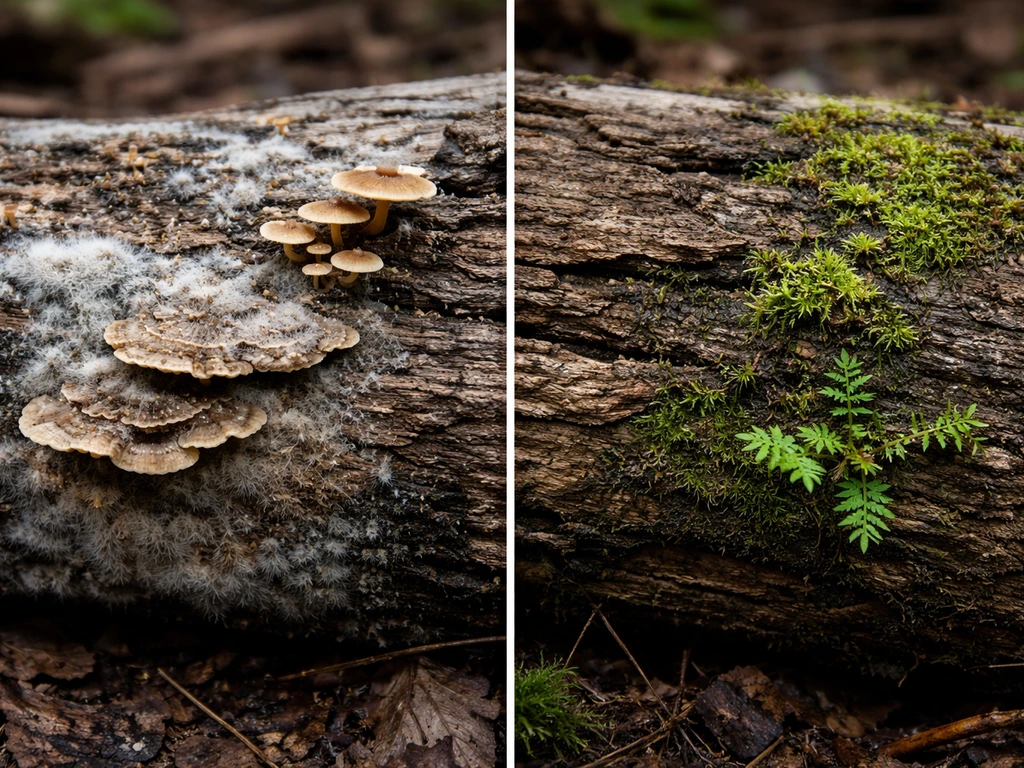
Let's be direct about what shows up on dead and decaying material, because this is where most people get confused. The vast majority of visible growth on a rotting log, dead animal, or compost pile is fungal. True flowering plants almost never grow on purely dead matter because they need photosynthesis, which requires light, and they typically root in soil that has at least some mineral component. What looks like a "plant" growing from decay is almost always one of the following:
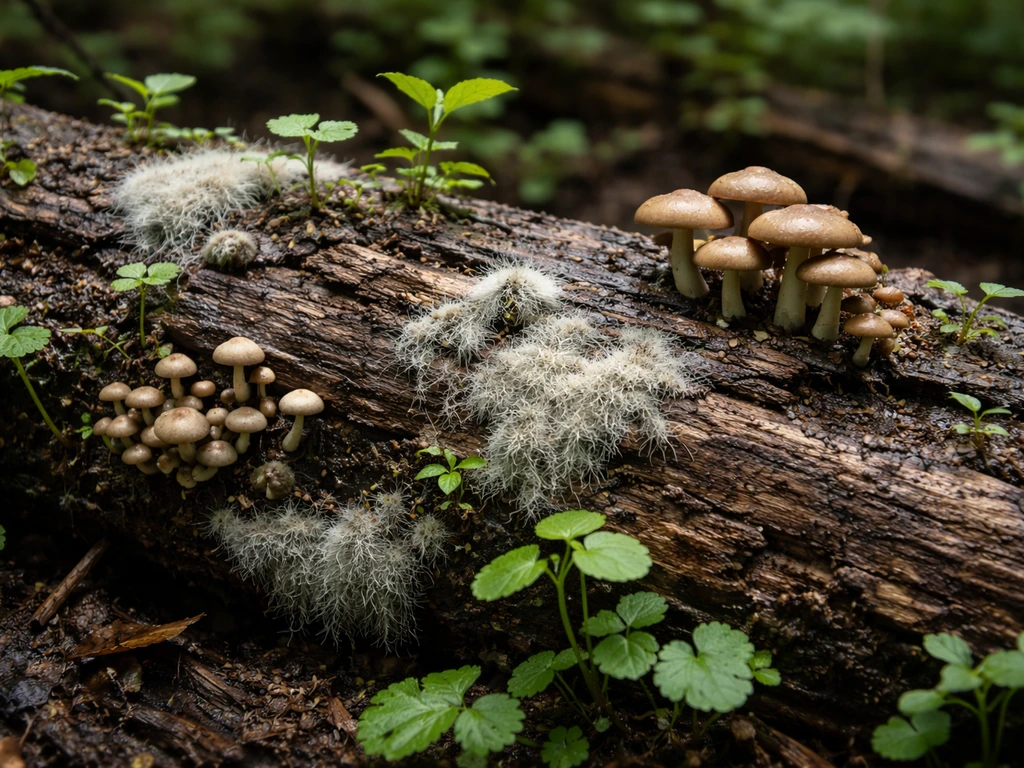
- Fungi (mushrooms, bracket fungi, molds, mildews): These are the dominant saprotrophs in most terrestrial ecosystems. You'll see mushrooms fruiting from rotting logs, white or gray mycelium threading through leaf litter, and colorful bracket or shelf fungi spreading across dead hardwood.
- Bacteria and actinomycetes: Not visible to the naked eye but responsible for the earthy smell of decomposing leaf litter and compost. They work alongside fungi at the microscopic level.
- Water molds (Oomycota): Fungus-like organisms that appear as white fuzzy growths on waterlogged wood or dead aquatic material. They look like mold but are more closely related to algae.
- Mosses and liverworts: These are true non-vascular plants and the closest you'll get to an actual plant colonizing decaying wood. They don't feed on the dead matter itself but use it as a moist substrate to anchor and absorb water from. They're photosynthetic, so they need light.
- Parasitic or mycoheterotrophic flowering plants: A small group of true plants (like ghost pipes, Monotropa uniflora, or certain orchid species) that have lost chlorophyll and tap into fungal networks connected to decaying organic matter for their nutrition. These are genuinely rare but are the closest thing to a true "plant that feeds on dead matter."
Ghost pipe (Monotropa uniflora) is worth mentioning specifically because it looks exactly like what people imagine when they picture a "plant growing on dead matter." It's waxy white, has no green chlorophyll, and pushes up through forest floor debris. It doesn't photosynthesize at all and instead taps into mycorrhizal fungi connected to tree roots and decaying organic matter. It's technically classified as mycoheterotrophic. This is a genuine edge case where a flowering plant comes close to the saprophyte model, though it's stealing nutrients through a fungal intermediary rather than directly digesting dead tissue itself.
How to tell what's growing on decaying material
When you find something growing on dead wood, leaf litter, or compost, a few quick observations will tell you a lot about what you're dealing with.
Signs it's fungal
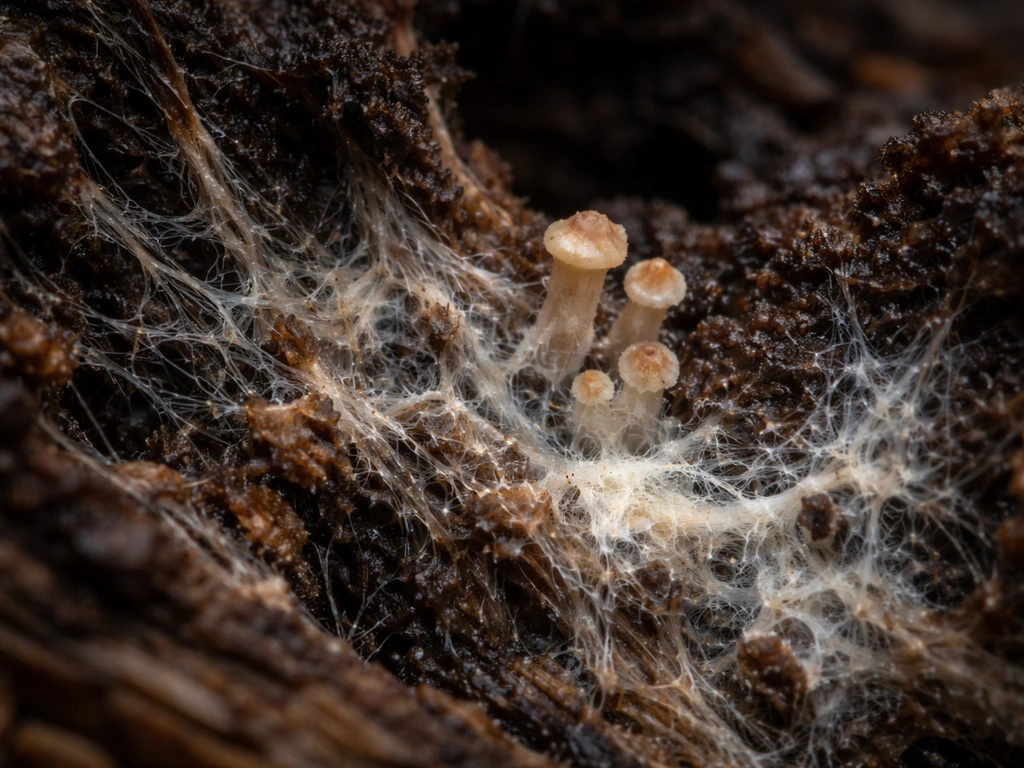
- Visible mycelium: white, cream, or gray thread-like strands spreading through the material when you break it apart
- Mushroom bodies or bracket structures emerging directly from wood or buried organic matter
- No leaves, no green coloration at any point in its life cycle
- Rapid appearance after rain or humidity increase, often overnight
- Powdery, fuzzy, or slimy texture in mold-type growths
- Strong earthy, musty, or occasionally sweet smell
Signs it's a true plant (vascular or non-vascular)
- Green coloration (except in rare mycoheterotrophic species like ghost pipe)
- Leaf structures, even tiny scale-like ones
- Growth toward light sources
- Roots extending into soil below or around the decaying substrate, not into the substrate itself
- Mosses or liverworts forming dense green mats on the surface of damp decaying wood (they're using it for moisture, not nutrition)
Signs it might be a mycoheterotrophic plant
- Waxy, pale, white, pink, or translucent appearance with no green at all
- Found in deep forest shade where photosynthesis would be impossible
- Small, single-stemmed with nodding or hooded flower structures
- Associated with specific tree species nearby (ghost pipe requires beech or conifers; certain orchids require specific host fungi)
Where saprotrophs thrive: conditions that matter
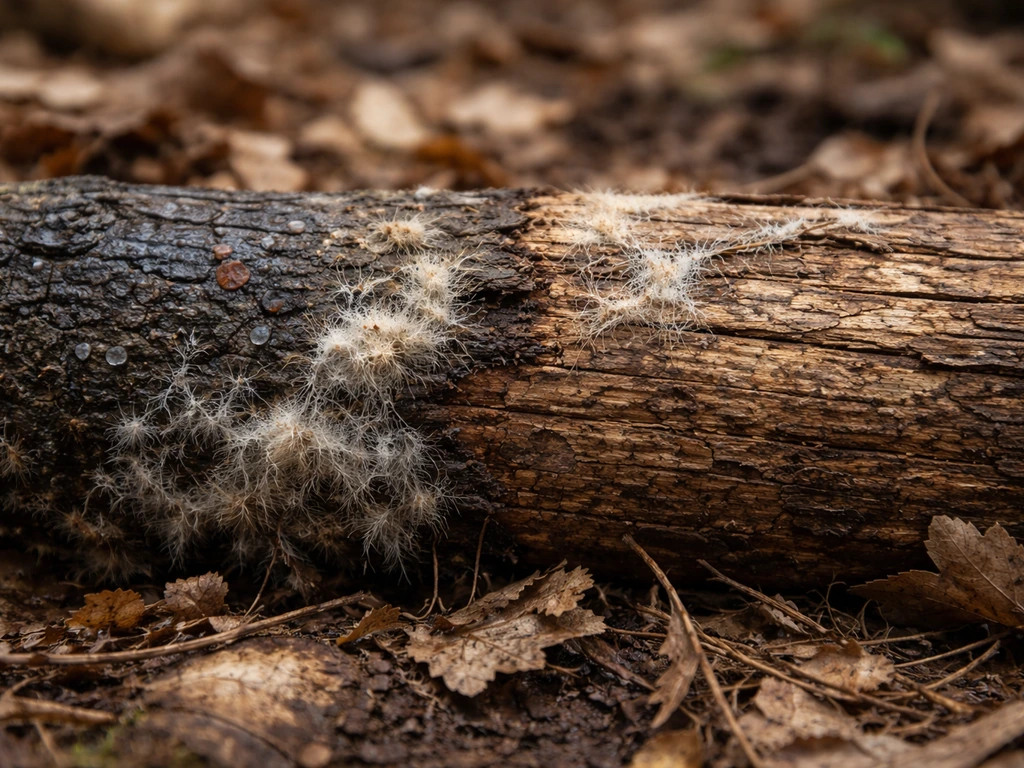
Saprotrophic organisms are not randomly distributed. The substrate, moisture level, temperature, and even the species of dead tree all influence what grows where. I've walked through temperate hardwood forests after a wet autumn and found bracket fungi on nearly every fallen oak, then walked through a dry pine stand two miles away and found almost none. The conditions are that specific.
| Condition | Effect on saprotrophic growth | What you're likely to see |
|---|---|---|
| High moisture (above 70% relative humidity or after rain) | Dramatically accelerates fungal mycelium spread and fruiting body formation | Mushrooms, slime molds, water molds on waterlogged wood |
| Cool to moderate temperatures (50–75°F / 10–24°C) | Optimal range for most temperate saprotrophic fungi | Bracket fungi, oyster mushrooms, turkey tail fungi on hardwood logs |
| Warm and humid tropical conditions | Fastest decomposition rates; dense fungal activity year-round | Rapid wood breakdown, dense mold colonies, diverse mushroom species |
| Dry or arid conditions | Slows decomposition sharply; few fungi active | Dry rot fungi (slower), bacterial decomposition dominates |
| Cold but moist (temperate winters) | Slowed but not stopped; cold-tolerant fungi remain active | Oyster mushrooms, velvet shanks fruiting even near freezing |
| Hardwood substrate (oak, beech, maple) | Rich in lignin and cellulose; supports diverse fungal communities | Bracket fungi, hen of the woods, chicken of the woods |
| Softwood substrate (pine, spruce) | Different lignin chemistry; supports different fungal communities | Conifer-specific bracket fungi, reishi on hemlock |
| Leaf litter and compost | Accessible carbon source for bacteria and smaller fungi | White mycelium threads, ink caps, bird's nest fungi |
Geography matters too. Tropical rainforests decompose organic matter so quickly that fallen trees can be nearly unrecognizable within a year. In boreal forests or tundra margins, the same log might persist for decades. If you're used to watching decomposition in one climate zone, it can be genuinely surprising how different the pace and the organisms are in another.
Practical next steps for confirming and learning more
If you're a student trying to nail down the terminology for an exam: the answer is saprotroph (modern) or saprophyte (older, still accepted). If you're a gardener or naturalist trying to figure out what's actually growing on that rotting stump in your yard, here's how to investigate today.
- Collect a small sample of the growth and break it apart: if you see white thread-like strands (mycelium) woven through the material, it's almost certainly fungal. No mycelium and a green color points toward a plant like moss.
- Check your moisture conditions: saprotrophic fungi spike dramatically after rain or in consistently humid areas. Note whether the growth appeared after a wet period.
- Identify the substrate: what species of tree is the log from? Hardwoods and softwoods host very different fungal communities, and matching what you see to known species for that wood type narrows identification quickly.
- Look at the light environment: if whatever is growing is in deep shade and has no green coloration, consider whether it could be a mycoheterotrophic plant like ghost pipe. These are rare but do exist, and they always grow in specific forest types associated with certain tree species.
- Use a field guide specific to your region: for fungi, regional mushroom guides organized by substrate (log, soil, dung) are the most practical. For mosses and liverworts on decaying wood, a bryophyte guide keyed to habitat works well.
- Cross-reference with habitat and climate: the organisms present on decaying matter shift with the season and climate zone. Learning which saprotrophic fungi are typical for your forest type and season is one of the most reliable ways to build identification confidence over time.
For students building out a broader understanding, it's worth connecting this topic to how succession works. Saprotrophs on dead matter are part of the same ecological story as the first plants to colonize bare ground after disturbance, or the pioneering species that move in after a fire. In fire ecology, the first plants to grow after a fire are called pioneers the first plants to colonize bare ground after disturbance. In primary succession specifically, the earliest colonizers are often hardy species that can tolerate thin, developing soils, such as certain mosses and lichens first plants to colonize bare ground after disturbance. They prepare substrates, cycle nutrients, and hand off conditions to the next wave of organisms. Once you see saprotrophs as part of that chain rather than just "stuff growing on rotting wood," the whole concept clicks into place.
FAQ
Are there any true flowering plants that feed on dead and decaying matter directly like saprotrophs do?
Not in the standard sense. Most flowering plants that appear on rotting logs still obtain nutrients through normal roots in mineral soil or through fungal partners, as with mycoheterotrophs, where the plant indirectly benefits from fungal digestion rather than secreting enzymes to break down dead tissue itself.
How can I tell whether something on compost or dead wood is a fungus, bacteria, or a flowering plant?
Check for visible fruiting bodies (mushrooms, brackets, puffballs), branching thread-like growth (mycelium), and the lack of leaves or green chlorophyll. Flowering plants will show true stems, leaves, and identifiable reproductive structures, and they typically root into soil rather than only appearing as growth on the surface.
If the term saprophyte is still “accepted,” should I use it on assignments or exams?
Use the term your course or professor expects, but default to saprotroph for modern accuracy. If your instructor uses older wording, saprophyte usually won’t be penalized, yet explaining that it means fungi and bacteria feeding on dead organic matter can protect your score.
Why does decomposition sometimes look like it is “fast” or “slow,” even in the same place?
Moisture and temperature drive microbial enzyme activity, and oxygen availability matters too. A waterlogged log can slow aerobic decomposition and change which decomposers dominate, while warm, well-aerated conditions often speed up breakdown and make the microbial community more active.
Do fungi that decompose dead wood always harm living trees?
Not always. Some are decomposers that specialize in dead material, while others can be pathogens or opportunistic colonizers of stressed or wounded trees. A useful field clue is whether the fungus is on clearly dead, detached wood versus actively growing on healthy tissue or wounds.
Are earthworms and millipedes decomposers, and do they count as saprotrophs?
They are usually called decomposers because they break organic matter down and cycle nutrients, but they do not typically use external enzyme digestion the way saprotrophs do. In strict terms, saprotrophy refers to absorptive feeding from externally digested substrate, which is more typical of fungi and many bacteria.
What’s the difference between “decomposition,” “saprotrophy,” and “mycoheterotrophy” in simple terms?
Decomposition is the ecosystem role (converting organic matter into simpler compounds). Saprotrophy is the feeding method (digesting externally with enzymes and absorbing the products). Mycoheterotrophy is a specific strategy where a plant relies on fungi for carbon and nutrients rather than photosynthesizing, so it is not the same feeding mechanism as saprotrophy.
Can saprotrophs break down any kind of dead material, or only plant material?
They can act on a wide range of dead organic matter. However, the dominant enzymes differ by substrate, so plant cell wall components like cellulose and lignin are often highlighted, while animal remains often involve different decomposition pathways and nutrient releases.
Why do saprotrophs show up first after a fire or flood, before most plants?
Because microbes can rapidly colonize available organic debris and start enzyme breakdown without needing sunlight or soil formation. Their activity conditions the substrate by releasing nutrients and creating more habitable material, which helps later pioneers establish.
If I see white fuzzy growth on rotting food, is that the same as what grows on a stump in the forest?
Often it is still fungal growth, but the species and conditions differ. Household environments usually have different moisture, temperature, and oxygen levels, and some molds produce spores quickly on food surfaces, while forest wood decay is shaped by the specific tree species and local climate.