
Plants that grow on other plants are most commonly called epiphytes, though depending on how they relate to their host, they might also be parasites or hemiparasites. Epiphytes use another plant purely for physical support and get their water and nutrients from rain, dew, and airborne debris, not from the host itself. Parasitic plants go much further: they physically penetrate the host's tissue and tap directly into its vascular system to steal water and food. Hemiparasites land somewhere in between, still photosynthesizing on their own but also pulling resources from the host through the same kind of penetrating connection. Knowing which category you're looking at changes everything about where that plant grows, how it behaves, and what it means for the tree it's living on.
What Are Plants That Grow on Other Plants Called?

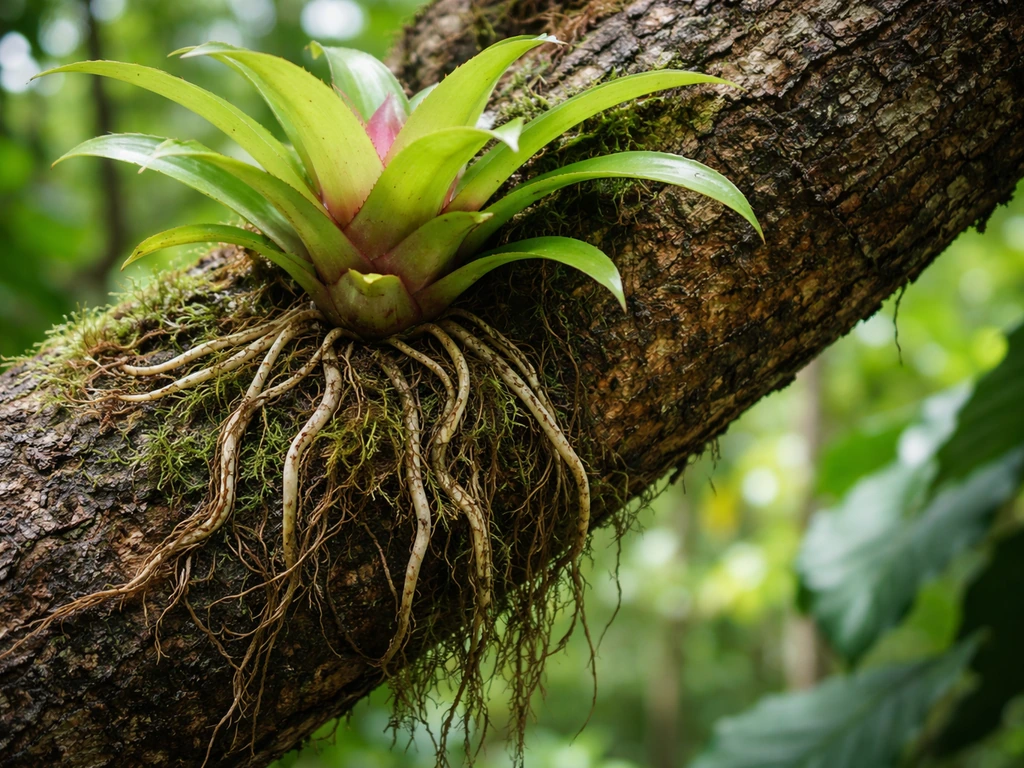
The correct term: epiphytes, parasites, and hemiparasites
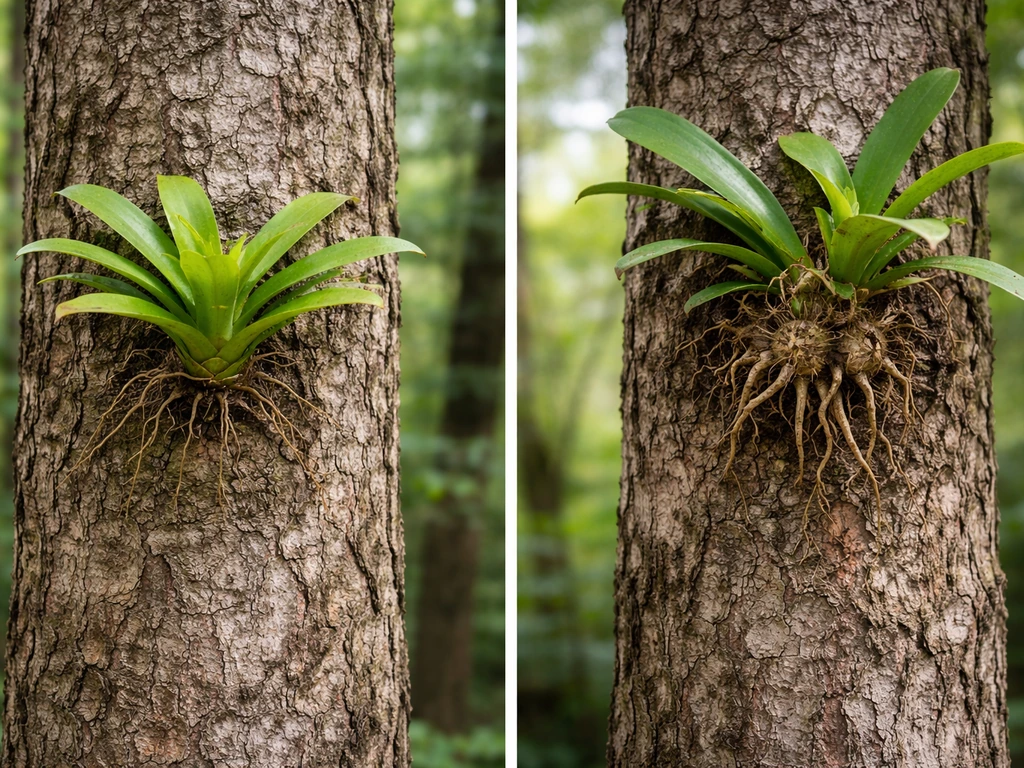
The umbrella term you'll see most often is epiphyte, from the Greek for 'upon plant.' But that word only applies to the non-extracting category. The full picture breaks into three groups, and the distinctions matter a lot once you're trying to identify what's actually growing on a tree in front of you.
| Category | Relationship to Host | Gets Nutrients From Host? | Photosynthesizes? | Key Structure |
|---|---|---|---|---|
| Epiphyte | Physical support only | No | Yes | Aerial roots (surface contact only) |
| Hemiparasite | Support + resource extraction | Partially (water, minerals, sometimes carbon) | Yes | Haustorium (penetrates host tissue) |
| Holoparasite | Fully parasitic | Yes (completely dependent) | No | Haustorium (penetrates host vasculature) |
The haustorium is the key anatomical giveaway for any true parasite. It's a specialized organ that the parasitic plant grows into the host's tissue, connecting directly to the host's xylem or phloem (or both) so it can draw out water, minerals, and in some cases sugars. Epiphytes have nothing like this. Their roots may grip the bark tightly, but they stay on the surface and never penetrate the host tissue. That surface-only contact is the critical dividing line.
Everyday examples of plants that grow on other plants
The most recognizable epiphyte in North America is probably Spanish moss (Tillandsia usneoides), those long silvery curtains you see draped over live oaks across the U.S. Southeast, from southeastern Virginia down through Florida and west to Texas and southern Arkansas. Despite the name, it's not a moss at all. It's a bromeliad, more closely related to pineapple than to any true moss, and it's a textbook epiphyte: hanging off the branches, pulling moisture from humid air and rain, doing absolutely nothing to harm the tree structurally. Orchids are another classic example, and in tropical rainforests they're among the most species-rich epiphytes in the canopy. Bromeliads broadly, many ferns, and countless mosses and lichens round out the epiphyte world, and lichens show up as epiphytes in almost every biome on earth, from tropical rainforests to temperate woodlands.
On the parasitic side, mistletoe is the go-to example. Oak mistletoe is common across California and the West, and dwarf mistletoes (Arceuthobium species) are widespread across conifer forests in North America. Both develop haustoria that drill into the host's vascular system. Mistletoe seeds typically arrive on branches via bird droppings, germinate, and immediately start building that parasitic connection. The plant is visible year-round on deciduous hosts once leaves drop, which is part of why it's so culturally associated with winter. Dodder (Cuscuta species) is another striking parasite: a leafless, orange or yellow thread-like vine that twines around host plants and inserts haustoria along its entire length. It looks almost alien and has no chlorophyll to speak of, making it a holoparasite fully dependent on whatever host it's attached to.
Hemiparasites include plants like Indian paintbrush (Castilleja species), yellow rattle (Rhinanthus minor), and eyebright (Euphrasia species). These look like ordinary wildflowers and they do photosynthesize, but they're also tapping into the roots of neighboring plants through haustoria, supplementing their water and mineral supply. You'd never guess from looking at them in a meadow that they're pulling resources from the grasses around them.
How to tell if it's an epiphyte vs a parasite
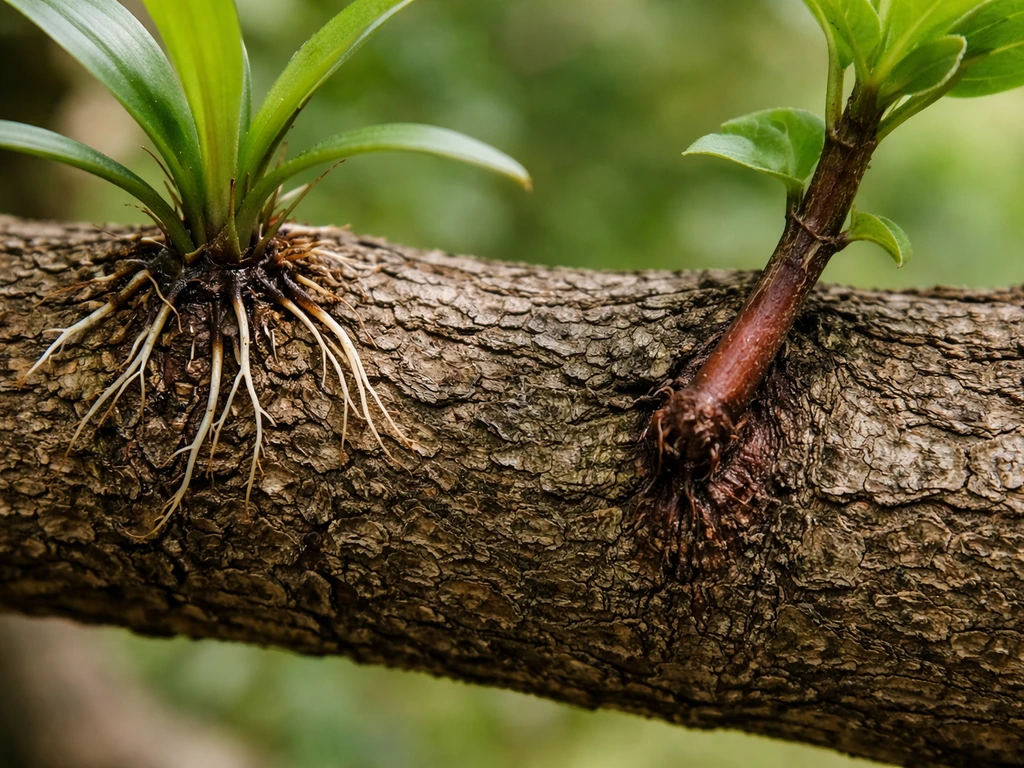
The clearest field test is to look at the point of attachment. An epiphyte's roots or holdfast structures will be on the surface of the bark or branch. If you could (carefully) pull the plant away, the host bark underneath would be intact. A parasitic plant's attachment goes into the host tissue. With mistletoe, you'll see swollen, cup-like structures called basal cups where the haustorium has embedded itself into the branch. The branch itself often shows a visible swelling or distortion around the attachment point. With dwarf mistletoe specifically, USDA Forest Service identification guidance stresses that you need to see the plant itself or those basal attachment cups to make a positive ID, because the symptoms on the host branch alone (witches' brooms, abnormal growth clusters) can look like other problems.
With Spanish moss or orchids on a tree, there's no distortion of the host bark. The plant simply sits on the surface. Orchid roots, for example, have a specialized spongy outer layer called the velamen that absorbs water rapidly during a rain event and then holds onto it. That's the adaptation for living without soil contact, not for extracting anything from the tree. If the root isn't penetrating and there's no basal swelling on the host, you're almost certainly looking at an epiphyte.
- Check the attachment point: surface grip only (epiphyte) vs. embedded with swelling or basal cups (parasite)
- Look for host damage: distorted growth, witches' brooms, or branch dieback near attachment suggests parasitism
- Examine the roots: spongy, whitish aerial roots with no penetration = epiphyte; no visible surface roots and a fused attachment zone = likely parasitic
- Check for chlorophyll: a completely yellow, orange, or white threadlike plant with no green tissue is almost certainly a holoparasite like dodder
- Consider the host health: epiphytes rarely harm a structurally sound, healthy tree; heavy parasitic loads can visibly reduce host vigor over time
Where epiphytes and parasitic plants grow: climate, humidity, and habitat
Epiphytes are overwhelmingly a humid-climate story. The largest and most diverse epiphyte communities on earth are in moist tropical forests, where high rainfall, persistent humidity, and dense canopy cover give them the consistent atmospheric moisture they depend on. Orchids, bromeliads, and ferns dominate in these settings. But epiphytes aren't limited to the tropics. Mosses and lichens grow epiphytically in temperate forests across the Pacific Northwest, the Appalachians, and even boreal zones. Spanish moss itself occupies subtropical and warm temperate conditions across the U.S. South, where high humidity, frequent fog or dew, and the canopy structure of live oak forests create ideal conditions.
What matters most for epiphytes is not just rainfall totals but how often the plants get wet. Research on epiphytic lichens shows that intact forest canopies retain humidity after rain events, extending the window during which the plants can absorb water. A gap in the canopy or more exposed position changes the dew frequency and moisture retention dramatically. If you're trying to understand why epiphytes cluster heavily on certain trees or certain branches within the same canopy, microclimate is usually the explanation: shadier, more humid spots support more epiphytes than sun-exposed outer branches.
Parasitic plants have their own distinct habitat patterns. Mistletoe species occur across a wide range of climates including Mediterranean, semi-arid, and temperate zones, but their distribution is shaped by both host availability and climate tolerances. Research modeling parasitic mistletoe (Loranthus europaeus) distribution found that mean temperature during the wettest season and temperature variability were the strongest predictors of where the plant occurs, with hard frosts limiting its northern range. Closer to home, a long-term study of western hemlock forests in Oregon showed that warmer, drier conditions actually amplified the damage mistletoe caused to host trees, increasing hemlock mortality. That's a useful reminder: parasitic plant impacts are not static. Climate shifts can tip the balance between a tree managing a modest parasitic load and being seriously compromised by it.
How to find and verify plants in your region
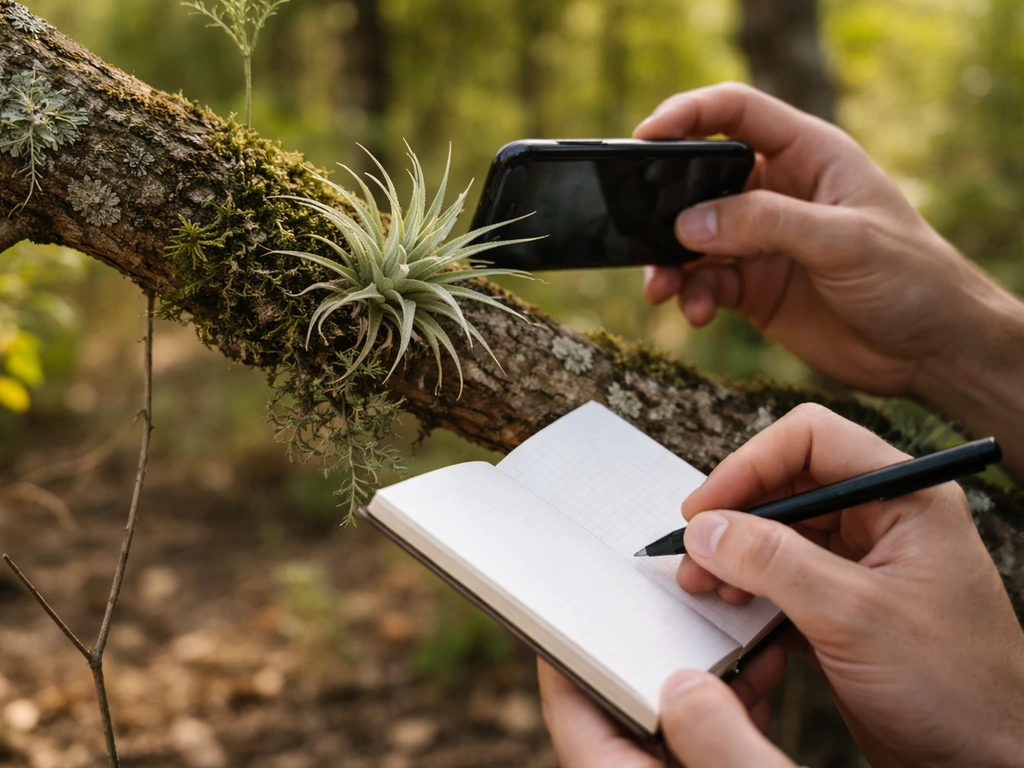
If you're trying to figure out what's actually growing on plants in your specific area, the most reliable approach is to combine field observation with a few targeted resources. Here's how I'd approach it.
- Start with the host tree: identifying the host first narrows down which epiphytes or parasites are likely. Mistletoe on oaks in California is common; Spanish moss on live oaks in the Southeast is expected; orchids on tropical trees in Florida or Hawaii fit known distributions.
- Search GBIF (Global Biodiversity Information Facility) for occurrence records in your region: filter by country, state, or county and search for 'epiphyte' as a habitat tag or look up specific genera like Tillandsia, Dendrophthoe, or Arceuthobium to see mapped occurrences near you.
- Use the USDA PLANTS Database or USDA APHIS parasitic plant genera list to confirm whether a plant genus you've identified contains parasitic species, especially useful if you're working with an unfamiliar plant on a host.
- Check USDA Forest Service regional field guides for your area: the DECaid system and regional GTR publications cover mistletoe and other forest parasites with photo-illustrated ID keys organized by host species and region.
- Cross-reference with your state's university extension service: Clemson, University of Wisconsin Extension, and similar institutions publish regionally specific guides that address local epiphytes and parasitic plants with climate and host context.
- For verification, photograph the attachment point, not just the plant: photos showing whether roots penetrate the host or remain on the surface, and whether basal cups or swellings are present, are what specialists and online communities need to give you a confident ID.
What this means for gardening and ecosystems
Epiphytes aren't just freeloaders on trees. In forest ecosystems, they play genuinely significant ecological roles. Bromeliad rosettes in tropical canopies collect and hold water, creating small aquatic habitats used by amphibians, insects, and other organisms. Mosses and lichens hold moisture and organic matter on branches, contributing to canopy nutrient cycling. NSF-funded research has described epiphyte communities as playing keystone roles in forest canopy biodiversity. In a managed garden setting, this means that a healthy live oak draped in Spanish moss or a tropical tree hosting orchids isn't being harmed; it's hosting a functional community.
Parasitic plants are a more complicated story for managed landscapes. Light mistletoe loads on a healthy, well-watered tree may have limited impact. But in stressed trees, or under increasingly warm and dry conditions, mistletoe can accelerate decline. In natural forests, parasitic plants are part of the ecological structure: they can affect stand dynamics, create habitat features like dead branches, and influence which tree species dominate over time. In a home garden or orchard, heavy mistletoe infestations are worth managing, typically by pruning out infested branches well below the attachment point, since surface removal without removing the haustorium just leads to regrowth.
Hemiparasitic wildflowers like yellow rattle are actually used deliberately in ecological restoration. Yellow rattle suppresses aggressive grasses in meadows by tapping their root systems, which opens up space for wildflower diversity. That's a case where understanding the parasitic relationship is practically useful for land management, not just academic interest. It's also a reminder that 'parasitic plant' isn't automatically a label for something harmful. Context, host identity, and infestation level all matter.
Common misconceptions and identification tips
The single most common mistake is assuming that any plant growing on another plant is parasitic. It's not. Spanish moss is the classic example: it looks like it's invading the tree, people assume it's killing it, and garden centers sell products to remove it from healthy oaks that don't need any intervention at all. Clemson's extension service specifically addresses this misconception, noting that Spanish moss is an epiphyte that uses the tree for support and protection but takes nothing from it. The moss may visually dominate a tree's canopy and even reduce light to some inner branches, but it is not feeding from the tree's vascular system.
Another misconception is that you can identify a parasite from the host's symptoms alone. Witches' brooms, abnormal branch clusters, and unusual growth patterns on conifers can result from dwarf mistletoe, but they can also come from fungal infections, insects, or other causes. USDA Forest Service guidance on dwarf mistletoe is clear: positive identification requires actually seeing the mistletoe plants or their basal attachment cups. Dwarf mistletoe is a parasitic plant that lives its entire life in the tree canopy USDA Forest Service guidance on dwarf mistletoe is clear: positive identification requires actually seeing the mistletoe plants or their basal attachment cups.. Symptoms on the host are suggestive but not diagnostic.
A third misconception is that all climbing plants or vines that use trees for support count as epiphytes. They don't. Vines like poison ivy or Virginia creeper climb trees but are rooted in soil, making them terrestrial plants using the tree as a trellis. True epiphytes are not rooted in the ground. Their roots contact only the host's surface or the open air, and they depend entirely on atmospheric moisture and leached nutrients from canopy debris for sustenance. If the plant has a root system running down to the soil, it's not an epiphyte regardless of how high up the trunk it climbs.
One more worth mentioning: the question of what plants grow on other plants connects to a broader story about plant independence and adaptation. Plants that generate their own growth from nothing, colonize bare ground, or establish without any host are a different ecological chapter entirely, just as the earliest land plants had to figure out terrestrial life without any established plant community to rely on. Plants that grow on their own are called autotrophic, meaning they can make their own food without needing to tap a host. In contrast, plants that take in resources from a host without making their own food, including some that can colonize dead organic material, are not autotrophic. The first plants to grow on land were among the earliest to solve the challenge of living on substrates without an existing plant community. If you're wondering what plant grow on land in the broader sense, the key is whether they can make their own food or need a host for resources. The diversity of strategies, from fully self-sufficient to fully parasitic, reflects how many different ecological niches the plant world has found ways to fill.
FAQ
If a plant looks like it’s taking over a tree, does that automatically mean it’s a parasite?
“Epiphyte” covers plants that live on a host for physical support only, but the same plant can switch behavior in different species or environments (for example, some mistletoes and other hemiparasites show more or less reliance on the host). So, for accurate classification, use the key anatomical clue discussed in the article (presence and location of a penetrating haustorium) rather than relying only on appearance.
Where would I most likely find epiphytes versus mistletoe on the same tree?
Usually, epiphytes grow in canopy and branch crevices because they depend on frequent wetting from rain, dew, and trapped canopy humidity. In contrast, parasites are often tied to specific compatible host species and the host’s health and stress level, so you may see more parasitic activity where hosts are common and where attachment points are accessible.
Are all plants that climb up trees epiphytes?
No. True epiphytes do not have roots that reach soil. If the plant has living roots that continue down to the ground or into a pot of soil, it is likely a terrestrial plant using the tree only as a trellis or support (like many climbing vines), not an epiphyte.
What if the plant growing on another plant is on dead wood, is it still epiphyte or parasite?
Yes, and it’s an important edge case. Some epiphytes or epiphyte-like plants can establish after the host plant dies, but the classification still depends on how the organism gets water and nutrients. If it relies on atmospheric moisture and does not penetrate host tissue, it remains an epiphyte even when the “host” is no longer alive.
If I remove a mistletoe clump from a branch, will it come back?
Don’t prune to remove only the visible growth if it’s a parasite. For true parasites such as mistletoe, embedded attachment structures remain inside the host tissue, so regrowth can occur. The article notes that effective garden management usually means removing the infested branch section well below the attachment point.
Can I identify dwarf mistletoe from the tree’s symptoms alone?
Yes, especially with mistletoe. Host symptoms like witches’ brooms or abnormal clusters can also come from fungi, insects, or other stressors. For a confident ID, you generally need to locate the actual plant tissue or attachment structures (basal cups in the mistletoe case), not just interpret the host’s abnormal shape.
Could epiphytes ever harm a healthy tree?
Often, but not always. Spanish moss and many orchids have features that make them look harmless, yet drought, extreme heat, or poor tree health can change the overall outcome because the host may become less able to tolerate any added shading, moisture demand in the canopy, or resource competition from the broader epiphyte community.
What’s the fastest practical way to tell epiphyte versus parasite when I’m standing in front of a tree?
Field identification is easiest when you check the attachment interface. If you can gently see that the plant’s roots only contact the bark surface and the host surface beneath remains intact, that supports epiphyte status. If you observe a swollen attachment site or any evidence of tissue penetration, suspect parasite status and avoid assuming based on color or leaflessness alone.
If a plant is parasitic, does that mean it should always be removed from a garden or meadow?
Not necessarily. Some “parasitic” relationships are part of ecological restoration because they can suppress specific grasses without being broadly devastating. Whether a parasitic plant is harmful in a home yard depends on infestation level, host condition, and the local ecosystem context, not just the label “parasite.”
Are lichens that grow on trees the same thing as mistletoe or other parasites?
Lichens are a frequent surprise. They often appear on bark or branches as epiphytes, but they are not the same category as vascular parasites, and they do not penetrate host tissue. Their role is more about holding moisture and contributing to canopy nutrient and habitat functions.