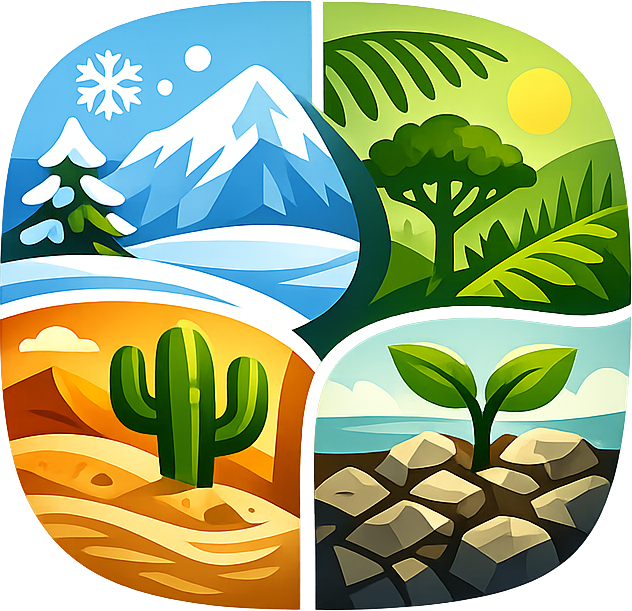
Plants grow naturally where their environment already matches what they need: the right temperature range, rainfall pattern, soil type, and seasonal rhythm. A Douglas fir thrives naturally in the Pacific Northwest's wet, cool forests. A saguaro cactus grows naturally in the Sonoran Desert's rocky, sun-baked slopes. A black spruce holds on naturally in the cold, waterlogged soils of the boreal tundra edge. The key to finding which plants grow naturally in your location is to think like the plant: start with climate zone, then narrow by habitat conditions like soil moisture, light, and seasonal temperature swings.
Examples of Plants That Grow Naturally by Climate
Dr. Marcus Weatherby
12 May 2026
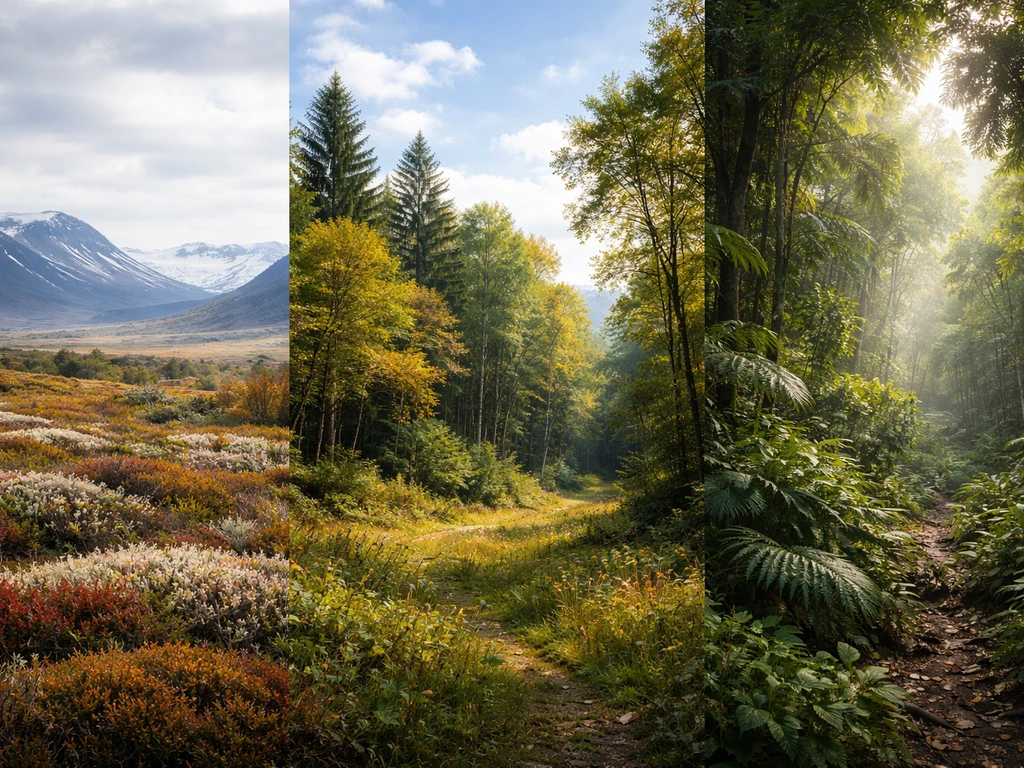
Plant Examples by Climate Zone (Tundra to Tropics)
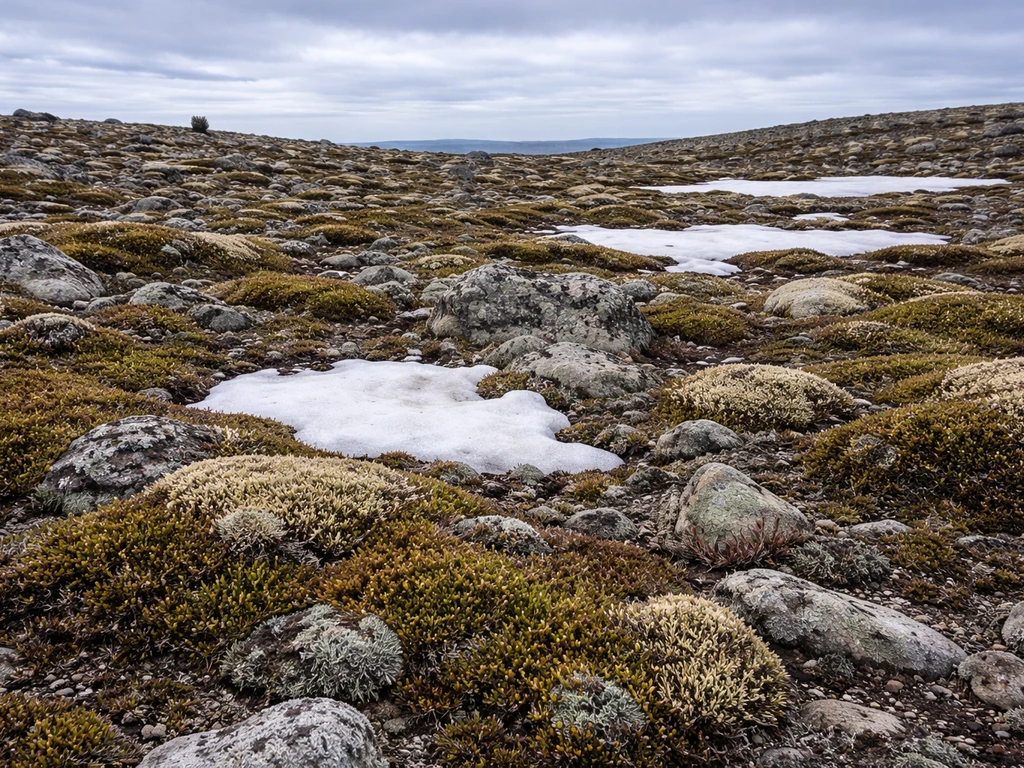
Climate zone is the single biggest filter for what grows naturally anywhere. Temperature extremes, frost-free days, and annual precipitation shape everything else. Here are concrete plant examples organized by major climate zone, with the conditions that make each one possible.
Arctic and Alpine Tundra
In the Arctic and high-alpine tundra, plants grow low, slow, and tough. The growing season is compressed to just 6 to 10 weeks, soils are frozen for much of the year (permafrost sits just inches below the surface in many areas), and wind strips moisture constantly. Arctic willow (Salix arctica) survives here by growing as a ground-hugging mat rather than a tree, rarely exceeding a few centimeters tall. Caribou moss (Cladonia rangiferina), technically a lichen, carpets vast areas and fixes moisture from fog and snow melt. Purple saxifrage (Saxifraga oppositifolia) is often the first plant to bloom after snowmelt, flowering at temperatures barely above freezing. These plants succeed because they tolerate freeze-thaw cycles, operate with minimal soil nutrients, and complete their life cycle extremely quickly.
Boreal Forest (Taiga)
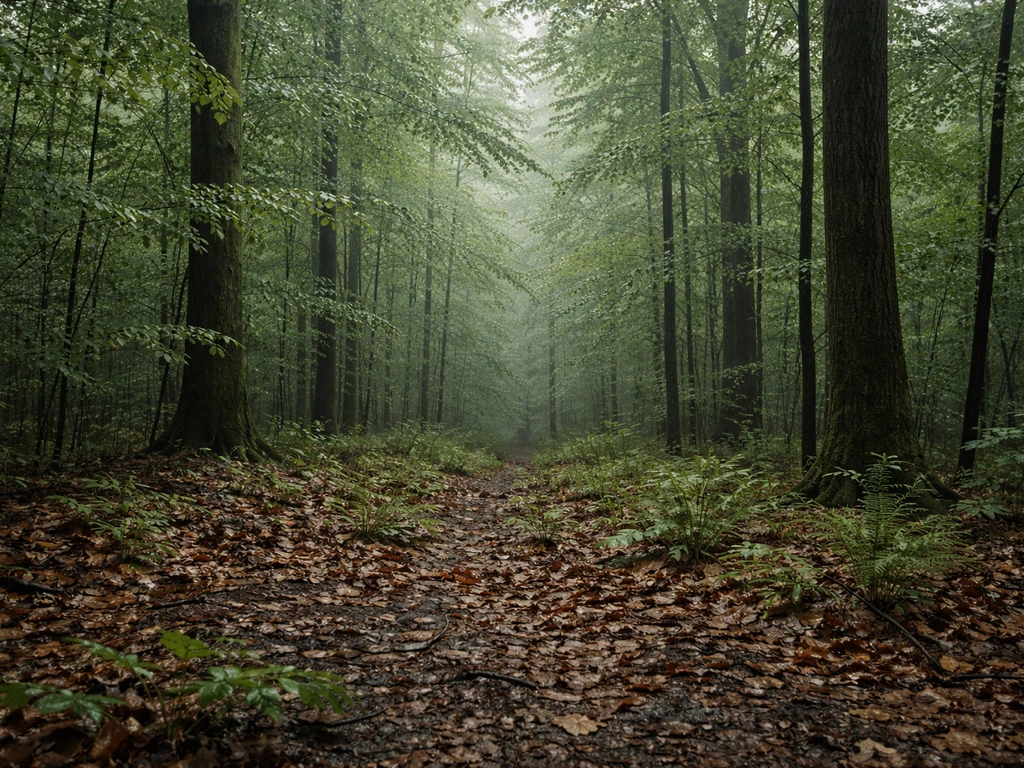
The boreal forest stretches across Canada, Russia, and Scandinavia and is dominated by cold-tolerant conifers and acid-tolerant understory plants. Black spruce (Picea mariana) is the signature tree of boggy, cold boreal lowlands. It tolerates waterlogged, nutrient-poor soils that would kill most other trees. Balsam fir (Abies balsamea) grows on better-drained boreal slopes. Underneath these trees, you'll find bog rosemary (Andromeda polifolia), cloudberry (Rubus chamaemorus), and feather mosses blanketing the forest floor. All of these thrive because they're adapted to soils with a low pH (often around 4.0 to 5.5), short warm summers, and long, cold winters.
Temperate Deciduous Forest
Temperate deciduous forests cover much of the eastern United States, Western Europe, and parts of East Asia. These zones get 30 to 60 inches of annual rainfall distributed fairly evenly, with distinct seasons. Sugar maple (Acer saccharum) and American beech (Fagus grandifolia) are textbook examples in the eastern U.S., growing naturally on well-drained, moderately fertile soils at elevations ranging from sea level to around 3,000 feet. The understory is rich too: wild ginger (Asarum canadense), trillium (Trillium grandiflorum), and bloodroot (Sanguinaria canadensis) all grow naturally on the moist, leaf-litter-covered forest floor where they get filtered light in spring before the canopy closes.
Mediterranean Climate
Mediterranean climates (coastal California, the actual Mediterranean basin, parts of Chile, South Africa, and southwest Australia) share a distinctive pattern: wet winters and hot, dry summers. Plants that grow naturally here have to handle summer drought without going completely dormant. California poppy (Eschscholzia californica) germinates after winter rains and completes its cycle before summer heat arrives. Chamise (Adenostoma fasciculatum) is a tough shrub that dominates chaparral landscapes, with small waxy leaves that limit moisture loss. Lavender (Lavandula spp.) grows naturally in rocky, well-drained soils of the Mediterranean basin under full sun. All of these plants fail or rot if given wet summer conditions they're not built for.
Grasslands and Prairies
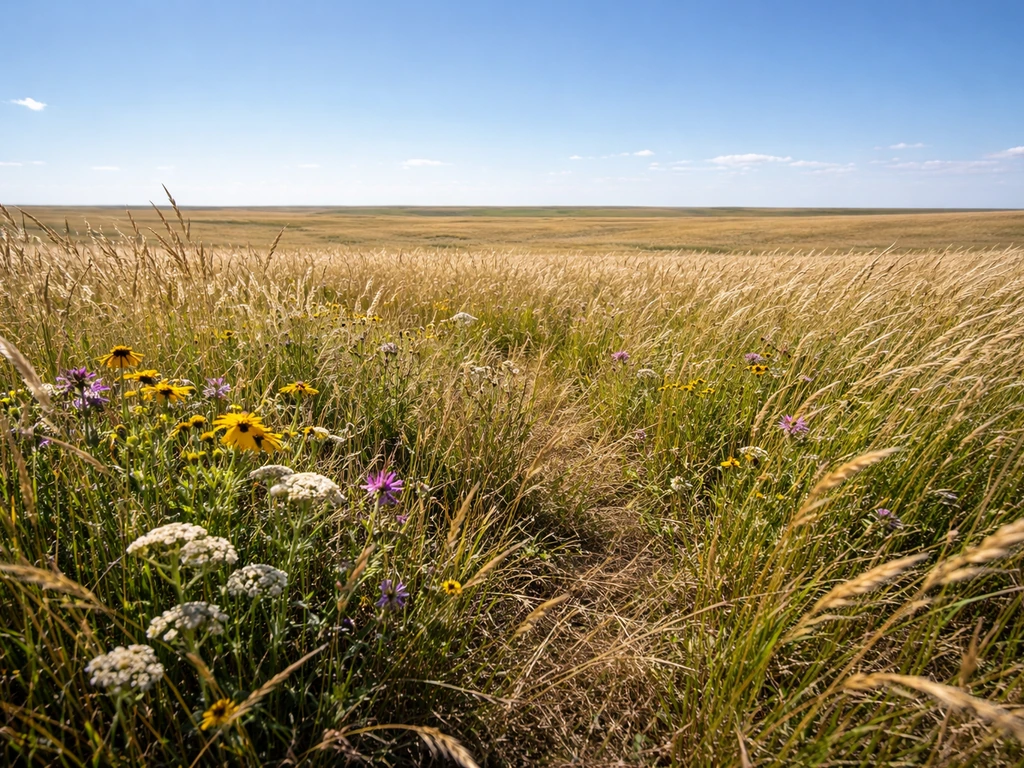
Grasslands exist where rainfall is too low for forest but too high for desert, typically 10 to 30 inches per year. North American tallgrass prairies once covered the Midwest with big bluestem (Andropogon gerardii), switchgrass (Panicum virgatum), and compass plant (Silphium laciniatum). These grasses have root systems extending 6 to 15 feet deep, which is how they survive drought, fire, and grazing. In shortgrass prairies further west, buffalo grass (Bouteloua dactyloides) and blue grama (Bouteloua gracilis) dominate. The South American pampas has its own natural grassland community including pampas grass (Cortaderia selloana), though that species has become invasive in California, which is an important reminder that a plant growing naturally somewhere does not mean it belongs everywhere.
Desert
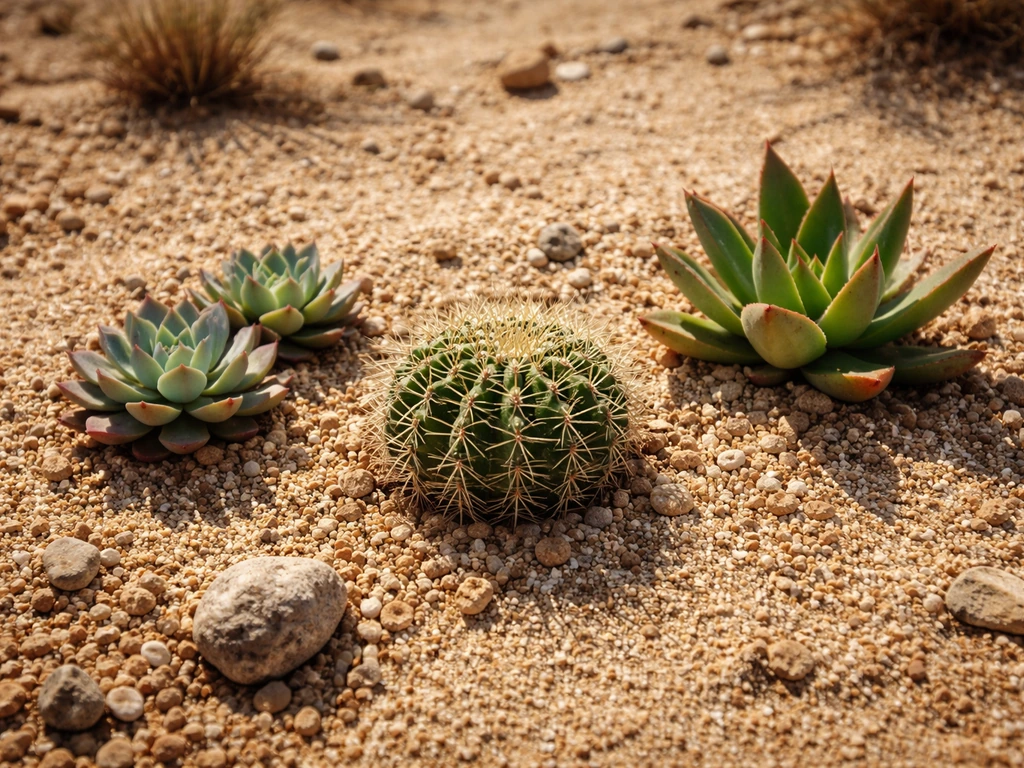
Desert plants deal with less than 10 inches of annual rainfall, often extreme heat, and soils with little organic matter. The Sonoran Desert (Arizona, northern Mexico) hosts saguaro cactus (Carnegiea gigantea), which grows naturally only between roughly 1,000 and 3,600 feet elevation, where it avoids both severe frost and waterlogging. Creosote bush (Larrea tridentata) is one of the most drought-tolerant plants on the continent, growing in all four North American deserts. Joshua tree (Yucca brevifolia) occupies the Mojave Desert specifically, between 2,000 and 6,000 feet. These plants are not just tolerating harsh conditions; they've evolved to exploit short pulses of rainfall and shut down metabolic activity during extreme heat.
Tropical and Subtropical Rainforest
Tropical rainforests receive more than 80 inches of rain annually with no real dry season and year-round warm temperatures (typically above 64°F even at night). Plant diversity here is staggering. Strangler fig (Ficus aurea in Florida, various Ficus species across the tropics) begins life as an epiphyte and gradually encases its host tree. Heliconia (Heliconia spp.) grows naturally along forest edges and stream banks in Central and South America, where it gets high humidity and filtered to partial sun. Bromeliads (family Bromeliaceae) grow naturally as epiphytes on tree branches throughout the neotropics, collecting water in their leaf rosettes rather than relying on soil moisture. In tropical zone understories, shade and humidity rule.
Seasonal Examples: What Grows Naturally at Different Times of Year
Season shapes what's actively growing just as much as climate zone does. Many plants are highly season-specific in their growth, flowering, and seed production windows. Here's how that plays out across the year in a temperate climate, with examples from other zones where relevant.
| Season | Natural Plant Examples | What's Happening Ecologically |
|---|---|---|
| Early Spring | Bloodroot, trout lily, skunk cabbage, pussy willow | Ephemeral wildflowers exploit light before canopy closure; wetland shrubs break dormancy as soil temps hit 40°F |
| Late Spring / Early Summer | Wild lupine, prairie phlox, elderberry, red columbine | Peak pollinator activity; plants with high nitrogen needs grow fastest during warming soils |
| Mid-Summer | Big bluestem, black-eyed Susan, cattail, Joe-pye weed | Tall prairie grasses at peak height; wetland species flowering at full sun exposure |
| Late Summer / Fall | Goldenrod, aster, ironweed, little bluestem | Wind and animal dispersal at peak; grasses and composites dominate open areas |
| Winter (temperate) | Winterberry holly (fruiting), witch hazel (flowering), Douglas fir (evergreen) | Evergreen conifers photosynthesize during mild winter days; some woody plants flower in late winter warmth |
| Dry Season (Mediterranean/Desert) | Chamise, prickly pear, ceanothus, brittlebush | Drought-dormant or drought-tolerant species; most growth paused until autumn rains |
| Wet Season (Tropical) | Heliconia, wild ginger, taro, broad-leaved ferns | Explosive growth during monsoon or rainy season; shade species maximize diffuse light |
Spring ephemerals are one of the best examples of tight seasonal adaptation. Plants like trout lily (Erythronium americanum) and Dutchman's breeches (Dicentra cucullaria) complete their entire above-ground life, from emergence to seed set, in roughly 6 to 8 weeks in spring before the forest canopy shades them out. If you plant them in an open garden bed, they'll struggle because their whole biology is calibrated to that narrow spring light window in a woodland setting.
Soil and Habitat-Based Examples
Climate zone gets you in the right ballpark, but soil type and local habitat often determine the exact species you'll find. Two sites 500 feet apart can support completely different plant communities if one has sandy, fast-draining soil and the other has heavy clay that stays waterlogged. Here's a breakdown by habitat type.
Sandy, Fast-Draining Soils
Sandy soils drain quickly, warm up fast in spring, and hold few nutrients. In the eastern U.S., pitch pine (Pinus rigida) and scrub oak (Quercus ilicifolia) naturally dominate the Pine Barrens of New Jersey, one of the best examples of a plant community evolved for nutrient-poor sand. Beach grass (Ammophila breviligulata) grows naturally on coastal sand dunes, with deep rhizomes that stabilize shifting sand. Bearberry (Arctostaphylos uva-ursi) is a ground-covering shrub that grows naturally across sandy, dry sites from the Atlantic coast to alpine zones in the West.
Clay and Poorly-Drained Soils
Heavy clay soils stay wet in winter and spring, then crack and harden in summer. Plants that grow naturally here have to tolerate both temporary flooding and summer drought. Swamp white oak (Quercus bicolor) thrives in low-lying clay soils in the eastern U.S. Buttonbush (Cephalanthus occidentalis) grows naturally along pond and stream edges where clay keeps soils saturated for extended periods. Blue flag iris (Iris versicolor) is a natural colonizer of clay-bottomed wetland margins. Matching moisture tolerance to actual drainage conditions is something extension services emphasize strongly, because planting the wrong species in the wrong hydrologic setting is one of the most common reasons plants fail.
Wetlands, Stream Banks, and Floodplains
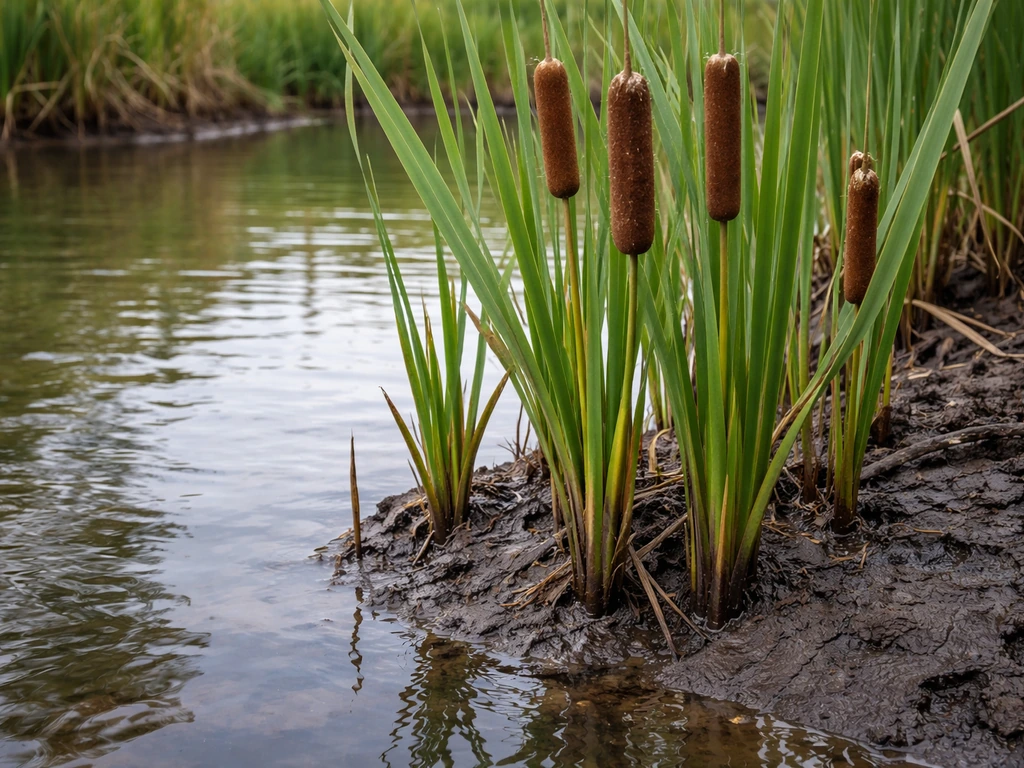
Wetland plants have specialized adaptations for saturated or flooded soils, including aerenchyma tissue that moves oxygen to submerged roots. Cattail (Typha latifolia) grows naturally in marshes and along slow-moving waterways across North America, Europe, and Asia. Bald cypress (Taxodium distichum) grows naturally in the flooded swamps of the southeastern U.S., producing pneumatophores (knees) that help oxygenate roots underwater. Smooth cordgrass (Spartina alterniflora) grows naturally in Atlantic and Gulf Coast salt marshes and plays a major structural role in coastal ecosystems. Selecting plants based on flood tolerance and drainage conditions is one of the most important site-matching steps for any riparian or low-lying planting.
Forests: Canopy to Understory
Forest habitats layer plants vertically by light availability. The canopy (full sun) supports oaks, maples, and conifers. The mid-story gets filtered light and supports species like serviceberry (Amelanchier spp.), redbud (Cercis canadensis in the east), and vine maple (Acer circinatum in the Pacific Northwest). The forest floor and understory, receiving 2 to 10 percent of full sunlight, hosts shade specialists: wild ginger, ferns, trilliums, and mosses. Trying to grow a sun-loving prairie plant on a shaded forest floor is going to fail, even if you're in the same climate zone and the same county.
Grasslands and Open Meadows
Open grassland habitats favor plants that tolerate full sun, periodic drought, and sometimes fire or grazing. Native grassland species typically have deep root systems and grow from the base rather than the tips, which is why they regrow after being mowed or grazed. Purple coneflower (Echinacea purpurea) grows naturally in open prairies and woodland edges in the central U. USGS provides species media information for purple coneflower (Echinacea purpurea) and notes that it can provide habitat for butterflies and bees. S. Wild bergamot (Monarda fistulosa) is a prairie-edge native found naturally in well-drained, loamy to sandy soils. Yellow prairie coneflower (Ratibida pinnata) tolerates clay soils in open prairie settings better than most forbs.
How to Match Natural Plants to Your Location
You don't need a PhD in ecology to figure out what grows naturally where you are. You need a few key pieces of information and a systematic way to use them. The USDA ARS Plant Hardiness Zone Map instructions say to enter your ZIP code to find your location’s hardiness zone blank" rel="noopener noreferrer">few key pieces of information. Many people also use the phrase for the plants that grow on land are called terrestrial plants.
- Find your USDA Plant Hardiness Zone. This is the standard starting tool for determining which plants are likely to survive your winter temperatures. The USDA describes it as the standard for determining which perennial plants will thrive at a location based on average annual minimum temperature. Your ZIP code gets you there in seconds on the USDA website.
- Identify your climate type. Beyond hardiness zone, know if you have a Mediterranean summer-dry climate, a humid subtropical climate, a semi-arid steppe, or a maritime climate. These affect summer moisture as much as winter cold, and they drastically change which plants grow naturally near you.
- Assess your soil. Is it sandy and fast-draining, or clay-heavy and slow to drain? Does it stay wet after rain for hours, or does it dry out within 30 minutes? This single factor determines whether you're in a wetland-adjacent plant community or a dry-slope one, even within the same neighborhood.
- Observe what's already growing nearby. A vacant lot, roadside, or natural area near you is a free field guide to what thrives locally without intervention. If you see cattails in a low area, that area has wet, poor-draining soil. If you see prickly pear and yucca on a sunny hillside, that slope is hot and fast-draining.
- Use your state's native plant database or a tool like King County's Native Plant Guide (which filters by sun exposure and moisture level) to cross-reference your observations with documented native species for your region.
- Cross-check with USDA PLANTS database. This database tracks native status by jurisdiction, so you can look up whether a species is genuinely native to your state or county versus introduced.
Matching drought tolerance to drier, sunnier exposures and moisture-loving plants to wet or poorly drained sites is one of the most consistent recommendations from university extension programs. Matching drought tolerance to dry, sunny conditions helps you zero in on the kind of plants that grow on dry land. It sounds obvious, but it's the step most people skip, and it's why plants fail. A plant that grows naturally in a moist riparian zone is not going to thrive on a south-facing, sandy hillside in the same county, even if it's technically native to your state.
Native vs. Naturalized: How to Tell What Truly Grows Naturally
This distinction matters a lot, and it's one of the most misunderstood parts of plant ecology. Just because a plant is growing somewhere in the wild does not mean it grew there naturally. There are three categories you need to know.
True Natives
A native plant is one that developed in a particular region or ecosystem over hundreds or thousands of years, becoming part of the natural balance of that environment. In the U.S. context, the USDA frames this as plants present before European settlement. These plants have co-evolved with local insects, birds, fungi, and soil organisms. They support food webs in ways that introduced species often cannot. When you plant a native, you're restoring a thread in a web, not just filling space.
Naturalized Plants
A naturalized plant is a non-native species that has been introduced (deliberately or accidentally) and is now reproducing and persisting in the wild without human help. Garlic mustard (Alliaria petiolata) in North American forests and common mullein (Verbascum thapsus) on roadsides are classic examples. They look established. They grow in wild areas. But they are not native, and in many cases they're outcompeting native species. Dandelion (Taraxacum officinale) is another example most people don't realize is European in origin.
Invasive Species
Invasive species are non-native organisms whose introduction causes or is likely to cause economic, environmental, or human health harm. Non-native and invasive are not interchangeable terms, which both NISC and USGS are clear about. Most non-native plants don't become invasive. But those that do, like kudzu (Pueraria montana) in the southeastern U.S. or purple loosestrife (Lythrum salicaria) in northern wetlands, can restructure entire plant communities and displace natives. A plant that grows abundantly doesn't equal a plant that belongs.
How to Check
To verify whether a plant is truly native to your area, check the USDA PLANTS database, which tracks native status codes by jurisdiction (state and county level). The database distinguishes native from introduced status even when introduced populations are widespread. For species-level occurrence mapping, GBIF (Global Biodiversity Information Facility) provides documented occurrence records that show where species have actually been recorded in the wild, which helps you distinguish historical native range from post-introduction spread. iNaturalist observations can also be cross-referenced, especially when they've reached Research Grade through community verification. It's also worth noting that some topics closely related to this one, including what distinguishes plants that grow on dry land, plants that grow in air (epiphytes and air plants), and how we classify plants that grow where they're not wanted, connect directly to understanding native versus naturalized status in different habitats. Plants that grow where they are not wanted are called invasive species. Plants that grow in air are called epiphytes and they use tree branches mainly for support while getting moisture from the air or rain.
Your Practical Checklist for Finding What Grows Naturally in Your Area
Use this checklist as your starting framework whether you're a student documenting a local ecosystem, a gardener trying to establish a native planting, or a plant enthusiast learning your region's flora.
- Look up your USDA Plant Hardiness Zone by ZIP code to anchor your plant research to your actual winter temperature range.
- Identify your broad climate type: humid, semi-arid, Mediterranean, continental, maritime, or tropical. This shapes summer moisture availability, which is just as important as cold hardiness.
- Walk your site and assess soil drainage by observing how quickly water disappears after rain. Sandy or loamy soil that drains within 30 minutes supports dry-to-medium habitat plants. Soil that stays wet for hours or days after rain is wetland-adjacent territory.
- Note sun exposure: full sun (6+ hours direct sun), part shade (3 to 6 hours), or full shade (less than 3 hours). This filters your plant options as strongly as soil moisture does.
- Visit a nearby natural area, nature preserve, or undisturbed roadside and document what's already growing. Photograph and identify plants using iNaturalist or a regional field guide. What grows there without any help is your best guide to what naturally works.
- Cross-reference your observed species with your state's native plant list or the USDA PLANTS database to confirm which are truly native versus naturalized or invasive.
- Use a regional native plant guide (such as a state extension service or county resource) to find additional species matched to your specific sun and moisture conditions.
- Before planting, check the USGS US-RIIS or state invasive species lists to confirm that any non-native species you're considering is not on the invasive watch list for your region.
- Start with 3 to 5 locally native species that match your specific site conditions (soil drainage, sun exposure, climate zone) rather than trying to establish a large diverse planting all at once.
- Reassess after one full growing season. What thrived? What failed? The survivors are telling you which plants are truly matched to your conditions.
The biggest shift in thinking here is moving from 'what plant do I like?' to 'what does this site already want to grow?' When you answer that second question first, everything else gets much easier. The plant does the work. You're just getting out of its way.
FAQ
How can I use “climate zone” examples if my specific spot is wetter or drier than the surrounding area?
Start by matching your site to the plant’s hydrology, not just your climate zone. For example, a species that grows naturally in a cool, moist forest may still fail on a nearby slope if the drainage is fast or the exposure is full sun. If you can, observe how water moves after rain (where it pools, where it drains, how fast it dries).
Can a plant be native to my state but not native to my exact location?
Yes. Many plants are labeled “native” at a broad state level but may not be native to your county or exact habitat. Checking jurisdiction level native status matters because soils, microclimates, and historical range can differ within the same state.
What’s the biggest mistake people make when they try to grow “naturally growing” plants?
Don’t rely on a plant list that only shows presence in the region. The same species can occur naturally in multiple habitats, but it will only thrive in the habitat where its moisture and light requirements are met. Use the article’s habitat layering idea (canopy, understory, wetland margin, open sun) to decide if it’s actually a match.
How do I tell whether a plant growing wild near me is native, naturalized, or invasive?
A plant can be “growing in the wild” and still be non-native. To avoid common confusion, treat three terms separately: native (evolved locally), naturalized (non-native but self-sustaining), and invasive (harmful spread). If the plant is self-seeding aggressively or displacing natives, it is a red flag even if it looks well established.
Do seasonal patterns matter as much as annual rainfall for plants that grow naturally?
Yes, and it’s a common edge case. A wetland-edge plant may survive only at certain water levels, and a “drought-tolerant” plant may still need winter or spring moisture pulses. If your site has different seasonal rainfall timing than the reference location, the plant may not flower or may fail after a particular month.
Why do some plants that are native in my region fail even though temperatures and rain seem similar?
Look for the plant’s active window, not just whether it can survive the climate. Spring ephemerals, for instance, require the light and timing that occur before canopy closure. In a garden with similar zone but thicker shade or later leaf-out, they often underperform.
How do elevation and frost-free days change which plants grow naturally in a “warm” climate?
Yes, elevation and frost timing can be decisive. The saguaro example highlights that a species may be naturally present only within a specific elevation band because frost, cold snaps, and waterlogging risk change with altitude and local cold-air drainage.
If two areas are both “dry,” why might different plants grow naturally in them?
Match plants to soil texture and drainage speed, then refine for nutrients and pH. Sandy soils and heavy clays can both be “dry” on the surface at times, but they behave very differently in spring and after storms. If you do only one test, prioritize drainage by checking how long water takes to infiltrate after watering or rain.
Beyond climate, what hidden factors can determine whether a native plant actually thrives?
Pollinator and soil-microbe relationships can be a major difference between natives and naturalized ornamentals. Even when a plant seems adaptable, introduced species may not support the local insects and fungi that native food webs depend on, which can affect establishment and long-term persistence.
Does it matter where I source native seeds or nursery plants from within my region?
In many regions, “native planting” success depends on starting with locally sourced, genetically appropriate stock, especially for perennials and trees. If you use material from a different seed source or a different habitat type, it may survive but grow slowly or not reproduce well.