Coastal areas support a surprisingly wide range of plants, but which ones survive depends almost entirely on which part of the coast you're looking at. Marram grass (Ammophila arenaria) locks down sand dunes across Europe and the British Isles. Smooth cordgrass (Spartina alterniflora) dominates the flooded edges of North American salt marshes. Sea thrift (Armeria maritima) clings to rocky headlands where almost nothing else will grow. The key is that "coastal" covers four very different environments, each with its own stress factors, and the plants that succeed are the ones adapted to that specific combination of salt, wind, flooding, and soil instability.
Which Plants Grow in Coastal Areas Best Options

Dr. Marcus Weatherby
19 May 2026
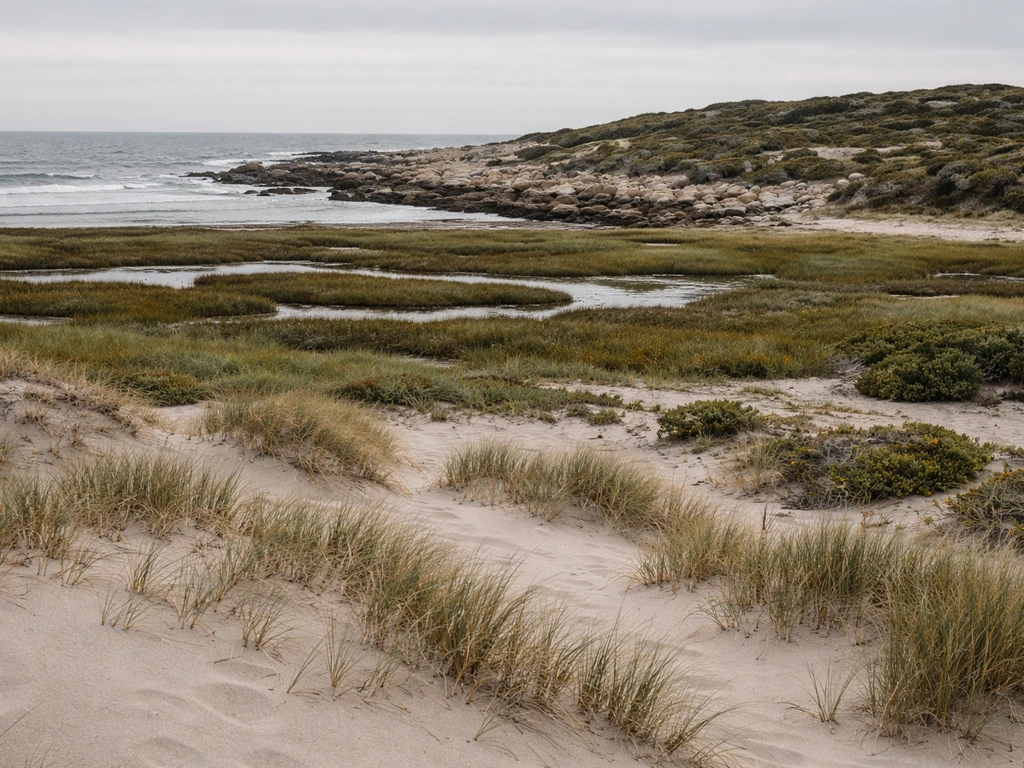
What "coastal areas" actually means for plant survival
When ecologists talk about coastal plants, they're really talking about stress specialists. The coastline isn't one environment; it's a gradient of overlapping pressures. Salt spray carries airborne salt aerosols inland, coating leaves and burning unprotected plant tissue. Soils are often sandy, nutrient-poor, and drain fast, or they're waterlogged and low in oxygen. Wind is relentless and often one-directional, which physically deforms plants and accelerates moisture loss. And then there's tidal flooding, which brings saline water directly into the root zone on a schedule tied to the moon rather than rainfall.
Plants that handle all of this fall into a few broad categories. Halophytes are the specialists: plants physiologically adapted to high-salinity environments. They survive by excreting excess salt through blank" rel="noopener noreferrer">specialized glands in their leaves, and by regulating the balance of ions and water pressure inside their cells. Ocean water runs around 35 parts per thousand (ppt) salinity. Freshwater is below 0.5 ppt. The brackish zone in between, roughly 0.5 to 35 ppt and varying with each tide, is where many of the most interesting coastal plants live. The further you move inland from the water, the more the challenge shifts from salt tolerance to wind and spray tolerance on drier, freer-draining ground.
Before picking any plant, you need to identify your specific coastal setting. Is the ground sandy and shifting? Are there tides reaching the roots? Is the soil waterlogged and saline, or just exposed to salt spray on dry rocky ground? Those answers will narrow your plant list faster than anything else.
Plants for coastal sand dunes and beaches
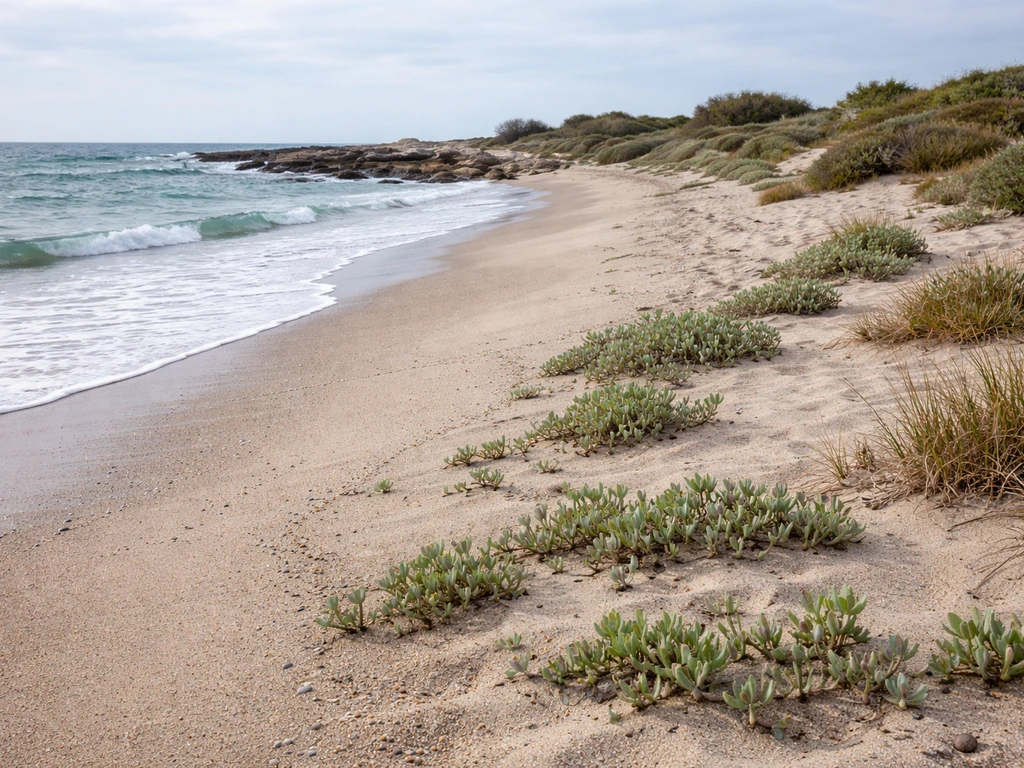
Sand dunes are one of the most demanding environments on earth for plants. The sand moves, burial is common, salt spray is intense, freshwater is scarce, and there's almost no organic matter in the substrate to hold nutrients. Plants that succeed here have a very specific toolkit: thick, waxy, or furry leaves to reduce moisture loss; low-growing or mat-forming habits to stay below the worst of the salt spray and wind; and, most importantly, extensive underground rhizome systems that let the plant push back up through fresh sand after burial.
Marram grass (Ammophila arenaria) is the iconic European dune plant. It's found virtually everywhere on the British and Irish coast where there are dunes. Its rhizomes form a dense underground network that can regrow through sand burial, which is exactly why it's so effective at building and stabilizing dunes rather than just tolerating them. In eastern North America and around the Great Lakes, the equivalent is American beachgrass (Ammophila breviligulata), a close relative with the same dune-building habit. In the southeastern United States, sea oats (Uniola paniculata) takes that role. Sea oats actually grow faster when sand buries their base, which is an extraordinary adaptation to an environment that would kill most plants.
On Australian coasts, particularly in New South Wales, Spinifex (Spinifex sericeus) is the most important sand-stabilizing plant. It's used deliberately in coastal dune restoration because of how effectively it binds mobile sand. Along the California coast and other parts of the western United States, the coastal strand community includes plants like beach morning glory (Calystegia soldanella), sand verbena (Abronia maritima), silver beachweed (Ambrosia chamissonis), and various saltbush species (Atriplex spp.), all low-growing plants with adaptations for salty, dry, shifting substrate.
- Ammophila arenaria (marram grass): European and British dunes, spreads by rhizome, classic dune builder
- Ammophila breviligulata (American beachgrass): Atlantic coast and Great Lakes dunes, same growth habit
- Uniola paniculata (sea oats): Southeastern US beaches, burial stimulates growth
- Spinifex sericeus: Australian coastal dunes, critical sand binder for NSW and similar coasts
- Calystegia soldanella (beach morning glory): California coastal strand, low-growing, salt-spray tolerant
- Abronia maritima (sand verbena): California strand, salt-tolerant, sandy substrate
- Atriplex spp. (saltbush): Various coastal regions, tolerates saline sandy soils
A quick way to identify whether you're in dune plant territory: if the sand visibly moves in the wind, if you can see sand piled around existing plants or buried stems, and if there's no stable soil crust, you're looking for dune specialists. Generic salt-tolerant ornamentals won't last here without those burial-recovery and sand-binding adaptations.
Plants for salt marshes and brackish wetlands
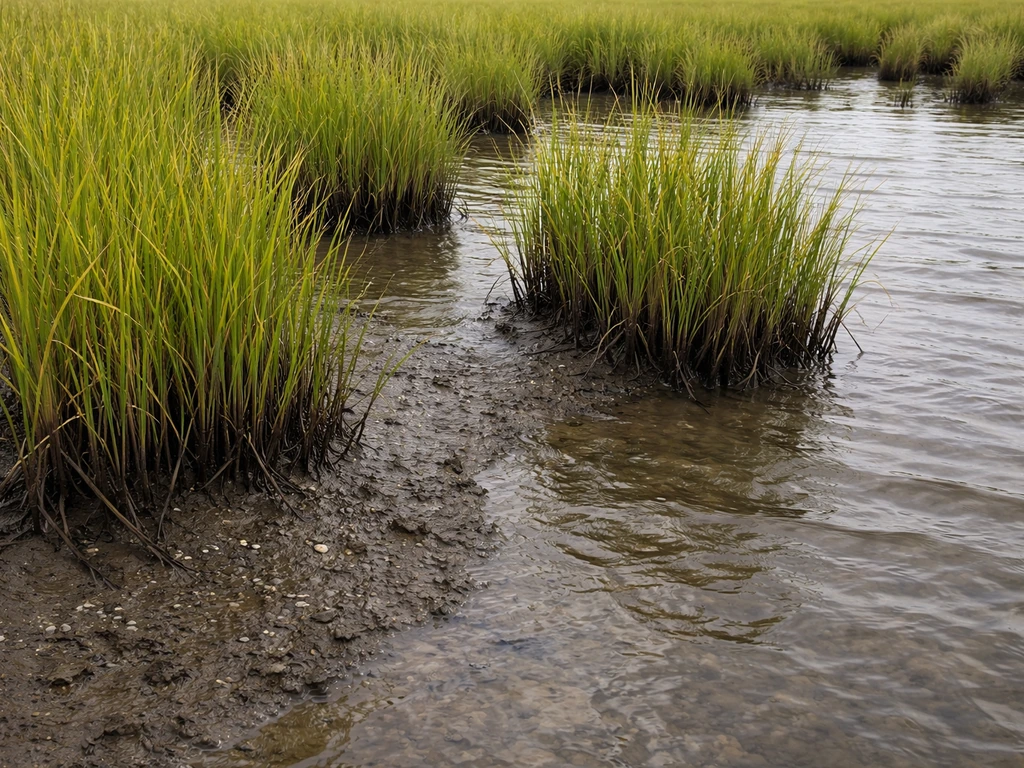
Salt marshes are structured by tides. The lower marsh floods frequently and for longer periods, which means lower oxygen in the soil, higher salinity, and only the toughest halophytes survive. The higher marsh floods irregularly, salinity fluctuates more, and a broader range of species can establish. This tidal zonation is one of the clearest examples of plant ecology you can observe with your own eyes: walk from the water's edge upland through a marsh and you'll watch one community shift to another in a matter of meters.
Smooth cordgrass (Spartina alterniflora) dominates the low marsh along the North American Atlantic and Gulf coasts. It's the plant you see standing in water at high tide, and it handles both the flooding and the high salinity of that zone better than almost anything else. Above it in the higher marsh, saltmeadow cordgrass (Spartina patens) takes over, thriving where flooding is irregular and salinity is more variable. Saltgrass (Distichlis spicata) and glasswort (Salicornia spp.) also appear in the upper marsh and brackish transition zones. Needlegrass rush (Juncus roemerianus) is common in the mid-to-high marsh, particularly in the southeastern United States.
Glasswort deserves special mention because it's one of the most visible indicators of high-salinity marsh conditions. The succulent, jointed stems are a direct adaptation to salt stress, storing diluted water internally. If you see glasswort, you know you're in genuinely saline ground. The topic of what plants specifically grow in brackish water and saline soils is closely related here, since many marsh species span the gradient from brackish to full salt marsh conditions depending on their zone within the system.
| Plant | Zone | Salinity tolerance | Key trait |
|---|---|---|---|
| Spartina alterniflora (smooth cordgrass) | Low marsh | High (near ocean salinity) | Tolerates frequent tidal flooding and waterlogged, low-oxygen soil |
| Spartina patens (saltmeadow cordgrass) | High marsh / brackish | Moderate to low | Most abundant where salinity and water levels are lowest in marsh |
| Distichlis spicata (saltgrass) | Upper marsh / brackish edge | Moderate | Broad tolerance for variable salinity and irregular flooding |
| Salicornia spp. (glasswort) | Upper marsh to saline flats | High | Succulent stems store water; indicator of high-salinity ground |
| Juncus roemerianus (needlegrass rush) | Mid to high marsh | Moderate to high | Dense stands, common in southeastern US marshes |
To match marsh plants correctly, observe how often the ground floods. If it floods daily with every high tide, you're in low marsh territory and Spartina alterniflora is your reference species. If it only floods during storm surges or very high tides, you're in upper marsh or brackish transition, and Spartina patens, Distichlis, and Juncus become more relevant. Salinity ranges in brackish settings swing with every tide cycle, dropping at low tide when freshwater input increases and rising again when salt water pushes in.
Plants for rocky coasts and headlands
Rocky coasts present a different set of challenges. There's no tidal flooding in most cases, but salt spray is intense and constant, soils are thin and very fast-draining, and the wind exposure is extreme. Plants here tend to be low-growing cushion forms or mat-formers that minimize their surface area to wind, and they need to tolerate both salt spray and drought simultaneously.
Sea thrift (Armeria maritima) is one of the best examples. It grows on rocky coastal cliffs, shallow soils, and even salt marsh edges across Britain, Ireland, and parts of North America, forming tight pink-flowered cushions that hug the ground. It tolerates moderate salt spray, shallow and dry rocky soils, and exposed conditions where most plants would simply die. Sea thrift is genuinely one of those plants where, if you see it growing, it's telling you something real about the conditions: thin soil, good drainage, salt exposure, and wind.
Sea kale (Crambe maritima) is another rocky-shore specialist, found on shingle beaches and fragmentary coastal habitats in Britain and parts of Europe. It's a true halophyte with thick, waxy, bluish leaves that reflect and conserve moisture, and it tolerates the unstable, coarse substrate of shingle and rocky coasts where organic matter barely accumulates. On California's rocky coast and beyond, iceplant (Carpobrotus spp.) has become a well-known colonizer of exposed coastal bluffs, though it's worth noting that non-native iceplant causes significant ecological problems in areas where it wasn't originally present.
The organizing principle for rocky coast plants is a combination of salt spray tolerance and drought tolerance together. Thin soil means fast drainage, so these plants need to handle dry spells right alongside salt exposure. That's a different challenge from marsh plants, which cope with too much water rather than too little.
Plants for coastal woodlands and wind-exposed bluffs
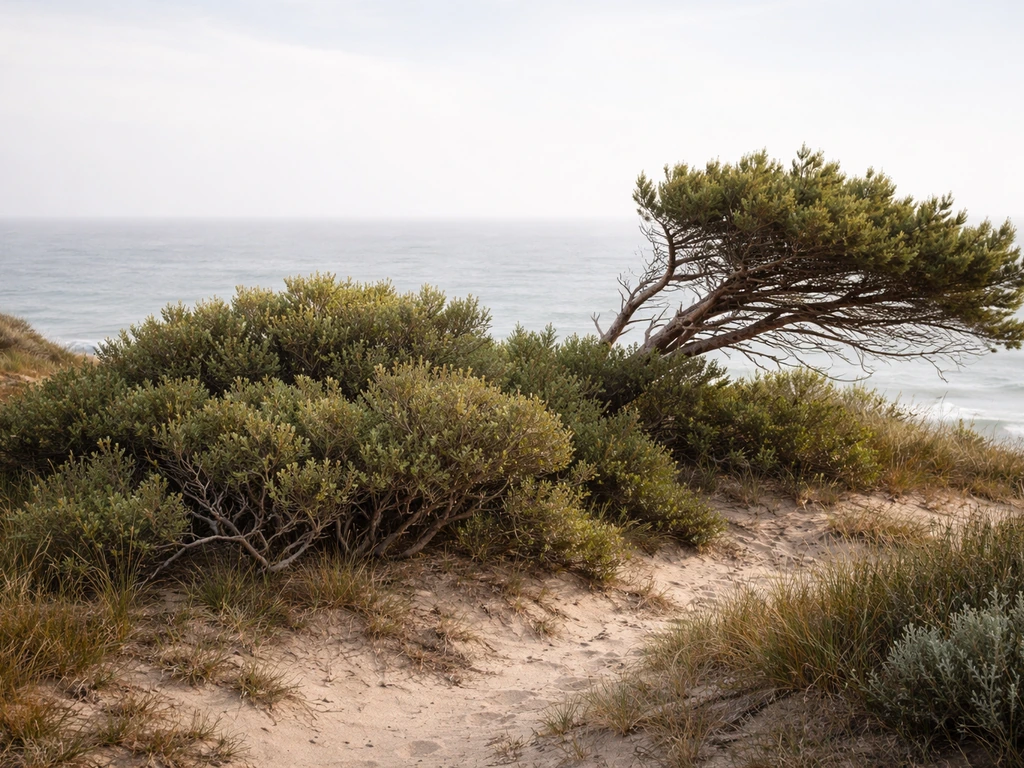
Further back from the water, where tidal flooding no longer reaches, the coast transitions into maritime shrublands and woodlands. These communities are still shaped by the coast because salt spray travels inland, especially during storms, and the wind continues to prune and sculpt vegetation. Soils are typically nutrient-poor, sandy, or shallow, and the combination of spray and wind creates a very specific ecology that isn't captured by either "normal woodland" or "salt marsh" plant lists.
Maritime forests and shrublands, as they're often called, exist as shifting mosaics influenced by cliff edges, woodland margins, and the degree of salt spray penetration. Species that thrive here need to handle occasional heavy salt exposure without the physiological machinery of a true halophyte. Sea lavender (Heliotropium gnaphalodes and related species) is a practical example: highly tolerant of saline beach soils and salt spray, it works in exactly these transitional coastal conditions where the soil is dry and salty but there's no tidal flooding.
Wind-pruned shrubs like hawthorn, blackthorn, and various coastal willow species appear in these communities in Britain and Ireland, their growth asymmetrically shaped by prevailing onshore wind. In North America, pitch pine and scrub oak appear in maritime shrubland communities on the Atlantic coast, growing in nutrient-poor, sandy soils behind the primary dune. The ecological pattern is consistent globally: once you're back from direct tidal and heavy spray influence, woody plants establish, but they're still environmentally filtered by the coast rather than by inland conditions.
How to pick the right plants for your specific shoreline
The most reliable approach is to read your site before you look at any plant list. Walk the area and ask four questions: Does the ground flood, and how often? Is the substrate sandy and mobile, or stable and rocky, or waterlogged and fine-grained? How close are you to the water, and how intense is the spray exposure? And what's already growing there? Native plants that are already establishing are the single most useful indicator of what belongs in that specific setting.
- Identify your flooding pattern: Daily tidal flooding means low marsh conditions and you need Spartina alterniflora-type halophytes. Irregular flooding points to upper marsh or brackish species. No flooding at all means you're in dune, rocky coast, or coastal woodland territory.
- Check the substrate: Mobile sand with visible burial of plants means dune specialists like marram grass, sea oats, or Spinifex. Stable sandy or rocky dry ground favors sea thrift, sea kale, or coastal strand species. Waterlogged fine sediment means marsh plants.
- Estimate salinity context: If you're in a tidal system, salinity will track roughly with flooding frequency. Frequently flooded areas near the ocean approach 35 ppt. The upper marsh and brackish transition sit between 0.5 and 18 ppt roughly, varying with tide cycles. Purely spray-exposed upland sites have no soil salinity but need spray tolerance.
- Cross-reference with regional habitat guidance: For North American marshes, the VIMS salt and brackish marsh native plant resources give zone-based species lists. For Australian dunes, NSW coastal dune management guidance identifies the key native stabilizers by region. For British coasts, RHS and local coastal flora guides are highly specific to habitat type.
- Use what's already there as your template: If you see Spartina alterniflora, you're in low marsh. If you see glasswort, you're in high-salinity ground. If you see marram grass, you're on a mobile dune. Match to what the native community is already telling you.
One practical caution: avoid sourcing plants purely from ornamental gardening lists labeled "salt tolerant. Plants grown in coastal areas reflect the specific stresses of each shoreline type, so examples like dune grasses, marsh cordgrass, and headland sea thrift are a useful guide plants grow in coastal areas examples. " Many of those plants tolerate occasional salt spray in a garden context but won't survive actual coastal conditions, whether that's regular tidal flooding, complete sand burial, or the relentless abrasive wind of a headland. The plants listed in this article are documented in their actual native coastal habitats, which is a very different standard from "can survive near a coastal garden bed." For verification, look for habitat-specific native plant lists from regional coastal management agencies, extension services, or national park and estuary education resources in your area. Those sources are organized by real habitat conditions rather than aesthetics, which is exactly what you need.
Finally, keep in mind that coastal plant ecology connects to several overlapping systems. The plants that grow in sandy soils, the species adapted to brackish water conditions, and the halophytes of truly saline ground all overlap along the coastal gradient, and understanding where each group applies helps you match the right plant to the right part of your shoreline rather than treating the entire coast as one uniform environment.
FAQ
How can I tell if I’m dealing with true salt marsh versus brackish wetland when I don’t have lab test results?
Look for daily versus occasional flooding and the vegetation “zoning” pattern. Daily high-tide flooding with low-oxygen, peaty or muddy soils points to low marsh species. If flooding is less frequent and species change more gradually across the slope, you’re more likely in upper marsh or brackish transition, where plants tolerate wider salinity swings. Visual clues like salt-crust or very succulent marsh plants (for example, glasswort) also suggest genuinely saline ground, but confirmation is safest if you can measure conductivity or salinity.
Can I use the same coastal plant across dune, marsh edge, and rocky headland?
Usually no. Dune plants are adapted to mobile sand, burial, and droughty nutrient-poor substrate, while marsh plants are adapted to root-zone waterlogging, low oxygen, and tidal salinity cycles. Rocky-coast plants are adapted to constant salt spray plus fast drainage without tidal flooding. Even if a plant survives for a season, it often fails when the stress mismatch becomes chronic (for example, burial tolerance in dunes versus flooding tolerance in marshes).
What’s the biggest mistake people make when trying to grow coastal plants outside their natural zone?
Using “salt tolerant” garden plants without matching the shoreline process. Coastal survival depends on recurring tidal flooding, sand movement and burial, or constant wind-driven salt spray, not just occasional misting or one-time salting. If your site doesn’t recreate the main stressor, select species that match that specific environment rather than relying on broad salt tolerance labels.
If my garden is near the coast but not in a tide zone, which plant group should I focus on?
Focus on spray- and wind-tolerance rather than tidal-flood specialists. When tidal water never reaches the roots, you’ll typically be closer to rocky headland conditions or maritime shrubland conditions. In that case, prioritize cushion or mat-formers for exposed rocky/sandy spots, and wind-pruned shrub or hardy maritime species for slightly more sheltered areas back from the shore.
How much salt exposure is “enough” for rocky-coast plants like sea thrift or sea kale?
For rocky-coast specialists, the key is repeated salt spray and exposure-driven drying, not submerged salinity. If you only get light coastal fog and protected conditions, these plants may not establish well or may become vulnerable to long, humid periods. Try to match exposure by choosing a similarly windy, open location with strong drainage and minimal shade, because thin soil and fast drying are part of the survival package.
What should I do if my site has sandy soil but it stays wet for long periods?
Treat it as a different habitat than dunes. Persistent wetness and low oxygen change the plant requirements, so dune species that depend on free drainage and burial recovery may struggle. Instead, look for marsh or brackish-transition species, and confirm whether flooding is tidal and how frequently it occurs. Matching the hydrology often matters more than matching the soil “type” label.
How can I identify a plant’s stress “match” quickly using what’s already growing there?
Use the existing vegetation as the most reliable indicator of the prevailing stress combination. If you see low, mat-forming plants on shifting sand, that suggests dune-type stresses (burial and salt spray). If you see tall marsh grasses rooted in regularly flooded ground, that suggests tidal water and low-oxygen soils. A mixed sward that shifts over a short distance often signals a gradient, so sample and map the visible zones before choosing additions.
Why do dune plants sometimes disappear even when they’re planted correctly?
The most common causes are lack of sand movement and burial dynamics, or too-stable soil. Many dune specialists rely on rhizomes to regrow through sand burial, and sand-binding behaviors help keep the microhabitat within their tolerance. If you stop sand from shifting entirely or cover roots with heavy organic matter, you may remove the conditions they’re adapted to.
Can non-native “coastal colonizers” work like the native species mentioned, especially iceplant?
They may establish, but “works in the landscape” is not the same as “fits the ecosystem safely.” Some aggressive non-natives can outcompete native dune or headland plants and alter habitat structure, biodiversity, and succession. If you want long-term ecosystem compatibility, prioritize region-appropriate native coastal species and avoid plants known to become invasive in coastal habitats.
What planting approach improves success if I’m restoring or creating coastal habitat from scratch?
Recreate the habitat first, then plant. For dunes, focus on substrate stability for the first establishment phase while still allowing natural sand processes, and ensure drainage and low nutrient input. For marsh edges, respect flooding frequency and avoid planting into areas that remain waterlogged beyond the natural inundation regime. For rocky zones, avoid adding compost or topsoil that holds water and instead use material that matches local drainage and texture.