
Most plants you see growing on tree branches do have some kind of root or root-like structure, just not in the soil. The groups people usually mean when they ask this question are epiphytes (orchids, ferns, mosses) and lichens. They cling to bark using rhizoids, holdfasts, or aerial roots, pulling water from rain, fog, and humid air rather than from the ground.
Which Plants Have No Roots and Grow on Tree Branches

Dr. Marcus Weatherby
17 May 2026
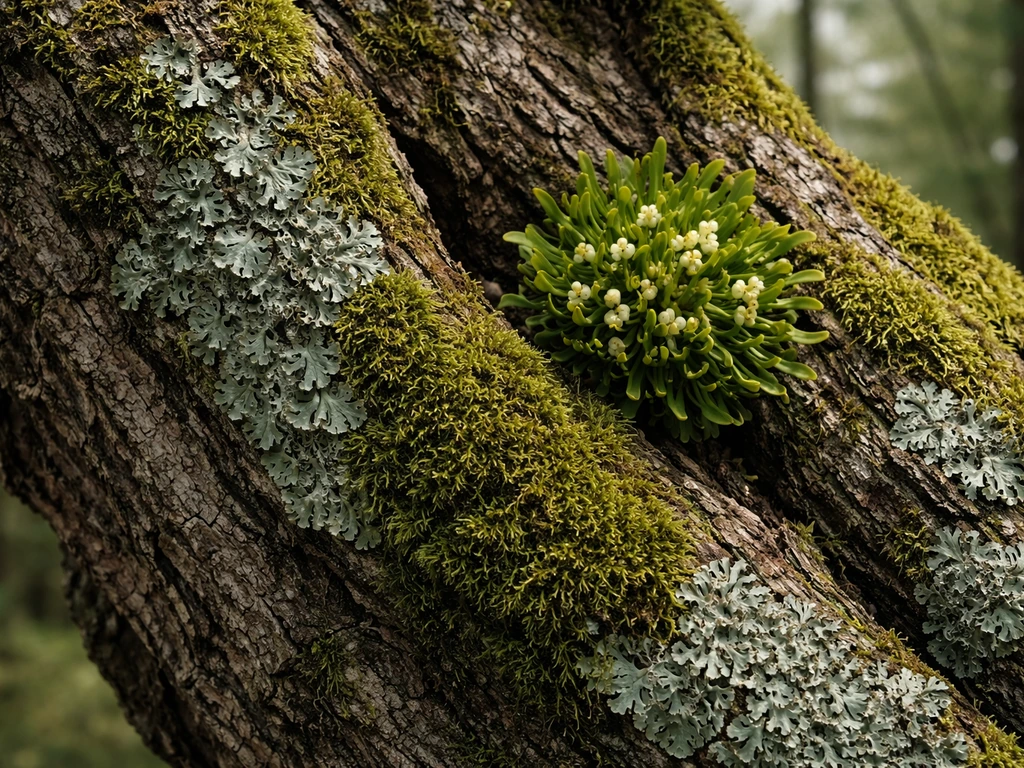
The one major exception in the 'growing on branches' category is mistletoe, which is a true parasite that taps directly into the host tree's plumbing. So the honest answer is: none of these plants are completely rootless, but most of them have no roots in the soil, which is exactly what makes them fascinating and worth understanding on their own terms.
What 'no roots' actually means in botany
True roots are vascular structures that pull water and dissolved minerals up through specialized conducting tissue. By that strict definition, several whole plant groups simply don't have them. If you are studying this for class 5, the answer usually includes mosses, liverworts, and lichens as plants that can grow without seeds which are the plants which grow without seeds class 5. [Bryophytes, which include mosses and liverworts, lack both true roots and the vascular tissue that roots require.
](https://openstax. org/books/biology-2e/pages/25-3-bryophytes) Lichens aren't even plants in the traditional sense; they're a symbiotic partnership between a fungus and algae or cyanobacteria, and they have no root structures at all. Epiphytic orchids and ferns do have real roots, but those roots dangle in open air or grip bark rather than digging into soil.
So when someone says a plant 'has no roots,' they usually mean one of two things: either the plant genuinely lacks root anatomy (mosses, liverworts, lichens), or the plant has functional roots that work completely outside the soil (epiphytic orchids, ferns). Some plants that do not grow from seeds include mosses, liverworts, and lichens mosses, liverworts, lichens.
This distinction matters when you're trying to identify what you're looking at in the field. A mossy green crust on a branch and a clump of orchid aerial roots are both 'rootless' in casual speech, but they are structurally and ecologically completely different things.
The main plant groups you'll find on tree branches
Mosses and liverworts (bryophytes)
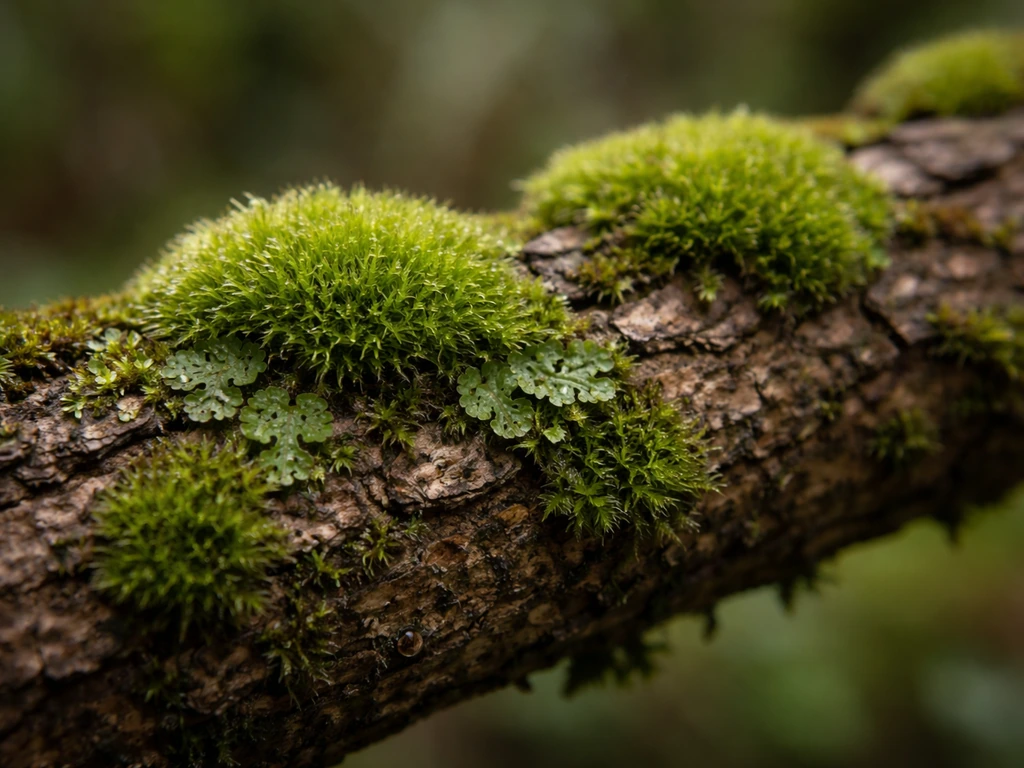
Mosses are probably the most commonly seen 'rootless' plants on branches worldwide. They anchor themselves using rhizoids, which are simple filaments that grip the bark surface. Rhizoids are not vascular; they don't conduct water the way roots do, though they can assist with water uptake depending on the species. The actual water and nutrient gathering happens across the whole surface of the moss body.
Liverworts work similarly: they attach via hair-like rhizoids from the underside of their flat, ribbon-like thallus, and they also lack true roots, stems, or leaves in the botanical sense. Both groups are described as 'poikilohydric,' meaning their water content fluctuates with the surrounding environment rather than being actively regulated. They dry out when conditions are dry and rehydrate quickly when moisture returns.
In the field, mosses on branches look like soft, dense mats or cushions, usually deep green when moist and olive-brown or almost grey when dry. They prefer the shaded, north-facing sides of branches and trunks in humid, temperate, and tropical environments. You'll see the heaviest moss growth on older, rougher-barked trees where there's more surface texture for rhizoids to grip.
Lichens
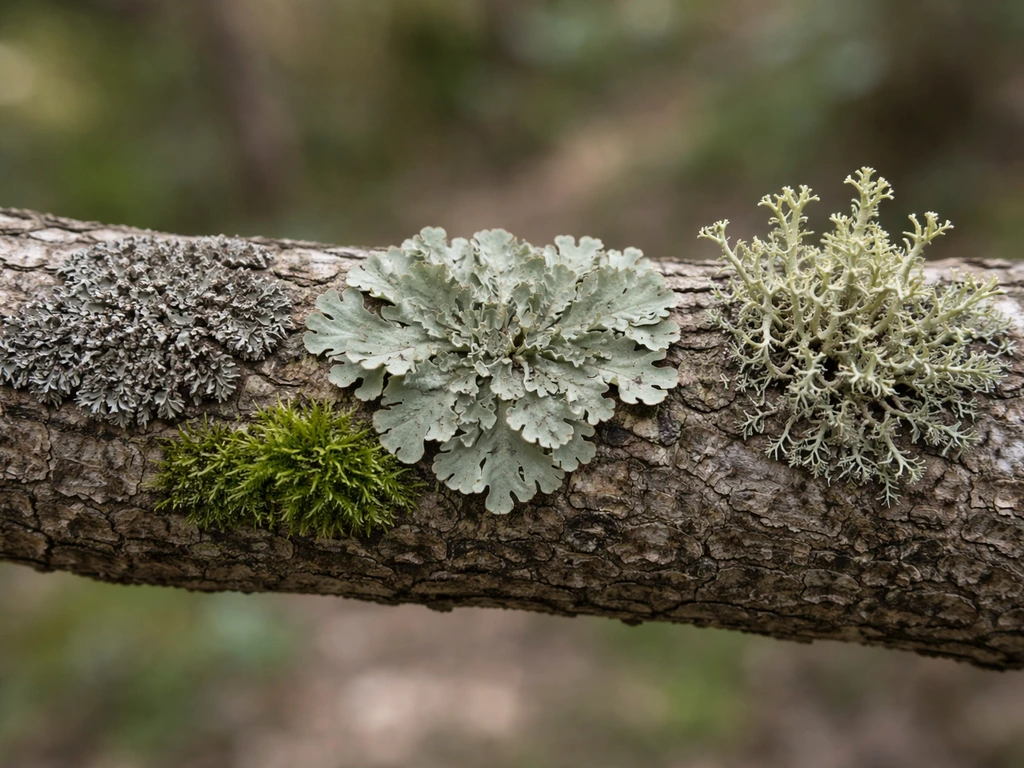
Lichens are everywhere on tree branches, but they're often mistaken for moss or algae. They anchor to bark using rhizines, which are root-like fungal structures that hold the lichen down to its substrate. Like bryophyte rhizoids, rhizines anchor but don't transport water or nutrients the way vascular roots do. The whole lichen body absorbs water vapor and liquid water directly through its surface, which is why lichens are so sensitive to air quality: they have no filtering root system to protect them from dissolved pollutants. They're widely used as bioindicators for air quality precisely because sulfur dioxide and other airborne pollutants hit them directly.
There are four growth forms you'll encounter on branches, and recognizing them helps separate lichens from everything else. Crustose lichens form a flat crust that's almost impossible to remove without taking bark with it. Foliose lichens are leafy, with distinct upper and lower surfaces, and lift slightly off the bark at the edges. Fruticose lichens are shrubby or hair-like, projecting outward from the branch in three dimensions. Squamulose lichens look like small overlapping scales. Colors range from pale grey and green to bright orange, yellow, and even black depending on species and local conditions.
Epiphytic ferns
Epiphytic ferns are true plants with true roots, but those roots grip bark and organic debris rather than soil. The staghorn fern (Platycerium) is the classic example. It produces two distinct frond types: flat, rounded 'shield' fronds that press against the tree and collect falling organic matter (essentially building their own compost pile against the bark), and the fertile, antler-shaped fronds that project outward. The shield fronds protect the root mass behind them from drying out and from physical damage.
The roots beneath those shield fronds are real vascular roots doing real water and nutrient uptake, just from accumulated bark debris and rain runoff rather than soil. Other epiphytic fern genera you might find on tropical and subtropical trees include Asplenium (bird's nest ferns) and various Polypodium relatives, which tuck their rhizomes into bark crevices and moss mats.
Epiphytic orchids
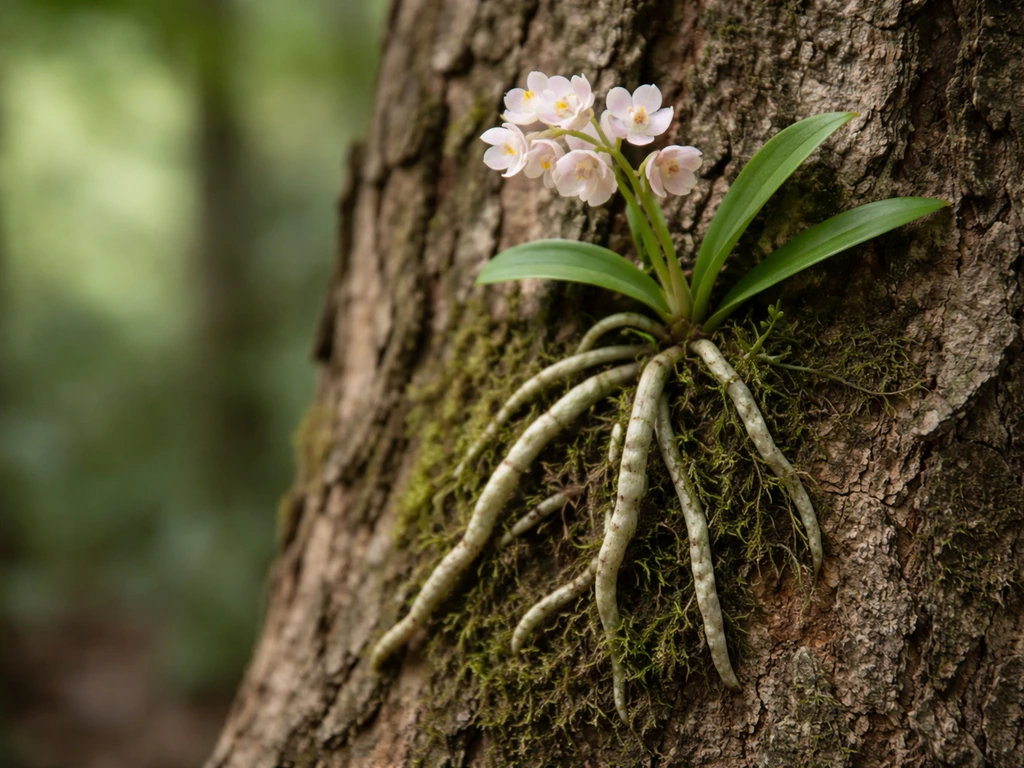
Epiphytic orchids have some of the most specialized aerial roots in the plant kingdom. The roots are covered in a spongy tissue called velamen radicum, a multilayered sheath of cells (mostly dead at maturity) that can absorb water from rain or atmospheric moisture within seconds. Evaporation from that same velamen takes several hours, which effectively means the root acts as a temporary water reservoir between wet spells. When the roots are dry, velamen appears silvery-white or grey. When wet or recently hydrated, it turns green because the chlorophyll-containing layer beneath becomes visible. That color shift is one of the most useful field clues for identifying live, healthy epiphytic orchid roots on a branch.
Epiphytic orchids grow on a host tree purely for physical support. They get nothing from the tree's tissue, which is what separates them from parasites like mistletoe. The host just provides a place to perch in the canopy where light, humidity, and airflow are favorable.
Parasites vs. non-parasites: where mistletoe fits in
Mistletoe is not an epiphyte. It's a hemiparasite, meaning it does photosynthesize some of its own food but depends on the host tree for water and minerals. It connects to the host's vascular tissue using a specialized organ called a haustorium, which forms 'sinkers' that embed into the host's xylem and pilfering water and dissolved nutrients directly. The seeds are coated in sticky pulp that helps them adhere to bark when they're deposited by birds. Once the seedling establishes its haustorium, it has a permanent plumbing connection to the host tree. Unlike moss or lichen, you cannot separate mistletoe from its host without damaging the branch.
In the field, mistletoe looks like a conspicuous rounded clump or ball of green to yellowish shoots growing out of a branch. In winter, when the host deciduous tree has dropped its leaves, mistletoe clumps become very obvious because they stay green. The white, sticky berries (produced by female plants) are another reliable identification feature. If you see a dense, ball-shaped cluster of green shoots attached directly to a branch of an oak, apple, poplar, or similar host, and especially if you can see white berries, you're almost certainly looking at mistletoe.
Root-like structures that aren't real roots
The terminology around root-like structures trips people up, so here's a quick reference for the main ones you'll encounter on branch-growing plants.
| Structure | Found in | Primary function | Absorbs nutrients like a root? |
|---|---|---|---|
| Rhizoid | Mosses, liverworts (bryophytes) | Anchorage to substrate; some water uptake | No (not vascular) |
| Rhizine | Lichens | Anchors lichen to bark or rock | No |
| Haustorium | Mistletoe (parasite) | Connects to host xylem, extracts water and minerals | Yes, but from the host, not soil |
| Aerial root (velamen-covered) | Epiphytic orchids | Anchors to bark, absorbs rain and atmospheric moisture | Yes, from air and rainwater |
| Root rhizome | Epiphytic ferns (e.g., staghorn) | Anchors to bark, absorbs water from organic debris | Yes, from accumulated debris |
The key takeaway is that 'root-like' doesn't mean 'functioning like a root.' Rhizoids and rhizines anchor their plant to the substrate but don't do the vascular nutrient transport that true roots perform. Aerial roots on orchids do absorb water and some nutrients, making them functionally closer to true roots even though they never touch soil. This is related to the broader topic of plants that grow without soil, where the distinction between anchorage and nutrition becomes especially important.
Where these plants actually grow: climate, humidity, and bark
Where you find each group depends heavily on humidity, temperature, light, and even the texture of the bark on the host tree. Here's how those conditions break down across the main plant groups.
Mosses and liverworts
Mosses thrive in moist, shaded conditions and are found on tree branches across temperate forests, boreal zones, cloud forests, and high-rainfall coastal environments. You'll find them most abundantly in the Pacific Northwest of North America, the British Isles, New Zealand, and montane tropical forests where fog and persistent moisture keep bark surfaces wet for extended periods. They favor rough, fissured bark (oaks, alders, and maples) over smooth bark because the texture gives rhizoids something to grip. North-facing and lower branch surfaces tend to hold moisture longest, so that's where moss biomass is densest.
Lichens
Lichens are the most climate-tolerant of the bunch. You can find them on tree branches in arctic tundra, temperate deciduous forests, Mediterranean scrublands, and tropical dry forests, because their poikilohydric nature lets them survive extended dry periods. The one condition that reliably excludes them is high air pollution: they're largely absent from heavily industrialized urban centers. Fog belt environments, where liquid water from fog supplements rainfall, support exceptionally rich lichen communities. Open-canopy trees with high light exposure on the upper surfaces of branches often host fruticose and foliose lichens, while crustose species tolerate deeper shade and tighter bark.
Epiphytic orchids and ferns
These are primarily tropical and subtropical plants. Epiphytic orchids are most diverse in the montane cloud forests of Central and South America, Southeast Asia, and Madagascar, where persistent humidity, warm temperatures, and alternating wet-dry cycles suit the velamen root system perfectly. Staghorn ferns are native to tropical Africa, Asia, Australia, and the Americas. Both groups need warm temperatures (generally above 10°C / 50°F year-round) and high relative humidity. They colonize mid-canopy branches where they get filtered bright light but aren't scorched by direct sun. Smoother bark species like eucalyptus are less hospitable; rougher bark with existing moss or organic debris accumulation provides a better foothold.
Mistletoe
Mistletoe has a remarkably wide distribution, from temperate deciduous forests in Europe and North America to subtropical and tropical zones, depending on the species. Common European mistletoe (Viscum album) favors apple, poplar, lime, and hawthorn trees in temperate climates. North American dwarf mistletoes (Arceuthobium) are particularly damaging to conifers in western forests. The key habitat requirement for mistletoe isn't bark texture or humidity so much as the presence of the right host species and bird populations to disperse seeds.
How to identify what you're seeing on a branch today
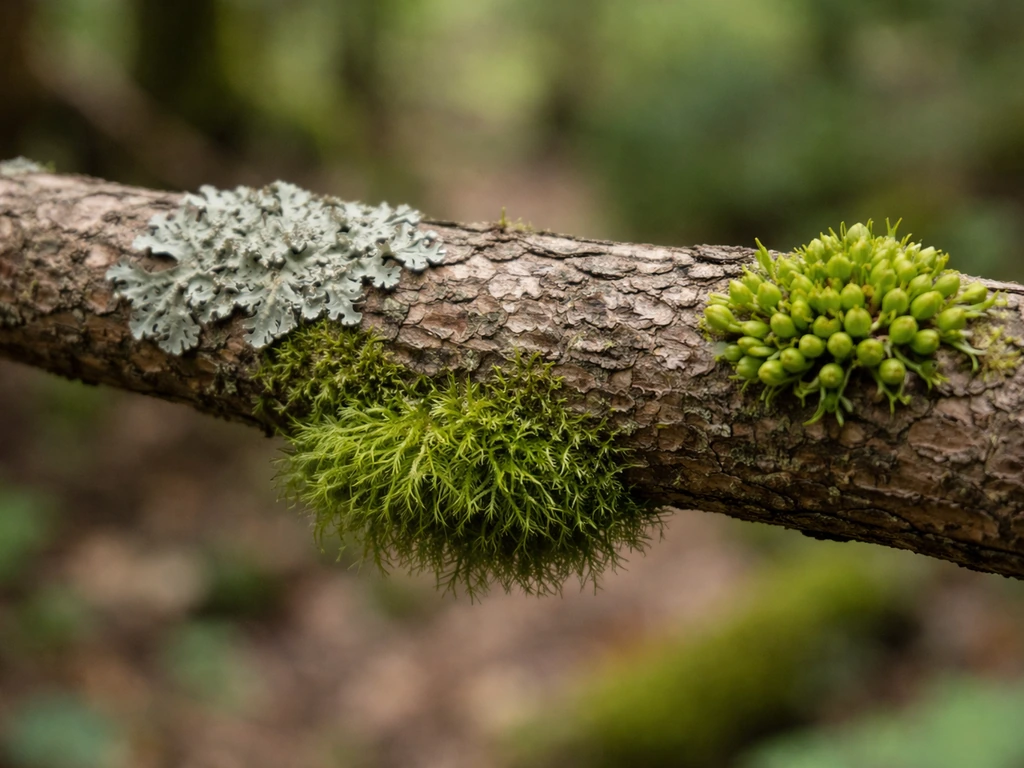
If you're standing in front of something growing on a tree branch and you're not sure what it is, work through these visual clues in order.
- Is it a rounded ball or dense cluster of green shoots attached directly to the branch, staying green in winter when surrounding trees are bare? That's almost certainly mistletoe. Look for white sticky berries to confirm on female plants.
- Is it flat, crust-like, and almost impossible to scrape off without taking bark with it? Or leafy and loosely attached, lifting slightly at the edges? Or shrubby and hair-like, projecting outward? Those are crustose, foliose, and fruticose lichens respectively. Lichens often show multiple colors (grey, green, orange, yellow) and have a dry, papery or leathery texture.
- Is it a soft, dense mat or cushion that's bright green when moist and brownish when dry, lying flat against the bark? Likely moss. Run your finger across it: moss has a distinct soft, velvety texture. Liverworts are flatter and more ribbon-like or have a distinct geometric patterning on their surface.
- Do you see strap-like or antler-shaped fronds projecting out from the branch, with a papery or spongy flat portion pressed against the bark? That's a staghorn or elkhorn fern. Look for the flat shield fronds at the base where it contacts the tree.
- Do you see dangling or clinging silvery-white or green cord-like roots attached to the bark, sometimes with small plants or pseudobulbs above them? Those are epiphytic orchid aerial roots. When you mist or wet them, they should turn green within seconds.
A useful quick test for distinguishing moss from lichen: wet it and look at the texture. Moss will feel soft and the individual stems become more distinct. Lichen will absorb water but retains its leathery or papery texture and doesn't soften the same way. You can also try to gently lift an edge: moss tends to peel away relatively easily because its rhizoids sit on the bark surface, while crustose lichens are essentially bonded to the bark and will not lift cleanly.
Also check the bark and the broader microhabitat. Heavy moss and liverwort growth suggests persistent moisture and shade. A rich mix of fruticose and foliose lichens alongside clean air and good light exposure. Epiphytic orchids and ferns indicate you're in a warm, humid climate, likely tropical or subtropical. Mistletoe is independent of humidity and often visible on the silhouettes of bare deciduous trees in winter.
Growing them yourself: care, propagation, and doing it responsibly
Epiphytic orchids
The best way to grow epiphytic orchids is mounted, not potted. Cork bark is the standard mount material because it's durable, pH-neutral, and doesn't break down quickly. Attach the orchid's roots directly to the mount with minimal or no planting medium if your environment is humid enough. In drier indoor environments, a small amount of loosely packed sphagnum moss around the roots helps retain moisture between waterings.
Mounted orchids in lower-humidity settings often need daily misting or periodic soaking to keep the velamen from drying out completely. If you're trying to grow plants with low watering needs, focusing on species adapted to dry spells or using mounting methods that reduce water loss can make a big difference plants which need less water to grow. Never buy wild-collected orchids; propagate from divisions of cultivated plants or purchase nursery-grown stock.
Epiphytic ferns
Staghorn ferns are almost always blank" rel="noopener noreferrer">grown mounted on a board or bark slab in cultivation, which mimics their natural epiphytic position and ensures the drainage they need. If you want to grow epiphytic ferns without soil, focus on mounting and steady moisture management rather than relying on drainage from a pot drainage they need. Propagation is done by separating offsets (pups) that develop from the main plant's rhizome and remounting them on a new board with a pad of sphagnum at the attachment point. Warmth and high humidity are non-negotiable for tropical species: they don't tolerate frost and struggle below about 50 percent relative humidity without supplemental misting.
Mosses
Mosses can be propagated from small fragments or clumps pressed onto a moist, shaded surface and kept consistently damp with daily misting until established. The critical rule for responsible moss propagation is to take only small amounts from any one location, leaving the bulk of the existing colony intact. Large-scale harvesting of wild moss is ecologically damaging and in many areas is restricted or prohibited. For cultivation, fragment-based propagation or slurry methods (blending moss fragments with water or buttermilk and spreading the mix) work well on rough, shaded surfaces including bark mounts and wooden boards.
Lichens
Lichens are extremely slow-growing and nearly impossible to cultivate deliberately from scratch in a reasonable timeframe. The most practical approach if you want lichens in a garden is to create the right conditions (clean air, rough stone or bark surfaces, adequate humidity and light for the species you want to attract) and let colonization happen naturally. Do not harvest lichens from wild sites: they take decades to develop and are sensitive to disturbance. Because they're excellent air quality indicators, their presence or absence on local trees tells you something real about the pollution load in your area.
If you're interested in the broader world of plants that operate outside normal soil-based growing conditions, branch-growing epiphytes connect naturally to questions about plants that grow without soil entirely and plants that need less water to grow, since many epiphytes are adapted to intermittent rainfall and air-based moisture rather than consistent ground-level water access.
FAQ
Is there any true plant that has zero roots, even no root-like structures, and still grows on tree branches?
In the strict sense used in botany, no. Even “rootless” branch dwellers have some form of anchoring structure. Mosses and liverworts use rhizoids, lichens use fungal rhizines, and epiphytic orchids and ferns use real roots that grip bark or organic debris. The closest to “no roots at all” are lichens, but they still have root-like attachment structures (rhizines).
How can I tell if something on a branch is an epiphyte or mistletoe without pulling it off?
Look for a direct connection to the host. Mistletoe grows as a clump of shoots from the branch itself and often persists as green even when deciduous trees lose leaves. If you see sticky white berries on the clump, that strongly supports mistletoe. In contrast, epiphytes like moss, lichens, orchids, and ferns sit on the bark surface or in bark debris without sending tissue into the tree’s plumbing.
Can orchids and staghorn ferns be watered less if they are mounted instead of potted?
Mounted plants usually need more careful timing, not necessarily less water. Because they rely on exposed velamen (orchids) or exposed root masses under shield fronds (staghorns), they dry faster between wettings than many potting setups. The practical fix is adjusting frequency to your humidity and airflow, for example more frequent misting or soaking indoors in dry seasons rather than a one-size schedule.
Do mosses and lichens harm trees they grow on?
Usually they do not harm trees. Mosses and lichens are generally non-parasitic surface colonizers, they mainly use bark as an attachment surface and collect moisture from air and rainfall. The tree may look worse because the surface is covered, but the organisms themselves are not typically extracting water and minerals from the tree like a parasite would.
Why do “rootless” plants often grow more on one side of a branch?
Moisture persistence and light exposure drive most of the uneven growth. Mosses often concentrate on shaded, cooler sides where bark stays wet longer, for example north-facing sides in many regions. Lichens can vary by growth form, some preferring brighter exposed branch tops, others tolerating deeper shade.
What is a quick field way to distinguish moss from lichen besides just color?
A reliable option is the gentle wet-and-feel test. Moss tends to feel soft and its structure becomes more obvious when moist, while lichens often remain leathery or papery and do not “soften” in the same way. You can also try lifting an edge carefully, crustose lichens are usually much more firmly bonded to the bark than moss cushions.
Are aerial roots on orchids considered “real roots,” and do they work like soil roots?
They are real roots, but their function is tuned to the air. Orchid aerial roots have velamen that absorbs moisture from rain and humid air quickly and stores water temporarily. They do not pull from soil minerals, so they work in a different way than underground roots, but they still perform uptake and transport through vascular tissue inside the root.
Can I grow lichens on purpose the way I propagate moss fragments?
It is extremely difficult to intentionally cultivate lichens from scratch in a short timeframe. Lichens establish slowly and are sensitive to disturbance and especially air quality. If you want them, the most realistic approach is to create suitable conditions and let local species colonize naturally on clean, rough surfaces, rather than trying to “start” a lichen colony the way you might with moss.
Is it safe to remove moss or lichens from a branch to identify the organism?
Be cautious. For identification, you can often confirm by texture and how it lifts, but repeatedly scraping or peeling can damage the surface habitat. Lichens in particular can take decades to recover, and removing large areas can also reduce an indicator of local air quality.
Why do epiphytic plants sometimes look fine outdoors but fail indoors?
The biggest causes are lower humidity and different drying cycles, often combined with airflow and light differences. Orchids relying on velamen can dry out rapidly indoors with dry heating or air conditioning. Staghorn ferns also need consistently high humidity, and without it they can desiccate. If humidity is low, you typically need more frequent misting or soaking and a placement with suitable light.