
Some plants genuinely do not get along, and it is not just gardening folklore. The real reasons come down to chemistry, competition, and habitat mismatch. When you put two plants side by side that evolved in completely different environments, or that actively poison each other's root zones, or that fight over the same narrow band of light and moisture, one of them usually loses. The good news is that once you know which mechanism is causing the problem, fixing it becomes straightforward.
What Plants Do Not Grow Well Together: Fixing Clashes

Dr. Marcus Weatherby
24 Mar 2026
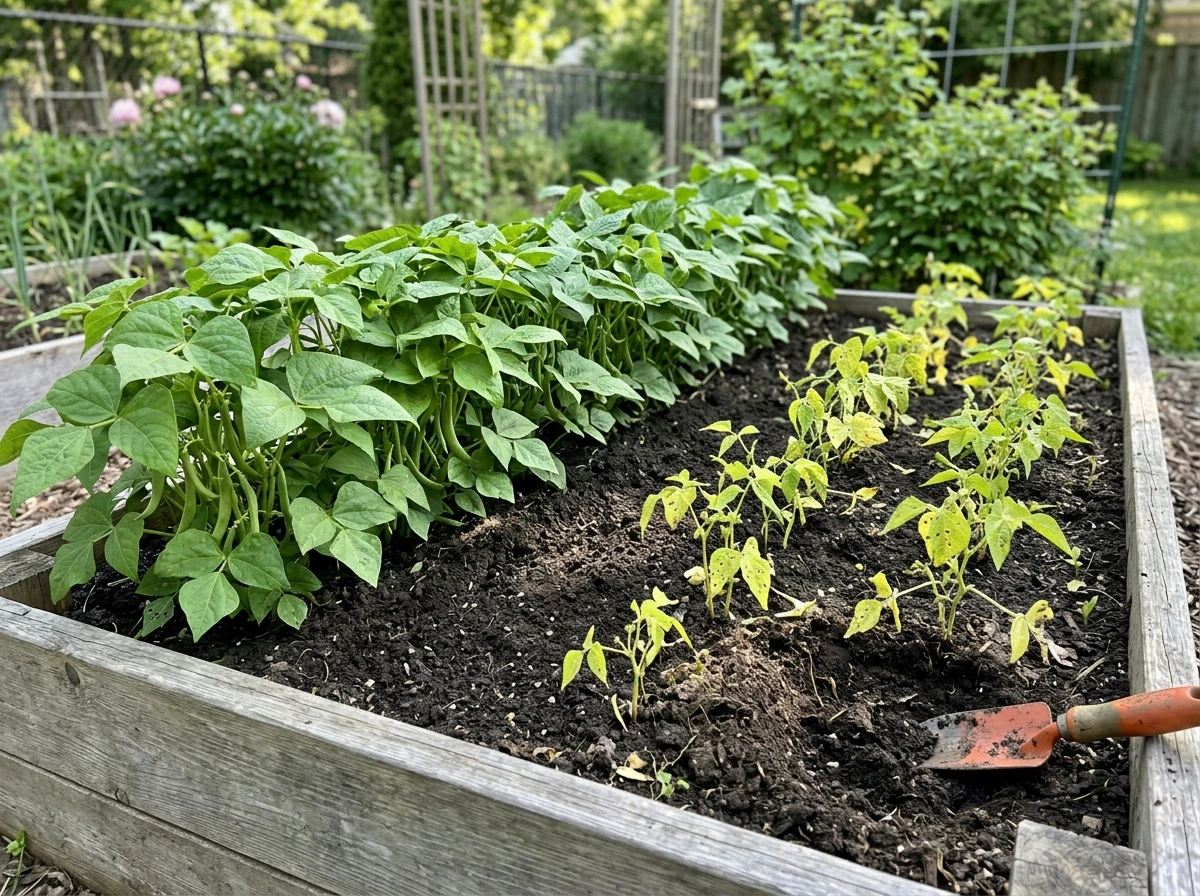
Why some plants clash: chemistry, competition, and habitat mismatch
There are three distinct reasons plants fail as neighbors, and they require different solutions. Lumping them together as 'bad companions' is why so much companion-planting advice feels vague or contradictory.
Allelopathy: chemical warfare through the soil
Allelopathy is when a plant releases chemical compounds that suppress, stunt, or kill neighboring plants. These allelochemicals move through root exudation, leaching from leaves and bark, volatilization into the air, and decomposition of plant residue. That last pathway matters a lot: a plant can keep suppressing your garden beds even after you have removed it, because the chemicals persist in decaying root and leaf material. Black walnut (Juglans nigra) is the most well-known example. It produces juglone, a compound that is toxic to tomatoes, peppers, blueberries, apples, and many other species within roughly 50 to 80 feet of the trunk, because the root zone extends well beyond the canopy drip line. The Wisconsin Plant Disease Diagnostics Clinic reports that mature black walnut toxicity can extend about 50, 80 feet from the trunk, with the greatest toxicity within the tree’s dripline, and it can affect sensitive crops like tomatoes about 50–80 feet from the trunk. Sunflowers produce allelopathic compounds too, which is why some gardeners notice weak germination in the soil directly beneath them. Rye cover crops produce allelopathic residues as well, though this is actually useful: the residue can suppress weed germination without harming transplanted vegetable seedlings if managed carefully.
Competition: fighting for the same resources
Competition is simpler and more common than allelopathy. Two plants grown in the same space will compete for light, water, and soil nutrients. Tall, fast-growing plants can shade out low-growing neighbors almost entirely. Shallow-rooted crops like lettuce and spinach get outcompeted by vigorous surface-feeding roots from plants like sweet corn or pumpkins, which spread aggressively and pull up moisture before the smaller plant can reach it. Deep-rooted perennials such as fennel or horseradish draw from deeper reserves but still dominate the topsoil layer early in the season. Nitrogen-hungry heavy feeders like corn and brassicas placed together will strip available nitrogen faster than either plant would alone, leaving both deficient.
Habitat mismatch: wrong environment, wrong neighbors
This is the one most beginners overlook. A plant that thrives in well-drained, slightly alkaline, low-humidity conditions will struggle when planted next to something that needs consistently moist, acidic, humus-rich soil. Even if neither plant is chemically antagonistic to the other, the environmental compromise you create to satisfy both will leave one of them stressed and disease-prone. which plant does not grow in hydrophytic environment Pairing a Mediterranean herb like rosemary (which wants dry, rocky, alkaline ground and full sun) with a bog-native like cardinal flower (which wants wet, slightly acidic, organically rich soil) is a classic mismatch. You can not reliably water for both without rotting one or drought-stressing the other.
The 'avoid planting next to' list: common incompatible pairings
These are some of the most reliably documented clashes you are likely to encounter. Most of them are backed by both observational evidence from gardeners and some degree of chemical or ecological research.
| Plant | Bad Neighbor | Why It Clashes |
|---|---|---|
| Tomatoes | Black walnut, fennel, brassicas | Juglone toxicity from walnut; fennel releases compounds that stunt tomato growth; brassicas compete for nutrients and can harbor shared diseases |
| Fennel | Almost everything (especially basil, tomatoes, peppers, kohlrabi) | Strong allelopathic compounds from roots and foliage suppress germination and growth of most vegetables |
| Onions/Garlic | Beans, peas | Allium compounds inhibit nitrogen-fixing bacteria that legumes depend on, reducing yields in both |
| Brassicas (cabbage, broccoli, kale) | Strawberries, tomatoes, mustard | Shared pest and disease vectors; mustard can outcompete and suppress brassicas in close quarters |
| Cucumbers | Sage, aromatic herbs | Cucumbers are sensitive to volatile oils from strongly aromatic herbs; can show stunted growth |
| Potatoes | Tomatoes, peppers, eggplant | Same family (Solanaceae), share late blight (Phytophthora infestans) and other diseases easily |
| Mint | Most garden vegetables | Extremely aggressive surface-root competition; spreads to dominate bed space and reduces available water for neighbors |
| Sunflowers | Beans, potatoes (planted directly beneath) | Allelopathic root exudates suppress germination and early growth of sensitive crops in the immediate root zone |
| Rosemary/Lavender | Moisture-loving plants (basil in wet climates, mint, cardinal flower) | Opposite water and soil pH needs; irrigation compromise stresses at least one plant |
| Black walnut (tree) | Tomatoes, blueberries, apples, rhododendrons | Juglone toxicity extends 50-80 ft from trunk through root zone, including via decomposing leaf litter |
One thing worth noting: fennel is unusually antisocial. It is one of the few plants that most experienced gardeners recommend growing in a container or completely isolated bed, rather than mixing into a vegetable garden at all. Its allelopathic effect is broad-spectrum enough that the risk is rarely worth it.
How to troubleshoot your specific bed
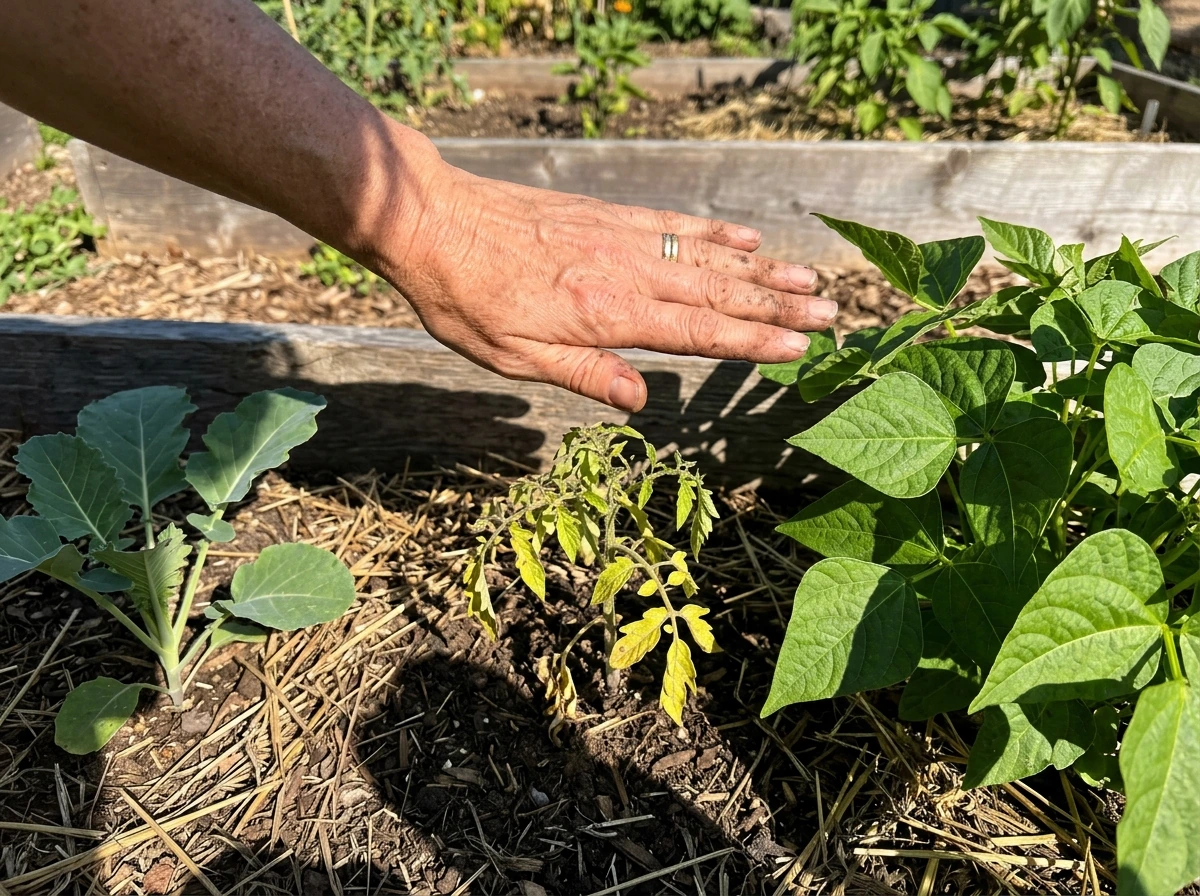
If something is struggling in your garden and you suspect a neighbor is the cause, work through these diagnostic questions in order. Each one points to a different mechanism and a different fix.
Check light first
Hold your hand over the struggling plant at mid-morning and mid-afternoon. Is it in full shade, partial shade, or direct sun? If a neighbor has grown taller and is casting shadow across a sun-loving plant, that alone explains most stunting and poor fruiting. Tall brassicas, corn, and indeterminate tomatoes are frequent light-blockers in mixed beds. The fix is usually repositioning in the next season, moving taller plants to the north side of the bed (in the Northern Hemisphere) so shorter plants still get direct light.
Look at water and drainage
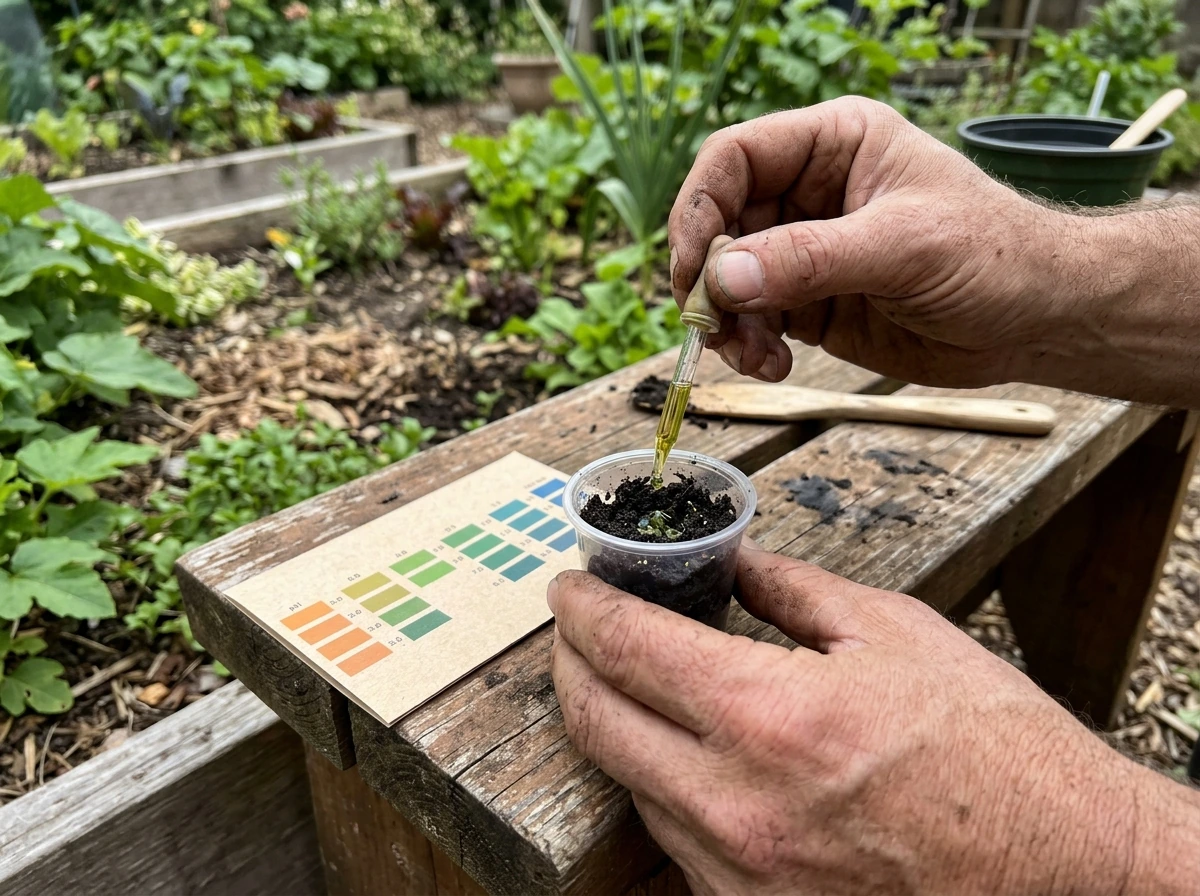
After watering, observe which areas dry out fastest and which stay wet. Plants with very different moisture needs will create a conflict no matter how good your timing is. Yellowing leaves with dry soil on one plant next to healthy soil on another often means an aggressive neighbor is pulling moisture from the shared root zone. Conversely, root rot and wilting in a normally drought-tolerant plant (like rosemary or sage) often means it is sharing irrigation with moisture-hungry neighbors that are driving you to overwater.
Test soil pH
A basic soil pH test (inexpensive kits are available at any garden center) will tell you whether the bed is acidic, neutral, or alkaline. Blueberries want pH 4. Oregon State University Extension also recommends keeping soil pH in the range of 4.5 to 5.5 for highbush blueberries (and 4.2 to 5.0 for rabbiteye blueberries) Blueberries want pH 4.. 5 to 5.5. Most vegetables prefer 6.0 to 7.0. Lavender and rosemary do best at 6.5 to 7.5. If you have planted blueberries next to lavender in the same bed and amended for one, you have undermined the other. You can not reliably satisfy both in one unamended plot.
Consider root depth and spread
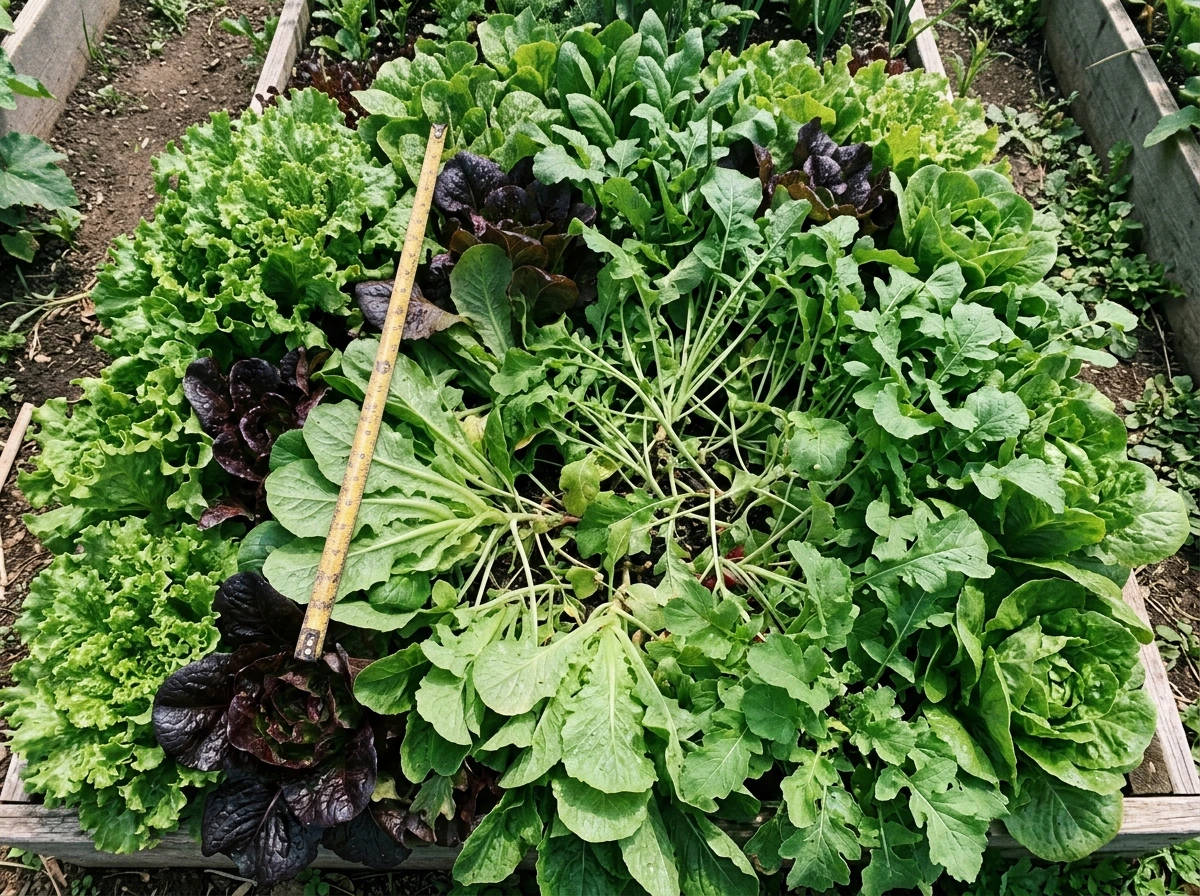
Shallow-rooted plants (lettuce, radishes, most herbs) lose to surface-spreading competitors like pumpkins, zucchini, and corn, which can run surface roots 3 to 5 feet in every direction. Deep-rooted plants (tomatoes, peppers, carrots, parsnips) are more insulated from surface competition but can be victims of allelopathy because their roots run directly through the zone where chemical exudates concentrate. If your tomatoes are showing stunted growth near a large tree, trace the root zone of that tree before blaming disease or nutrient deficiency.
Watch for spacing collapse
Overcrowding is the most common problem in home vegetable beds. A plant listed as needing 18 inches of space will tolerate 12 inches early in the season but will run into serious airflow and resource competition by midsummer. Poor airflow from crowded planting accelerates fungal diseases, especially in humid climates. If plants that were fine in May are collapsing by July, spacing is often the real culprit rather than any chemical incompatibility.
Grouping plants by zone, season, and habitat
The most reliable way to avoid incompatibility is to group plants that genuinely share the same native habitat conditions rather than trying to force different plants into a compromise environment. This is the ecological approach to companion planting, and it is more reliable than memorizing a list of specific pairings.
Mediterranean dry-summer plants
Rosemary, lavender, thyme, oregano, and sage all evolved in rocky, well-drained, low-fertility, alkaline soil under intense summer sun and very little summer rain. They grow well together because they share those needs exactly. In USDA hardiness zones 7 through 10, these can be planted in a shared bed with minimal conflict. They are poor companions for anything that needs frequent irrigation or high organic matter.
Cool-season crops in temperate zones
Lettuce, spinach, arugula, radishes, peas, and cilantro all perform best in the 45 to 65 degrees Fahrenheit range, in consistently moist (but not waterlogged) soil with moderate fertility. They share a season window (early spring and fall in most temperate zones, zones 4 through 8) and tolerate partial shade, which makes them compatible with each other in ways they would never be with warm-season crops. Planting these next to heat-lovers like basil, peppers, or sweet corn almost always ends in stress for the cool-season plants as temperatures climb.
Warm-season fruiting crops
Tomatoes, peppers, eggplant, cucumbers, squash, and corn all want similar temperature ranges (soil temperature above 60 degrees Fahrenheit, air temperatures above 70 degrees Fahrenheit during the day) and reasonably consistent moisture. The compatibility breakdown here is mostly about size, disease sharing, and nutrient load. Tomatoes, peppers, and eggplant share Solanaceae family diseases, so keeping them together concentrates disease risk even though they tolerate similar conditions. Corn and squash grow well together from an environmental standpoint, and with beans added (the traditional Three Sisters combination), you get nitrogen, shade, and ground cover working together.
Woodland understory plants
Ferns, hostas, astilbe, wild ginger, and trillium all evolved in the same general habitat: dappled or deep shade, consistently moist acidic soil rich in organic matter, with low wind and relatively stable temperatures. In zones 4 through 8, these group together naturally and support each other by building a humid microclimate and shared leaf litter that enriches soil. Placing any sun-loving Mediterranean herb into this kind of bed would be a textbook habitat mismatch.
When you can't separate them: mitigation strategies
Sometimes you are working with a fixed landscape, a tree you can not move, a perennial bed that is already established, or a small garden where you have limited flexibility. These approaches can reduce incompatibility damage without requiring a full redesign. DeepRoot’s tree and root barrier sizing guidance can help you choose appropriate barrier depths and select the right barrier application for root-barrier mitigation barrier depths and barrier applications.
- Increase spacing beyond the standard recommendation: if two plants are known competitors, give each 1.5 times the normally recommended spacing. This reduces root overlap and improves airflow.
- Use physical root barriers: for aggressive spreaders like mint or horseradish, a 12-inch deep buried barrier (heavy plastic edging or a large container sunk into the bed) prevents lateral root invasion into neighboring plants' zones.
- Create raised beds or berms with distinct soil mixes: a raised bed filled with acidic blueberry mix sits physically above and separate from an adjacent alkaline herb bed. Drainage and soil chemistry stay independent.
- Zone your irrigation separately: a drip line or soaker hose can be zoned so moisture-loving plants get daily watering while drought-tolerant neighbors get water only weekly, even if they are in the same general area.
- Use heavy mulch as a buffer: a 3 to 4 inch layer of wood chip mulch between a sensitive planting and an allelopathic tree's root zone will not eliminate the chemical exposure, but it slows leaching, moderates soil temperature, and gives sensitive roots slightly more buffer.
- Time plantings to stagger canopy development: if one plant matures and is removed by midsummer, a sun-sensitive neighbor can be planted afterward and enjoy full light for the second half of the season without ever competing directly.
- Apply targeted soil amendments per plant: using a localized acidifying amendment (like sulfur or acidic compost) around individual acid-loving plants within a larger neutral-pH bed lets you support specific plants without converting the whole bed.
Better alternatives: compatible pairings and crop rotation
Rather than memorizing every incompatible pair, it is more practical to learn a set of reliable companions that grow in similar conditions and support each other. If you’re trying to plan where to place plants, it helps to answer what plants can grow next to each other before you commit to a layout. If you are interested in building out a full compatible-planting layout, the principles around [what plants grow together](094D6B0A-7A1D-45B3-ABED-B9F7C2A1D409) and what plants can grow next to each other are worth exploring as a next step, since they give you positive pairings to build from rather than just a list of what to avoid.
Reliable compatible groupings by habitat
| Habitat/Condition | Compatible Group | Why It Works |
|---|---|---|
| Full sun, dry, well-drained, alkaline | Rosemary, thyme, lavender, oregano, sage | Identical moisture and pH needs; similar native Mediterranean origin |
| Full sun, moist, fertile, warm-season | Corn, beans, squash (Three Sisters) | Corn provides structure, beans fix nitrogen, squash shades soil to retain moisture |
| Full sun, fertile, warm-season | Tomatoes, basil, carrots | Basil may deter some pests; carrots loosen soil without competing for the same nutrient bands |
| Partial shade, moist, acidic, cool | Ferns, hostas, wild ginger, astilbe | Shared woodland understory habitat; build a mutually supportive humid microclimate |
| Full sun, cool-season, moderate moisture | Lettuce, spinach, radishes, peas, cilantro | Same temperature window; radishes loosen soil for others; peas add nitrogen |
| Full sun, warm-season, moderate fertility | Cucumbers, dill, nasturtiums | Dill attracts beneficial predatory insects; nasturtiums deter aphids; none compete heavily with cucumbers |
Crop rotation as a long-term incompatibility fix
Crop rotation is one of the most effective tools for managing soil-based incompatibility across seasons. The basic principle is to avoid growing the same plant family in the same bed in consecutive years. Solanaceae (tomatoes, peppers, eggplant, potatoes) should move to a different bed each year to avoid building up the specific soil pathogens and nutrient deficits that accumulate when the same family stays put. A simple four-bed rotation works for most home gardens: legumes (beans, peas) in bed one to fix nitrogen; brassicas (cabbage, broccoli, kale) in bed two using that nitrogen; fruiting crops (tomatoes, peppers, squash) in bed three; and root crops (carrots, beets, parsnips) in bed four. Each year, every family shifts one position forward.
Rotation also addresses allelopathic residue buildup. Because allelochemicals can persist in decomposing root and leaf material, moving sensitive crops away from a bed where a known allelopathic species grew the previous season gives the chemistry time to break down before the next planting. A full seasonal gap, combined with incorporating organic matter to speed microbial decomposition, is usually enough to reduce the residual chemical load significantly.
The bottom line is that plants do not grow poorly together by accident. There is always a mechanism: a toxin, a resource conflict, or a mismatch in the environmental conditions each plant evolved to need. Identify which of those three is operating in your bed, address it directly, and your garden layout problems become a lot more solvable than they looked when you started.
FAQ
Can plants “not grow well together” be fixed without moving them to a different bed?
Often, yes. If the conflict is light, you can reposition the taller neighbor and use pruning or trellises to raise the canopy. If it is moisture or soil pH, you may be able to solve it with targeted irrigation zones (drip lines per group) and separate amendments in raised sections of the same bed, but if both plants require opposite pH ranges, a single unamended plot usually can’t satisfy both reliably.
How can I tell if the problem is allelopathy versus simple crowding or disease?
Allelopathy tends to show up as stunting or failure to establish specifically near the problematic plant, and it can persist into the next crop after removal because residues decompose. Crowding usually improves when plants are thinned and space is restored, and disease often responds to airflow changes and sanitation. A quick test is to compare the same crop planted in a nearby area that has never held the suspected allelopathic species.
Does allelopathy affect germination only, or can it also harm established transplants?
It can harm both. Some allelochemicals inhibit seed germination or root growth immediately, while others suppress plants more slowly as the chemical concentration builds in the root zone and decomposing residue. That is why removing the plant is not always enough, especially with known offenders like black walnut, where the impact can extend beyond the canopy area.
Is it safe to plant vegetables right after removing a plant that had a reputation for being antisocial (like fennel or black walnut)?
Not automatically. For broad allelopathic plants, give the bed time and consider rotating a less sensitive crop first. The article’s key point is residue persistence, so you should expect a lag even after you pull the plant, and you may need to avoid the most sensitive species in that spot for at least a season or two.
Can I “cheat” by watering more or fertilizing more to make incompatible plants coexist?
Usually not. If the issue is allelopathy, extra fertilizer does not neutralize the chemicals. If the issue is moisture mismatch, watering for one plant can trigger rot in the other. If the issue is competition, higher fertility can still leave one neighbor shaded or moisture-stressed, so the best lever is changing position, spacing, or habitat grouping.
What’s the fastest diagnostic step if I don’t know which mechanism is causing the trouble?
Check light first (mid-morning and mid-afternoon). Light blockage from taller neighbors is one of the most common and easiest to confirm, and it often explains stunting or poor fruiting even when soil and watering seem “fine.” If light checks out, then move to moisture patterning and soil pH.
How much spacing is “enough” if a plant’s label says 18 inches but my bed is tight?
Treat the spacing number as a mid-season minimum, not just an early-season target. Overcrowding often looks okay in May and then collapses by midsummer due to airflow loss and intensified competition for water and nutrients. If you must squeeze, choose plants with similar mature size and root habits, and thin earlier than you think.
Can I combine sun-loving herbs with shade-loving ornamentals by using mulch or shade cloth?
Sometimes you can reduce temperature and light stress, but you can’t reliably replace the plants’ evolved soil habitat needs. Mediterranean herbs typically need dry, well-drained, alkaline-leaning conditions, while shade woodland plants usually require consistently moist, acidic, organic-rich soil. Shade cloth may help light, but it will not fix the moisture and pH conflict.
Does root competition only happen above ground, or can deep-rooted plants still interfere?
Deep-rooted plants can still interfere, mainly through resource overlap near the surface early in the season and through allelopathic chemistry when applicable. The practical takeaway is to consider both root depth and the timing of growth, and if a deep-rooted plant is adjacent to a known allelopathic species or a large tree, trace the shared root zone rather than guessing nutrient deficiency or pests.
How do I handle a fixed constraint, like a big tree that I can’t remove?
Assume the tree is changing both moisture and root chemistry. In practice, look at which area dries out fastest after watering, then reduce sensitivity by placing tolerant crops farther from the trunk and choosing plants adapted to that drier, competing condition. The article’s diagnostic advice to trace the tree’s root zone is the right starting point before you blame fertilizer or disease.
Will crop rotation help with allelopathic problems, or only with diseases?
Rotation can help with residue-driven incompatibility too. Because allelochemicals persist in decomposing root and leaf material, moving sensitive crops away from the bed where an allelopathic species grew gives time for residue breakdown. Pair rotation with soil incorporation (organic matter) to speed microbial decomposition.