Plants that grow on or in rocks are called lithophytes. That's the core ecological term, and once you know it, a whole world of plant science opens up. Lithophytes are plants adapted to survive on bare rock surfaces, in crevices, or in the thin mineral soils that accumulate in rocky habitats. They're not a single family or genus but a functional grouping that includes everything from tiny mosses and ferns to flowering perennials and succulents, all united by one trait: they can establish and persist where most plants would simply die from lack of soil and nutrition.
Plants That Can Grow on Rocks: Names and How to Grow Them

Dr. Marcus Weatherby
19 Apr 2026
What lithophytes and rock-dwelling plants are actually called
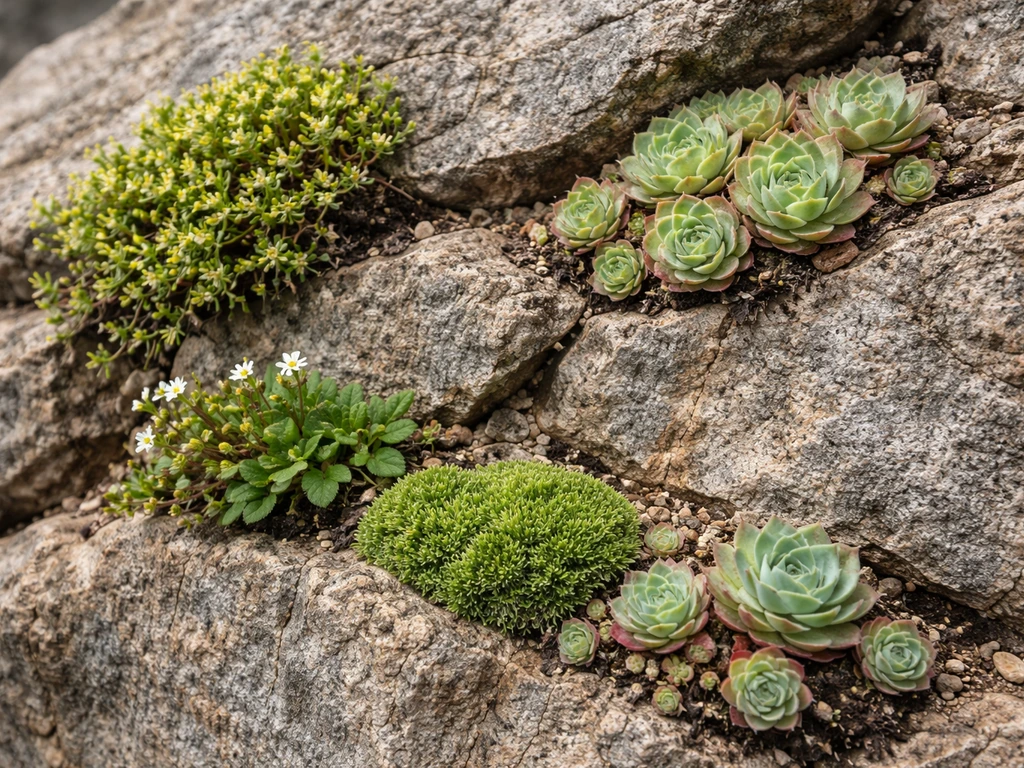
The word lithophyte comes from the Greek for rock (lithos) and plant (phyton). In ecology it covers two main categories. Epilithic or epipetric lithophytes grow on the surfaces of rocks, anchoring themselves to bare stone with specialized root systems or root-like structures. Endolithic lithophytes go a step further and grow inside rock pores or in cracks, which is where the term chasmophyte comes in. Chasmophytes are plants specifically adapted to colonize cracks, fissures, and crevices in rock faces, and the communities they form are called chasmophytic vegetation.
Within those categories, lithophytes can be obligate (meaning they grow exclusively on rocky substrates) or facultative (meaning they can also grow in normal soil but do well on rock too). Most of the plants gardeners work with are facultative lithophytes. You'll also hear the term chasmophytic used in habitat descriptions for cliff faces, road cuts, and boulder fields, especially in European conservation frameworks. If you're doing any research into local plant communities, these terms will help you find relevant data quickly.
One more term worth knowing is caespitose (sometimes spelled cespitose), which means growing in dense tufts or cushion-like clusters. A huge number of rock-adapted plants grow this way because the cushion form conserves moisture, reduces wind exposure, and keeps the plant's center insulated against temperature swings on exposed rock. When you're out in the field looking at what's growing on a rocky outcrop, compact cushion-forming plants are usually a strong signal that you're looking at a true rock specialist.
Growing on rock doesn't mean what you might think
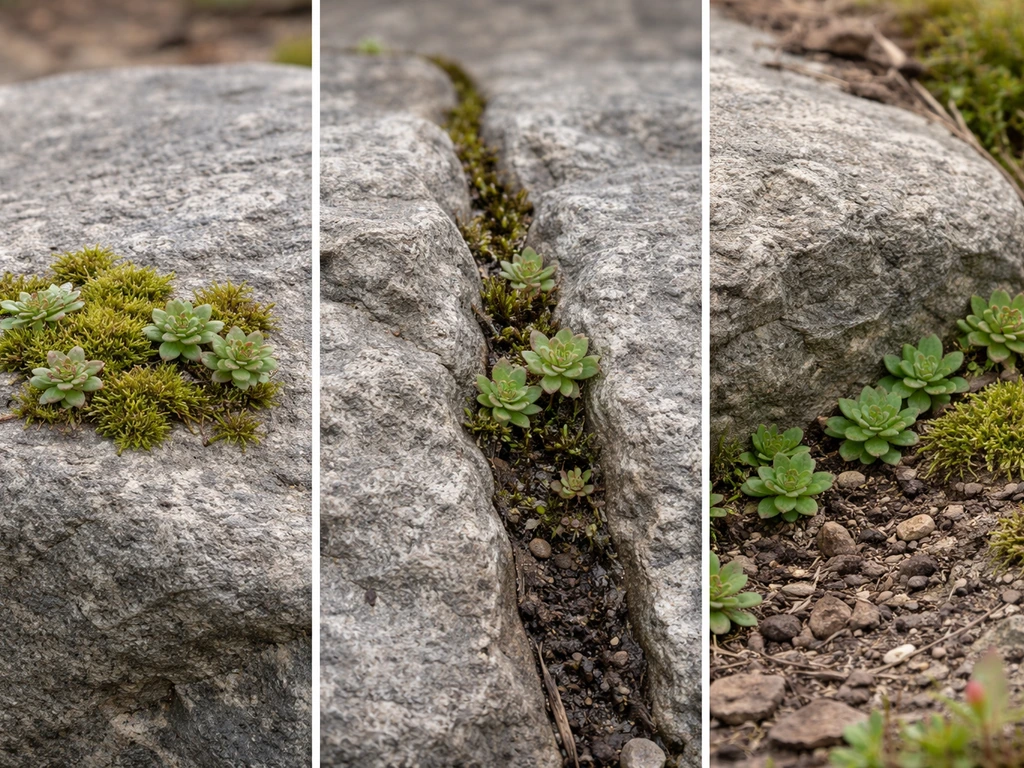
There's an important distinction between a plant growing on a rock, in a rock, and near a rock. In casual conversation these all sound the same, but ecologically they describe very different situations with different moisture and nutrient dynamics.
- Bare rock surface: epilithic plants anchor directly to the stone. Nutrient input comes almost entirely from rainfall, dust, and the decomposition of earlier colonizers like lichens. Moisture availability is extremely limited and evaporates quickly after rain.
- Rock crevices and fissures: chasmophytes root into cracks where organic debris accumulates. These pockets can hold more moisture than exposed surfaces and often contain a small but meaningful reservoir of decomposed material, making them significantly more hospitable than bare rock.
- Shallow pockets and ledges: thin layers of mineral soil collect in hollows and on ledges. Plants here have a bit more nutrition and water access than true epilithic species, but drainage is still rapid and root depth is limited.
- Rock scree and talus: loose rock fragments create a matrix where plants root between stones. There's more soil contact but the substrate shifts, which means plants need flexible or deep root systems.
Rock type also matters more than most beginners realize. Limestone and chalk rocks are alkaline and tend to produce calcium-rich habitats. Sandstone and granite are typically acidic. Volcanic rock like basalt or pumice is highly porous, which creates rapid drainage but also holds some moisture within the rock itself. Tufa, a porous limestone, is almost uniquely suited for lithophyte gardening because it absorbs moisture but also allows surface evaporation, mimicking the microclimate of a natural cliff face. Matching your plants to the rock chemistry of your substrate is one of the most important things you can do early on.
What conditions rock-growing plants actually need
The short version is this: excellent drainage, lean nutrition, good light (usually), and tolerance for temperature extremes. Let's go through each one in practical terms.
Drainage is non-negotiable
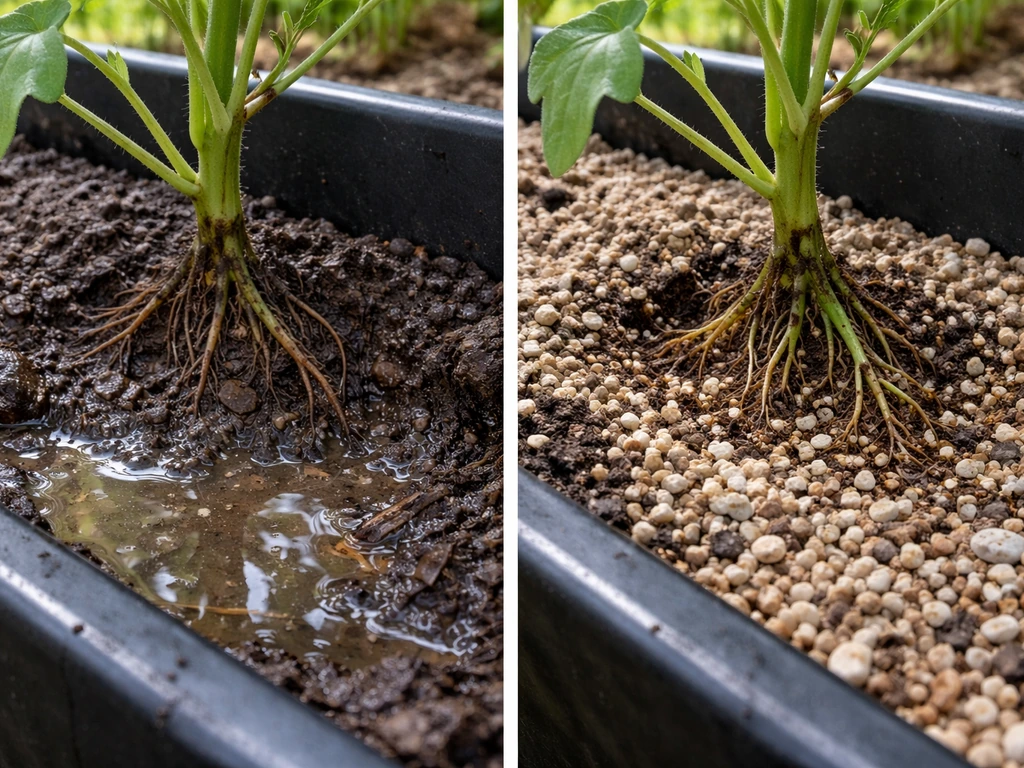
Almost every true lithophyte will rot in waterlogged conditions. Their root systems evolved in substrates that shed water fast. In a garden context, this means you need to build drainage into your setup from the start, whether that's a raised bed, a scree layer, or a crevice garden where water runs through rather than pools. These same drainage principles are also key for a terrarium, where water can otherwise pool around the roots raised bed. Sedums, saxifrages, and most alpine lithophytes will tolerate drought far better than they'll tolerate wet feet.
Lean soil, not rich soil
Rock-adapted plants evolved in nutrient-poor conditions. If you plant a stonecrop or a cushion phlox in rich garden compost, it often grows too lush, becomes weak and floppy, and loses its characteristic compact form. The ideal growing mix for most lithophytes is a combination of topsoil, coarse grit or perlite, and a small amount of compost or sand. For rock-garden soil mixes, gardening guidance recommends using a layered approach for drainage and keeping organic material to a minimum so the growing medium stays well-draining for rock-garden plants layered approach for drainage and using organic material sparingly. You want a mix that holds just enough moisture during dry spells while still shedding excess water quickly after rain.
Light and wind exposure
Most epilithic and chasmophytic plants are sun-adapted. Open rock faces receive intense solar radiation, and the plants that live there have developed thick leaves, waxy coatings, or tight rosette forms to cope. That said, north-facing rock crevices and shaded cliff walls support their own distinct plant communities, including many ferns and shade-tolerant mosses. If you're wondering what plants grow on a north facing wall, those cooler, shaded crevices are exactly the kind of microhabitat many shade-tolerant ferns and mosses prefer north-facing rock crevices. If your rocky feature faces north or sits under tree canopy, your plant options shift significantly. Wind is another factor often overlooked: in naturally windy rocky sites, that air movement actually helps low-water plants by reducing fungal pressure, even as it increases desiccation stress. For topics related to north-facing exposures specifically, that's a distinct habitat with its own plant set worth exploring separately.
Temperature swings
Rock absorbs heat during the day and releases it at night, creating more extreme temperature fluctuations than soil-based habitats. Lithophytes adapted to alpine or desert rocky environments can handle these swings, but tropical lithophytes (like many orchids and bromeliads that grow on rainforest boulders) are frost-sensitive and need very different conditions. Knowing your climate's low temperatures is critical before choosing species, and hardiness zone ratings should be treated as a starting point, not a guarantee, since local microclimates around rocky features can be significantly warmer or colder than surrounding areas.
Mosses and lichens vs true lithophyte plants
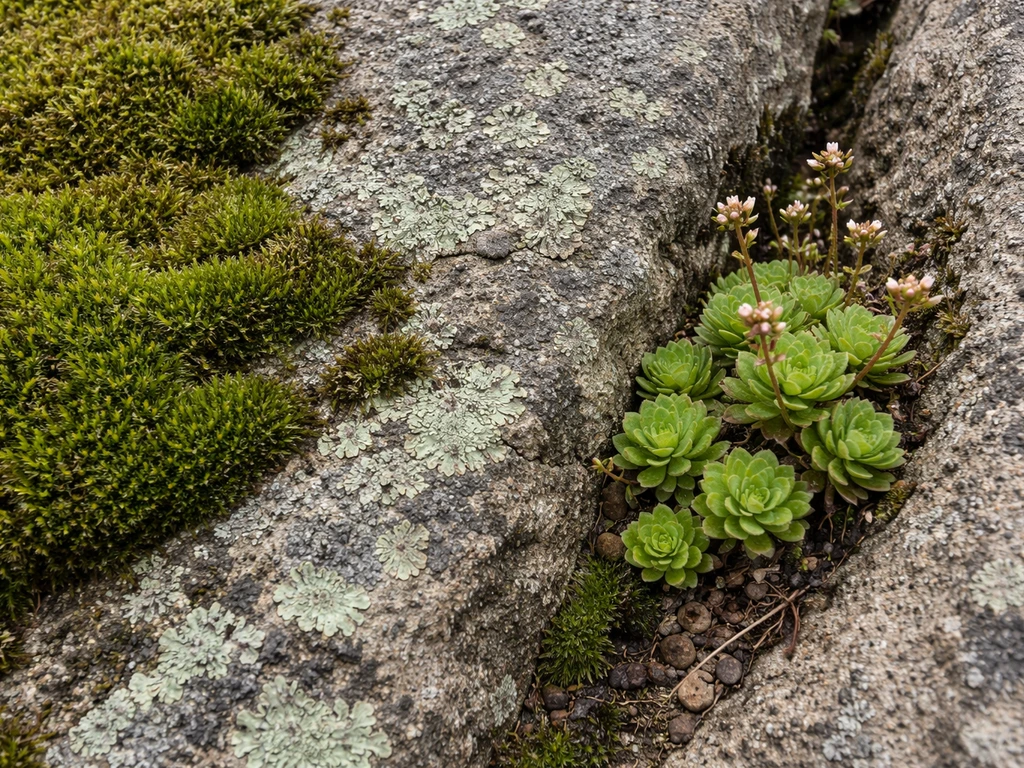
This distinction trips a lot of people up, so it's worth being clear. Mosses and lichens are often the most visible rock colonizers you'll see, but they belong to completely different biological groups than vascular plants.
| Type | Biological group | Root system | Nutrient source | Water needs | Common rock habitats |
|---|---|---|---|---|---|
| Lichens | Fungus + algae/cyanobacteria (symbiosis) | None (attach with holdfasts) | Atmospheric and mineral weathering | Very low, highly drought-tolerant | Bare rock surfaces, cliff faces |
| Mosses | Non-vascular plants (Bryophytes) | Rhizoids (no true roots) | Atmospheric moisture and surface runoff | Moderate to high, need periodic moisture | Shaded crevices, moist rock ledges |
| Ferns (chasmophytes) | Vascular plants | True roots into crevice soil | Decomposed organic matter in cracks | Moderate, prefer sheltered crevices | Deep crevices, cliff faces, cave entrances |
| Sedums / Stonecrops | Vascular plants (succulents) | Shallow fibrous roots | Thin mineral soils, low fertility | Very low, highly drought-tolerant | Rock outcrops, scree, shallow pockets |
| Saxifrages | Vascular plants | Fibrous to taproot depending on species | Thin mineral or organic soils | Low to moderate, sharp drainage essential | Crevices, rock ledges, tufa walls |
| Alpines (cushion-forming) | Vascular plants (various families) | Taproot or fibrous | Thin mineral soils | Low to moderate | Exposed rocky slopes, scree, crevices |
Lichens are not plants at all. They're a symbiosis between fungi and photosynthetic organisms, and they're actually the primary rock colonizers: they chemically weather rock surfaces and begin the very slow process of creating the thin organic layer that later allows true plants to establish. Mosses are plants in a broad sense but lack the vascular tissue that flowering plants and ferns have, so they can't transport water or nutrients over distance. True lithophyte plants, the ones most gardeners are working with, are vascular plants that have evolved specific adaptations to root into rocky substrates.
Examples of true lithophyte plants by climate
In temperate and alpine climates, the most reliable lithophytes include sedums (stonecrops), saxifrages, sempervivums (houseleeks), dianthus species, lewisia, and cushion-forming plants like Silene acaulis and Androsace. In Mediterranean and arid climates, euphorbias, certain cacti and agaves, and a wide range of drought-tolerant composites colonize rocky slopes. In tropical and subtropical climates, the lithophyte list expands to include many epiphytic orchids, bromeliads, and philodendrons that naturally root onto boulders and rock outcrops in humid forest environments. Ferns like polypody species are notable worldwide, showing up in rock crevices from temperate woodlands to tropical gorges.
Matching plants to your rock type and climate
Before you buy a single plant, answer these three questions: What is your rock's pH? What is your climate's minimum winter temperature? And how much direct sun does your site get? These three factors will eliminate most wrong choices immediately.
Limestone and concrete-based rockwork are alkaline. On these substrates, calcium-loving species like many saxifrages, dianthus, and certain sedums will thrive. Trying to grow acid-lovers like heathers or most ferns directly in or on limestone will frustrate you. Conversely, sandstone, granite, and slate create acidic to neutral conditions where a different suite of plants does best. If you're building a new feature and have flexibility, tufa is worth considering: it's lightweight, porous, and plants can actually be pushed directly into pre-drilled holes or natural pores, which is about as close as you'll get to recreating a natural cliff face in a garden.
For climate matching, don't rely solely on hardiness zone ratings. A plant that's listed as hardy to your zone might still fail if your rocky site is exposed to wind and frost-heave, or conversely, a sheltered south-facing rock face can create a microclimate a full zone warmer than your surrounding garden. Spend time observing your site across seasons before committing to plant selection. Local native plant societies, regional botanic gardens, and online resources like iNaturalist are genuinely useful for identifying which lithophytic species are native to your area and therefore already adapted to your exact conditions.
How to set up a rock garden or crevice garden from scratch
You have two main approaches: a traditional rock garden (rocks placed in soil to create pockets and ledges) and a crevice garden (rocks set vertically on edge to create tight, deep gaps between them). Crevice gardens are increasingly popular because they better mimic natural rock formations and provide the drainage and root run that true chasmophytes need. Both approaches work well, but crevice gardens tend to be more forgiving because the rock itself sheds water away from plant crowns.
- Choose your site: Most rock plants need at least five to six hours of direct sun. A gentle slope aids drainage. Avoid low spots where water pools.
- Prepare the base: Lay a scree base of crushed stone, coarse gravel, or grit. This layer should be at least 10 to 15 cm deep and acts as the drainage foundation beneath your planting medium.
- Mix your growing medium: Combine roughly one part topsoil, one to two parts coarse grit or perlite, and a small amount of compost or coarse sand. The goal is a mix that holds some moisture but drains sharply. Avoid standard potting mix, which stays too wet.
- Set your rocks: For a crevice garden, tilt rocks slightly backward so that rain runs into the crevice rather than off it. This directs water toward the root zone. Bury at least one-third of each rock for stability.
- Match soil chemistry to your plants: If using limestone rocks and growing lime-lovers, keep the mix neutral to slightly alkaline. For acid-lovers on granite or sandstone, amend with minimal or no lime.
- Plant into crevices: Use small plants or rooted cuttings rather than large specimens. Bare-root plants establish better in tight crevices than pot-grown plants with large root balls. Work roots gently into the gap and pack the mix firmly around them.
- Top-dress with inorganic mulch: A layer of fine gravel or stone fragments around plants reduces moisture loss, prevents crown rot, and looks naturalistic. In shaded or woodland-style rock gardens, a mix of screened leaf mold and grit can be used instead.
- Water in, then step back: New plants need regular watering to establish, but once roots reach the rock fissures and the underlying scree, most lithophytes become very self-sufficient. Overwatering during establishment is a common mistake.
A note on tufa: if you can source it, you can drill or chisel small planting holes directly into the tufa, fill with a minimal soil mix, and push small plant plugs directly in. The North American Rock Garden Society (NARGS) also offers practical, step-by-step tufa construction guidance, including drilling holes and creating planting pockets for vertical tufa structures drill or chisel small planting holes directly into the tufa. The porous nature of the rock holds moisture at depth while the surface dries quickly, which is exactly what most saxifrages and cushion alpines prefer. It's one of the best materials for replicating true cliff-face conditions.
Finding local species and knowing what to expect

The best way to find lithophytes suited to your climate is to go look at what's already growing on rocks in your region. Road cuts, natural outcrops, cliff faces, old stone walls, and even cemetery headstones are all places where you can observe which plants have naturally colonized rocky substrates in your area. Note what's growing in full sun versus shade, on what rock type, and whether plants are in open fissures or thin pockets of accumulated soil. This field observation is genuinely more useful than any plant list because it shows you what works under your exact conditions. (Plants that colonize walls are a related group worth exploring, as are plants adapted to cave entrances and deeply shaded rock faces, which represent the shaded end of the lithophyte spectrum. Many of the same lithophyte principles also apply to what plants grow in caves, where low light, limited soil, and moisture swings shape the species that can survive cave entrances. )
For identification help, iNaturalist is a strong tool: photograph plants in context (showing the rock, the crevice, the exposure), and the community can help with ID. It's also genuinely useful for building a picture of what species have been recorded on rocky substrates in your county or region.
One critical point on collection ethics: do not collect plants from national parks, protected wilderness areas, or other public lands without explicit permission. In the U.S., plants in national park boundaries are legally protected under federal regulation, and collection is prohibited. Land managed by the Bureau of Land Management and state agencies typically requires permits for plant collection. The right approach is to source plants from specialist nurseries (rock garden societies like NARGS have seed exchanges with a huge range of lithophyte species) or to propagate from plants already in cultivation. This is both legal and more likely to succeed, since nursery-grown plants are acclimated to garden conditions.
Realistic maintenance expectations
Rock gardens and crevice gardens are genuinely low-maintenance once established, but establishment itself takes time. Most lithophytes are slow growers by nature: their native habitat is resource-limited, and they've adapted by growing slowly and living long. Expect the first full season to be mainly about root establishment with minimal visible top growth. Don't panic and don't over-fertilize. Resist the urge to water excessively after the first month. The main ongoing tasks are removing weeds before they get established (weeds in rock gardens can be very difficult to remove once rooted deep into crevices), occasional top-dressing with fresh grit, and dividing or trimming any plants that outgrow their allotted space. Beyond that, a well-built rock garden with the right plants is one of the lowest-input features you can create.
FAQ
Can I grow plants that can grow on rocks in containers instead of a rock garden or crevice garden?
Yes. Use a shallow wide container with lots of drainage holes, line the bottom with coarse grit or broken stone, and keep the planting mix lean (topsoil plus grit, minimal compost). Container rock plants also dry faster, so plan for less frequent but more complete watering, and avoid potting mixes that stay damp.
How do I keep roots from rotting if my rocky feature collects water during heavy rain?
Assume standing water will happen at least sometimes. Build for it by grading so water drains away from crowns, using a scree or gravel base, and planting slightly above the lowest wet point. If water pools repeatedly in the same spot, relocate the plant or add a drainage channel before you plant.
Do lithophytes need fertilizer, or will they die without it?
Most tolerate low fertility, but some need occasional light feeding once established. Use a very diluted balanced fertilizer or a top-dress of grit with a trace of compost sparingly, typically at most once in the growing season. Overfeeding is a common cause of floppy growth and crown rot because it encourages soft, moisture-holding growth.
What’s the best way to match plants that can grow on rocks to limestone versus granite without testing everything?
If you cannot test pH, use a practical shortcut: limestone and concrete-based rock often looks chalky, weathers into powder, and the water around it can feel alkaline. If your rock garden frequently grows calcium-loving species well, you are likely on the alkaline side. For accurate decisions, do a soil or substrate pH test, then choose plants accordingly.
How much sun do plants that grow on rock actually need?
Many epilithic and crevice species prefer strong light, but “full sun” can mean different intensities. In very hot climates, afternoon shade or east-facing exposure helps prevent heat scorch. If your north-facing crevice stays cool and damp, prioritize shade-tolerant mosses and ferns rather than classic sun-loving sedums.
What should I do if a plant survives the first year but then declines in year two?
Year two failures often point to crown wetness, nutrient imbalance, or insufficient light as weeds and plants mature. Check after storms for water pooling around the crown, reduce any rich compost contact, and remove competing weeds early. Also verify that your plant still has open drainage paths between rocks.
Are lichens and mosses good indicators of conditions for vascular plants?
They can be, but not perfectly. Lichens indicate that rock surfaces are stable and that the area gets enough light, while mosses suggest persistent moisture. However, moss cover can also mean chronic dampness, which may rot vascular lithophytes. If you see lush moss, use plants that tolerate more moisture or improve drainage before planting vascular species.
Can I use any gritty mix for lithophytes, or do I need special ingredients?
Aim for structure and drainage, not just “sandiness.” Coarse grit, pumice, or perlite works well for aeration, and small amounts of topsoil help with initial anchoring. Avoid mixes heavy in peat or fine compost that retain water, especially near the crown. If you can squeeze a handful of mix and it stays clumped wet for long, it is too moisture-retentive.
How do I water plants that can grow on rocks during establishment?
Water to settle roots, then shift to a drier rhythm. After planting, water thoroughly, then let the mix dry down before watering again. In beds or crevice gardens, a common mistake is frequent shallow watering that keeps crowns damp, increasing rot risk.
Do plants that colonize cracks and crevices need deep soil pockets?
Not always. Many true rock specialists prefer minimal soil but good access to moisture and air. A thin pocket of gritty mix in a fissure is often enough for anchoring. Deep, rich soil in a crack can create water retention and reduce the plant’s ability to adapt to lean conditions.
Is it safe to collect lithophytes from rocky spots, like road cuts or old walls?
Only if the location allows it and you have permission where required. Avoid protected areas and follow local rules, because legal protection and permits vary by country and land manager. For better long-term success, source nursery-propagated plants or seeds and avoid taking slow-growing specimens from the wild.
How can I identify whether my failure is due to rock chemistry or climate?
If multiple plants fail on the same rock type, pH or substrate chemistry is a likely cause. If plants that match the rock type still fail intermittently, climate factors like frost pockets, wind exposure, or crown wetness may be responsible. Keep a simple log of where each plant is placed (rock type, exposure, and drainage) so you can correlate outcomes to one variable at a time.