Insectivorous plants generally grow in nutrient-poor, waterlogged, acidic habitats: think sphagnum bogs, wetland pine savannas, fens, seeps, and shallow coastal plain ponds. The one thing that ties every single location together is not the climate or the continent, it is the soil. These plants evolved carnivory as a workaround for growing in places where nitrogen and phosphorus are so scarce that trapping insects became more efficient than relying on roots alone.
Insectivorous Plants Generally Grow in Nutrient-Poor Wetlands

Dr. Marcus Weatherby
28 Apr 2026
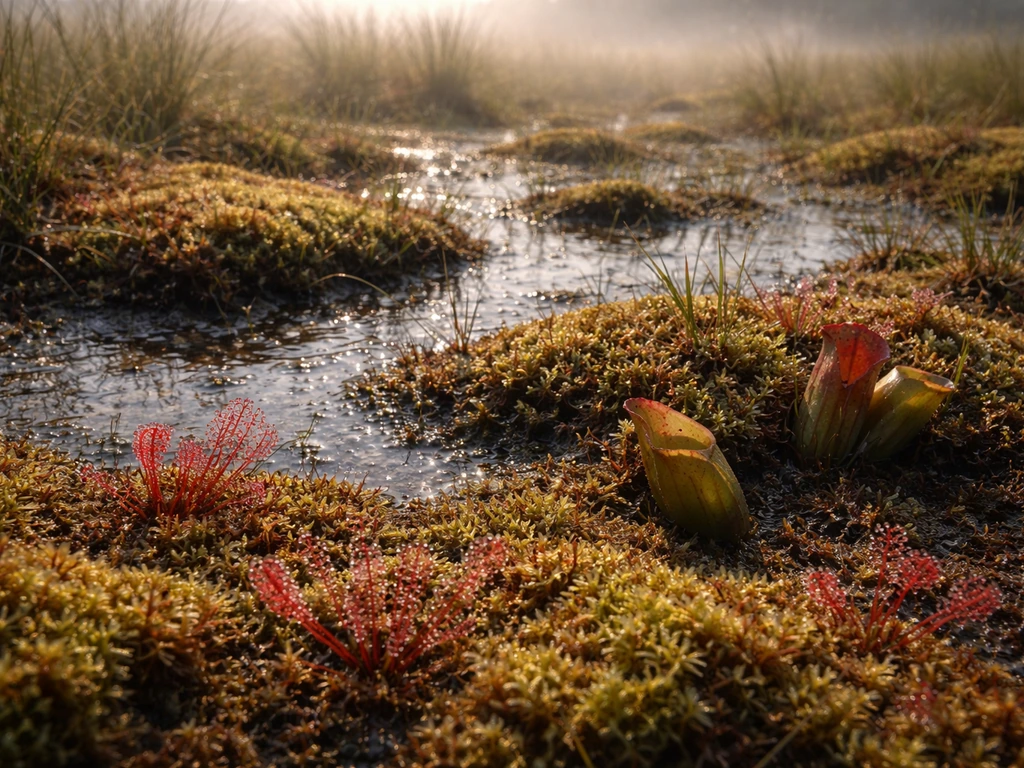
You will find them across a wide range of latitudes, from boreal Canada to tropical Borneo, but only where the ground stays saturated, the soil stays poor, and the sun stays unobstructed. Carnivorous plant habitat and distribution also includes fens, where some species thrive in constantly wet but nutrient-poor conditions [fens are home to some carnivorous plants](https://www. thecps. org.
uk/education/habitat-distribution/).
The typical habitats at a glance
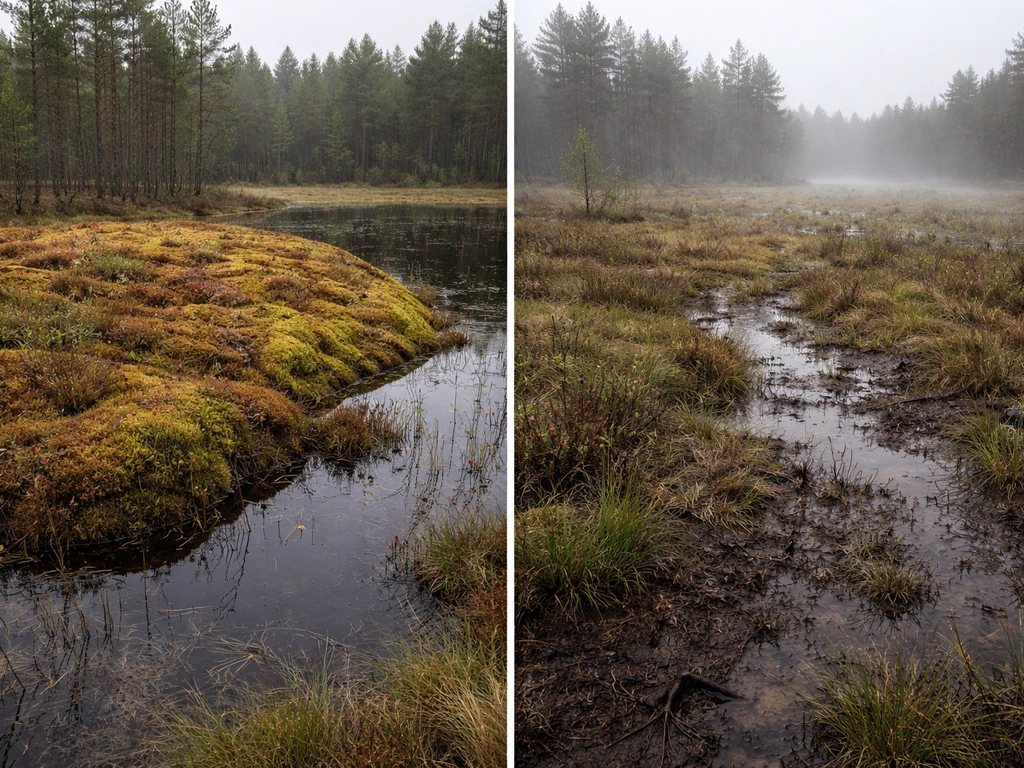
The clearest way to picture where these plants live is to think about what all their habitats share, not what makes them different. Whether you are looking at a raised bog in Scotland, a Carolina Bay rim in North Carolina, or a mossy seep on a tropical mountainside, the common thread is a combination of mineral-starved soils, persistent wetness, and open sky. Ecologically, carnivory is thought to have evolved precisely because nutrient-poor, well-lit habitats like bogs make the energy cost of maintaining a trap worth it, since the nitrogen payoff from a captured insect is simply unavailable from the soil. When you see a location that checks those boxes, the conditions are right.
- Sphagnum peat bogs: raised bogs with acidic, rain-fed, waterlogged peat
- Poor fens: acidic groundwater-fed wetlands with water at or near the surface through the growing season
- Wetland pine savannas: fire-maintained, open, wet flatwoods with sandy, nutrient-poor soils
- Seeps and wet meadows: slopes or flats where water moves slowly over mineral-poor substrate
- Shallow coastal plain ponds and bog lakes: peaty, acidic, sun-exposed open water margins
- Tropical and subtropical cloud forest margins and montane bogs: humid, low-nutrient, often mossy substrates
How climate shapes which species you find where
The habitat type stays consistent, but the climate envelope shifts the cast of characters considerably. Here is how it breaks down by broad climate zone.
Cool temperate regions
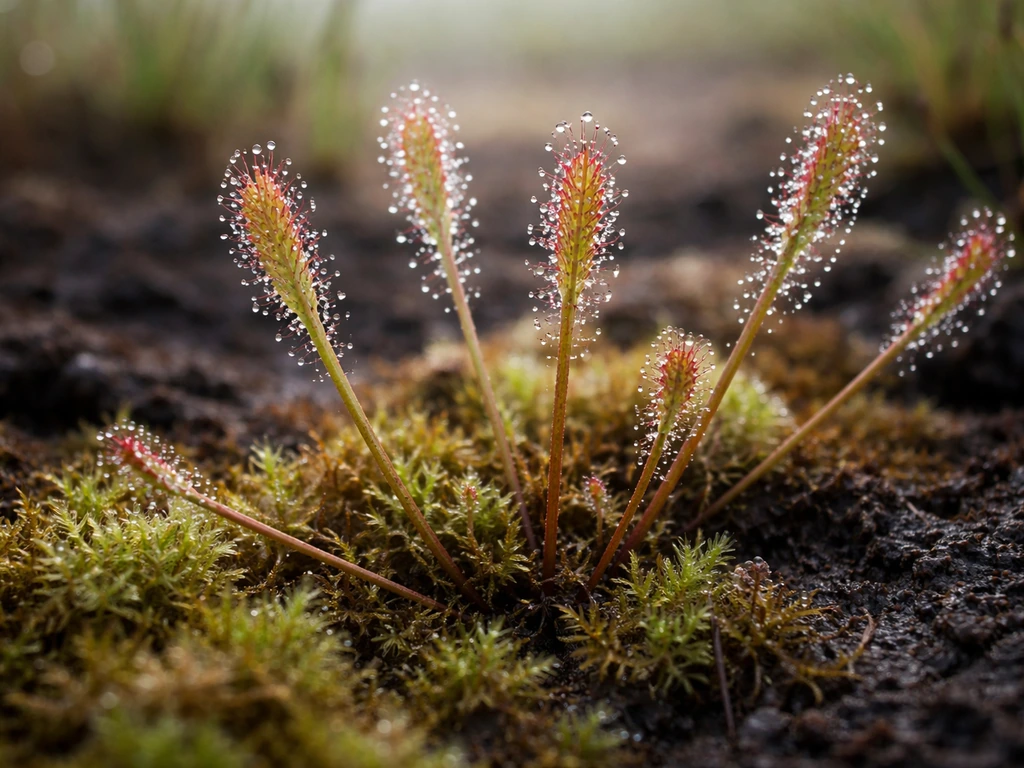
Cool, moist boreal and temperate zones are classic sundew and pitcher plant territory. Drosera anglica, the English sundew, is a strict obligate wetland species found in bogs and fens across northern North America, Europe, and Japan. Sarracenia purpurea, the purple pitcher plant, is a signature bog species across northeastern North America, thriving in sphagnum peat bogs from Newfoundland to the Great Lakes.
Temperate sundews like Drosera intermedia turn up in shallow water at bog and fen edges and in seeps across eastern North America and Europe. In the UK, raised lowland bogs and blanket bogs support sundews and bladderworts at latitudes where long cool summers keep evaporation low enough to maintain bog hydrology. Fens in boreal regions, as Britannica describes them, accumulate moisture in cool climates precisely because low temperatures slow evaporation and allow persistent inundation.
Subtropical regions
The subtropical southeastern United States is arguably the richest insectivorous plant zone on earth by number of genera in one place. The Venus flytrap (Dionaea muscipula) is native only to a narrow strip of nutrient-poor wetlands in North and South Carolina, specifically the ecotone between wet savannas and drier sandy areas like the rims of Carolina Bays.
The South Carolina Encyclopedia describes the Venus flytrap as native to a small region in South Carolina and North Carolina and associated with wetland habitat that is threatened by development, overcollection, and lack of fire a narrow strip of nutrient-poor wetlands in North and South Carolina. Multiple Sarracenia species, including the hooded pitcher plant (Sarracenia minor), occupy wetland pine savannas in Florida and the Gulf Coast states.
Butterworts (Pinguicula) appear in sunny, open, wet areas across the Southeast. Bladderworts (Utricularia) are widespread in shallow, acidic, quiet waters throughout the region. This subtropical concentration exists because the climate delivers heavy rainfall, warm temperatures maintain year-round wetness, and the flat coastal plain geology creates vast areas of low-lying, poorly drained, sandy, nutrient-stripped soil.
Tropical regions
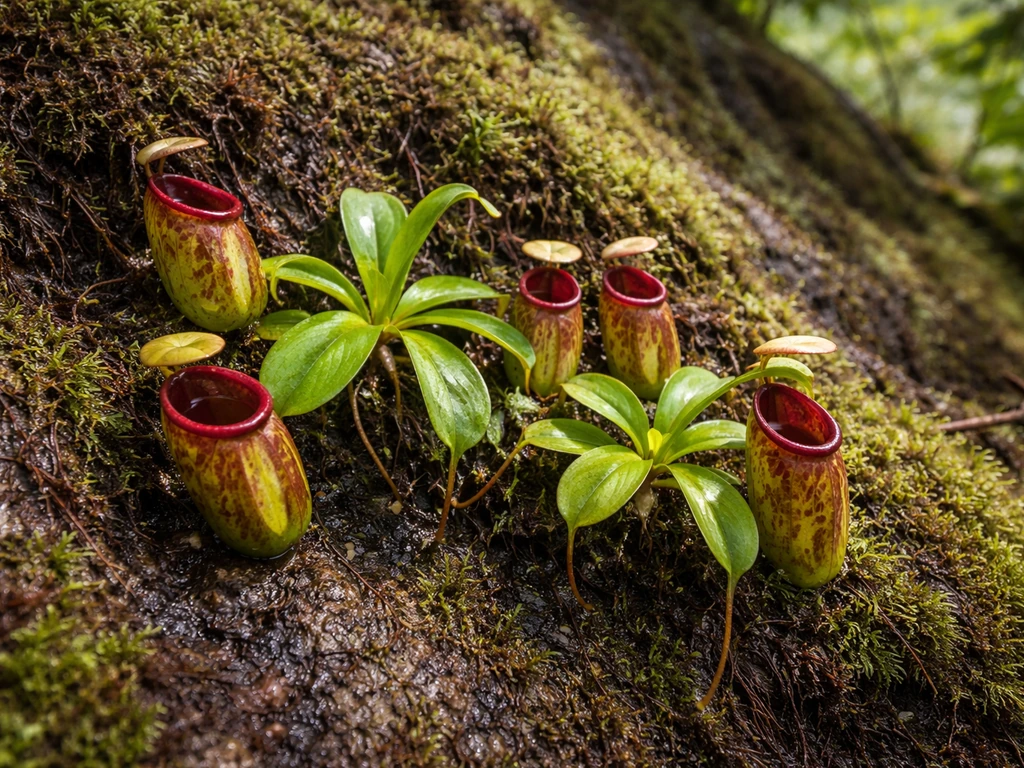
Tropical insectivorous plants, especially Nepenthes tropical pitcher plants, tend to occupy a different kind of nutrient-poor habitat: mossy ridges, ultramafic (low-nutrient) soils, and montane cloud forest margins in Southeast Asia and Australasia. Nepenthes rajah, for example, is native to Mount Kinabalu in Borneo, growing on steep, exposed ridges with very poor, often serpentine-derived soils and high humidity. Tropical sundews and bladderworts extend into wet savannas, flooded grasslands, and bog-like formations in Africa, South America, and Australia. The constant across tropical habitats remains the same: low soil fertility, high moisture, and relatively open canopy.
Soil conditions: poor, acid, and peaty by design
The soil chemistry is really the whole story. Insectivorous plants do not just tolerate nutrient-poor soils, they depend on them. In fertile soil, faster-growing non-carnivorous plants crowd them out immediately. The soils they prefer are typically sandy or peaty, often both, and acidic enough to suppress the decomposition and nitrification that would otherwise release nitrogen. Porewater nitrogen in classic sphagnum bog habitats runs in the range of roughly 5 to 50 micromoles of N per liter, which is extremely low. The pH in raised bogs typically sits between about 3.7 and 4.3. At that acidity, nitrification rates are negligible, and what little nitrogen is present comes mostly as ammonium rather than nitrate.
Sphagnum moss is a major driver of this chemistry. Sphagnums actively absorb mineral cations from water and release acids in exchange, pulling the surrounding water chemistry toward greater acidity and lower nutrient availability. Living Sphagnum creates a self-reinforcing trap for insectivorous plants: it acidifies, it retains water, and it slowly builds up as peat beneath the living surface layer. Sandy soils in wetland pine savannas accomplish similar ends through different means: rapid drainage strips nutrients, leaving behind almost no organic matter to buffer the system. Either way, the plant ends up in a substrate that cannot supply what it needs from roots alone.
Moisture and the water table: how wet is wet enough
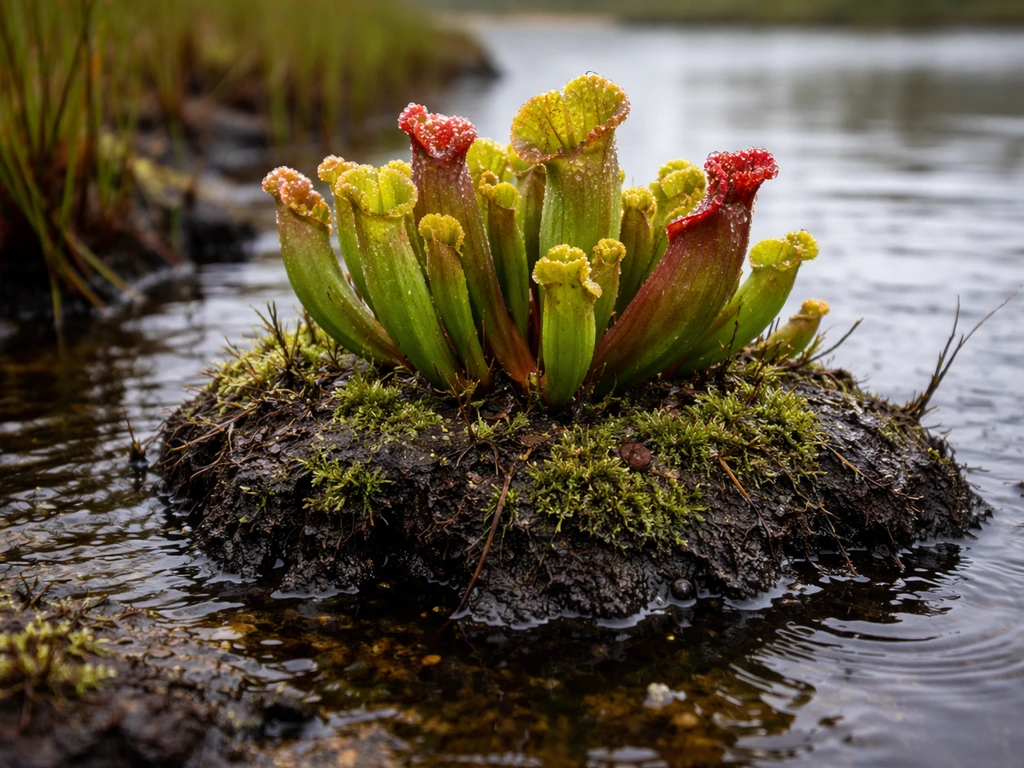
Saturated or near-saturated soils are non-negotiable for almost all insectivorous plants. Drosera anglica requires continuously moist to saturated soils. Sarracenia purpurea sits in standing water or at the saturated surface of a sphagnum mat. Utricularia species often grow submerged or floating in shallow, acidic standing water, sometimes forming dense mats. Restoration targets for lowland bog management specify getting the water table to within 15 centimeters of the surface, which gives you a concrete sense of what these habitats require: not just moist, but essentially waterlogged for most or all of the growing season.
The difference between bogs and fens matters here. Bogs are rain-fed, so the water table is maintained entirely by precipitation and the water-retaining capacity of Sphagnum. The result is stagnant, very acidic, extremely low-nutrient water. Fens receive groundwater or upslope drainage in addition to rain, making them less acidic (pH typically 6.
4 to 6. 9 in eutrophic fens, but lower in poor fens) and slightly richer in nitrogen, roughly double that of raised bogs. Poor fens can still support insectivorous plants, particularly sundews and some bladderworts, because they maintain water at or near the surface through much of the growing season even if the chemistry is slightly less extreme than a true raised bog.
Seeps and slow-moving water over mineral-poor rock or sandy substrate provide a flowing-water equivalent: the constant movement keeps nutrients from accumulating, and Pinguicula species in particular often colonize exactly these kinds of wet, rocky, or gravelly flows.
Light and disturbance: why these plants need open ground
Full sun is nearly as critical as wet, poor soil. Virtually every insectivorous plant habitat is an open, exposed environment where the canopy does not close over. Venus flytraps require flat land that receives full sun and burns frequently. Drosera anglica prefers full sun. Bladderworts in Massachusetts coastal plain ponds are specifically documented in saturated and sunny conditions. This is not coincidental. In a forest understory, faster-growing shade-tolerant plants dominate. The open, sunny environment of a bog or savanna is what keeps the competition at bay long enough for slow-growing, carnivorous specialists to hold their ground.
Fire is the disturbance mechanism that maintains this openness across many insectivorous plant habitats, particularly in the southeastern United States. The Venus flytrap's native range depends on periodic forest fires that burn through encroaching woody vegetation and prevent the canopy from shading out the wet savanna floor. Sarracenia minor in Florida has been managed with prescribed burns, including a 2019 burn at a Florida State Park following a six-year absence of fire, precisely to keep the habitat open and suitable.
Without fire on a roughly 3 to 5 year cycle in fire-adapted habitats, shrubs and trees move in, the light drops, the bog or savanna character degrades, and insectivorous plants disappear. In boreal and temperate bogs that do not burn, the equivalent mechanism is the hydrology itself: the waterlogged, acidic conditions prevent forest establishment, keeping the habitat perpetually open.
Finding insectivorous plant habitat in your own region
If you want to locate insectivorous plants in the wild, or identify where they could theoretically occur in your area, the process is simpler than it sounds. You are not looking for a specific plant first, you are looking for a specific type of place. Once you find the habitat, the plant is either there or it is a candidate for being there. In most cases, those habitats are found in wetlands, where conditions stay saturated and the soil remains nutrient-poor.
- Look for open, sunny wetlands with no tree canopy: bogs, fens, wet meadows, wetland edges of pine flatwoods, or seepy slopes with thin, mossy ground cover.
- Check for Sphagnum moss presence. If you see a living Sphagnum mat, you are almost certainly in acidic, nutrient-poor, waterlogged territory. That is your first strong indicator.
- Note the soil. Sandy, peaty, or sandy-peaty substrates without rich dark humus are what you want. Rich black soil means nutrients are present and insectivorous plants will not compete well there.
- Look for standing or near-surface water. The ground should be spongy or visibly wet, not just damp. Shallow pools, bog pools, or persistently soggy ground are the target.
- Check for signs of fire history or active land management in savanna habitats. Charred ground, young herbaceous regrowth, and open grassy or sedgy flats in otherwise forested landscapes often indicate fire-maintained savanna where carnivorous plants may persist.
- Use iNaturalist to search for carnivorous plant observations near your coordinates. Filter by genus (Drosera, Sarracenia, Utricularia, Pinguicula, Dionaea) and look at the habitat descriptions and photos attached to nearby records to confirm whether local habitat matches.
- Cross-reference USDA PLANTS or state natural heritage databases for your state or province. These will show which insectivorous species are documented locally and what habitats they are associated with, giving you specific wetland community types to search for.
If you are in the northeastern U.S. or Canada, target sphagnum bogs and poor fens, where Sarracenia purpurea and temperate Drosera species are the most likely finds. In the southeastern U.S., wet pine savannas and Carolina Bay wetlands are the highest-priority habitats. In the Pacific Northwest, look for mountain bogs and acidic lakeshores for Drosera rotundifolia. In Europe, lowland and upland bogs support sundews and bladderworts across a wide latitudinal range. In the tropics and subtropics of Southeast Asia and Australia, mossy montane ridges and nutrient-poor wet savannas are where Nepenthes and tropical Drosera turn up.
Quick habitat comparison by major genus
| Genus | Primary habitat type | Climate zone | Key soil/water conditions |
|---|---|---|---|
| Drosera (sundews) | Bogs, fens, seeps, wet sandy flats | Cool temperate to tropical | Saturated, acidic, peaty or sandy, full sun |
| Sarracenia (pitcher plants) | Wetland pine savannas, bogs, Carolina Bays | Temperate to subtropical (eastern N. America) | Sandy or peaty, seasonally to permanently saturated, full sun, fire-maintained |
| Dionaea (Venus flytrap) | Wet savanna/dry savanna ecotones, Carolina Bays | Subtropical (Carolinas only) | Sandy, acidic, moist to saturated, full sun, fire-dependent |
| Utricularia (bladderworts) | Shallow acidic ponds, bog pools, marshes, seeps | Temperate to tropical (cosmopolitan) | Standing or slow water, acidic, low nutrients, sunny |
| Pinguicula (butterworts) | Seeps, wet rocky slopes, sunny wet meadows | Cool temperate to subtropical | Flowing or seeping water, low nutrients, very humid, sun-exposed |
| Nepenthes (tropical pitchers) | Montane mossy ridges, ultramafic soils, cloud forest margins | Tropical to subtropical (SE Asia, Australasia) | Very low nutrient soils, high humidity, partly open canopy |
The broader picture here connects to patterns you will notice when exploring other specialized plant groups. Non-vascular plants like mosses often share the same bog and fen habitats with insectivorous plants, while ferns tend to prefer the shadier, moister forest edges nearby. Understanding what insectivorous plants need makes it easier to interpret why plant communities in these wet, open, low-nutrient environments look so different from everything surrounding them. The conditions that seem inhospitable are actually a precise ecological niche, and the plants that evolved to fill it did so by solving the nutrient problem in one of the most creative ways in the plant kingdom.
FAQ
If a place has nutrient-poor soil, can insectivorous plants still grow there without constant wetness?
Yes. Most insectivorous plants require more than poor soil, they need a persistently high water table (often within about 15 cm of the surface through much of the growing season). If the ground is nutrient-poor but dries out for long stretches, many species cannot survive even if the soil looks right.
What visible signs should I use to recognize the right habitat in the wild?
Look for habitat indicators of acidity and low nutrient availability, not just “wet.” Sphagnum presence, peaty or sandy substrates, standing or slow-moving acidic water, and frequent open, unshaded ground are practical field cues that match the conditions the plants depend on.
Do all wetlands qualify as the same kind of habitat for insectivorous plants?
No, and a common mistake is focusing on any “bog-like” area. True raised bog conditions are usually more extreme (very acidic, very low nutrients) than many wetlands that are merely wet. Fens and seeps can support certain species, but the plant mix and success rate vary with water source and chemistry.
How important is sunlight, and can I expect insectivorous plants in shaded wetlands?
Full sun is usually a hard requirement, especially for the classic bog and savanna specialists. In partially shaded spots, competition from faster-growing shade-tolerant plants increases, and many species either decline or fail to establish from seed or small divisions.
Is fire necessary everywhere insectivorous plants grow?
Fire is region-specific, but openness is the goal. In fire-prone habitats (notably parts of the southeastern U.S.), lack of burning can let shrubs and trees close in, reducing light. In cooler regions without frequent fire, persistent waterlogging often prevents forest establishment, which serves a similar “openness maintenance” role.
Why might insectivorous plants be missing from a wet, sandy area near a known bog?
Not by soil nutrients alone. Even with suitable acidity and wetness, insectivorous plants can be absent where hydrology is altered (drainage ditches, road cuts, groundwater diversion) or where water levels fluctuate too much. They are especially sensitive to changes that lower the water table or change it seasonally.
Can I grow insectivorous plants in the ground if I use poor soil and avoid fertilizers?
They can tolerate nutrient inputs better than many plants, but they do not handle enrichment well long term. Lawn fertilizer, nutrient runoff, or organic debris additions can raise available nitrogen and phosphorus, allowing non-carnivorous competitors to outgrow them.
Do insectivorous plants only grow in stagnant water, or can flowing seep habitats work too?
Yes for some sites, because water source and flow can create a “nutrient keeping” effect. Seeps and slow-moving water over mineral-poor substrates can prevent nutrients from accumulating, and some species like Pinguicula often associate with wet, rocky or gravelly flows.
What is the simplest way to predict where insectivorous plants could occur in my area?
If you are trying to predict “where” based on habitat, prioritize a three-part checklist: nutrient-poor substrate (often peaty or sandy and acidic), consistently saturated or near-saturated water, and an open canopy with enough light. Species differ in tolerance, but most fail when one of these essentials is missing.
In tropical regions, do insectivorous plants occur anywhere it is humid and wet?
Be careful with elevation and exposure in the tropics. Many Nepenthes occur on steep, exposed ridges or montane cloud-forest margins where soils are extremely poor and humidity stays high, so a nearby low-elevation wetland may not match even if it is acidic and wet.
When restoring or creating habitat, what should I focus on first, water level or water source?
If you are relocating or attempting restoration, the target is usually water-table stability, not just “wet soil sometimes.” Because many habitats are maintained by a specific balance of rain-fed versus groundwater-fed water, restoration success often depends on controlling hydrology, including where the water comes from.