
Carnivorous plants grow in places most other plants can't survive: waterlogged, nutrient-poor, strongly acidic wetlands where the soil chemistry is so harsh that roots can barely pull nitrogen or phosphorus from the ground. That's the short answer. The longer answer is that these plants are scattered across every continent except Antarctica, from the bogs of Canada and the Carolina flatwoods to the highland rainforests of Borneo and the seepage slopes of the Mediterranean. What ties all those locations together isn't a single climate, it's a specific combination of poor soil, consistent moisture, and enough light to support photosynthesis and hunting at the same time.
Where Do Carnivorous Plants Grow In the Wild? Habitats

Dr. Marcus Weatherby
22 Apr 2026
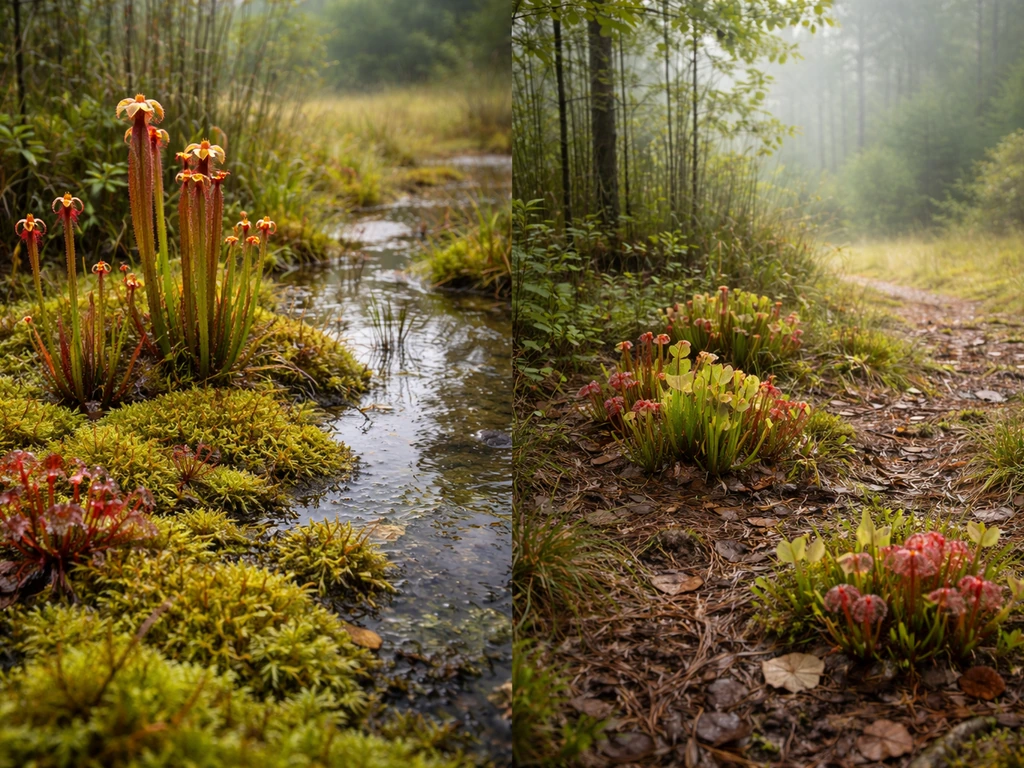
Natural habitats and global distribution
The majority of carnivorous plant species cluster in a handful of habitat types, and knowing which type matches which genus will tell you a lot about where to look for them or how to grow them.
Sphagnum bogs and acidic wetlands (temperate North America and Europe)
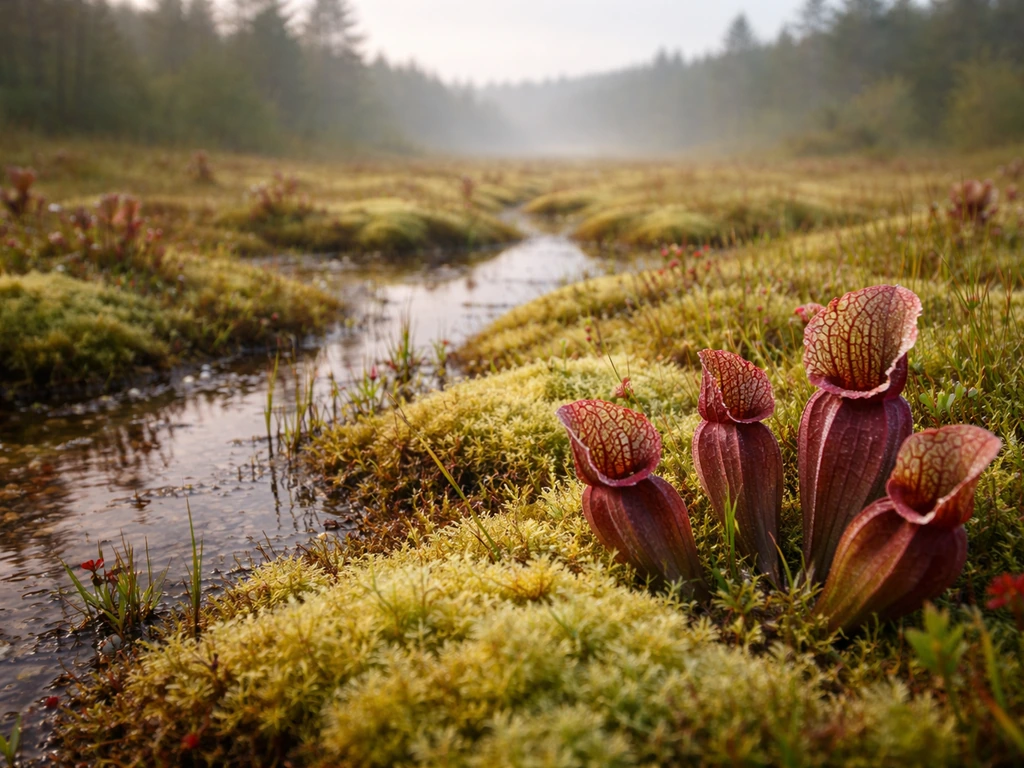
Sarracenia (the North American pitcher plants) are almost entirely restricted to the eastern half of North America, from the Gulf Coast up into Canada. Brooklyn Botanic Garden also notes that eastern North America has the greatest diversity of carnivorous plants, and that Sarracenia pitcher plants include eight known species plus several subspecies, with many in the Southeast blank" rel="noopener noreferrer">Sarracenia (the North American pitcher plants) are almost entirely restricted to the eastern half of North America. Their core habitats are sphagnum peat bogs, flat pine savannas, wet pine barrens, and swamps where the water table sits at or near the soil surface. The water in these places is extremely acidic, often with a pH below 4.5, and essentially free of the base cations (calcium, magnesium) most plants depend on. Moving water constantly leaches nutrients away, making the soil nutritionally bankrupt. That's the whole reason these plants evolved trapping mechanisms: there's simply nothing useful coming through the roots. Roundleaf sundew (Drosera rotundifolia) turns up in similar blank" rel="noopener noreferrer">sphagnum-dominated bogs across the Northern Hemisphere, where the water table typically hovers between about 1 inch above and 16 inches below the soil surface depending on season.
Subtropical seepage bogs and pine savannas (Southeastern US)
The longleaf pine ecosystem of the southeastern United States is one of the richest carnivorous plant habitats on earth. Species like Drosera capillaris (pink sundew) grow in subtropical-to-tropical seepage bogs, wet savannas, and open grasslands closely associated with longleaf pine flatwoods. Pinguicula planifolia (the bog butterwort) shows up in pineland depressions, bogs, wet prairies, and swamps throughout the Gulf Coast region, sometimes colonizing man-made drainage ditches and retention pond edges. Venus flytrap (Dionaea muscipula) is even more restricted, growing natively only in a narrow band of coastal plain bogs and wet savannas in North and South Carolina.
Tropical and highland rainforests (Southeast Asia, Australasia, the Americas)
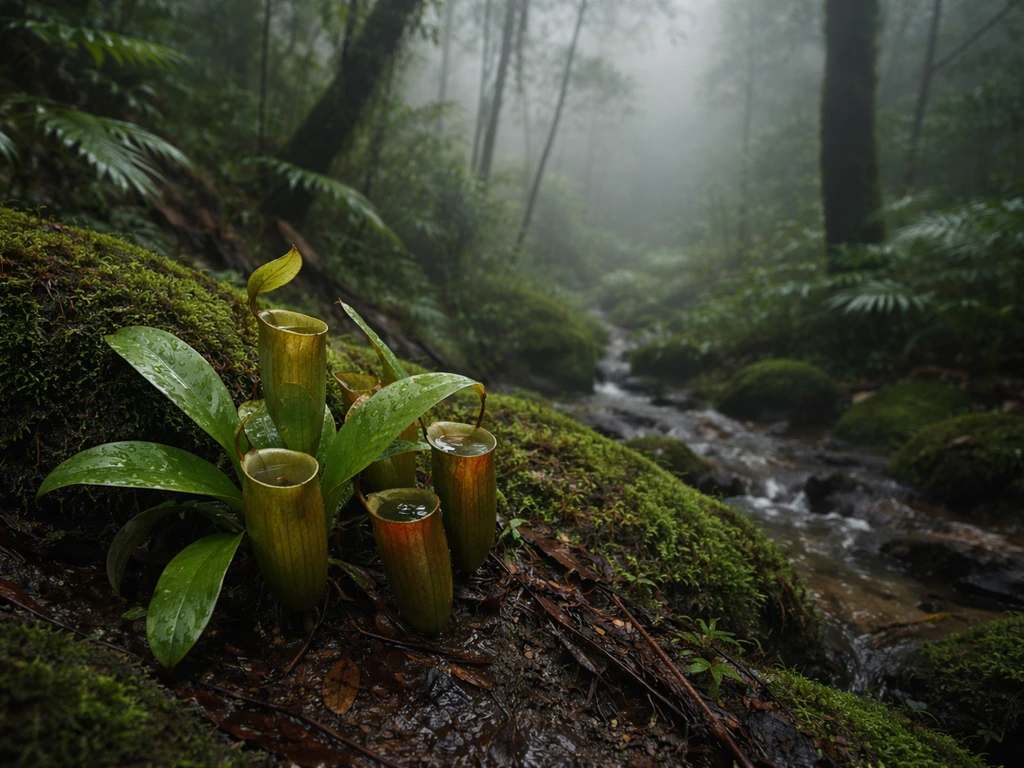
Nepenthes (tropical pitcher plants) have a very wide range across Southeast Asia, northern Australia, Madagascar, and the Seychelles, but most species center on Borneo, Sumatra, and the Philippines. Their preferred substrates are acidic and low in nutrients: peat, white sand, sandstone, and volcanic soils. Some Nepenthes species prefer dense forest shade, while many others favor forest margins and clearings where light is higher. Elevation matters a lot within this genus. Nepenthes hemsleyana, for example, is endemic to Borneo and grows in peat swamp forest and heath forest at elevations below 200 meters above sea level. Highland Nepenthes species, on the other hand, can grow at over 2,000 meters in cooler, mistier conditions.
Freshwater wetlands and aquatic habitats (global)
Utricularia (bladderworts) are the most widely distributed carnivorous plants on earth, growing on every continent except Antarctica. They live in fresh water for at least part of the year, with the main plant body typically lying beneath the substrate, whether that's pond water or dripping moss on a tropical rainforest tree. Utricularia minor, for example, turns up in marshes and low-nutrient peatland complexes across the Northern Hemisphere. These are genuinely rootless, free-floating plants in many cases, which sets them apart from nearly every other carnivorous genus.
Temperate Europe and cold-climate zones
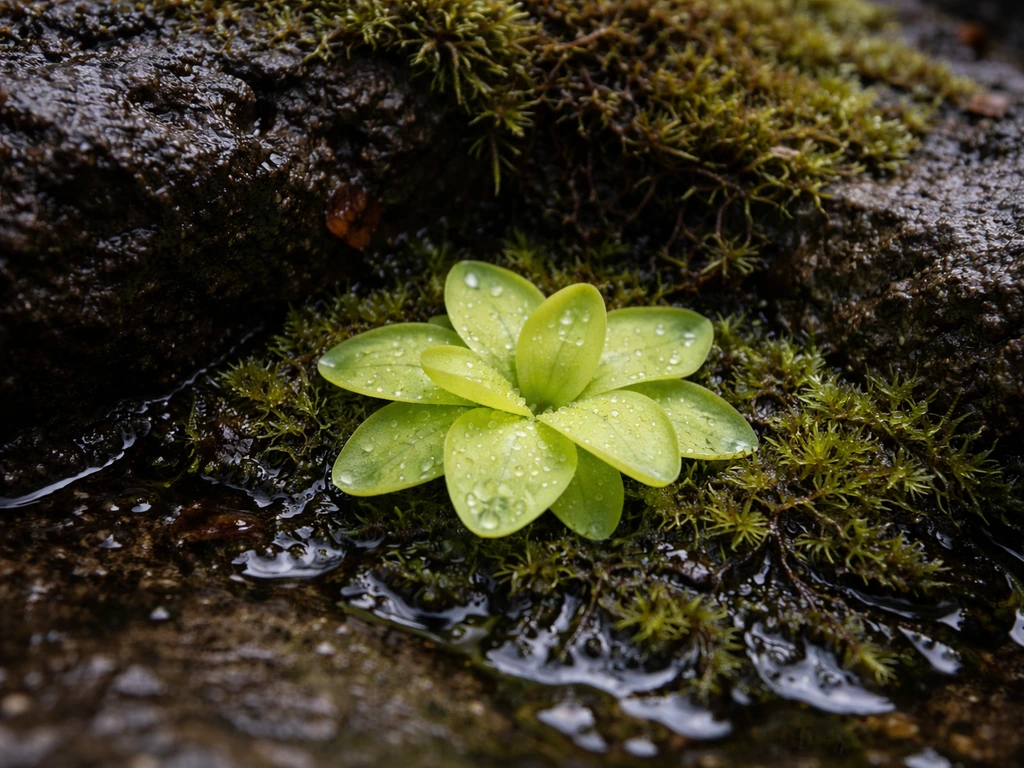
Temperate butterworts (Pinguicula) occur widely across Europe, the Mediterranean, and northern North America in acidic peat bogs, rocky wet ledges, and seepage zones with cold winters. Some species grow on or near alkaline bedrock shorelines, which is a reminder that not every carnivorous plant follows the same acid-peat formula. The common thread is nutrient poverty and consistent moisture, not necessarily extreme acidity in every case.
How carnivorous plants actually grow
Carnivorous plants solve a simple problem in an unusual way: the soil provides almost no nitrogen or phosphorus, so the plant supplements its nutrition by digesting animals (mostly insects). This dietary strategy frees them to colonize waterlogged, acidic substrates that chemically exclude most competitors. The trapping structures (pitchers, sticky leaves, snap traps, underwater bladders) are essentially modified leaves, and maintaining them costs energy. That's why these plants are generally slow-growing and why they need strong light: they have to photosynthesize enough to run both a normal plant metabolism and a hunting operation.
The seasonal growth cycle for temperate species follows a clear pattern. Sarracenia flowers from March (in the South) through August (in northern populations), with active pitcher production continuing through summer. Dormancy sets in during October through March, when the plant essentially shuts down above ground. Drosera rotundifolia and Drosera anglica both produce hibernacula in winter: tight buds of curled leaves at ground level that unfurl in spring when temperatures rise. Venus flytraps go fully dormant and need roughly 3 to 4 months at temperatures between 35 and 50 degrees Fahrenheit (2 to 10 degrees Celsius) to stay healthy long-term. Skipping dormancy is one of the most common reasons temperate carnivorous plants die in home cultivation.
Tropical species like Nepenthes and many Utricularia don't require a hard winter dormancy, but they still track seasonal shifts in rainfall and light. Their growth cycle is tied more to wet and dry seasons than to temperature extremes.
Climate preferences and what that means for locations
The easiest way to think about carnivorous plant climates is to split them into three broad groups: temperate (cold winters, warm summers), subtropical/warm temperate (mild winters, long hot summers), and tropical (year-round warmth, no frost). Each group tolerates or actually requires specific seasonal conditions.
| Genus | Climate Group | Key Regions | Dormancy Needed? |
|---|---|---|---|
| Sarracenia | Temperate to subtropical | Eastern North America (Gulf Coast to Canada) | Yes (Oct–Mar) |
| Dionaea | Warm temperate | Coastal plain of North/South Carolina | Yes (3–4 months, 35–50°F) |
| Drosera (temperate spp.) | Temperate to boreal | North America, Europe, northern Asia | Yes (hibernaculum) |
| Drosera (tropical spp.) | Subtropical to tropical | SE USA, Africa, Australia, SE Asia | No |
| Nepenthes (lowland) | Tropical | Borneo, Sumatra, Philippines | No |
| Nepenthes (highland) | Cool tropical/montane | High elevations in SE Asia | No (but cool nights) |
| Pinguicula (temperate) | Temperate to cold | Europe, North America, Mediterranean | Yes (winter rosette) |
| Utricularia | Global (freshwater) | All continents except Antarctica | Species-dependent |
Seasonality is the underappreciated variable. If you're trying to locate carnivorous plants in the field, late spring through early fall is the right window for temperate species. In the southeastern US longleaf pine ecosystem, late April through June is ideal for seeing Sarracenia in active pitcher production alongside sundews and butterworts. In northern Europe and Canada, the season is compressed into May through September for sphagnum bog species.
Soil and water conditions: the bog chemistry that makes it work
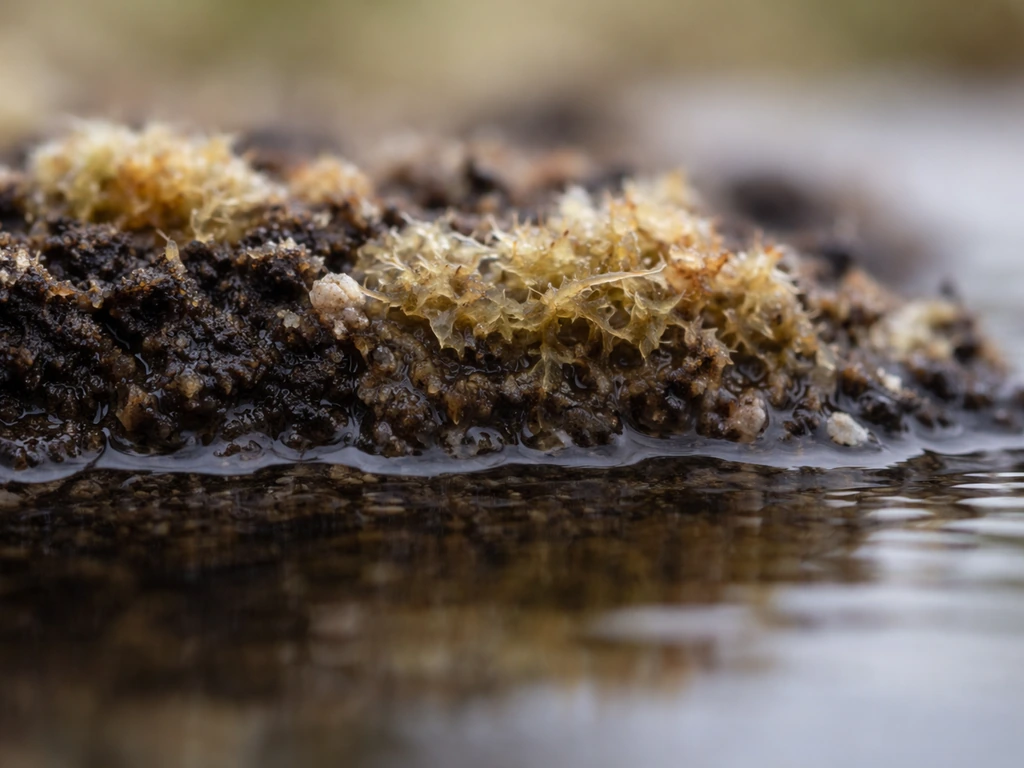
This is the factor that most determines where carnivorous plants grow and where they don't. The soil profile is almost always nutrient-poor, strongly acidic, and saturated. Typical substrates include sphagnum peat (living or decomposed), coarse sand, white or silica sand, sandstone-derived soils, and volcanic substrates in tropical settings. What they share is a near-total absence of available nitrogen, phosphorus, and calcium. Soil pH typically falls in the range of about 4 to 5 for most bog-dwelling species, with Sarracenia wetlands often dropping below 4.5. Drosera rotundifolia grows in soils with surface pH readings commonly in the range of 3.3 to 5.0.
Water is equally important, and it has to be the right kind. Carnivorous plant bog habitats are fed by rainwater and surface runoff, not by mineral-rich groundwater. The water is soft, acidic, and low in dissolved solids. This is why tap water is problematic for home cultivation: even moderately hard tap water can deposit enough minerals over time to raise soil pH and introduce calcium and other nutrients the plant's substrate is supposed to lack.
In the field, Sarracenia habitats often have standing water or a water table at or just below the surface, with some of the wettest microsites being slow-moving acid bog streams or shallow bog ponds. Drosera rotundifolia tolerates more variation, with the water table ranging from slightly above the surface to about 40 centimeters below it across its range. Utricularia species are often fully submerged or growing in waterlogged sphagnum with no root system to anchor them at all.
Light and seasonal growth needs
Most carnivorous plants are sun-hungry. Sarracenia in particular does best in full sunlight, with some protection from intense afternoon sun being useful in very hot, exposed sites to prevent excessive desiccation rather than light damage. Open bog habitats, pine savannas, and wet meadows are naturally bright environments with little canopy overhead. If you find a sphagnum bog surrounded by mature forest, the carnivorous plants will almost always be concentrated in the open patches, not under the tree cover.
Nepenthes is a partial exception. Many species grow at forest margins or in clearings where light is filtered or comes in at an angle, and some specifically prefer shade. Highland Nepenthes in particular are adapted to bright but diffuse light at altitude, with frequent mist reducing direct sun intensity. If you're growing Nepenthes indoors or in a greenhouse, replicating that diffuse, bright-but-not-scorching light is more important than maximizing direct sun hours.
For seasonal light management, temperate species need reduced light in autumn and winter to help trigger and sustain dormancy. Moving Sarracenia to a cooler, lower-light location in late autumn is a practical way to replicate what happens in the field as days shorten and temperatures drop. This isn't just about protecting the plant from frost; the light reduction itself signals the plant to enter dormancy and stop wasting energy on active growth during a period when prey is scarce.
Picking a location at home: matching the conditions that actually matter
If you want to grow carnivorous plants outdoors or find them in the wild, you're essentially looking for a specific intersection of conditions. Where do rubber plants grow compared with these carnivorous plants? Most plants grow best in nutrient-rich, well-balanced soils, so the extreme bog conditions carnivorous plants prefer explain why they thrive in places where many other species cannot where do most plants grow. Getting all of them right at once is what separates a thriving plant from one that slowly declines over a season or two.
For temperate species (Sarracenia, Dionaea, temperate Drosera, temperate Pinguicula)
These plants need a spot with at least 6 hours of direct sun, a substrate of roughly 50/50 peat and coarse silica sand (no perlite or vermiculite, which can add minerals), and constant moisture. The most practical home setup is a container bog: a deep plastic pot or reservoir with drainage holes plugged or restricted so that a small amount of standing water (around a quarter inch) sits at the bottom, keeping the medium continuously damp without becoming stagnant. Refill with distilled water, collected rainwater, or reverse osmosis water only. Tap water with dissolved solids will gradually push pH up and introduce minerals the plant can't handle. In late autumn, move the container to an unheated garage, cold frame, or sheltered outdoor spot where temperatures stay in the 35 to 50 degrees Fahrenheit range for the dormancy period.
For tropical lowland species (lowland Nepenthes, tropical Utricularia, tropical Drosera)
These plants need consistent warmth (generally above 60 degrees Fahrenheit at night, ideally 70 to 85 degrees Fahrenheit during the day), high humidity, bright but often filtered light, and a low-mineral acidic substrate like pure peat, peat and perlite, or live sphagnum. They don't need a dormancy period. A heated greenhouse, bright indoor windowsill with supplemental humidity, or an enclosed terrarium can all work. Utricularia aquatics do well in a simple clean-water container with no added fertilizer.
For Pinguicula (species-by-species substrate matching matters)
Butterworts are one genus where the standard peat-and-sand recipe doesn't always apply. Temperate North American and European species often grow in acidic peat bogs, but some species naturally grow on alkaline rock faces or calcareous substrates. Before setting up a Pinguicula bed or container, confirm whether your specific species comes from an acid or alkaline-tendency habitat. Getting this wrong is one of the more subtle ways butterworts fail in cultivation.
A practical setup checklist before you plant
- Confirm your species group: temperate vs. tropical, and whether dormancy is required.
- Source a peat-based or pure sphagnum substrate with no added fertilizer or lime — verify the bag label before buying.
- Mix substrate as needed: a 50/50 peat and coarse silica sand blend works for most Sarracenia, Dionaea, and temperate Drosera.
- Check and match substrate chemistry for Pinguicula — acidic peat vs. mineral-lean near-neutral mix depending on species origin.
- Set up a bog reservoir or tray system to maintain constant moisture without waterlogging the crown of the plant.
- Use only distilled water, collected rainwater, or reverse osmosis water for irrigation — no tap water.
- Test the substrate pH with a simple pH meter or strips; the target range for most bog species is pH 4 to 5.
- Place in a spot with at least 6 hours of direct sun for temperate bog species; use bright indirect light for shade-adapted Nepenthes.
- Plan for dormancy if growing temperate species — arrange a cool, lower-light winter location before autumn arrives.
- Avoid all fertilizers, mineral supplements, and mineral-based soil amendments in the growing medium.
The topic of insectivorous plant habitat overlaps closely with this one, the ecological reasons these plants evolved in nutrient-poor areas are well documented in field ecology, and understanding that 'why' makes every condition on that checklist feel logical rather than arbitrary. If you're also exploring where other non-standard plant groups thrive, the patterns that govern carnivorous plant distribution share some similarities with the habitat specificity you'll find when looking at fern distributions or the range of non-vascular plants in wet, low-nutrient environments. Fern plants are most likely to grow in consistently moist, low-nutrient habitats with the right light and humidity levels where are fern plants most likely to grow. You can see similar habitat patterns when you look at where non-vascular plants grow in wet, low-nutrient environments.
The bottom line: carnivorous plants grow where almost nothing else can, and that's exactly the environment you need to replicate. Get the water chemistry, soil nutrition (or lack of it), light, and seasonal temperature cycle right, and these plants are surprisingly resilient. Get any one of them wrong consistently, and the plant will decline no matter how carefully you handle everything else.
FAQ
If I see wet soil, how can I tell whether carnivorous plants will actually grow there?
In most wild sites they are found in sunlit openings, but the exact “open vs shaded” rule varies by genus. Pitcher plants and many sundews concentrate in gaps with little canopy, while many Nepenthes occupy forest margins and clearings (sometimes preferring filtered or angled light). When scouting, look for vegetation structure (open patches, wet meadows, seepage zones), not just wet ground.
What time of year should I look to find carnivorous plants in the wild?
Yes, many carnivorous plants can be missed if you arrive at the wrong time. For temperate bog species, late spring through early fall is usually the best window, because active pitchers and unfolded growth make detection much easier. In late summer you also get better visibility into microsites like shallow seeps and wet pine flatwoods.
Can carnivorous plants grow in any bog-like area, or does the water source matter?
They can tolerate different water table depths, but they usually need soft, low-mineral water and stable saturation. A wet spot fed by mineral-rich groundwater or streams can look “boggy” yet still be unsuitable. If the water source is mineral-heavy, soil pH often rises and minerals accumulate, which is a common reason populations disappear.
What soil and water clues should I look for when trying to locate carnivorous plants?
For field identification, use habitat chemistry clues: strongly acidic, nutrient-poor substrates like sphagnum peat, white silica sand, sandstone seep zones, or volcanic soils. Also watch for consistent moisture from rainwater or runoff rather than groundwater. A practical check is whether the site resembles an acid wetland, not whether it is merely wet.
What is the most reliable way to replicate bog conditions at home without accidentally overfeeding the plants?
A “container bog” works because it mimics a saturated but not stagnant system. Practical detail: keep the medium continuously damp and wet at the base, but avoid letting it turn sour by using clean distilled or reverse osmosis water and a pot/reservoir that drains properly during routine care. Also, skip mineral amendments and do not use fertilizers, because even small nutrient additions can shift the substrate away from what these plants evolved to handle.
Do all carnivorous plants need winter dormancy to survive?
Dormancy requirements are species-specific, and this is one of the biggest cultivation mistakes. Temperate plants such as Venus flytrap and many bog species generally need a cool rest period, while tropical species usually do not require a hard winter cold spell but still shift growth with wet and dry seasons. If you are unsure, identify the species first before deciding on temperature treatment.
Are the light requirements the same for all carnivorous plants, including tropical pitcher plants?
Yes, and it changes the “where” question in cultivation. Nepenthes can do better with brighter but diffuse light, especially highland types that evolved with mist and reduced direct intensity. If you give Nepenthes only harsh direct sun, leaf scorch and poor growth can occur even if the substrate is correct.
Why do some butterworts struggle even when I copy the bog recipe?
Butterworts (Pinguicula) are a key exception to a one-size-fits-all peat-and-sand rule. Some species naturally tolerate more calcareous or alkaline-leaning conditions, so forcing every Pinguicula into strictly acidic bog media can cause slow decline. The safe approach is to match the species to its natural substrate tendency before building the setup.
Should I feed carnivorous plants in cultivation to help them establish?
Prey availability usually is not the main limiting factor in good growth conditions, because strong light and correct water chemistry drive most healthy energy capture. In fact, overfeeding insects or adding nutrients can be harmful, since these plants rely on nutrient-poor substrate and do not need supplements. In cultivation, focus on correct water, light, and seasonality rather than frequent feeding.
What are the most common reasons carnivorous plants decline even when they seem to be growing at first?
If you notice the plant declining, don’t assume light is always the culprit. Common hidden cause: tap or hard well water raising pH and adding calcium, which is specifically disruptive over time. Another frequent issue is using the wrong drainage or medium texture, for example adding perlite or vermiculite that can contribute minerals, or letting water become stagnant and dirty.