Coastal areas support a remarkable range of plants, but the ones that actually thrive there share a common trait: they've adapted to conditions that would kill most garden-variety species. Sea oats (Uniola paniculata) anchor sandy dunes along the Gulf and Atlantic coasts. Smooth cordgrass (Spartina alterniflora) dominates low salt marshes from Maine to Florida. Sea thrift (Armeria maritima) clings to rocky cliffs in the Pacific Northwest and Britain. Glasswort (Salicornia spp.) survives salt pannes where almost nothing else can. Each of these plants occupies a very specific niche, and understanding which niche matches your location is the key to knowing what actually grows where you are.
Plants Grow in Coastal Areas Examples: Top Salt-Tolerant Plants

Dr. Marcus Weatherby
26 May 2026
What "coastal conditions" actually mean for plants
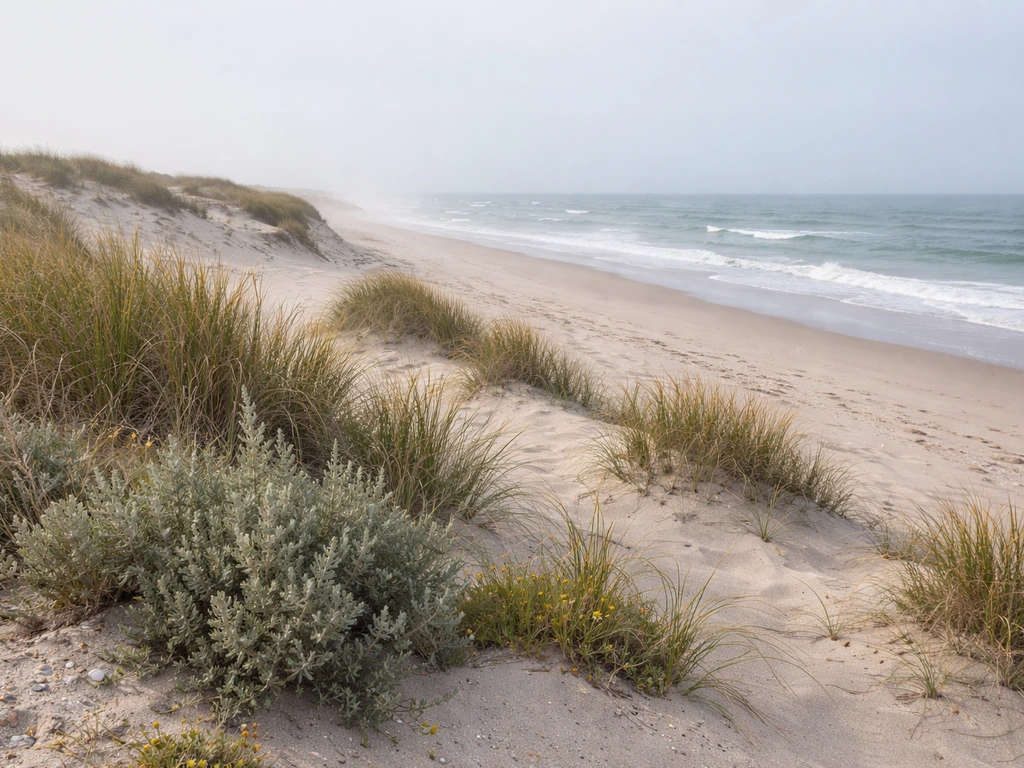
The coast isn't one environment. It's a layered set of stresses that vary sharply depending on how close you are to the water and what kind of shoreline you're standing on. The most important stressors are salt spray (tiny water droplets carrying dissolved salts that fall directly on leaves and soil), soil salinity, wind exposure, sand burial or movement, nutrient-poor substrates, and wide swings between drought and inundation. A plant on the open foredune of a barrier island faces all of these simultaneously. A plant sheltered in an estuary buffer 200 feet from the water may face only occasional salt spray and moderately saline soil.
Sandy dune soils are typically dry, nutrient-poor, and sometimes acidic. Salt marsh soils are waterlogged, low in oxygen, and can carry porewater salinity anywhere from 0.5 to 40 grams of salt per liter depending on how much freshwater is mixing in. Rocky shore soils (when there's soil at all) are thin, fast-draining, and scoured by wind. Estuarine flats are somewhere in between, with salinity that shifts constantly based on tidal cycles, rainfall, and freshwater runoff. Plants that grow well in one of these zones rarely do well in another, which is why matching species to zone matters more than just finding something labeled "salt-tolerant."
Examples organized by coastal habitat
Beach dunes (foredunes and backdunes)
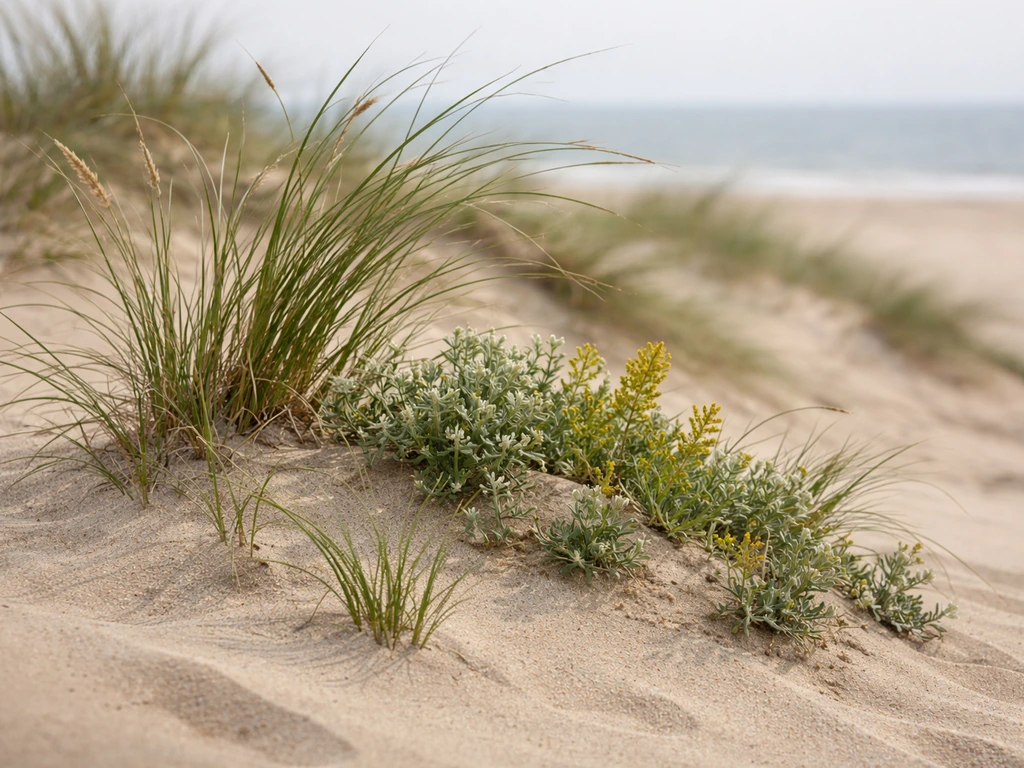
Foredune plants are the hardiest of all coastal plants. They're pioneers that colonize bare sand directly exposed to salt spray, sand blasting, and burial. Sea oats (Uniola paniculata) is the dominant dune-building species across the U.S. Southeast and Gulf Coast. It traps wind-blown sand with its stems and stabilizes dunes with a dense, spreading root system. American beachgrass (Ammophila breviligulata) plays the same role on the mid-Atlantic and Northeast coast. Bitter panicum (Panicum amarum) and maritime bluestem (Schizachyrium maritimum) also show up on Gulf Coast foredunes. Each of these grasses contributes differently to dune shape and protection depending on how it interacts with blowing sand around its roots and stems.
Moving back from the active foredune into more protected dune communities, you find a richer mix. On the Northeast coast, that includes beach pea (Lathyrus japonicus), seaside goldenrod (Solidago sempervirens), sea rocket (Cakile edentula), seabeach sandwort (Honckenya peploides), and dune grass (Leymus mollis). In Gulf Coast backdunes, beach elder (Iva imbricata) and beach morning-glory (Ipomoea imperati) are common. Virginia creeper (Parthenocissus quinquefolia) sometimes appears in the more sheltered interdune swales. All of these plants share deep or wide-spreading root systems, tolerance for fast-draining nutrient-poor sand, and varying degrees of salt spray resistance.
Salt marshes (low marsh vs. high marsh)
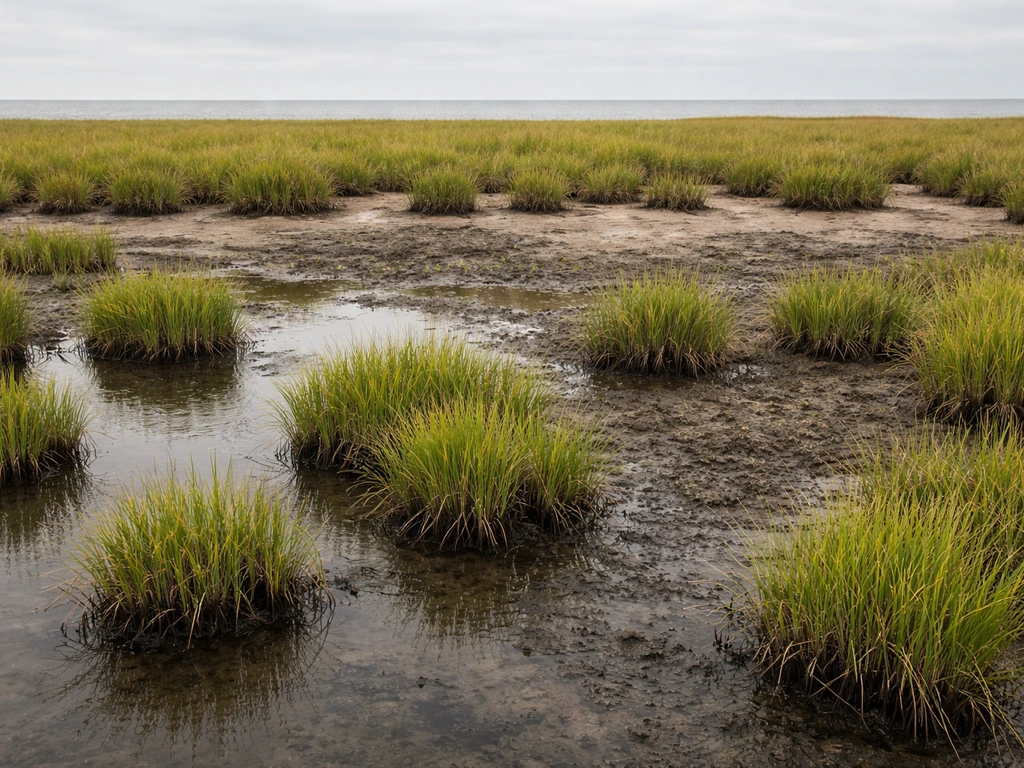
Salt marshes divide sharply into two zones based on flooding frequency, and the plant communities reflect that. Smooth cordgrass (Spartina alterniflora) is the defining species of the low marsh, the zone between the low and high tide lines that gets flooded twice a day. It's essentially the only vascular plant that can handle that flooding frequency and the anaerobic, saline soil conditions that come with it. Where the low marsh gives way to the high marsh (flooded less frequently by storm tides and spring tides), saltmeadow cordgrass (Spartina patens) takes over, often alongside black grass (Juncus gerardii). Saltgrass (Distichlis spicata) colonizes the upper and middle intertidal zones and is a clonal spreader that recovers quickly after disturbance or burial by wrack debris. Salicornia (glasswort or samphire) appears in high marsh salt pannes, the hypersaline depressions where standing water evaporates and leaves extreme salt concentrations. It's one of the most salt-tolerant plants on the planet.
Rocky shores and coastal cliffs
Rocky coastlines present a completely different set of constraints: thin or absent soil, wind scour, salt spray, and poor water retention. Sea thrift (Armeria maritima) is one of the most recognizable plants of rocky coastal habitats globally, growing in low cushion mats on cliffs, rocky outcrops, and coastal bluffs from the Pacific Northwest to Britain and Ireland. It's tolerant of shallow, rocky, well-drained soils and moderate salt spray. Abronia maritima, a succulent perennial found on California beaches and coastal bluffs, stores salt in its tissues and forms thick mats directly on saline, spray-exposed ground. Hardy ice plant (Delosperma cooperi) is another succulent option adapted to thin, rocky substrates with excellent drainage and moderate salt tolerance. These plants all share the pattern of low growth profiles that reduce wind exposure and succulent or waxy tissues that help manage salt and moisture stress.
Estuaries and brackish transition zones
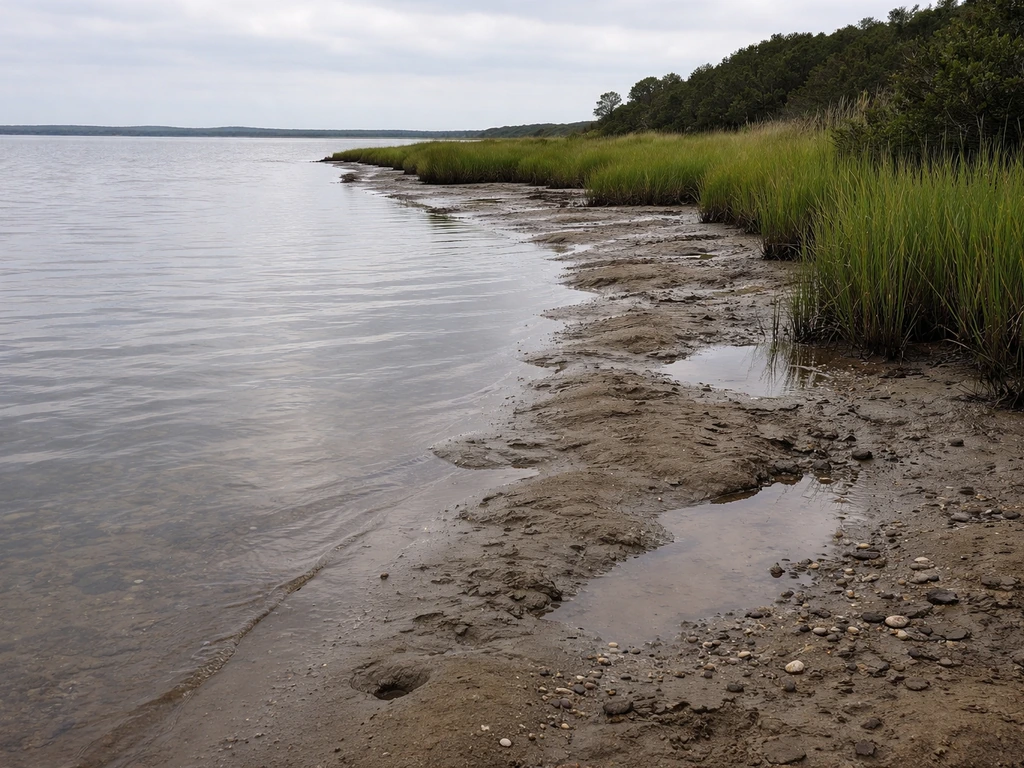
Estuaries are where freshwater meets saltwater, and salinity shifts constantly depending on tidal cycles, wind, and rainfall. NOAA’s Ocean Service estuaries education material also notes that estuaries can be blank" rel="noopener noreferrer">classified by circulation type, including salt-wedge systems, and that mixing depends on factors such as wind, tidal range, and freshwater input. That variability is itself the stress. Plants here need to tolerate a wide salinity range rather than a fixed high or low. Smooth cordgrass dominates estuary edges in the lower, marine-influenced sections. Saltgrass and saltmeadow cordgrass appear in the upper, more brackish areas. Sea lavender (Limonium carolinianum or L. nashii) is a common estuary and salt marsh plant along the Atlantic coast, recognizable by its clusters of small purple flowers on branching stems. Salicornia species also appear in estuarine flats wherever evaporation creates hypersaline pockets. If you're near a brackish estuary, you're in a transition zone, and plant selection gets more flexible than a fully marine-exposed site. In a brackish transition zone, you can often grow salt-marsh and estuary-edge species that tolerate shifting salinity rather than fully marine or fully freshwater plants brackish estuary. It's also worth noting that the specific plants in brackish water situations are covered more fully in discussions of halophyte ecology and saline soil plant communities.
Salt-tolerant plants you can recognize in the field
| Plant | Habitat | Region | Key trait |
|---|---|---|---|
| Sea oats (Uniola paniculata) | Foredune | Southeast/Gulf Coast USA | Sand-trapping, dune-building grass |
| American beachgrass (Ammophila breviligulata) | Foredune | Mid-Atlantic/Northeast USA | Pioneer dune stabilizer |
| Smooth cordgrass (Spartina alterniflora) | Low marsh, estuary edge | Atlantic/Gulf Coast USA | Tolerates twice-daily tidal flooding |
| Saltmeadow cordgrass (Spartina patens) | High marsh | Atlantic/Gulf Coast USA | Fine-leaved, mat-forming |
| Saltgrass (Distichlis spicata) | Upper/middle marsh | Both U.S. coasts | Clonal spreader, very high salinity tolerance |
| Glasswort/Samphire (Salicornia spp.) | Salt pannes, high marsh | Cosmopolitan | Survives extreme hypersaline conditions |
| Sea thrift (Armeria maritima) | Rocky cliffs, coastal bluffs | Pacific NW, Europe | Low cushion mat, thin/rocky soil |
| Seaside goldenrod (Solidago sempervirens) | Backdune, coastal bank | Atlantic Coast USA | Tolerates salt spray and sandy soil |
| Beach pea (Lathyrus japonicus) | Dune, coastal beach | Northeast USA, N. Europe | Nitrogen-fixer, spreads over sand |
| Sea lavender (Limonium carolinianum) | Salt marsh, estuary | Atlantic Coast USA | Distinctive purple flowers in late summer |
| Beach morning-glory (Ipomoea imperati) | Gulf foredune/backdune | Gulf Coast USA | Trailing mat, rapid sand coverage |
| Sea rocket (Cakile edentula) | Wrack line, dune base | Northeast USA | Annual pioneer on disturbed sand |
How to choose plants for your specific exposure and soil
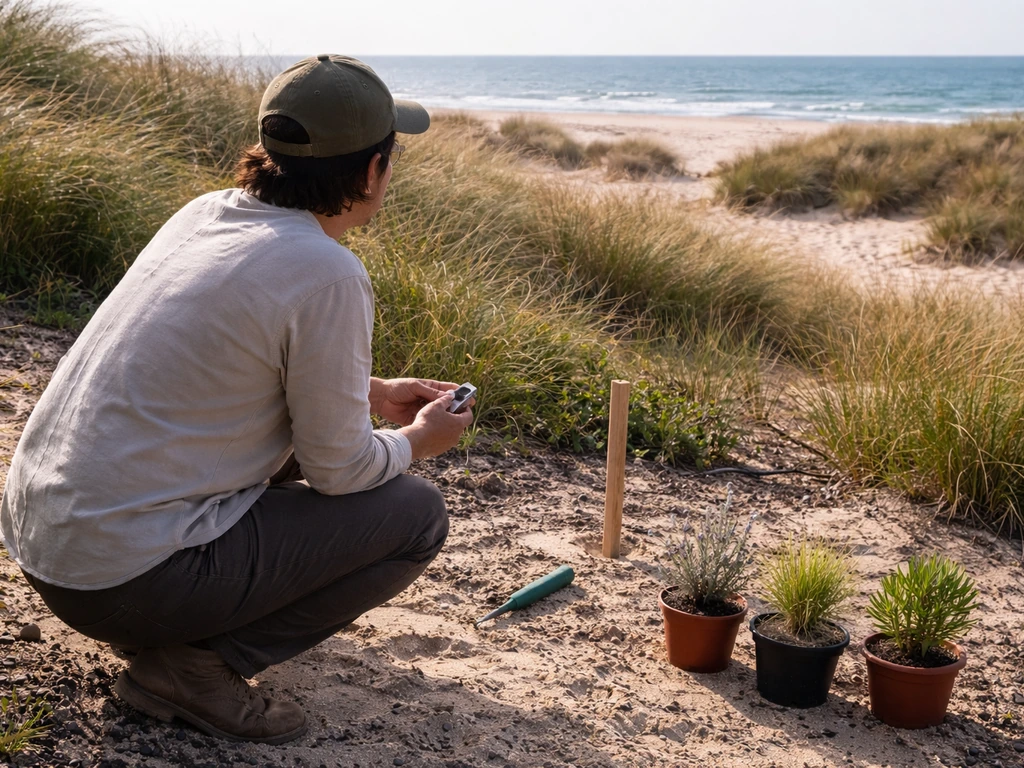
The single most useful thing you can do before choosing any coastal plant is stand at your site and observe the actual conditions. How far are you from the water? Is it open ocean or a sheltered bay? Does salt spray visibly coat surfaces near you after storms? Is your soil pure sand, rocky substrate, compacted clay, or the dark organic muck of a marsh edge? The answers to these questions matter more than any generic "salt-tolerant plants" list.
A practical way to think about it: sort your site into one of three exposure categories.
- High exposure (foredune, open beach, cliff top, full salt wind): Stick to true coastal pioneers. Sea oats, American beachgrass, sea rocket, and glasswort are designed for this. Ornamental plants will struggle without significant wind protection.
- Moderate exposure (backdune, coastal bank, sheltered rocky slope, upper marsh edge): A much wider range of plants works here. Seaside goldenrod, beach pea, sea thrift, sea lavender, and saltmeadow cordgrass are good starting points. Native woody shrubs like bayberry (Morella caroliniensis) also do well on coastal banks.
- Low exposure (estuary buffer, salt marsh landward edge, sheltered coastal garden 200+ feet from water): Many native meadow and edge species tolerate occasional salt spray and moderately saline soil. Focus on locally native species and avoid anything that needs consistent fresh irrigation, which can cause nutrient runoff into adjacent marsh or tidal creek.
Soil type matters equally. Sandy soils (above roughly 70% sand content) drain fast, hold almost no nutrients, and dry out quickly. Plants here need either deep root systems to reach moisture lower down, or succulent tissues that store what they can capture. Adding compost during initial planting helps water and nutrient retention without changing the soil structure too aggressively. Avoid relying on permanent irrigation systems near dunes and banks because excess water accelerates erosion. Rocky or thin soils call for low-mat species like sea thrift or ice plant that can anchor in shallow substrate. Marsh soils are waterlogged and anaerobic; if you're planting there, stick entirely to native marsh species matched to your salinity zone.
How to start planting near the coast (and what to avoid)
The best time to plant most coastal species is late fall or early spring when temperatures are moderate and establishment stress is lower. If you're planting in summer, many species (including American beachgrass) need temporary irrigation for four to six months to get roots established in hot, dry sand. After establishment, most true coastal natives don't need supplemental watering. Permanent irrigation systems near dune or bank plantings are a real problem: they can saturate sandy soils and accelerate erosion rather than prevent it.
Here's what consistently goes wrong for coastal plantings:
- Using mulch near salt marshes or tidal creeks: it gets carried into the water during storm tides and can smother marsh vegetation. Skip it near the water's edge and use close plant spacing to suppress weeds instead.
- Choosing plants from ornamental lists rather than coastal-native lists: many attractive salt-tolerant ornamentals (like certain ice plants or non-native grasses) have performed poorly on actual exposed dune faces or have become invasive in coastal communities.
- Planting non-natives in the intertidal zone: the low marsh is not a place for experimentation. Smooth cordgrass and saltgrass are there for a reason and should be the only options in actively flooded zones.
- Ignoring the salinity gradient: a plant rated as salt-tolerant for garden use may handle soil EC of 2-4 dS/m. Salt marsh porewater can reach salinity levels equivalent to or exceeding seawater. These are completely different environments.
- Over-irrigating during establishment with saline water: if you're using nearby water sources for irrigation, be aware that even modest salt levels in irrigation water add up in the soil over time and can tip marginal species into stress.
When grading or disturbing coastal soil for planting, minimize soil disturbance as much as possible. Bare exposed soil near the shoreline is quickly colonized by weeds and is vulnerable to erosion between planting and establishment. Plant densely enough that the canopy closes quickly and bare ground is minimized.
Quick ways to find region-appropriate coastal plants today
The fastest and most reliable path to a good coastal plant list is your state's cooperative extension service or a coastal management agency specific to your region. These organizations publish zone-specific lists that account for your actual salinity range, soil type, and climate. A few concrete resources worth looking up today:
- Your state's cooperative extension service: search for "[your state] coastal native plants" or "coastal landscaping plant list." States like Massachusetts, North Carolina, Virginia, Florida, and Oregon have detailed, zone-sorted coastal planting guides freely available online.
- USDA PLANTS Database (plants.usda.gov): search by species or browse by state; you can filter by habitat type and nativity to find locally appropriate coastal species.
- Your nearest National Estuarine Research Reserve (NERR) or National Seashore: these sites typically publish habitat-specific plant lists and sometimes offer plant material or technical assistance for shoreline restoration.
- Local native plant societies and native nurseries: they often maintain regionally specific salt-tolerant plant inventories that go well beyond what generic garden center lists offer.
- University herbarium records: if you want to know exactly what grows naturally on the coastal landforms in your county, herbarium databases show real collection records tied to specific habitats.
One practical observation trick worth using before you buy anything: walk the nearest undisturbed coastal area similar to your site and note what's already growing there. The plants that have been there for decades without anyone's help are telling you exactly what works under your conditions. Those are your best candidates, and you'll often find that they're the same species appearing on the extension lists once you look them up.
If your site involves sandy soil specifically, it's also worth understanding how sand-adapted plants in general cope with nutrient and moisture limitations. Plants that grow in sand are called sand-adapted plants. And if brackish water or flooding is part of your picture, the plant ecology of saline soils and halophyte communities adds important context for choosing species that will genuinely persist rather than just survive the first season. Plant grow in saline soil are known as halophytes, and they persist under salt stress better than most other plants.
FAQ
How do I tell whether my site is low marsh, high marsh, dune, or a rocky coastline before buying plants?
Use your distance-from-water and flooding pattern to narrow the zone. If you see twice-daily tidal flooding, you are usually in the low marsh band and should prioritize plants that tolerate frequent inundation. If flooding is only occasional (storm tides or spring tides), high marsh species are a better match. When you are unsure, also check soil appearance, waterlogging, and odor (marsh muck and anaerobic conditions point to marsh plants rather than dune or rocky shoreline species).
Why do some plants that are labeled salt-tolerant fail on coastal sites?
“Salt-tolerant” plants can still fail if they do not match your salt delivery method. Salt spray coats leaves and dries quickly, while salt in soil (salinity) stays longer and can be more damaging. A plant that looks good in a salty-spray rock garden may struggle in waterlogged, saline marsh soils, and vice versa. Choose based on whether your main problem is spray exposure, saline soil, or hypersaline puddles (salt pannes).
Can I use irrigation to help coastal plants establish, especially during summer?
Yes, but only when you mimic the site conditions. For sandy dunes, temporary irrigation may be needed to establish roots in summer, but for dune and bank areas you should avoid keeping soil permanently wet. For marsh edges, you generally should not replicate flooding with hoses, because many marsh species need stable waterlogged conditions that include low oxygen and specific salinity, which are difficult to recreate. If you must supplement, do it sparingly and only during establishment, then stop once roots are established.
What is the best way to build a reliable plant list for my specific shoreline instead of using a generic coastal mix?
Start with species already growing nearby in undisturbed areas, then confirm the match to your microzone. Coastal conditions vary over short distances, so even within the same beach you can have different communities on the foredune, backdune, and interdune swales. If you are planting outside the niche where the same species already persists, you should expect higher failure rates or slow establishment.
Is it always a good idea to amend soil with compost near the coast?
Limit or avoid adding compost and amendments right before planting in places where water moves differently, especially on thin rocky soils and active foredunes. In those zones, extra organic matter can change drainage and increase nutrient availability that favors weeds. For sandy dunes, compost during initial planting can help water retention, but keep it targeted and avoid building a thick, amended layer that disrupts the natural sand profile.
How should I adjust plant choices if my site is brackish (mixed freshwater and seawater) instead of fully marine?
In brackish transition zones, do not force a strictly marine plant or a strictly freshwater ornamental. Look for species that tolerate a wide salinity range and fluctuating salinity during tides, rainfall, and runoff. Practically, this means you can often plant both salt-marsh and estuary-edge species, but you should avoid plants that require a stable low-salinity or stable high-salinity environment.
What are common mistakes that cause coastal plantings to fail even when the species are correct?
Avoid disturbing or grading sand close to the shoreline. Exposed, bare substrate is quickly taken over by opportunistic weeds and is also more vulnerable to erosion during the establishment window. If you need to prepare a spot, do it minimally, plant densely so canopy cover comes quickly, and keep the surface as close as possible to the original soil structure.
Will salt-tolerant plants spread too much or change the landscape where I plant them?
Some coastal plants spread aggressively or form clonal colonies, which can be useful in erosion-prone areas but problematic in small yards. For example, certain clonal marsh grasses can expand after disturbance, while dune grasses can trap sand and shift the shape of the dune over time. Before planting, consider spacing, where you can tolerate spread, and whether the plant will help stabilize soil or overwhelm neighboring vegetation.
After the first season, do coastal plants usually need ongoing watering or fertilizing?
For most established coastal natives, the need for ongoing irrigation is usually low after establishment. The exception is during very hot, dry establishment periods, where some species may require short-term supplemental watering for several months. Once established, continued irrigation near dunes and banks can saturate sandy soil and increase erosion risk, so plan to phase out watering.
What is the best planting time for coastal plants, and what changes if I plant in summer?
Coastal plants differ in the form of salt stress they handle, and cold winters also affect establishment timing. Late fall or early spring is often the safest window because temperatures are moderate and the plant can root before major heat or extreme weather. If planting in summer, expect higher establishment risk and plan for short-term support only when absolutely needed.