Plants that grow in coastal areas are most precisely called halophytes, a term that describes plants capable of surviving in saline or salt-influenced environments. If you've been searching for the right ecological label, that's your answer. But the full picture is a little more layered than one word, because the coast isn't a single habitat. Depending on where exactly you're standing, you might be dealing with a salt marsh, a sand dune, a coastal strand just above the tide line, or a wind-battered bluff, and each of those environments has its own community of adapted plants with slightly different survival strategies.
Plants That Grow in Coastal Areas Are Called What?

Dr. Marcus Weatherby
24 Mar 2026
The correct terms for coastal plants
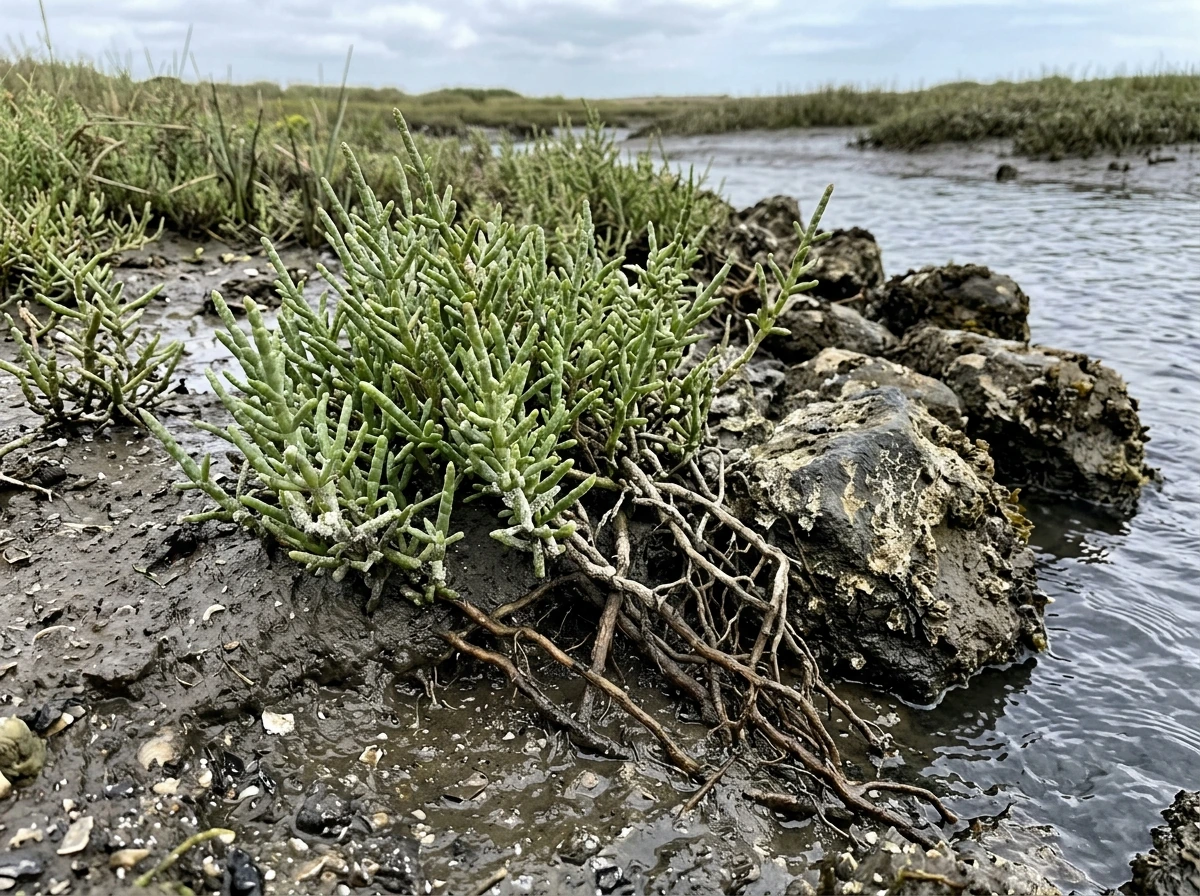
Halophyte is the primary ecological term you'll encounter in scientific and educational writing. It refers to any plant that tolerates high salinity, whether that means roots sitting in brackish water, regular tidal flooding with seawater, or constant exposure to salt spray blown in from the ocean. Salt marshes are the classic halophyte habitat, but halophytes also appear on beaches and coastal bluffs wherever salt spray reaches.
A second term worth knowing is psammophyte, which refers to plants that grow in sandy substrates. Psammophytes aren't necessarily salt-tolerant, but the term comes up when discussing dune plants because those species have to cope with shifting, coarse, nutrient-poor sand regardless of salinity. Many coastal dune plants are both psammophytes and halophytes at the same time, since dune sand near the ocean is usually soaked in salt spray.
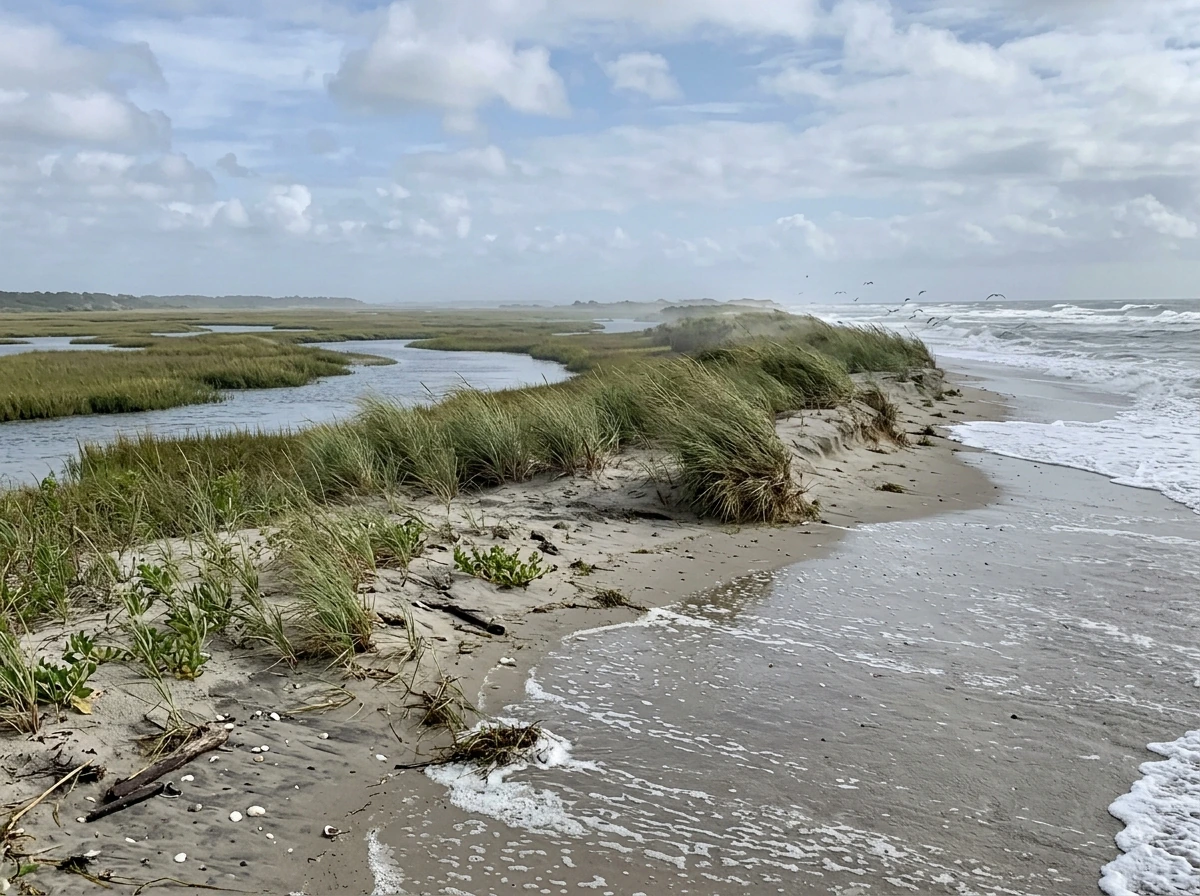
You'll also see the terms "coastal strand" and "coastal dune scrub" used in ecological writing to describe specific coastal plant communities rather than individual species. A coastal strand is the narrow band of vegetation that forms in loose sand just above the high tide line, shaped by wind, salt spray, intense sun, and unstable, infertile sand. Coastal dune scrub is a broader community found further inland on the dunes, but still subject to the same sand-driven dynamics including blowouts that can bury or uproot established plants. Both terms tell you something about the habitat, not just the plant.
The main coastal habitat types and the plants in them
The coast isn't one environment. When someone says "coastal plant," the right follow-up question is: coastal what? The beach itself, the dune system, and the salt marsh behind it all support different plant communities, and understanding those distinctions helps you identify what you're looking at and why it's growing there.
The beach and coastal strand
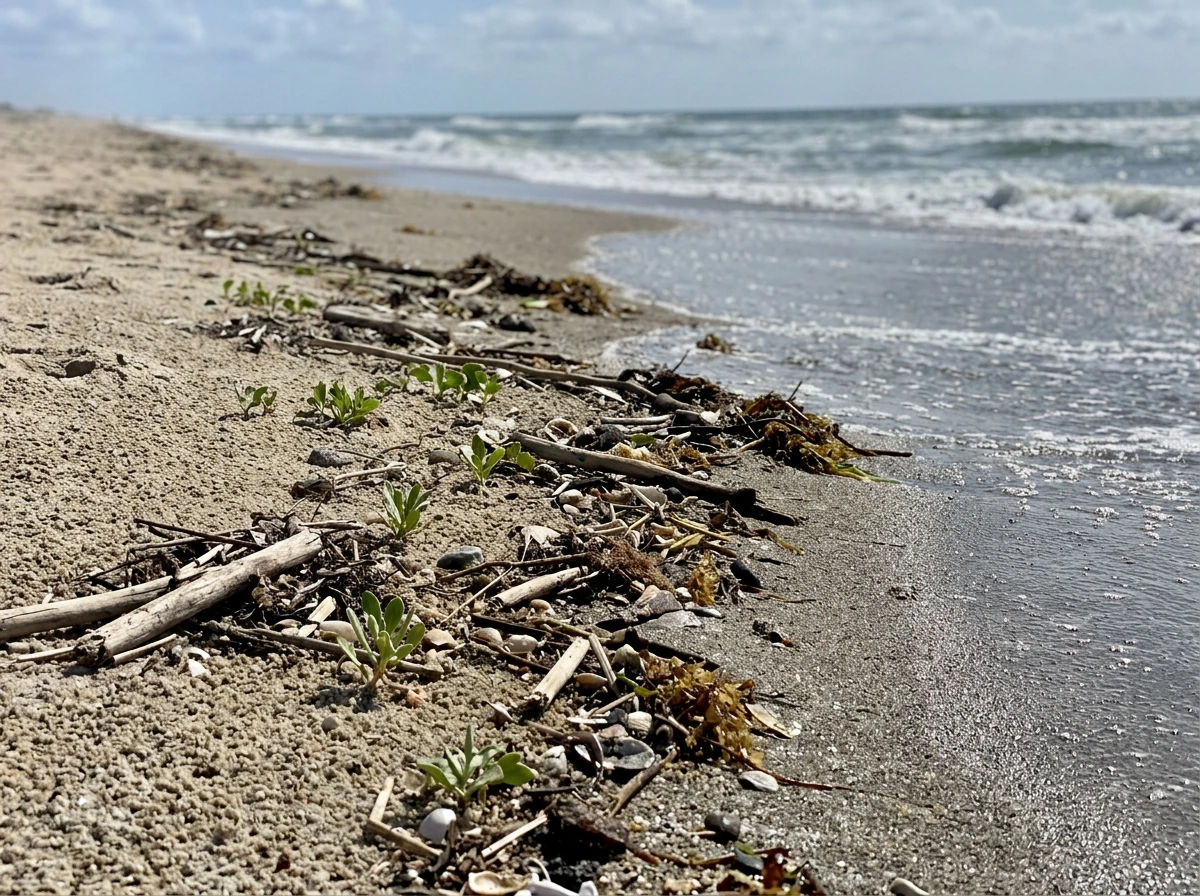
The area right at the foot of the dunes and along the high tide line is called the coastal strand. It's one of the harshest spots on the coast: the substrate is loose, coarse, and shifts with every storm; nutrients are nearly nonexistent; salt spray is relentless; and solar radiation is intense. Only a handful of specialized plants make it here. In the Northeast, that band commonly includes seabeach sandwort (Honckenya peploides), sea rocket (Cakile edentula), beach pea (Lathyrus japonicus), and seaside goldenrod (Solidago sempervirens). These aren't just salt-tolerant, they're built for sand instability and periodic flooding from storm waves.
Coastal dunes
Moving back from the shore, dunes form where sand accumulates and wind shapes the terrain. The key ecological challenge here is sand burial: dunes are dynamic, and plants get buried under fresh sand deposits constantly. The species that thrive here have evolved to grow upward through burial rather than being smothered by it. American beachgrass (Ammophila breviligulata) is the classic example in eastern North America.
It spreads through subsurface rhizomes, and when sand piles up around it, burial actually stimulates new growth rather than killing it. That's exactly why it's the dominant dune-builder on Atlantic coast dunes. Further inland on more stable dunes, shrubby species move in as sand movement slows and soil begins to develop, forming what ecologists call coastal dune scrub communities.
Salt marshes
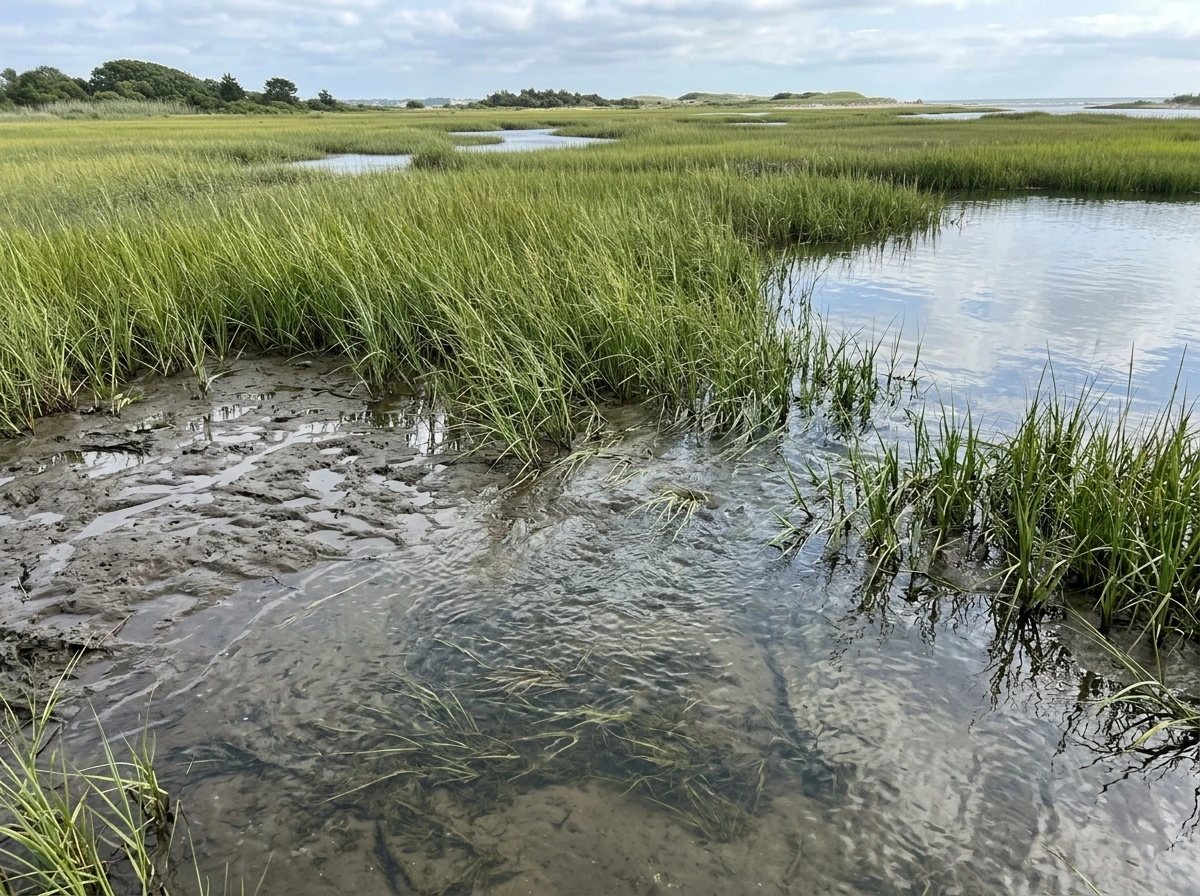
blank" rel="noopener noreferrer">Salt marshes are tidal wetlands that sit in the upper intertidal zone, regularly flooded by seawater or brackish water. They're arguably the most structured of all coastal plant habitats because plant distribution here follows elevation almost exactly. The lower the elevation, the more tidal flooding a plant has to survive, and the community shifts predictably as you move from the estuary edge toward higher ground, answering what plants grow in the ocean’s coastal waters.
NOAA's educational materials describe this zonation clearly: smooth cordgrass (Spartina alterniflora) dominates the low marsh near the water's edge. Moving upland and higher in elevation, salt hay (Spartina patens) and spike grass (Distichlis spicata) take over, and the highest parts of the marsh are where you find black rush (Juncus gerardii).
This pattern is consistent enough that you can use plant dominance as a rough indicator of tidal inundation frequency, which is useful both for identification and for understanding salt marsh ecology. what plants grow in the coral reef
In Florida marshes, the dominant species shift to black needle rush (Juncus roemerianus) and smooth cordgrass (Sporobolus alterniflorus, the current scientific name for what used to be Spartina alterniflora in Florida contexts), with sawgrass appearing at upper marsh edges in some settings. The principles are the same even if the species change by region.
How coastal plants actually survive the conditions
If you're trying to identify whether a plant is genuinely coastal-adapted rather than just a stray, understanding the survival traits that define these plants makes field identification much more intuitive. Coastal-adapted plants have evolved specific mechanisms to deal with salt, sand, wind, and waterlogging. Here's what to look for and why those traits matter.
Salt tolerance mechanisms
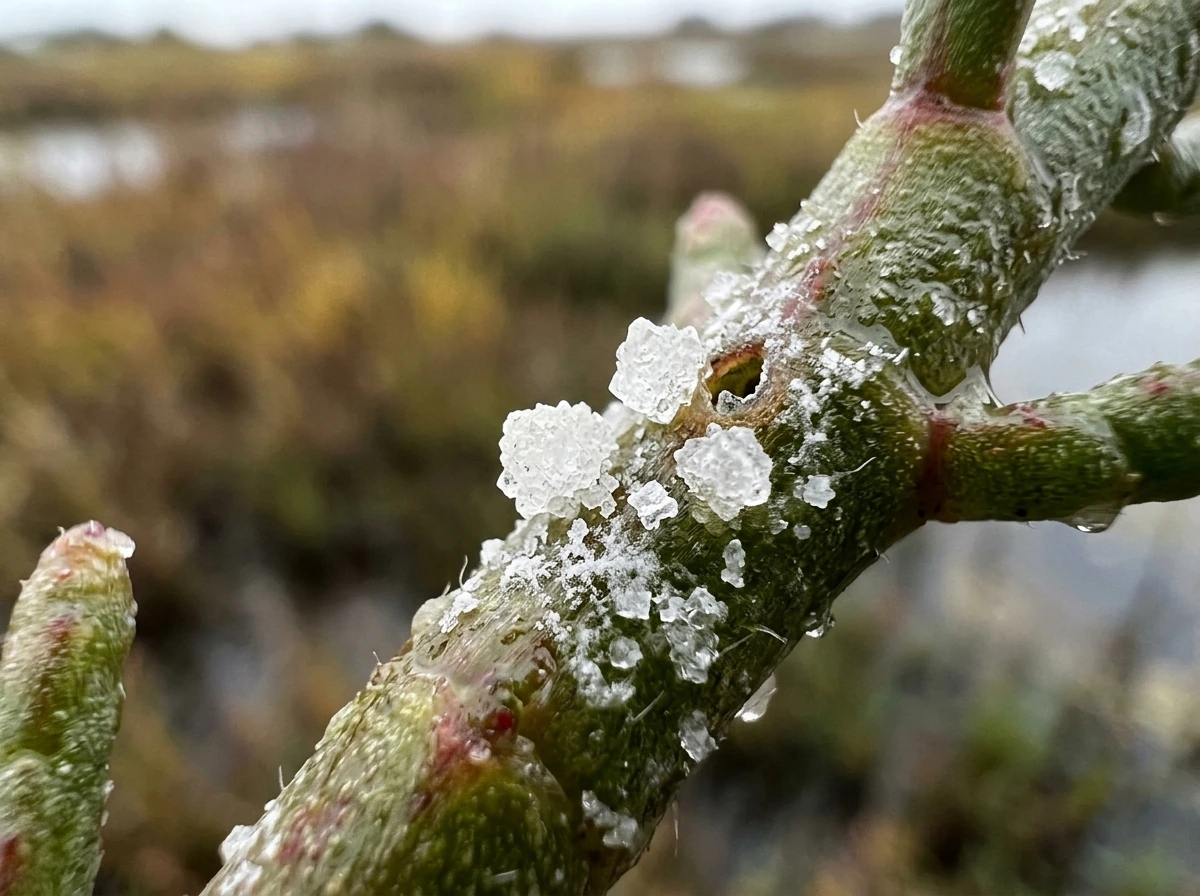
True halophytes deal with salt in one of two main ways. Some species excrete excess salts directly through specialized salt glands on their leaves or stems, which is why you can sometimes see a white crystalline residue on the leaves of plants like smooth cordgrass after the water evaporates. Others concentrate salts in special bladder cells that eventually die and fall off, carrying the salt load with them. Either way, the plant is actively managing salt rather than simply being unaffected by it. If you crush a leaf near the coast and smell or taste it (carefully), genuinely salt-adapted plants often have a noticeably saline quality.
Waterlogging and oxygen transport
Salt marsh plants like Spartina alterniflora face another problem beyond salt: tidal flooding creates waterlogged, low-oxygen soils. These plants have developed aerenchyma, a network of air spaces in their tissue that transports oxygen between above-ground stems and below-ground roots. This internal air supply system is why smooth cordgrass can stand in water that would quickly suffocate most terrestrial plants. You won't be able to see aerenchyma in the field without a microscope, but it's worth knowing because it explains why salt marsh plants are not interchangeable with generic wetland plants.
Sand burial tolerance
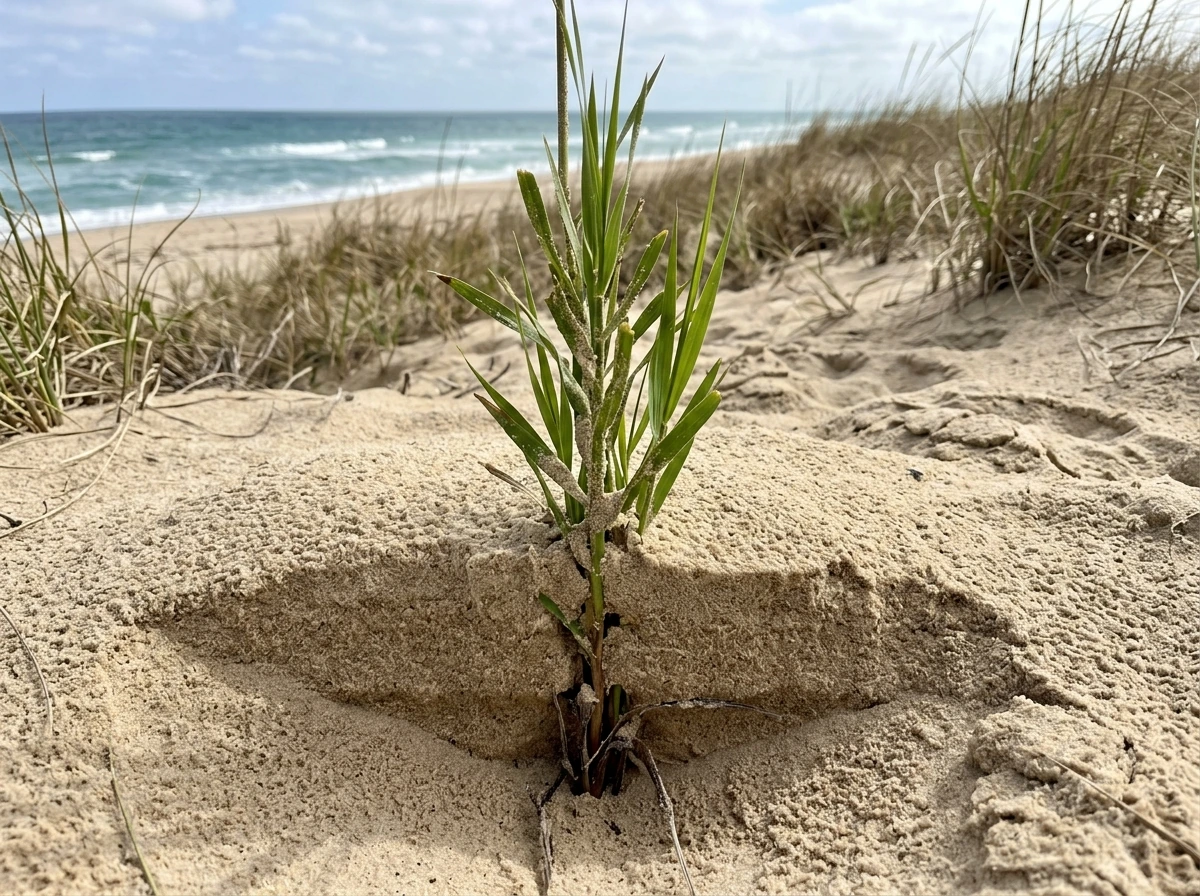
Dune plants are often defined by their response to burial. Species like American beachgrass don't just survive being buried under sand deposits, they actually grow more vigorously when buried, sending up new shoots through the fresh sand layer. Their root systems are extensive, spreading laterally through rhizomes to stabilize the substrate around them. Plants that can't manage this don't persist on active dunes. In the field, a plant that forms dense, spreading mats or tufts on the windward face of a dune is almost certainly sand-burial tolerant.
Wind and drought tolerance
Coastal strand and dune plants also deal with intense, constant wind and drought-like conditions, even near the ocean. Salt spray desiccates tissue, and sandy substrates drain so fast that plants experience water stress even in humid coastal climates. Many coastal plants respond with narrow or waxy leaves, low growth habits, or deep root systems that reach more stable moisture layers below the shifting surface sand. If you spot a plant on an exposed coastal headland with small, thick, or waxy leaves growing low to the ground, those are strong signals of wind and drought adaptation.
A comparison of the three main coastal habitat types
| Habitat | Key stressors | Dominant plant type | Example species (Northeast US) |
|---|---|---|---|
| Coastal strand (beach) | Salt spray, wind, sand instability, intense sun, infertile substrate | Low-growing annuals and perennials | Sea rocket, beach pea, seabeach sandwort, seaside goldenrod |
| Coastal dunes | Sand burial, wind, salt spray, drought, low nutrients | Rhizomatous grasses and dune scrub shrubs | American beachgrass (Ammophila breviligulata), northern bayberry |
| Salt marsh | Tidal flooding, high salinity, low-oxygen soils, waterlogging | Salt-tolerant grasses and rushes (halophytes) | Smooth cordgrass, salt hay, spike grass, black rush |
How to identify what you found in the field
When you're standing at the coast trying to figure out what plant you're looking at, the most useful thing you can do is orient yourself by position in the landscape first. Where you are relative to the water, the tide line, and the elevation tells you an enormous amount about which plants you're likely dealing with before you even look at a leaf.
- Locate your micro-habitat: Are you at the high tide line (coastal strand), on an active dune face, on a stabilized back dune, or in a low-lying marshy area that floods with tides? Each zone has a predictable community of dominants.
- Check tidal position in marshes: If you're in a marsh and you can see gradients, remember that tall, dense cordgrass at the water's edge means low marsh. Moving landward and uphill, the grass gets shorter and denser mixed-species cover appears. Black rush or spike grass means you're in higher marsh.
- Look for the adaptation cues: Salt crystals or white residue on leaves suggests a salt-excreting halophyte. Dense rhizome networks in sand points to a dune-builder. Low, waxy, or succulent-like leaves in exposed positions suggest wind and drought adaptation.
- Cross-check with your region's coastal plant lists: Don't rely on a single identification feature. Narrow your candidate species using a state or regional coastal plant reference that matches your habitat type and geography. Resources like VIMS native plant lists for the mid-Atlantic, Mass.gov's coastal dune guidance for New England, or Florida DEP's salt marsh species lists are practical starting points.
- Check native versus invasive status before assuming what you found is typical: Some species that look like established coastal plants in your area may be introduced invasives that have naturalized. Native plant databases like the Native Plant Trust's plant finder can help you confirm whether a species is native to your region's coast.
Where to find coastal plants by region
Coastal plant communities shift substantially as you move along the US coastline, even though the underlying ecological logic stays the same. Salt marshes dominated by smooth cordgrass appear from Maine all the way down to the Gulf Coast, but the associated species, the timing of tidal cycles, and the salinity gradients vary enough that species lists need to be region-specific. The same goes for dune systems: Atlantic coast dunes from New England to the mid-Atlantic are strongly shaped by American beachgrass, while Gulf Coast dune systems have different dominant stabilizers suited to warmer, more hurricane-prone conditions.
For the Northeast (New England and the mid-Atlantic), Mass. gov's coastal landscaping guidance and the Native Plant Trust's plant finder are genuinely useful resources that organize plants by coastal habitat exposure. [Mass. gov's coastal landscaping guidance](https://www.
mass. gov/info-details/landscaping-a-coastal-bank) is a practical place to look for grasses suited to coastal exposure, including species tolerant of salt spray and wind-driven sand. For Virginia and the mid-Atlantic, the Virginia Institute of Marine Science runs a Center for Coastal Resources Management with native plant lists organized by habitat type, including salt and brackish marsh categories.
On Virginia beaches and dunes, VIMS provides example lists of common plant species such as seabeach sandwort, sea rocket, and American beachgrass for coastal settings Virginia Institute of Marine Science runs a Center for Coastal Resources Management with native plant lists organized by habitat type. For Florida and the Gulf Coast, the Florida DEP's salt marsh pages list regionally dominant species by marsh position.
These aren't just lists, they're structured around habitat conditions, which makes them much more useful for matching a real site to real plants than a generic species database.
If you're working on the West Coast, the California coast has its own coastal scrub, dune, and estuary communities that differ significantly from the Atlantic, partly because of cooler upwelling-driven water temperatures, different storm patterns, and different native plant genera. The Presidio of San Francisco's documentation of coastal dune scrub is a useful entry point for understanding California coastal dune ecology, particularly the dynamic dune processes like sand blowouts that constantly reshape those communities.
Quick next steps for gardeners and students
Whether you're a gardener trying to choose the right plants for a coastal property or a student building a field identification skill, the practical path forward is the same: match the plant to the specific coastal micro-habitat, not just to "the coast" in general. A salt marsh plant will not perform on an exposed primary dune, and a dune grass won't establish well in regularly flooded intertidal zones. The habitat type determines everything.
- Start by naming your specific coastal habitat: beach/strand, active dune, stabilized back dune, low salt marsh, or high salt marsh. Each narrows your candidate plant list dramatically.
- Use your state's coastal resources management agency or university extension as your primary plant-matching tool. They'll have regionally accurate species lists organized by habitat exposure and salinity.
- For dune planting, look for species documented as sand-burial tolerant with rhizomatous root systems. In eastern North America, American beachgrass is the benchmark dune stabilizer for exposed primary dunes.
- For marsh edges and brackish wetland planting, start with smooth cordgrass for low intertidal positions and salt hay or spike grass for higher marsh positions, then verify those species are native and appropriate for your specific state.
- If you're studying coastal plants or building a reference list, use NOAA's estuary and salt marsh educational materials as a foundation, then layer in your region's state-level resources for species-level detail.
- Cross-reference any plant you're considering against a native plant finder for your region to confirm it's native, not just naturalized or invasive, before planting or flagging it as a characteristic coastal species.
- If you're exploring further, understanding which plants grow in sandy soils more broadly or what grows directly in the ocean adds useful context to how coastal plant communities grade from dry dune to wet marsh to subtidal zones.
The term halophyte gives you the ecological anchor. The habitat breakdown, the adaptation traits, and the regional plant lists give you the practical tools to go from that single term to confident identification and smart plant selection on any coastal site.
FAQ
Are all coastal plants halophytes?
Not always. Halophyte is the broad label for plants that tolerate saline or salt-influenced conditions, while psammophyte describes plants that grow in sand. You can have sand specialists that are not salt-tolerant, and many dune plants are both (they handle salt spray and shifting sand), but the categories are not identical.
Does “halophyte” mean the plant must live in a salt marsh?
A salt marsh is one example of a coastal halophyte habitat, but the definition is based on tolerance to salt or salt-influenced conditions, not on being in a marsh. Coastal strand, dune systems, and even certain bluff communities can support halophytes if salt spray reaches them.
How can I tell if a plant tolerates salt spray versus saltwater flooding?
Salt tolerance and “salt spray tolerance” are related but not the same. A plant may handle seawater flooding, or it may primarily tolerate dry salt deposits blown from the ocean. When evaluating a coastal site, note whether your exposure is constant spray, occasional storm splash, or regular tidal inundation, because those have different stress patterns.
What field clues suggest a plant is a true halophyte rather than just drought-tolerant?
Look for the type of salt management trait, especially if you are comparing candidates for planting or trying to confirm true coastal adaptation. White crystallized residue after evaporation can indicate salt excretion or deposition on leaf surfaces, and some plants concentrate salts internally. If a plant lacks obvious coastal traits and only survives with heavy irrigation, it is likely not a true halophyte.
If a plant is on the coast, how do I know which coastal habitat zone it belongs to?
Not necessarily, because “coastal plant” can be used casually for many unrelated habitats. The right approach is to identify the micro-habitat first (coastal strand, active dune, upper dune scrub, salt marsh low, middle, or high marsh). The same species name can also occur in more than one zone only if local conditions match.
How do I avoid misidentifying a coastal “stray” as a native halophyte?
Yes, because plants can be displaced by storms, landscaping, or drift. A common mistake is calling any plant found near salt water a halophyte. Confirm it by checking whether the plant is growing in the harsh substrate and salinity conditions typical of that zone, not just surviving near a protected edge or disturbed soil.
Why do some coastal plants fail in home gardens even if they’re labeled salt-tolerant?
For gardening, many plant failures come from matching the wrong stress pattern. Salt marsh plants usually cannot handle constant dry sand, and dune plants usually struggle in soils that stay waterlogged. Decide whether your site mimics tidal flooding, brackish seepage, or mainly salt spray over free-draining sand, then choose plants accordingly.
Do the “dominant species” names stay the same across regions and coasts?
Yes, and it matters for identification. Scientific names and even dominance patterns can differ regionally, such as smooth cordgrass versus regionally renamed or historically grouped species in Florida contexts. When researching for a specific coastline, rely on region-specific habitat lists rather than assuming the same species always dominates everywhere.
What happens to coastal plant communities if tides or flooding patterns change?
In salt marshes, dominant species often reflect elevation and inundation frequency, so shifting water levels can change which plants thrive. If sea level rise, altered tides, or drainage changes your site, you may see a transition in marsh zonation rather than stable bands, even if the salinity remains similar.
What is one practical mistake people make when restoring or planting dune habitats?
When planted, dune stabilizers like beachgrass often work better if you respect the burial and disturbance regime. A common mistake is planting them in overly compacted or permanently fixed sand where their natural competitive advantage for shifting dunes is reduced, or planting them too deep where burial patterns differ. If you are restoring dunes, mimic local dune dynamics as closely as feasible.