Coral reefs grow some of the most diverse plant-like communities on the planet, but almost none of what grows there is a "plant" in the way most people picture it. The honest answer to what plants grow in the coral reef is: mostly algae, sometimes seagrasses just adjacent to the reef, and flowering trees like mangroves at the shoreline edge. Each of those groups lives in a specific zone, responds to specific light and salinity conditions, and plays a different ecological role. Once you understand those zones, identifying what you're looking at becomes much more straightforward.
What Plants Grow in the Coral Reef and Where

Dr. Marcus Weatherby
24 Mar 2026
What actually counts as a "reef plant"
This trips people up. On a coral reef, most of the green, brown, and red growth you see is algae, not true plants. Algae are photosynthetic organisms, but they lack the roots, stems, and vascular tissues of flowering plants. For reef ecology purposes, though, they fill the plant role: they fix carbon, produce oxygen, and form the base of the food web. Scientists who monitor reefs for programs like NOAA's National Coral Reef Monitoring Program (NCRMP) track algae in functional groups including macroalgae, turf algae, and cyanobacteria alongside hard coral, treating all of them as the primary "benthic" (bottom-dwelling) producers.
True flowering plants do exist in and around coral reef systems. Seagrasses are the main ones actually submerged in reef-adjacent waters. They have roots, rhizomes, flowers, and seeds, just like land grasses. Mangroves are woody flowering trees that root at the shoreline. So when someone asks what plants grow in the coral reef, the complete answer has to cover all three categories: algae (the dominant reef producers), seagrasses (the rooted submerged plants of nearby shallows), and coastal flowering plants like mangroves that form the landward edge of the reef system.
Where on the reef things actually grow
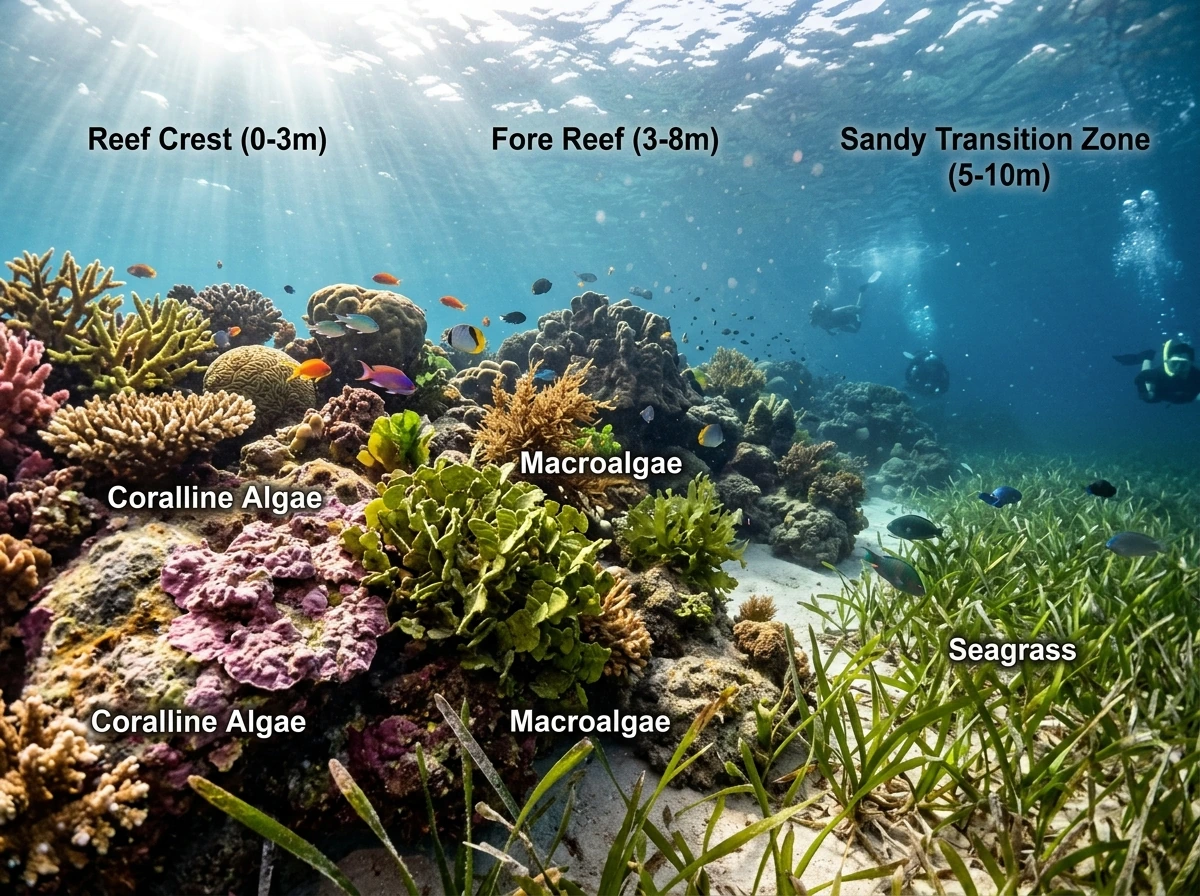
Reef habitats are not uniform. Light, wave energy, and substrate type change dramatically across even a small reef system, and those differences dictate what grows where. The major zones to know are the back reef and lagoon, the reef flat (reef crest), the fore reef, and the deeper mesophotic zone.
Lagoon and back reef
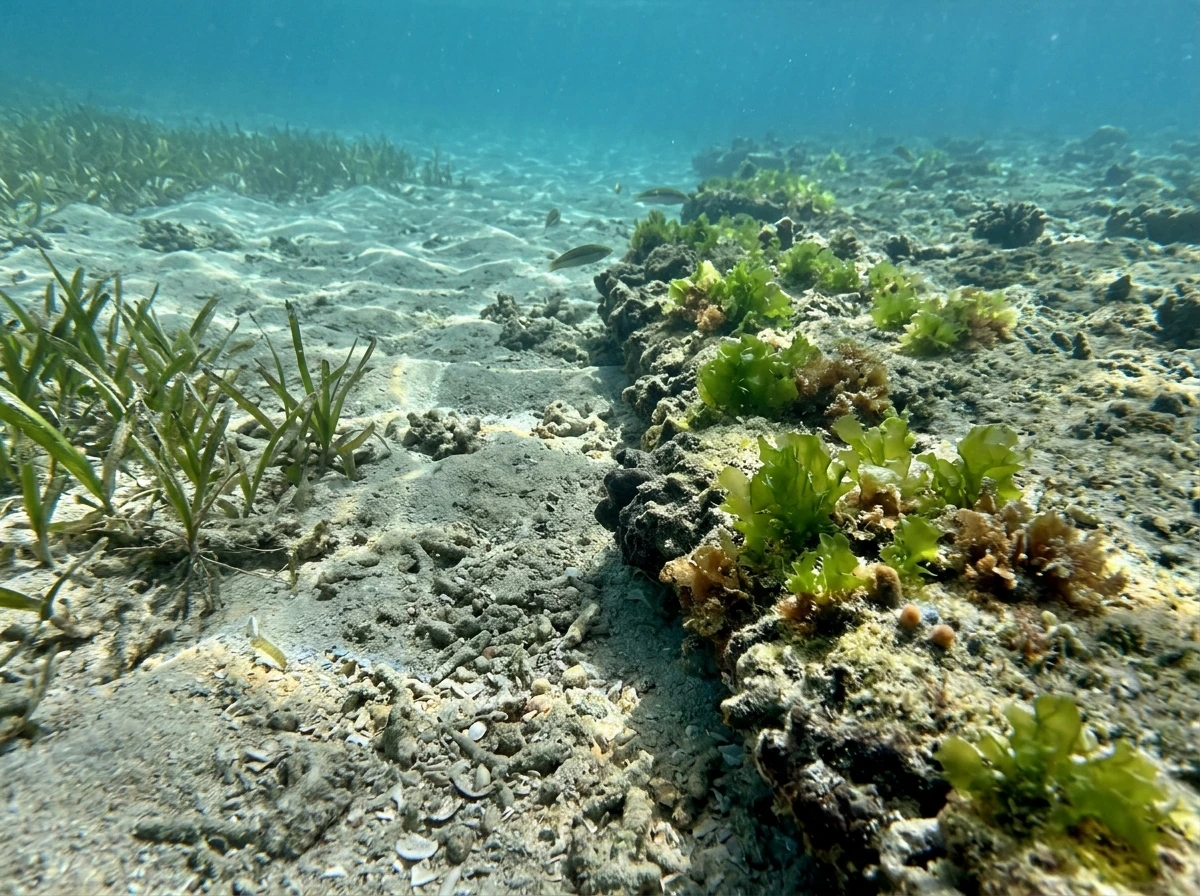
The lagoon is the shallow, protected area between the shoreline and the main reef structure. It typically has sandy or rubble substrate, calm water, and high light penetration. This is where you find seagrass beds mixed with patch reefs and sandy flats. Turf algae coat most hard surfaces. Because wave energy is low and sediment accumulates here, it is also where cyanobacterial mats are increasingly common, especially in areas affected by nutrient runoff.
Reef flat and reef crest
The reef flat is the shallowest, most wave-exposed part of the reef. Light is intense and wave energy is high. Coralline algae (which deposit calcium carbonate) are major inhabitants here, effectively cementing the reef structure. Turf algae form dense carpets on any available hard substrate. Larger macroalgae like Sargassum and Dictyota also appear on the reef flat when herbivore populations are low enough to allow them.
Fore reef and deeper walls
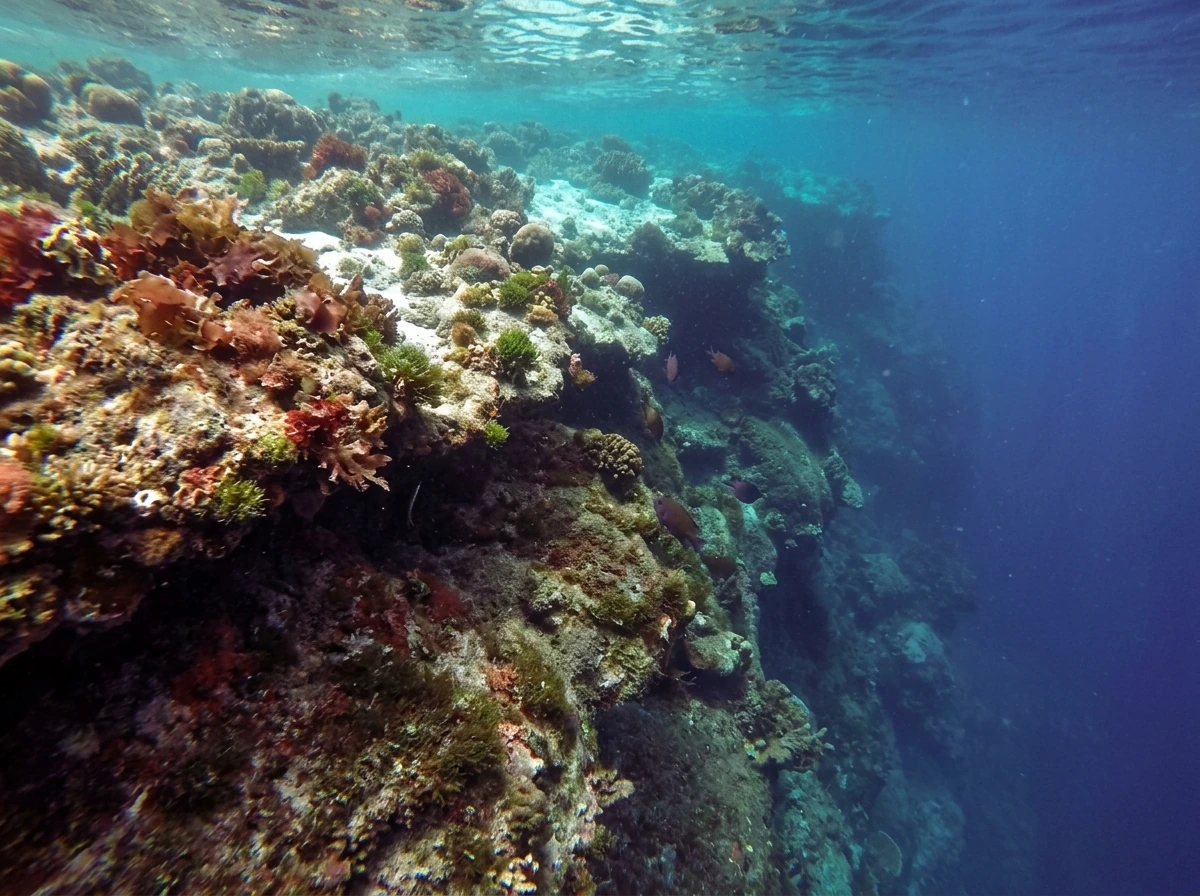
As depth increases on the fore reef, light decreases and sediment influence increases. Coral cover tends to be highest in the upper fore reef where light is still strong, then transitions to more algae-dominated communities deeper down. In mesophotic zones (roughly 30 to 150 meters), light is low enough that specialized algae take over. Mesophotic habitat mapping at places like Flower Garden Banks has identified distinct algal nodule habitats and coralline algal reef classes at these depths, showing that algae remain the dominant primary producers even where coral thins out.
The algae of coral reefs: macroalgae and microalgae
Algae on a reef split broadly into macroalgae (visible to the naked eye, sometimes large and structurally complex) and microalgae (microscopic, forming films, mats, or living inside other organisms). Both groups matter enormously to reef health.
Macroalgae you'll actually recognize
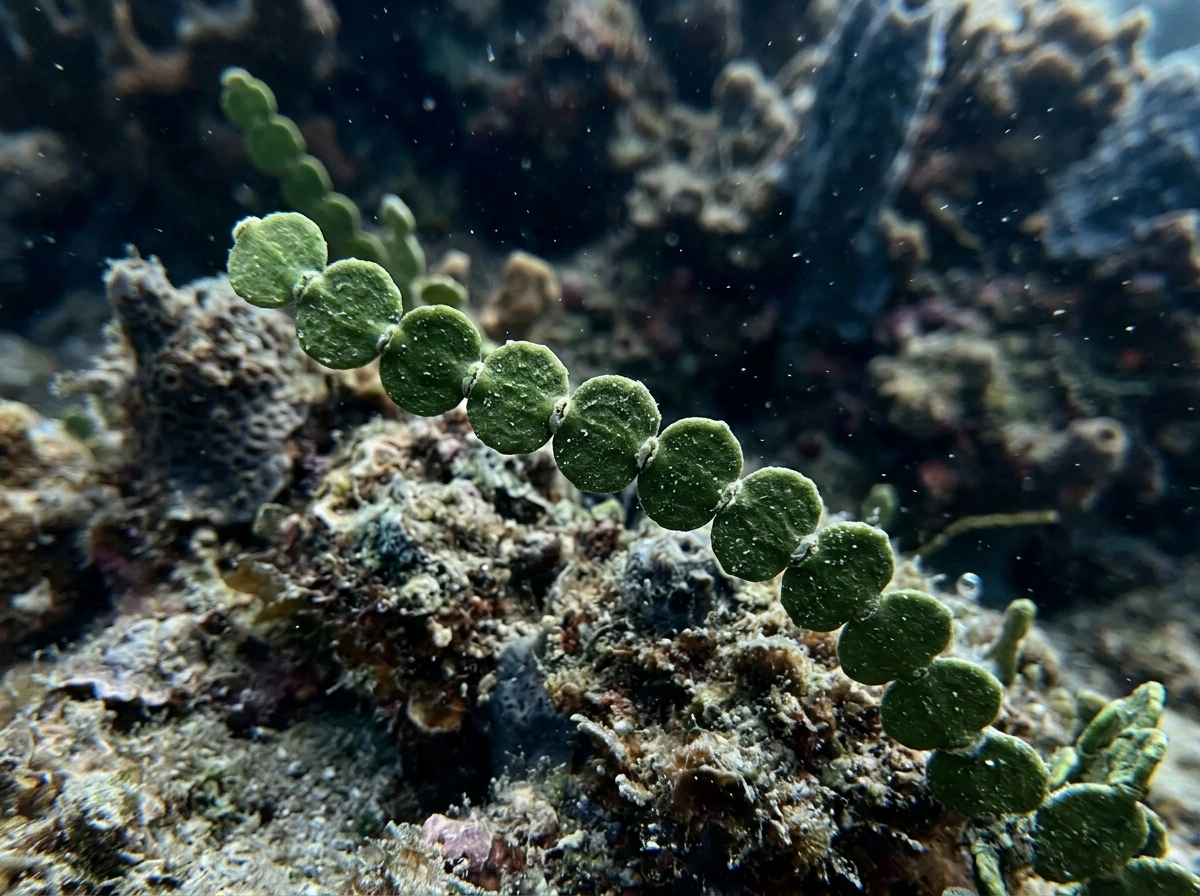
Macroalgae are the seaweeds, the growth you can pick up and examine. On coral reefs, the most commonly encountered genera include:
- Halimeda: calcified green alga that looks like a chain of small discs; one of the most abundant reef macroalgae and a major contributor to reef sediments
- Dictyota: a flat, forked brown alga common on Caribbean reefs, often dominant where herbivore grazing pressure is reduced
- Sargassum: a bushy brown alga with distinctive gas-filled floats; grows attached to reef substrates and also drifts in open water
- Chlorodesmis: a tuft-forming green alga sometimes called turtle weed, found in shallow reef areas
- Dictyosphaeria: a green bubble alga that can form large colonies on degraded reefs, often associated with elevated nutrient conditions
- Coralline algae (crustose): red algae that deposit calcium carbonate and form hard pink crusts on virtually all reef surfaces; critical to cementing reef structure
Turf algae deserve a separate mention because they are everywhere on reefs and often overlooked. Turf algae are not a single species but a mixed community of short (typically under 1 cm), fast-growing filamentous algae that colonize any available hard substrate. They are the first thing to grow on a cleared patch of reef and are constantly being grazed by fish and urchins. Where grazing pressure drops, turf gives way to larger macroalgae.
Microalgae and cyanobacteria
Microalgae include diatoms, dinoflagellates, and other single-celled photosynthesizers. On reef surfaces and sediments, diatoms form thin films that are an important food source for small invertebrates. Water clarity directly controls which diatom communities establish: turbid, eutrophied water shifts benthic microalgal composition significantly compared to clear, oligotrophic reef water.
Cyanobacteria (sometimes called blue-green algae, though they are technically bacteria) are a growing concern on reefs worldwide. Benthic cyanobacterial mats are increasing in abundance on coral reefs and can smother both coral and other algae. These mats fix atmospheric nitrogen, which can further fuel their own growth and that of other opportunistic algae. Their increase is strongly linked to elevated nutrients and disturbed reef conditions, so seeing extensive cyanobacterial mats is a useful field indicator of environmental stress. Reef monitoring programs now specifically track their spread.
Seagrasses: the actual flowering plants of reef systems
Seagrasses are the true vascular plants most tightly linked to coral reef ecosystems. They do not grow on the reef itself (they need soft substrate to root in), but seagrass meadows in the lagoon and back-reef zones are ecologically inseparable from reef function. They stabilize sediment, produce oxygen, and provide habitat for juvenile fish and invertebrates that eventually move onto the reef. Seagrasses are the true vascular plants most tightly linked to coral reef ecosystems. They do not grow on the reef itself (they need soft substrate to root in), but seagrass meadows in the lagoon and back-reef zones are ecologically inseparable from reef function. They stabilize sediment, produce oxygen, and provide habitat for juvenile fish and invertebrates that eventually move onto the reef. If you're researching plants that grow in coastal areas are called, our related coverage on what plants grow in the ocean covers the full global picture.
Which seagrass species grow near coral reefs
In the Western Atlantic and Caribbean reef regions, the most commonly encountered seagrasses are Thalassia testudinum (turtle grass), Syringodium filiforme (manatee grass), Halodule wrightii (shoal grass), and Halophila species. Each occupies a slightly different depth and disturbance niche.
| Species | Common Name | Depth Range | Key Conditions |
|---|---|---|---|
| Halodule wrightii | Shoal grass | Very shallow (intertidal to ~3 m) | High light, tolerates disturbance and exposure; often a pioneer species |
| Thalassia testudinum | Turtle grass | Shallow to mid-depth (~1–4 m) | High to moderate light, stable salinity, sandy/muddy substrate; the dominant species in calm lagoons |
| Syringodium filiforme | Manatee grass | Shallow to moderate depth (~1–5 m) | Similar to turtle grass but often found slightly deeper or in mixed beds |
| Halophila species | Paddle grass / Star grass | Moderate to deeper depths (~1–15+ m) | Lower light tolerance than other species; found deeper than Thalassia where enough sunlight reaches |
The depth zonation pattern matters for identification. In a typical Florida or Caribbean lagoon, you might wade through Halodule in the shallowest, most disturbed fringe, transition into dense Thalassia beds in the calm mid-lagoon, and find Halophila at the deeper, darker edge where other species can no longer get enough light. Seagrass distribution is almost entirely driven by light availability: different species have different minimum light requirements, and those thresholds determine where each species can establish and persist.
Seagrasses also support their own community of attached organisms called epiphytes, which include microalgae, macroalgae, and bacteria growing directly on the leaf blades. A seagrass blade is not just one plant: it is a miniature habitat in its own right.
Mangroves and the shoreline plants tied to reef systems
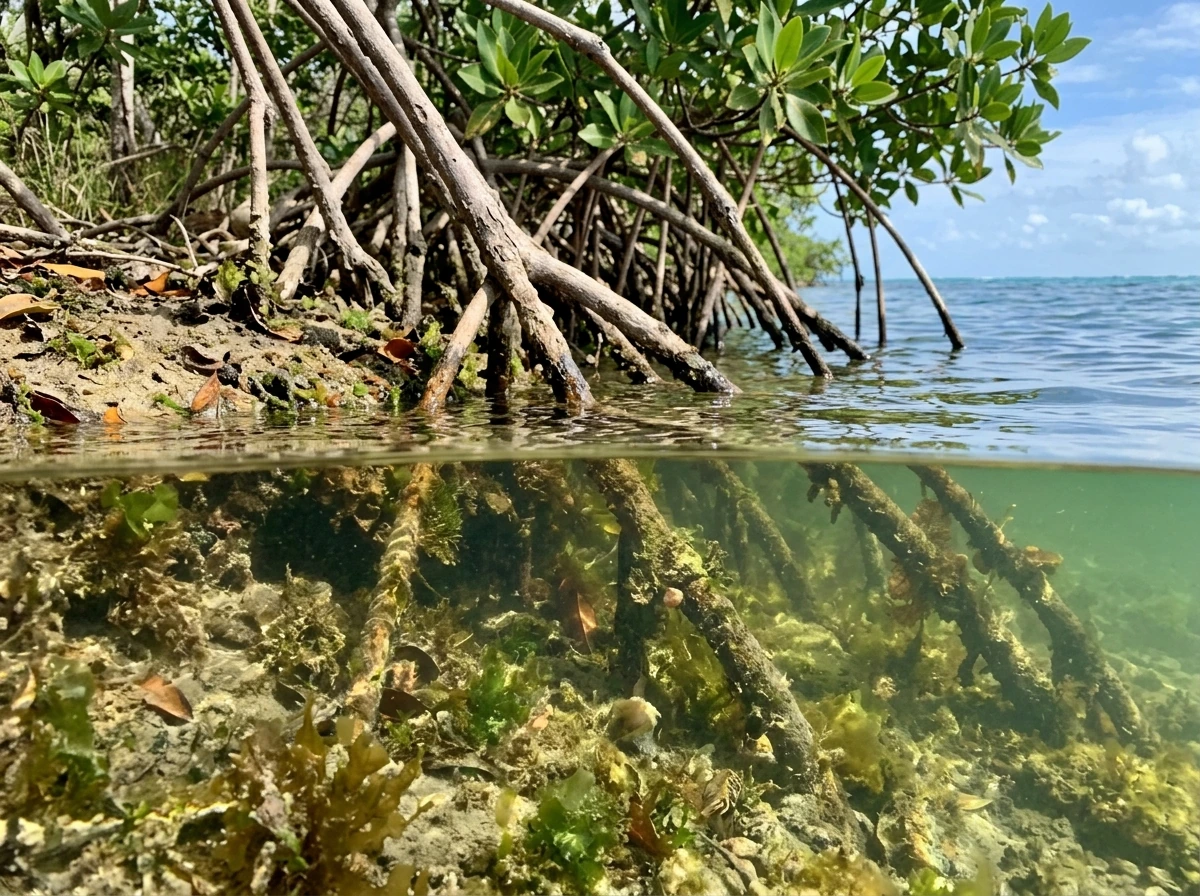
Mangroves are not reef plants in the strict sense, but they are functionally part of the reef ecosystem in tropical and subtropical regions. They grow at the water's edge, rooted in the intertidal zone landward of seagrass beds, which are landward of the reef. The connectivity matters: mangroves serve as nursery habitat for juvenile fish that migrate to the reef as adults. Water filtered through mangrove roots carries reduced sediment loads to the reef. Where mangroves are removed, reefs often show degraded water quality and reduced fish populations.
In the Gulf of Mexico and Caribbean region, four mangrove species are regularly recorded: red mangrove (Rhizophora mangle), black mangrove (Avicennia germinans), white mangrove (Laguncularia racemosa), and button mangrove (Conocarpus erectus). Each occupies a slightly different position relative to the water.
- Red mangrove (Rhizophora mangle): the waterward species, recognized by its distinctive arching prop roots that extend into the water; this is the one you see standing in the water along reef-adjacent shorelines
- Black mangrove (Avicennia germinans): grows slightly higher in the intertidal zone than red mangrove; identified by pneumatophores (small pencil-like aerial roots) poking up from the mud around the base
- White mangrove (Laguncularia racemosa): grows higher still, often at the landward fringe of the mangrove forest; lacks the distinctive prop roots or pneumatophores of the other two
- Button mangrove (Conocarpus erectus): the most landward and least salt-tolerant; found at the upland edge and not always considered a true mangrove
If you're researching plants that grow in coastal areas more broadly, that topic connects directly to the mangrove-seagrass-reef continuum discussed here. Coastal plant ecology and reef ecology are inseparable at the shoreline edge, which is why reef assessments routinely include adjacent mangrove and seagrass habitat mapping.
How to identify reef plants when you're actually there
Whether you're snorkeling, doing a boat survey, or standing on a shoreline with reef habitat in front of you, a few practical cues will help you sort out what you're looking at.
Visual field cues for algae
- Color alone is unreliable for reef algae: green, brown, and red algae can all look similar under water. Focus on structure instead.
- Calcified, disc-chained structures on hard substrate = Halimeda; this is one of the easiest reef macroalgae to ID
- Flat, forked, ribbon-like brown fronds = likely Dictyota; very common on Caribbean reefs
- Bushy brown growth with small berry-like floats = Sargassum
- Pink or lavender crust on rock = crustose coralline algae; rub it gently and it feels hard, not fleshy
- Dark green or purple-black slimy mats on sediment or rubble = cyanobacterial mat; a sign of stressed reef conditions
- Short (under 1 cm), mixed filamentous fuzz on every hard surface = turf algae; ubiquitous background growth
Visual field cues for seagrasses
- Wide, flat, ribbon-like green blades (often with brown epiphyte coating) rooted in sand = turtle grass (Thalassia); the most recognizable seagrass in the Caribbean/Florida region
- Cylindrical, spaghetti-like green blades in the same habitat = manatee grass (Syringodium); the round cross-section is the key trait
- Very narrow, flat blades in disturbed shallow water = shoal grass (Halodule); often pioneers on bare sand
- Small, oval paddle-shaped leaves on a thin stem = Halophila; found deeper or in lower-light conditions
Environmental clues that predict what you'll find
Before you even look at specific species, the local conditions will tell you a lot. Clear, warm (above 20°C), saline tropical water with good light penetration is the baseline for reef algae diversity. Turbid water shifts communities toward stress-tolerant microalgae and cyanobacteria. Shallow, sandy substrate in a calm lagoon almost always means seagrass somewhere nearby, especially if the water is oligotrophic (low nutrients). The presence of prop roots at the shoreline tells you red mangrove is there, and that a seagrass-reef continuum likely follows seaward.
Finding local examples and matching conditions
If you want to see reef plants in person or document what's in a specific location, a few practical tools and approaches will get you there faster than any textbook.
- Use iNaturalist to search observations tagged in reef-adjacent coastal areas. Filter by taxon (search Halimeda, Thalassia, or Sargassum) and map view to see what has been recorded near your target location. The community ID feature means most photos are verified by other naturalists.
- Look up NOAA's benthic habitat maps for U.S. reef regions (Florida Keys, Puerto Rico, U.S. Virgin Islands, Hawaii, and Pacific territories all have mapped data). These maps show which substrate types, including seagrass beds, macroalgae zones, and rubble patches, occur where in the mapped reef system.
- Check REEF (Reef Environmental Education Foundation) survey data for diver/snorkeler observations in your area. REEF surveys are done by volunteers using standardized methods and can show you which organisms have been recorded at specific dive sites.
- For seagrass identification in the field, Florida International University (FIU) has published identification keys for Western Atlantic seagrass species that use leaf blade shape and other structural traits. These are practical enough to use while wading in a seagrass bed.
- Match your location's conditions to expected species before you go: water temperature consistently above 20°C, salinity around 35 ppt, and clear water with light reaching the bottom are the baseline conditions for full reef-associated plant diversity. If your target area has elevated nutrients or turbidity (from river input or development), expect fewer seagrass species and more cyanobacterial mat presence.
- For habitat simulation or educational purposes (aquaria, classroom models), note that the reef-plant community you want to replicate depends entirely on which zone you're modeling. A lagoon simulation needs fine sandy substrate, calm conditions, and moderate light for seagrasses. A reef flat simulation needs hard substrate, strong flow, and intense light for coralline and turf algae. Getting the substrate and light right is more important than species selection alone.
The reef-plant picture is broader than most people expect when they first ask the question. Algae are the engine, seagrasses are the meadow, and mangroves are the boundary wall. Each zone has its own set of species tied to its specific light, substrate, and disturbance conditions, and once you start reading those environmental cues, what grows where stops being a mystery and becomes predictable.
FAQ
How can I tell if what I’m seeing is seagrass or algae?
Look for the difference between leaf-like blades and film-like growth. Seagrasses have true leaves and roots/rhizomes anchored in soft sediment, while most green patches on the hard reef are algae (turf algae films or macroalgae seaweeds) that do not pull up with roots or rhizomes.
What do cyanobacterial mats look like, and are they really algae?
Yes, cyanobacteria can look like algae but they are bacteria, and they often form thicker, dusty, or mat-like coatings on surfaces. If it smothers coral or builds extensive patches after nutrient spikes or disturbances, treat it as a cyanobacterial mat, not a typical seaweed.
Do any plants keep growing deeper than the main reef?
Corals often thin out with depth, but “no plants” is the wrong expectation. In mesophotic zones, specialized algae, including coralline algae and algal nodule habitats, tend to dominate as light drops.
Why does my reef look covered in “weeds” that never grow tall?
Most people miss turf algae because it is short and forms dense, fast-growing carpets. If you see a uniform, fuzzy or bristly surface under a reef rock, often changing with grazing pressure, you are likely looking at turf algae rather than one large seaweed species.
What factors most determine where algae or seagrass will grow?
Measure (or at least estimate) light and water clarity before assuming species. Light limitation strongly controls seagrass presence and depth range, and turbid or nutrient-rich water can shift benthic communities toward stress-tolerant microalgae and cyanobacteria.
Can seagrass grow directly on the reef rock?
Seagrasses usually require soft substrate, so you should not expect rooted seagrass directly on exposed reef rock. Instead, check nearby lagoon or back-reef areas with sand or rubble, where seagrass can anchor.
Do surveys include mangroves and seagrass when people ask what “plants” grow on the reef?
Yes. Reef surveys can include adjacent habitat types, but the field note should separate benthic producers: reef rock communities tend to be algae-dominated, while seagrass is found in lagoon or back-reef soft bottoms and mangroves at the intertidal shoreline edge.
How does removing mangroves affect the plants and algae on the reef?
They are functionally connected, but not “on the reef” in the same way. If mangroves are present, expect improved nursery habitat and filtered sediment, which can support healthier water conditions for seagrass and clearer conditions for reef producers.
What quick checklist can I use while snorkeling to guess what zone I’m in?
You can use a simple cue stack: clear water plus calm sandy lagoon signals seagrass nearby, wave-exposed reef crest signals more coralline and turf algae, and prop roots at the shoreline signals mangrove presence. Combining these cues gives a better ID than relying on color alone.
Why do different “green” patches on reefs look similar but seem to be different organisms?
Because many species look similar at a distance, focus on habitat structure and attachment. Macroalgae are often larger and 3D, turf algae are short and carpet-like, microalgae are films that may be hard to see without close inspection, and cyanobacterial mats are patchy and can smother.