Several distinct groups of plants grow in the ocean, and the most important ones to know are seagrasses, seaweeds (macroalgae), and free-floating algae like Sargassum. Plants that grow in coastal areas are called coastal plants, and they include the major groups covered in this guide. These are not the same thing, and understanding the difference tells you a lot about where to find them, how they survive, and what role they play in the ocean ecosystem. If you're a student, a gardener exploring marine habitats, or someone trying to understand what's growing along a coastline, this guide gives you a practical, habitat-based breakdown of what actually grows where and why.
What Plants Grow in the Ocean and How They Grow

Dr. Marcus Weatherby
24 Mar 2026
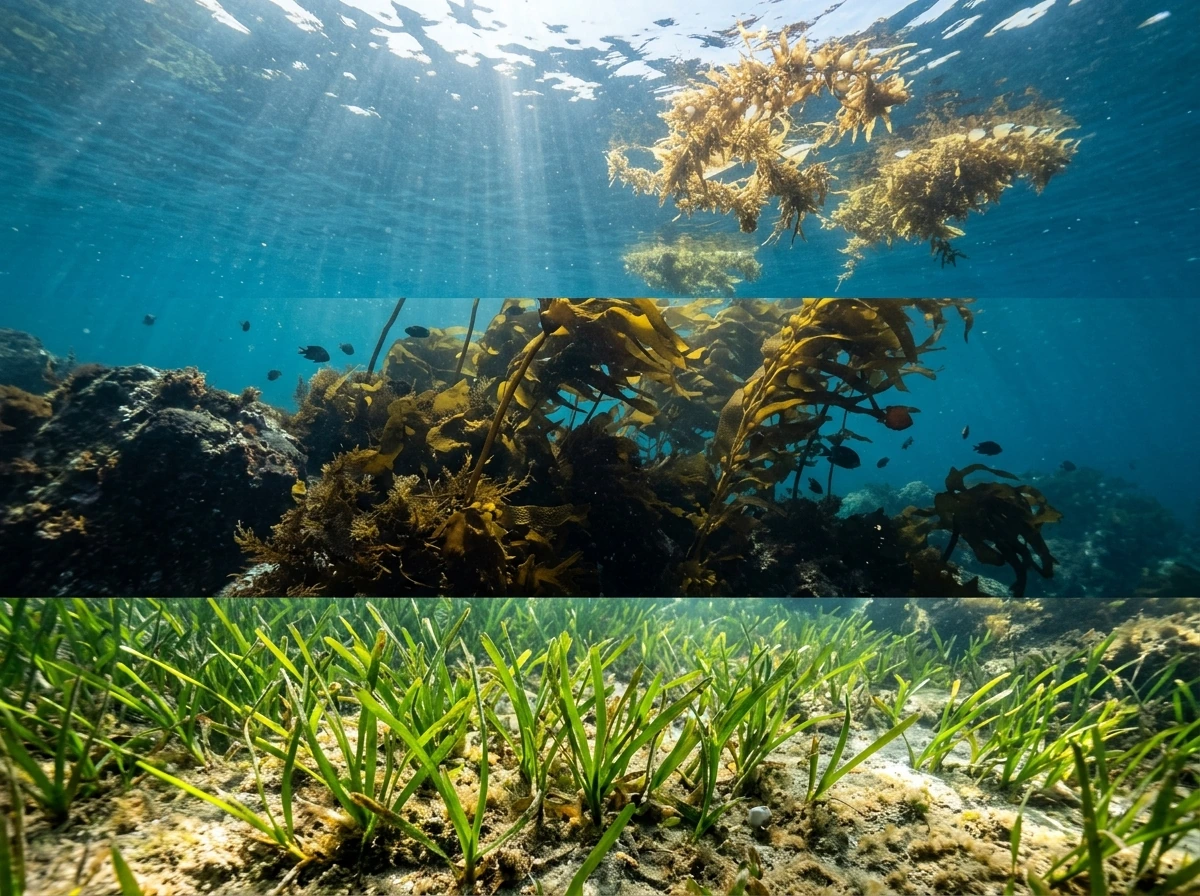
The main types of ocean plants
When people ask what plants grow in the ocean, they usually picture green, leafy stuff swaying underwater. That covers a few very different organisms that are worth separating out clearly.
Seagrasses: the ocean's only true flowering plants
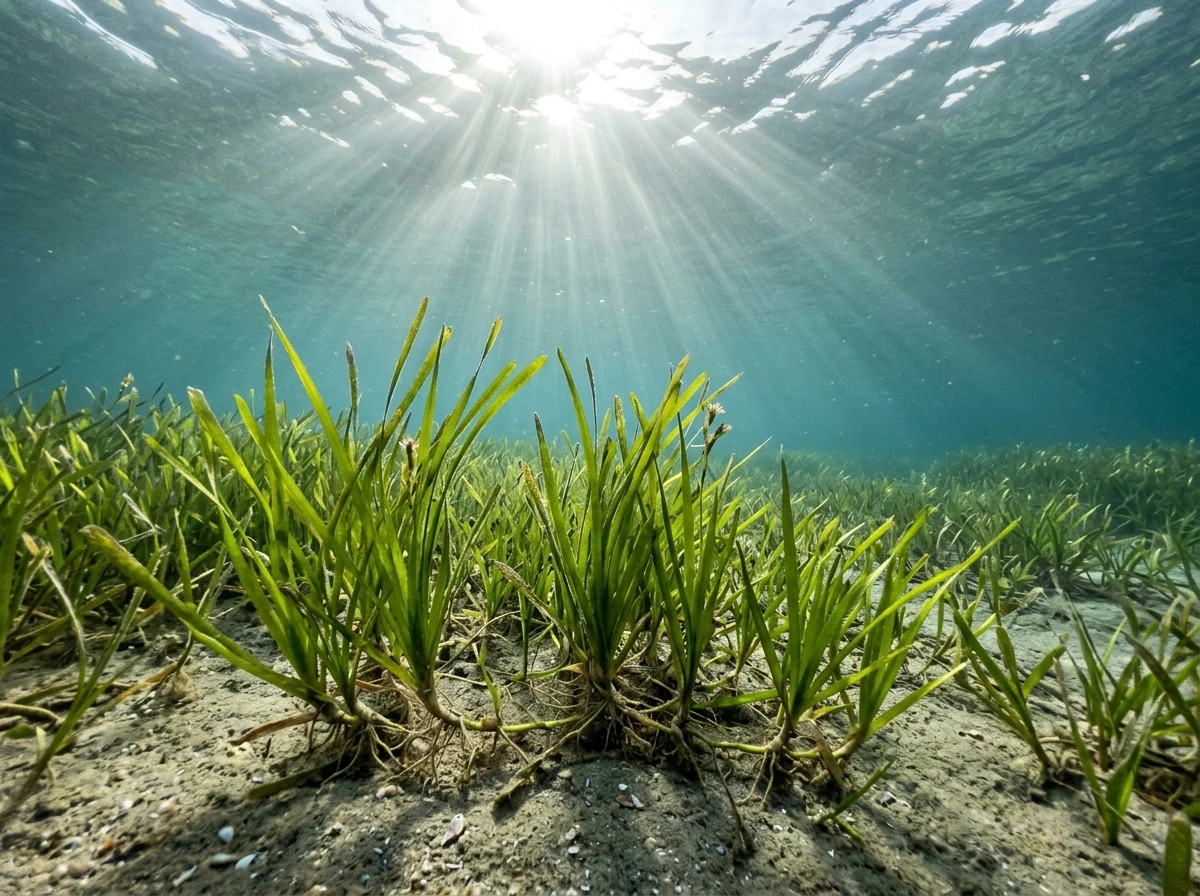
Seagrasses are the only genuine flowering plants living in the sea. They're angiosperms, meaning they produce flowers, seeds, and fruit, just like land-based flowering plants. They have real root systems, grow anchored in sandy or muddy sediments, and form dense underwater meadows in shallow coastal waters. You'll find species like eelgrass (Zostera marina) in temperate and cold-water coasts, turtlegrass (Thalassia testudinum) in tropical shallows like Florida Bay, and shoalgrass (Halodule wrightii) in extremely shallow, early-colonizer habitats. Seagrasses live fully submerged, from intertidal zones (sometimes exposed at low tide) through subtidal depths wherever enough light reaches the bottom.
Seaweeds and macroalgae: the holdfasts crew
Seaweeds are macroalgae, not true plants. They don't flower, don't produce seeds, and don't have real roots. Instead of roots, they use structures called holdfasts that anchor them to rocks, reefs, or other hard substrate. Britannica notes that seaweeds are generally anchored to the sea bottom or other solid structures by rootlike holdfasts that provide attachment but do not extract nutrients like roots of higher plants holdfasts that anchor them to rocks, reefs, or other hard substrate. They reproduce via spores or fragmentation, not flowering. Seaweeds come in three broad color groups: green algae (common in shallow, bright water), brown algae (including kelp forests in cold coastal zones), and red algae (which can tolerate lower light and grow somewhat deeper). Each group occupies a different niche along the coast or in the open water.
Sargassum: the free-floaters
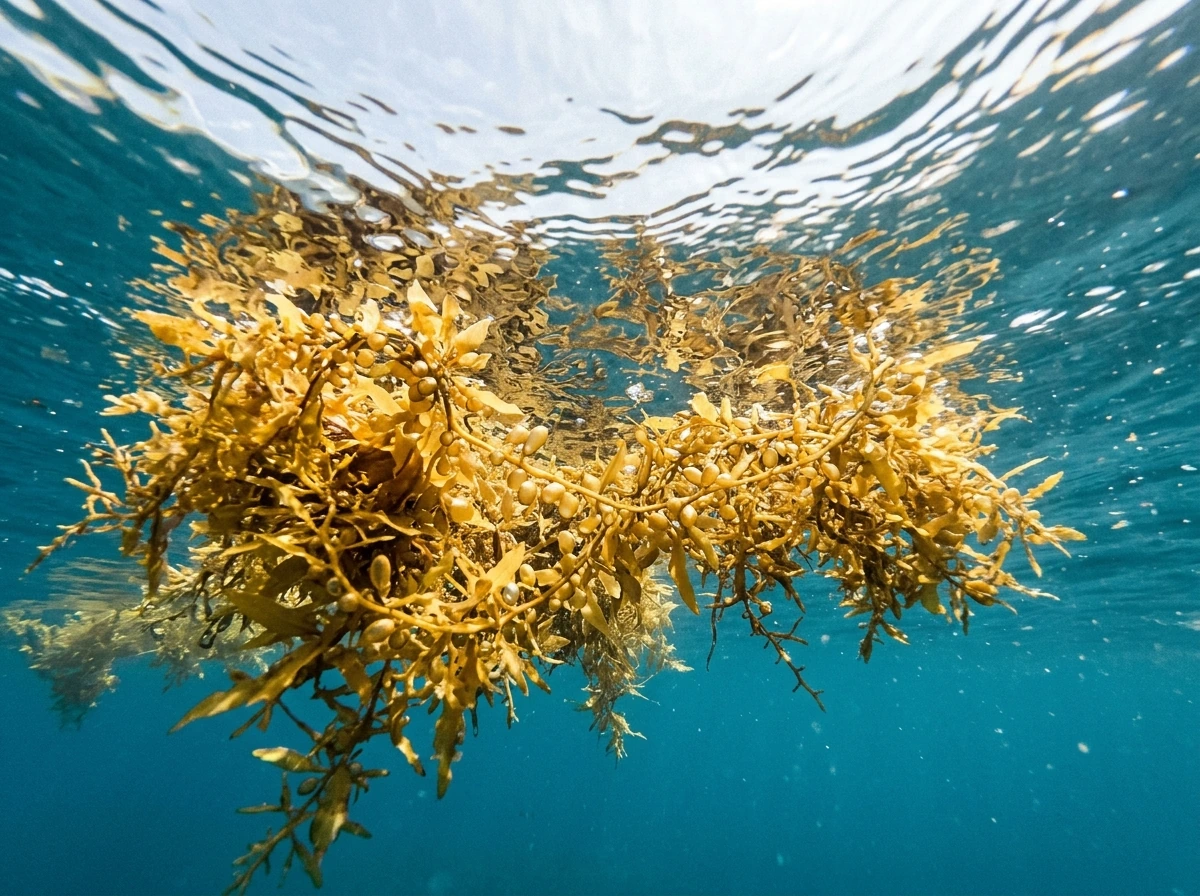
Sargassum is a genus of brown algae worth calling out separately because it doesn't follow the usual rules. Some Sargassum species spend their entire lives free-floating at the ocean surface, kept afloat by small air-filled pods called pneumatocysts. You'll spot it as golden-brown mats or weedlines drifting near the surface, especially in warm Atlantic waters. It never attaches to the seafloor. If you see floating mats of brown seaweed offshore, that's almost certainly Sargassum, not a seagrass bed.
Phytoplankton: the invisible ocean plant layer
Phytoplankton are microscopic algae suspended in the water column. They're not visible as individual plants, but they drive a huge portion of ocean photosynthesis and form the base of most marine food webs. When conditions are right (warm water, plenty of nutrients), phytoplankton populations can explode into harmful algal blooms, sometimes coloring the water red, green, or blue-green and producing toxins. These are not plants you can see or identify individually, but they're a major part of the answer to 'what grows in the ocean.'
How ocean plants actually grow: light, nutrients, and staying put
Growing in seawater creates a very specific set of challenges. Here's how the main ocean plant types handle them.
Light: the biggest limiting factor
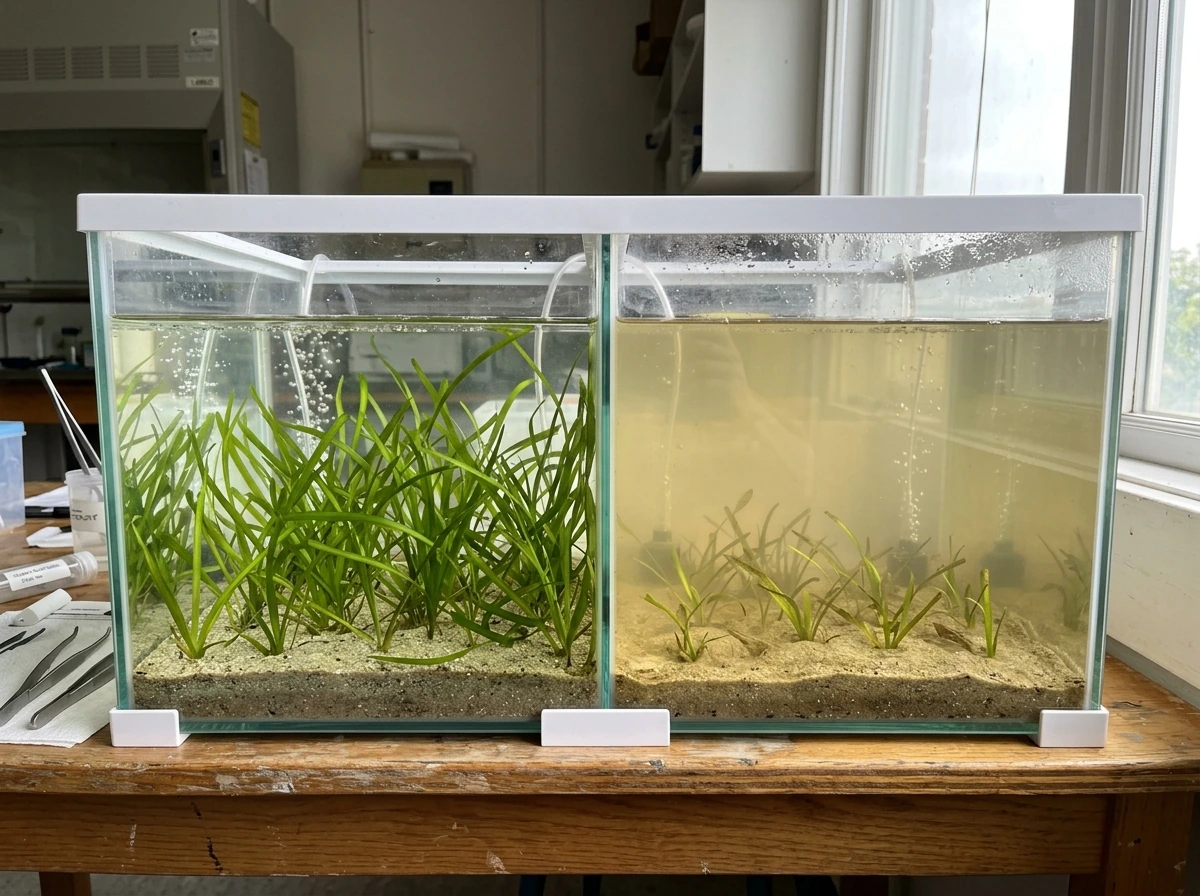
Every ocean plant that photosynthesizes needs sunlight, and seawater absorbs light quickly with depth. The euphotic zone is the upper portion of the water column that receives enough light for photosynthesis to outpace respiration, roughly defined as the layer receiving at least about 1% of surface light. Below that threshold, a plant burns more energy than it can produce. For seagrasses, this means they can only grow where the euphotic zone actually reaches the seafloor. In murky water, that might be just a meter or two. In very clear tropical water, it can extend to 30 meters or more. Water clarity is often measured using a Secchi disk: when you can no longer see the disk at depth, the water is too murky to support seagrass photosynthesis. Algal blooms and water pollution make this worse by blocking light from reaching the bottom, which is one of the main ways seagrass beds are lost.
Nutrients and root vs holdfast strategies
Seagrasses pull nutrients from both the water column and the sediment through their root systems, similar to how terrestrial plants feed through soil. plants that will grow in sand Macroalgae absorb nutrients directly from the surrounding seawater through their entire surface, since they don't have true roots. Sargassum does the same thing while drifting on the surface, feeding off nutrients in open ocean waters. This difference in nutrient strategy is a major reason why seagrasses are tied to specific substrate types (sand and mud beds) while many algae are happy on bare rock or floating freely.
Buoyancy and anchorage
Seagrasses stay put. They're rooted in sediment and their leaf blades extend upward through the water, flexing with currents. Most macroalgae anchor via holdfasts to hard substrate. Sargassum solves the buoyancy problem entirely differently, using those air-filled pneumatocysts to stay at the surface without any anchorage at all. Understanding this helps you predict where each type will show up: rooted seagrass in soft-bottom shallows, attached kelp on rocky coastlines, drifting Sargassum in open water.
Reproduction and spread
Seagrasses reproduce both sexually (via flowers, pollen carried through water, seeds) and asexually (via underground rhizome spread). Turtlegrass typically flowers from April through July depending on the location. Some temperate eelgrass species flower across an eight-month window from spring into late autumn. This means seagrass meadows expand slowly over time by rhizome growth and fill gaps via seed. Macroalgae spread faster, reproducing via spores and fragmentation. A chunk of broken Sargassum can drift and continue growing. This makes algae generally more opportunistic colonizers while seagrass meadows are more stable but slower to recover once disturbed.
Where ocean plants grow: coast, depth, and water conditions
Coastal vs open ocean
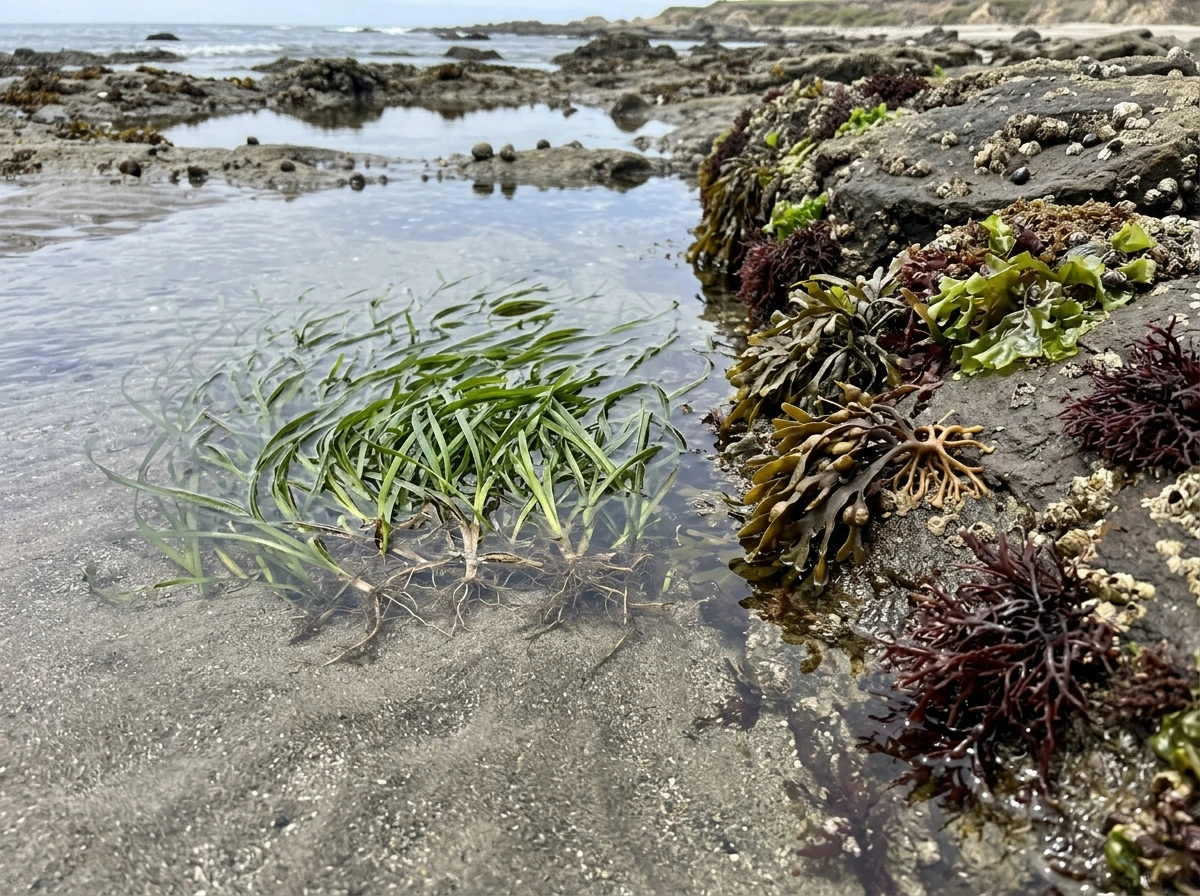
Almost all macroscopic ocean plants (the ones you can actually see) grow in coastal zones, not the open ocean. Seagrasses are strictly coastal and estuarine, needing shallow, protected, nearshore habitats with soft sediment and enough light reaching the bottom. Kelp and most seaweeds hug rocky coastlines. Even Sargassum, though it can drift far offshore in the open Atlantic, is most densely encountered near the surface in warm coastal and subtropical waters. The open deep ocean, below the euphotic zone, is essentially plantless at the macroscopic scale.
Depth zones and light limits
Depth is really just a proxy for light availability. In turbid estuaries, seagrass may only grow down to 1 to 2 meters. In the crystal-clear waters of the Florida Keys or Caribbean, tropical seagrass species can extend to 30 meters or beyond. For attached macroalgae, the pattern is similar: green algae dominate the shallowest, brightest zone; brown algae (including kelp) fill mid-depths; red algae, which can use the blue-green light wavelengths that penetrate deepest, can grow in somewhat deeper or lower-light conditions than greens or browns.
Salinity and temperature ranges
Seagrasses are sensitive to both salinity and temperature fluctuations. Different species have different tolerances. Eelgrass (Zostera marina) has a relatively wide temperature tolerance, with optimal photosynthesis occurring between roughly 10 and 25°C. Below or above that range, growth slows significantly. Halodule wrightii, a subtropical and tropical species, shifts in distribution with salinity gradients and has been recorded at salinities as low as around 11 to 14 ppt in estuarine areas, well below full ocean salinity of around 35 ppt. Eelgrass seed germination actually increases with decreasing salinity and rising temperature, which helps explain why new seedlings often establish in brackish transition zones. Sharp drops or spikes in either salinity or temperature can stress or kill seagrass beds.
Substrate: what the bottom looks like matters
Seagrasses need soft sediment: sand or mud bottoms where roots can anchor and rhizomes can spread. Seagrasses can be a good match if you're specifically looking for plants that will grow in sand where they can anchor and spread. Shoalgrass is often the first species to colonize in extremely shallow, disturbed, or marginal areas. Turtlegrass tends to colonize more stable, deeper sandy areas once pioneer species have established. Macroalgae (kelp, rockweed, etc.) need hard substrate: boulders, bedrock, or reef. If the bottom is bare sand with no rock, don't expect kelp. Sargassum needs no substrate at all.
What grows where by climate and season
Location and season change the picture significantly. Here's a practical breakdown by climate zone.
| Climate Zone | Main Ocean Plant Types | Key Species Examples | Best Observation Season |
|---|---|---|---|
| Cold/Arctic coastal | Brown macroalgae (kelp, rockweed), some eelgrass | Laminaria (kelp), Fucus (rockweed), Zostera marina | Late spring through early autumn |
| Temperate coastal (e.g., US East/West Coast, NW Europe) | Eelgrass meadows, kelp beds, green/red algae on rocks | Zostera marina, Macrocystis (giant kelp, Pacific), Ulva (sea lettuce) | Spring through autumn; eelgrass flowers spring–summer |
| Subtropical (e.g., Florida, Gulf of Mexico, Mediterranean) | Mixed seagrass beds, diverse macroalgae, Sargassum offshore | Halodule wrightii, Thalassia testudinum (turtlegrass), Syringodium filiforme | Year-round; turtlegrass flowers April–July |
| Tropical (e.g., Caribbean, Indo-Pacific) | Dense tropical seagrass meadows, coral-associated algae, Sargassum | Thalassia testudinum, Halophila species, Enhalus | Year-round; peak growth in warmer months |
| Open ocean (subtropical gyres) | Free-floating Sargassum | Sargassum natans, Sargassum fluitans | Spring–summer peak; lower biomass in autumn |
Seasonal timing matters most in temperate and cold zones. Eelgrass beds along the US East Coast and Pacific Northwest are most lush and visible from late spring through early autumn. In winter, above-ground biomass drops significantly even though roots and rhizomes persist. Sargassum biomass offshore peaks in spring and summer aligned with its reproductive season, then decreases sharply in autumn. Tropical seagrass systems (turtlegrass beds in the Caribbean and Florida) are more consistent year-round, though flowering peaks occur from April to July.
If you're exploring coastal habitats in colder climates, late spring through early summer is when you'll find the widest variety and the most visible growth. In subtropical and tropical zones, any time of year works, but water clarity is often best in the dry season when storm-driven turbidity is lower.
How to identify ocean plants when you're in the water or on the shore
You don't need a field guide to tell the major types apart. Here's what to look for.
Signs you're looking at a seagrass bed
- Long, flat, ribbon-like or strap-shaped green blades growing from a sandy or muddy bottom in shallow, sheltered water
- Blades rooted in place, not drifting: they sway with current but stay anchored
- Dense meadow appearance, sometimes covering large areas of seafloor in clear, calm bays and estuaries
- Often in water shallow enough to wade (knee to shoulder depth), though some species grow deeper in clear water
- May show epiphytic algae (a thin coating of algae) growing on the blades themselves, which is normal
Signs you're looking at seaweed or macroalgae
- Attached to rocks, reef, or hard substrate with no visible roots, just a holdfast point
- Variable shapes: fan-shaped, branching, sheet-like (sea lettuce), rope-like, or blade-like (kelp)
- Often found in rocky intertidal zones exposed at low tide, or in surge channels and tidal pools
- Color varies: bright green in shallowest zones, brown or olive in mid-zones, red or purplish deeper
- Can be found washed up on beaches after storms as drifted wrack
Signs you're looking at Sargassum
- Floating golden-brown mats or clumps at or near the water surface, not attached to anything below
- Small round air-filled pods (pneumatocysts) visible along the branches if you pick a piece up
- Often seen in weedlines or drifting aggregations offshore, or washed up on beaches in windrows
- Does not have any root or holdfast connecting it to the seafloor
Visual water quality clues
If water visibility is poor, turbid, or heavily discolored (green, red, or brown from algal blooms), seagrass is unlikely to be thriving there even if it once did. Clear water where you can see the bottom in 1 to 2 meters or more is the most reliable indicator that conditions could support submerged marine plants. Water that's heavily nutrient-polluted will often show excess free-floating algae (green scum, bloom discoloration) and declining seagrass, because the algae outcompetes seagrass for light.
Supporting ocean plants in aquariums or restoration projects
Whether you're setting up a marine aquarium with live macroalgae or thinking about participating in a seagrass restoration effort, the biology above translates directly into practical decisions. Here's what's realistic.
Marine aquariums: what actually works
Macroalgae are far more practical for home marine aquariums than seagrasses. Species like Chaetomorpha, Caulerpa, and Halimeda are commonly kept in refugiums (a separate lit chamber in the sump) where they absorb excess nutrients and provide a natural biological filter. They need strong, full-spectrum lighting to photosynthesize effectively. The lighting principle from seagrass science applies here: if light intensity drops below the threshold needed to sustain photosynthesis above respiration, the algae will decline rather than grow. Aim for high-output LED or T5 lights with appropriate spectrum and photoperiod (typically 8 to 12 hours per day for a refugium). Avoid lights that are too warm or too dim.
Growing actual seagrasses in aquariums is significantly harder. They require stable, consistent salinity (around 30 to 35 ppt for most marine species), water temperatures within species-specific ranges, strong light reaching a sandy substrate, and water movement that mimics coastal currents. Fluctuations in temperature or salinity that wouldn't trouble a macroalgae setup can quickly damage seagrass. This is not a beginner project, and most aquarists are better served by macroalgae for the practical benefits they provide.
Seagrass restoration: what to know before you start
Seagrass restoration is a real and growing field, but it's regulated and ecologically specific. In the US, transplanting or disturbing seagrass typically requires permits, and guidelines for conservation and restoration of US seagrass species are published and enforced. Restoration works best when the underlying cause of seagrass loss, usually poor water clarity from nutrient pollution or physical disturbance, has already been addressed. Planting seagrass into water that's too murky or too polluted will fail regardless of the effort.
If you're interested in hands-on restoration, the most practical entry point is volunteering with existing coastal restoration programs or monitoring projects. Organizations working on sites like Tampa Bay, Chesapeake Bay, or the Florida Keys have established frameworks and will have you doing real, useful work without risking damage to existing habitat. Anchoring in seagrass beds, walking through them, or collecting seagrass without authorization causes physical damage that takes years to recover. The practical rule: observe, don't disturb.
Setting realistic expectations
Ocean plants, especially seagrasses, are slow to establish and highly sensitive to water quality. A restored seagrass patch in good conditions can expand over years via rhizome growth, but a single pollution event, storm, or prolonged turbidity can wipe out a bed that took decades to form. Macroalgae in aquariums can crash if lighting fails or nutrient levels swing. If you're supporting marine plants in any context, consistency is the most important variable: consistent light, consistent salinity, consistent temperature. These are not forgiving plants when conditions wobble.
For readers interested in what grows in adjacent habitats, the plant communities in sandy coastal shores and the specialized ecology of coral reef-associated plants follow their own rules, and those are worth exploring separately as part of understanding the full coastal plant distribution picture.
FAQ
If I see green stuff underwater, how can I tell whether it is seagrass or seaweed?
Look for anchors and structure. Seagrass usually has a rooted base in sand or mud and blade-like leaves that form meadows, while seaweeds (macroalgae) attach to hard surfaces and often look like fronds or sheets growing from a holdfast. If the “plants” are free-floating mats offshore, they are more likely Sargassum than either seagrass or attached seaweed.
Why do some coasts look covered in algae while nearby areas still have seagrass?
The key difference is how much light reaches the bottom and whether the water stays clear enough. Nutrient enrichment can boost free-floating algae, which shades seagrass and blocks recovery. Even if both areas have similar temperature, seagrass typically disappears first where turbidity or bloom frequency is highest.
Can seagrass grow in rocky areas or on bare rock?
Generally no. Seagrasses require soft sediment (sand or mud) for roots and rhizome spread. If you are surveying and the bottom is mostly rock or boulders, you may see attached macroalgae, but expect seagrass only where soft substrate is present.
What does it mean if I can see the seafloor but seagrass still is not growing?
Light is necessary but not sufficient. Seagrass can fail due to sediment disturbance, chronic salinity or temperature stress, contamination, or repeated physical damage (boats, dredging, heavy storms). In seagrass decline sites, you can often see that light improved but beds still do not return quickly because the habitat conditions and stability have not fully recovered.
How deep can ocean plants grow, and can I estimate it from water clarity?
Depth is mainly limited by the euphotic zone, where enough light supports net photosynthesis. A practical field clue is whether you can see the bottom in roughly 1 to 2 meters in murky water, deeper in very clear water, and the more you notice shading from blooms, the shallower the effective depth limit becomes. In restoration planning, teams often measure water clarity over time, not just once.
Do seagrasses only grow in tropical places because they need warmth?
No. Many seagrasses are temperate or even cold-water adapted, but each species has a different temperature and salinity range. For example, some temperate eelgrasses tolerate broader temperature swings, while subtropical species shift distribution with salinity gradients. So location latitude alone is not enough, you need local water conditions.
Is Sargassum considered harmful, and is it always a sign of a healthy ecosystem?
Sargassum itself is a natural habitat-forming brown algae in the surface waters, but large accumulations can be problematic when they create thick mats. Those mats can deplete oxygen as they decay and can be associated with nutrient-rich conditions depending on location. If you are noticing heavy weedlines, it is worth checking for smell, fish stress, and whether mats persist unusually long.
Why can’t I grow seagrass in a typical aquarium the way I grow macroalgae?
Seagrass needs stable salinity, temperature, and strong light reaching a sand substrate, plus current patterns that mimic coastal flow. In a home tank, small swings in salinity or temperature can damage seagrass quickly, while macroalgae in a refugium may tolerate more variation. Also, seagrass establishes slowly, so “it died right away” is common if conditions are not already tuned.
What water movement and lighting changes make the biggest difference for macroalgae in aquariums?
For macroalgae, prioritize consistent, high enough light over “maximum brightness.” If light intensity drops, algae decline rather than grow, so photoperiod and spectrum matter. Moderate flow also helps by keeping the algae supplied with nutrients and preventing detritus buildup, but the biggest driver is usually whether the lighting sustains net photosynthesis.
How should I participate in seagrass restoration without accidentally harming it?
Choose volunteering activities that do not require walking or anchoring in beds, such as assisting monitoring, water quality measurements, or shoreline-side habitat assessments. Physical contact can damage seagrass leaves and rhizomes, and recovery can take years. Always follow site rules about where you can stand, boat, and sample.
If seagrass beds are gone, will they automatically come back after water gets clearer?
Not automatically. Beds can expand slowly from surviving rhizomes or from nearby seed sources, but repeated disturbance or prolonged instability can prevent reestablishment. Restoration usually needs the underlying cause of loss addressed first, and recovery is measured over years rather than weeks.
What should I do if I suspect a harmful algal bloom near shore?
Avoid contact with discolored water and do not collect or disturb drifting biomass, especially if there is foam, strong odor, or dead fish. Keep pets and swimmers away, and report observations to local environmental or public health authorities. Harmful blooms can change rapidly, so a single snapshot is not enough to judge risk.