Beach sand can grow <a data-article-id="262FFFAE-4483-418A-B1DD-B872436C9FB2">plants that grow in coastal areas are called</a>, but not just any plants. The ones that survive there have evolved specific tricks to handle conditions that would kill most garden species outright: shifting sand underfoot, salt spray in the air, almost zero nutrients, brutal sun, and wind that sandblasts leaves like fine-grit paper. If you want to know what actually grows in beach sand, the honest answer is: it depends entirely on where you are on the beach. The strand right at the water's edge looks nothing like the foredune, which looks nothing like the stabilized backdune. Once you understand those three zones, the right plant list follows naturally.
What Plants Grow in Beach Sand? Guide by Zone and ID
Why beach sand is such a brutal place to grow
Most soil builds up over centuries by accumulating organic matter, nutrients, and structure. Beach sand has almost none of that. Young foredune sand can have organic matter as low as 0.01% by dry weight. That's not a typo. Compare that to a decent garden loam at 3-5% and you get a sense of how extreme the deficit is. Nutrients don't accumulate because rain and wind move them through before roots can hold them. The only real nutrient input in many dune systems comes from sea-salt aerosol, which is also the same thing that burns and desiccates plant tissue.
The stresses stack up fast. Salt spray coats leaves and draws moisture out through osmosis. Wind-driven sand particles physically abrade leaf surfaces, making those salt effects even worse by breaching the waxy cuticle that plants use as a first defense. During dry or low-humidity periods, wind stress intensifies. On top of that, the sand itself moves. Storm tides can rework the entire substrate in a single event, burying or exposing roots overnight. Seeds and seedlings that can't handle burial, salt, drought, and nutrient poverty simultaneously don't make it. The plants you see on a beach are the survivors of all of that at once.
The three zones of a beach, and what grows in each
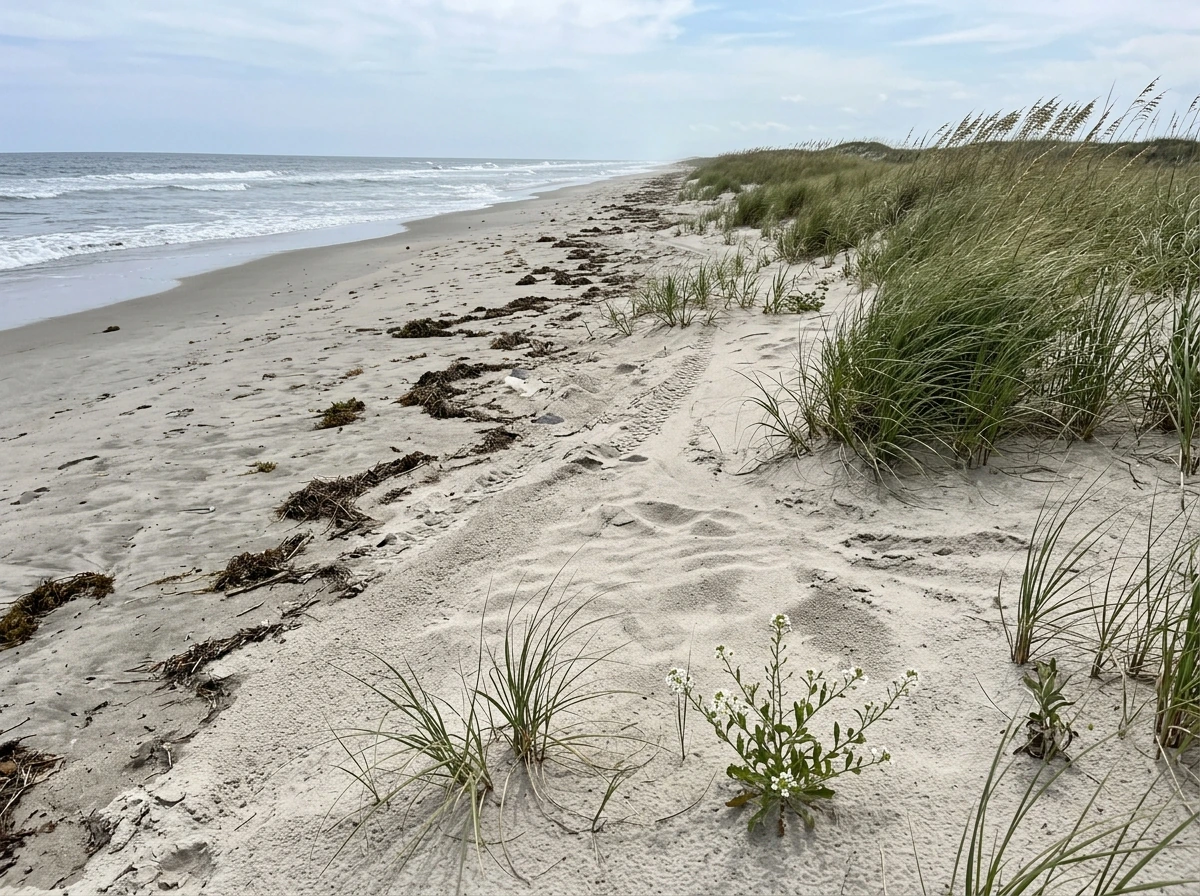
If you walk from the water's edge toward the interior, you're moving through a gradient of decreasing stress. The further you get from the ocean, the more stable the sand, the less salt spray, and the more plant diversity you typically find. Those three zones, strand, foredune, and backdune, each support a distinct set of species.
Strand (the upper beach)
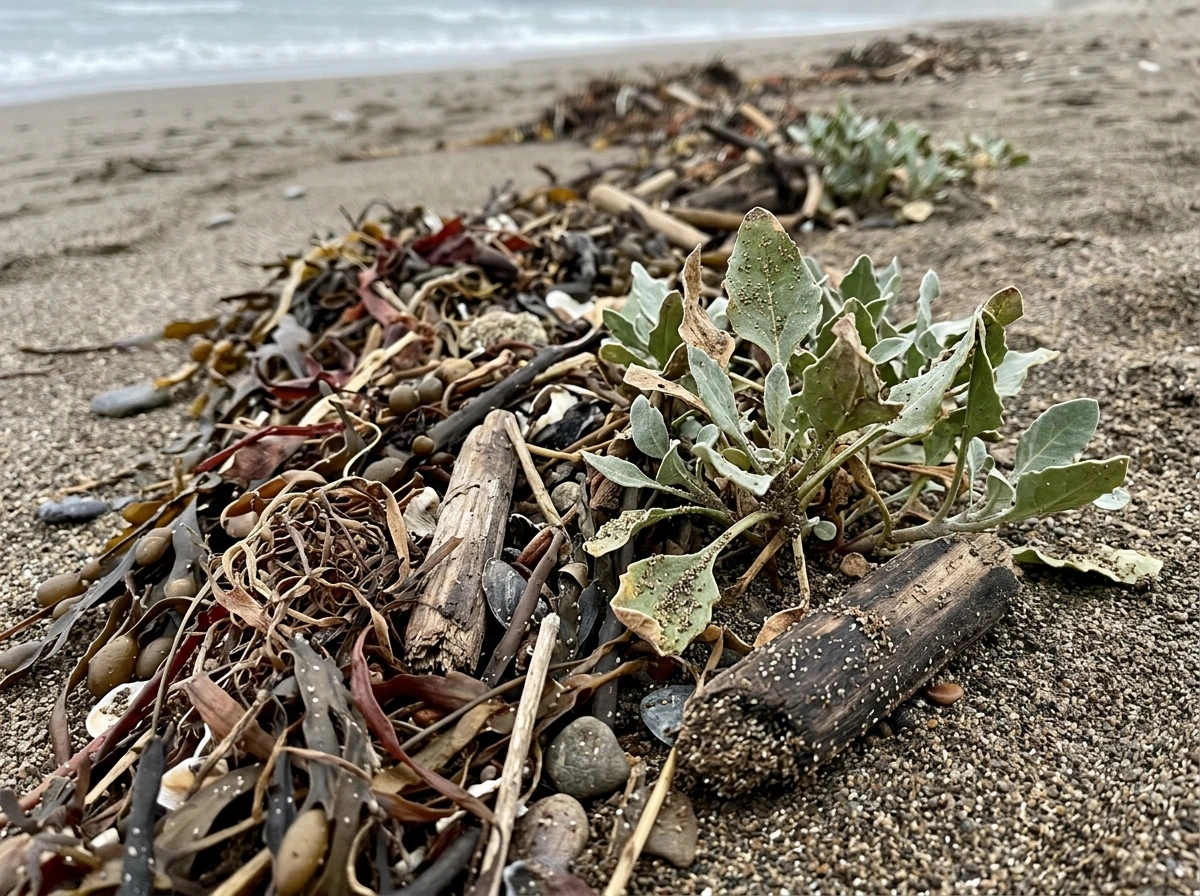
The strand is the zone just above the high-tide line, sometimes called the wrackline area. It gets occasional storm inundation, it has almost no organic matter, and it's the most exposed part of the beach to salt spray and wave wash. Very few plants establish here permanently. What you do see are opportunists: species like sea rocket (Cakile edentula on the Atlantic coast, or related species in other regions) and sea sandwort (Honckenya peploides) that can germinate quickly in wrack-deposited organic material, complete a fast life cycle, and tolerate occasional flooding. These are mostly annuals or short-lived perennials. They don't stabilize the strand so much as colonize it temporarily between disturbances.
Foredune (the first dune ridge)
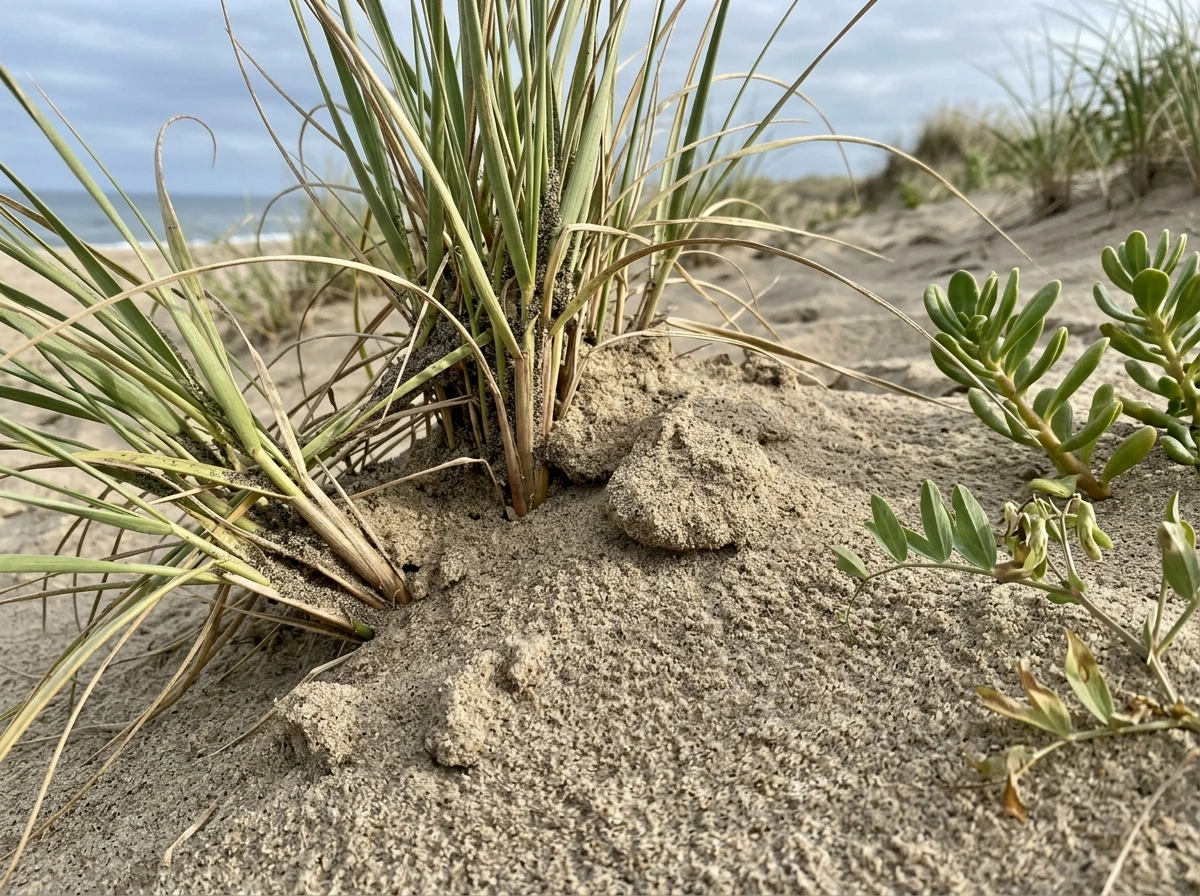
The foredune is where dune-building really happens, and it's dominated by grasses and a handful of extremely tough perennials. These plants have to handle regular salt spray, sand burial, and wind abrasion simultaneously. The key adaptation here is belowground: rhizomes. American beachgrass (Ammophila breviligulata) on the Atlantic and Great Lakes coasts grows from horizontal and vertical underground rhizomes that let it push new shoots up through deposited sand rather than being buried alive.
European marram grass (Ammophila arenaria) does the same thing on European and some Pacific coasts, though it's only tolerant of about 1% salinity, meaning it doesn't do as well right at the strandline. On Pacific North American coasts, sea lyme grass (Leymus mollis) fills a similar role on embryo dunes and foredunes, tolerating salt spray, unstable substrate, storm inundation, low nutrients, and wind abrasion.
Other species that commonly appear on the foredune depending on region include beach pea (Lathyrus japonicus), seaside goldenrod (Solidago sempervirens), beach morning glory or railroad vine (Ipomoea pes-caprae, more common in Florida and tropical coasts), and dusty miller (Artemisia stelleriana). The foredune is where salt spray tolerance matters most, and species here tend to have tough cuticles, low-growing habits to stay below the worst of the wind, or succulent tissue that dilutes absorbed salts.
Backdune (stabilized dunes and beyond)
Once a foredune ridge develops enough to block salt spray and plant cover slows sand movement, the backdune becomes a very different environment. Sand is more stable, organic matter starts to accumulate, and a wider range of species can establish. Shrubs and eventually trees move in.
In New England, the backdune community might include beach plum (Prunus maritima), bayberry (Morella caroliniensis), low-bush blueberry (Vaccinium angustifolium), poverty grass (Hudsonia tomentosa), pitch pine (Pinus rigida), eastern red cedar (Juniperus virginiana), and even white oak (Quercus alba) in well-developed dune forests. In the UK, marram gives way to a more diverse grassland community with sea holly, sea spurge, and eventually heath or scrub species.
In Tasmania, coastal tea-tree (Leptospermum laevigatum) and coast fescue (Austrofestuca littoralis) can dominate stabilized coastal sand. The principle is consistent across climates: more stability equals more diversity.
Common beach-sand plants by region
The specific species you'll encounter depend heavily on which coast and which climate you're dealing with. Here's a practical breakdown by region.
| Region | Strand/Foredune species | Backdune species |
|---|---|---|
| US Atlantic & Gulf (temperate) | Ammophila breviligulata, Cakile edentula, Honckenya peploides, Leymus mollis, Lathyrus japonicus, Solidago sempervirens | Prunus maritima, Morella caroliniensis, Vaccinium angustifolium, Hudsonia tomentosa, Pinus rigida, Juniperus virginiana |
| Florida & tropical US Gulf | Ipomoea pes-caprae, Cakile lanceolata, Uniola paniculata (sea oats) | Coccoloba uvifera (sea grape), Suriana maritima, Scaevola taccada |
| US Pacific Northwest | Leymus mollis, Cakile edentula, Ambrosia chamissonis | Myrica californica, Lupinus littoralis, Arctostaphylos uva-ursi |
| Northern Europe / UK | Ammophila arenaria, Leymus arenarius, Elytrigia atherica (sea couch) | Festuca rubra, Eryngium maritimum, Euphorbia paralias, heath/scrub species |
| Tasmania / southern Australia | Spinifex sericeus, Cakile spp., Ammophila arenaria (introduced) | Austrofestuca littoralis, Leptospermum laevigatum, Acacia longifolia |
Note that some species, like Ammophila arenaria, appear outside their native range as introduced stabilizers. When you're trying to identify what's native and appropriate for restoration or home planting, that distinction matters. Introduced dune grasses can outcompete native species and reduce habitat diversity over time.
How to identify beach plants in the field
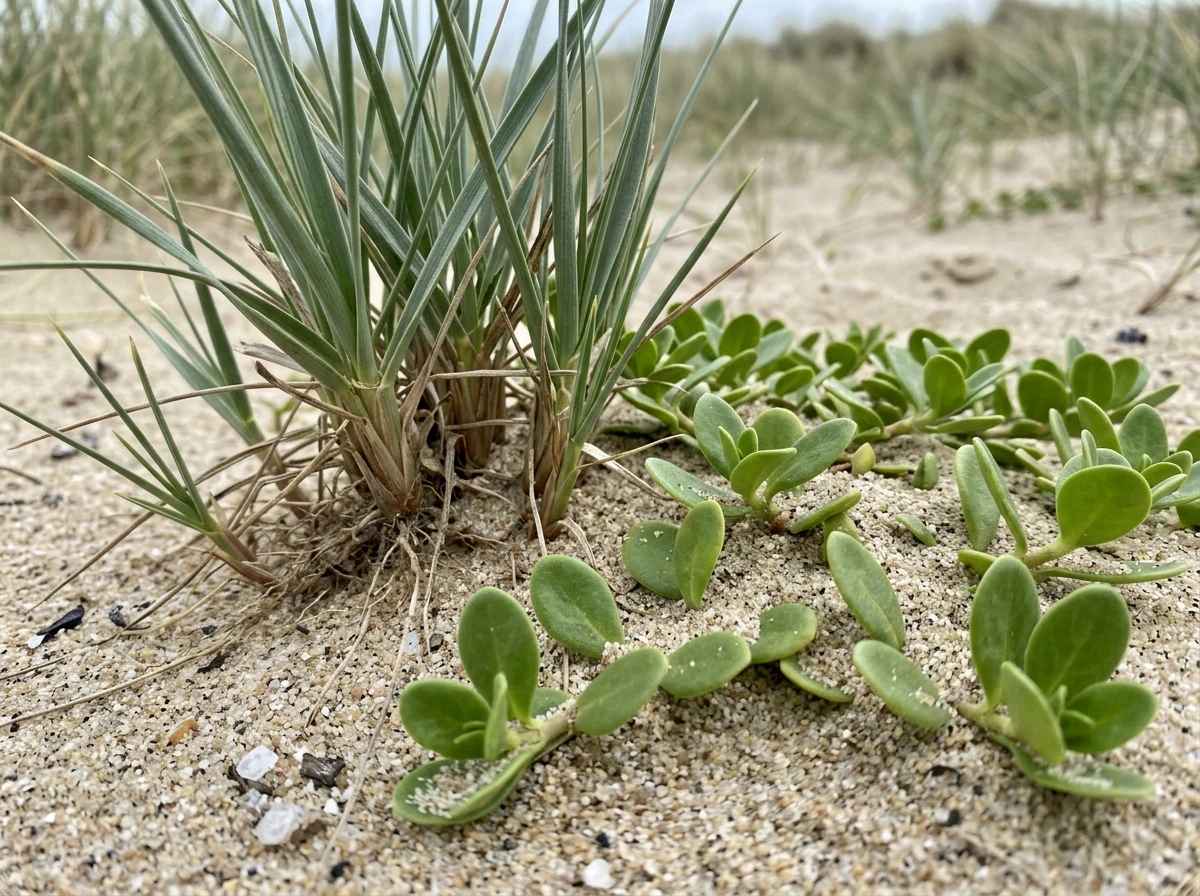
When you're walking a beach and want to identify what you're seeing, start by noting your position relative to the waterline. That single observation rules out or confirms a lot of candidates immediately. A dense, rhizomatous grass growing right on the dune face? That's almost certainly a beachgrass or lyme grass species. A sprawling vine with large, kidney-shaped leaves and pink flowers rooting at the nodes along a warm-coast beach? That's beach morning glory. Low, wiry shrubs on the stabilized backdune with small leaves and a sand-gripping root system? You're likely looking at poverty grass (Hudsonia), beach heather, or a heath species depending on your continent.
A few practical identification cues specific to beach-sand habitat:
- Rhizomatous grasses on the foredune face: look for tough, rolled or wiry leaf blades, often blue-green or gray-green. American beachgrass leaves are stiff and inrolled when dry.
- Succulent or waxy leaves: coastal plants often have thick, glossy, or powdery leaf coatings to reduce water loss and salt absorption.
- Low, prostrate growth form: many foredune plants grow flat to stay below the worst wind. Vining or mat-forming habits are common.
- Wrackline opportunists: small, fleshy-leaved plants near the high-tide line are often sea rockets (Cakile) or sea sandwort (Honckenya). These are the plants growing directly in decomposing seaweed and debris.
- Backdune woody plants: shrubby, multi-stemmed growth with small, often aromatic leaves suggests bayberry, beach plum, or similar species. These won't be on the exposed foredune face.
To confirm species identity and native status in your specific region, use resources like USDA NRCS PLANTS database, Native Plant Trust's Go Botany (for New England), or your state's native plant society database. For Connecticut, UConn's NEMO plant database is a solid regional resource. Cross-referencing the plant you've found with those tools, plus checking your local coastal habitat zone, will confirm whether you've got the right species and habitat match.
Growing beach-sand plants at home
If you're trying to grow beach-sand plants in a home garden or coastal planting, the most important thing to match is drainage, not fertility. These plants are adapted to poor, fast-draining sand. If you're also exploring plants that will grow in sand beyond the beach, focus on species bred for fast-draining, low-nutrient substrates like this. Putting them in rich, moisture-retentive soil is one of the fastest ways to kill them. Soil amendments that improve drainage (coarse sand, fine gravel) are appropriate. Organic matter-rich compost is usually counterproductive for the true strand and foredune species.
Sun and exposure
Almost every beach-sand plant requires full sun, which means at least 6-8 hours of direct light daily. No exceptions for the foredune and strand species. American beachgrass, for example, is specifically documented for full sun and well-drained sandy soil. If your planting site has shade from structures or vegetation, it's not the right environment for these plants.
Watering
Established beach-sand plants need almost no supplemental irrigation. During the establishment phase (the first 2-3 growing seasons), temporary irrigation from April through October can improve survival rates significantly. Massachusetts coastal planting guidance recommends temporary automated irrigation for this window, then discontinuing it. Permanent heavy watering is not just unnecessary, it's actively harmful. Excess water in sandy coastal soils can trigger erosion and, in dune bank situations, bank failure. Beach morning glory (Ipomoea pes-caprae) is a good example of this sensitivity: it tolerates very high salt spray but cannot handle overwatering.
Salt spray tolerance
Match your plant choice to the actual salt exposure of your site. Foredune species like American beachgrass, beach morning glory, and sea lyme grass are built for high salt spray. Backdune species like beach plum, bayberry, or pitch pine tolerate salt spray but don't need it, and they'll struggle if placed where salt spray and sand burial are constant. Getting this wrong is the most common mismatch when people try to establish coastal plantings.
Planting in dunes and coastal sandy beds
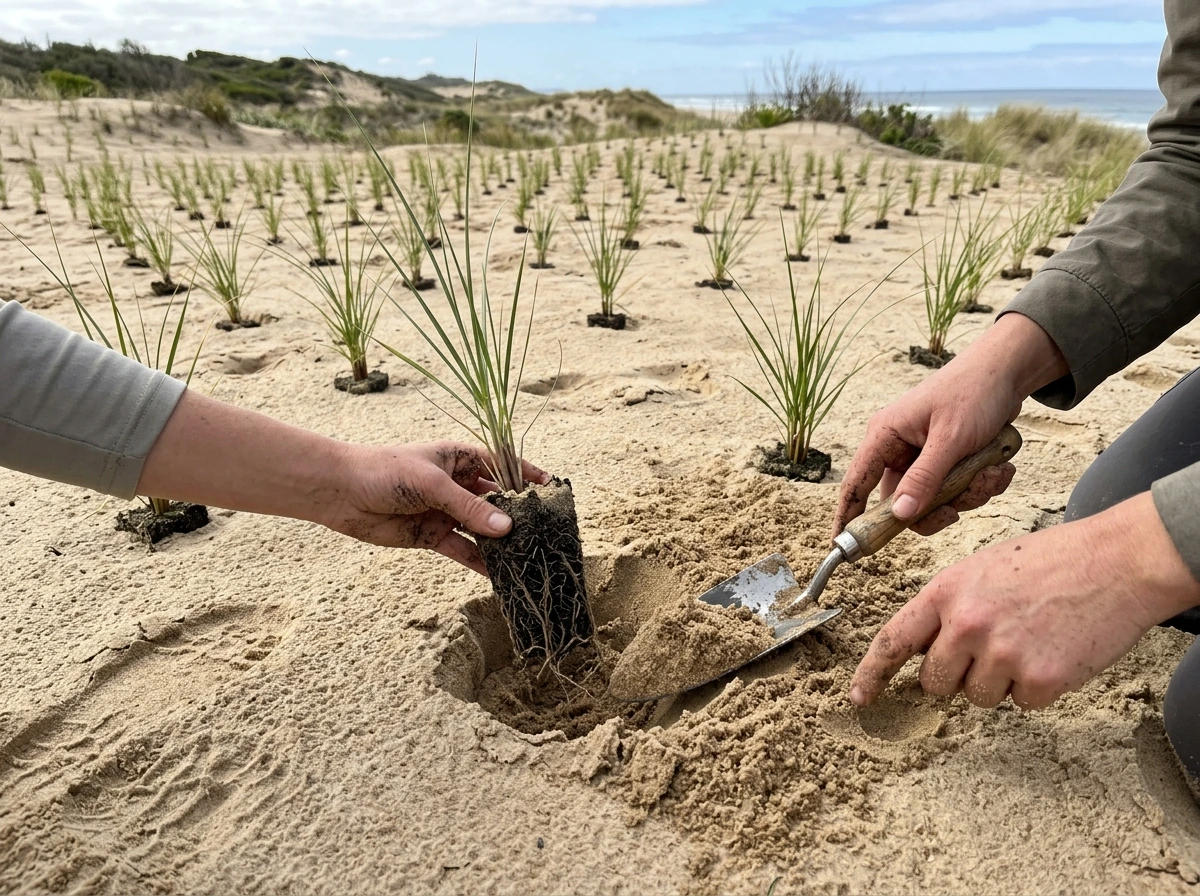
For dune stabilization or coastal bed establishment, spacing and technique matter as much as species selection. American beachgrass planted at 18-inch by 18-inch spacing can fill in completely within about 3 years. NC State Extension restoration guidance recommends spacing plants 18-24 inches apart at the dune crest, expanding to roughly 2 feet for the next rows on each side, then out to about 3 feet further from the crest. The geometry matters because you're working with a 3D landform, not a flat bed.
The roots of dune plants act as structural glue. Species like American beachgrass, beach pea, and seaside goldenrod knit together the sand with their root systems, reducing blow-out and slumping. This is also why trampling and foot traffic on dunes is so damaging: you're not just compressing the sand, you're breaking the root network that holds the whole structure together. If you're restoring a slightly damaged dune, plant stressed grasses into bare areas, fence off foot traffic, and apply only minimal fertilizer. Dunes revert to unstable conditions fast without that protection.
On mulch: traditional wood chip mulch is not appropriate for dune plantings. It's too heavy and organic-matter-rich for these plants' preference, and it can smother the rhizomatous grasses. If you need to protect newly planted areas from erosion during establishment, light straw mulch, jute mesh, or biodegradable erosion control fabric are better choices. In Florida, the wrackline seaweed and organic debris that washes up naturally at the high-tide line is best left in place because it benefits dune vegetation establishment.
On irrigation in coastal settings: hand watering during establishment beats sprinkler systems. Florida DEP guidance specifically recommends hand watering over sprinklers because it uses less water and avoids direct dune erosion. In Florida, installing an irrigation system in or near the dune zone actually requires a permit.
Finding the right plants for your specific coast
The single most useful question to ask before choosing any beach-sand plant is: what grows naturally within a mile of my site? That's your starting point, not a catalog or a general list. Native species that already grow in your coastal dune system are pre-adapted to your specific combination of salt exposure, sand texture, storm frequency, and climate. Introducing a foredune species from a different climate zone, even if it's technically beach-adapted, can underperform or cause problems.
Here's a practical workflow for finding the right match:
- Identify your dune zone: strand, foredune, or backdune. Walk the site and observe where relative to the waterline you're planting.
- Note your climate region: temperate Atlantic, Gulf Coast, Pacific Northwest, Florida/subtropical, or elsewhere. This determines which species pool applies.
- Check USDA NRCS PLANTS database for native species documented in your county and coastal habitat type.
- For New England, use Native Plant Trust's Go Botany for species-level native status and distribution confirmation.
- Contact your state's native plant heritage program (for example, NHESP in Massachusetts) to check whether your site falls within mapped rare or endangered coastal habitat that might restrict what you can plant.
- Look for local coastal restoration guides from your state's DEP, coastal management agency, or cooperative extension. These often include pre-vetted species lists and spacing recommendations specific to your coast.
The broader relationship between beach-sand plants and coastal habitat connects to plant communities found throughout the shoreline transition zone. If you're curious about what plants grow in the ocean that extend further into the marine environment, or about the broader category of coastal vegetation types, those are distinct ecosystems with their own plant communities that operate under very different conditions from beach sand. The dune system you're looking at here is the terrestrial edge of that spectrum, and it's worth understanding it on its own terms before moving outward.
One last point worth reinforcing: complete stabilization of a dune is not always the goal. Some sand movement and salt spray input are what maintain the conditions that pioneer dune species need to persist. Over-stabilizing a system with heavy planting or irrigation can actually reduce the habitat value for the specialized plants you're trying to support. Work with the dune's natural dynamics rather than against them, and you'll get better results with less effort.
FAQ
Can I use a general list of “beach plants” anywhere on the coast?
If the plant isn’t already in your local dune system, treat it as an experiment and expect stress, patchy survival, or slow spread. The main decision aid is distance and habitat match, use a native reference list for your nearest coast and then verify your exact zone (strand, foredune, backdune) and your typical storm exposure.
Will adding compost or fertilizer help beach-sand plants establish faster?
Mostly no. In sandy dune sites, compost and rich amendments can hold water and add fine organic particles that choke airflow around roots and increase the chance of root stress. If you must amend, prioritize drainage materials (coarse sand or fine gravel) and keep organic matter minimal.
Is it okay to run a sprinkler regularly to keep beach plants from drying out?
Avoid it. Many dune plants, especially rhizomatous grasses, are adapted to shifting sand and can fail when they are kept constantly wet or when sprinklers create runoff channels that erode dune faces. Use temporary, targeted irrigation only during establishment, then stop.
How do spacing and planting pattern affect dune survival?
Yes, but only in the right way. Use low, rhizomatous dune spacing and plant in patterns that allow sand to move through while roots knit it together. In general, tight spacing at the dune crest helps you cover the most mobile zone first, then expand outward, rather than planting everything loosely across the whole area at once.
How can I tell if a dune plant is native or an introduced stabilizer?
Don’t assume a plant is “native to the beach” just because it’s on a postcard. Several dune stabilizers were introduced and can reduce habitat diversity by outcompeting local pioneers. Before planting, confirm whether the specific species and variety are native to your state and coastal region.
What are signs that my beach-sand planting site is too shady or too wet?
Yes, and it’s one of the most common causes of failure in home plantings. If the site gets shade for part of the day or has consistently wet sand from irrigation runoff or a perched water table, even salt-tolerant species can decline. Use full-sun checks across seasons and avoid places where downspouts or sprinklers wet the dune face.
What should I do if storms keep burying or exposing my plants?
If you see repeated burial followed by dieback, match the plant to the zone’s burial frequency. Strand opportunists tolerate wrackline disturbance but are not meant for constantly buried dune faces, while rhizomatous grasses handle burial better. For ongoing storm-driven rework, prioritize pioneer species and consider temporary protection until roots anchor.
Why do my dune plants keep failing after I fence them but people still walk nearby?
Replanting alone often doesn’t work if the root network is still being damaged. The fix is to stop the disturbance, fence foot traffic, and re-establish plants specifically into bare or eroding patches while the surrounding dune is protected. Even small trampling events can break the “structural glue” effect and trigger slumping.
Should I remove seaweed and wrack that washes up at the high-tide line?
Wrack and natural debris at the wrackline is often a resource, it can provide organic matter for germination and reduce direct abrasion. The best approach is to leave it where it naturally accumulates unless it creates an unusual problem like blocked access paths or invasive spread risk in your specific area.
What mulch is safest for newly planted beach-sand vegetation?
It can. If you use heavy mulch like wood chips, it can smother rhizomes and add too much fine organic matter, which can shift the site away from the plants’ adapted conditions. For erosion control during establishment, choose light, degradable options like straw or biodegradable erosion fabric, and remove or thin once plants are established.
What should I do if my local plant database does not list a perfect match for my exact beach?
Use the closest match you can find and then treat the planting like an establishment trial. For best odds, pick species proven in your regional dunes and use zone-appropriate choices rather than “closest common beach plant.” If you are unsure, start with hardy foredune candidates for that region and monitor survival through the first two growing seasons.
My plants are dying quickly, how do I troubleshoot the most likely cause?
Test for the limiting factor. In dunes, the usual culprits are low salt exposure in a foredune-aimed planting, overwatering, poor drainage, and incorrect zone placement. If you matched the zone and still fail, check whether the sand is compacted or receiving runoff from landscape irrigation or roof drains.