
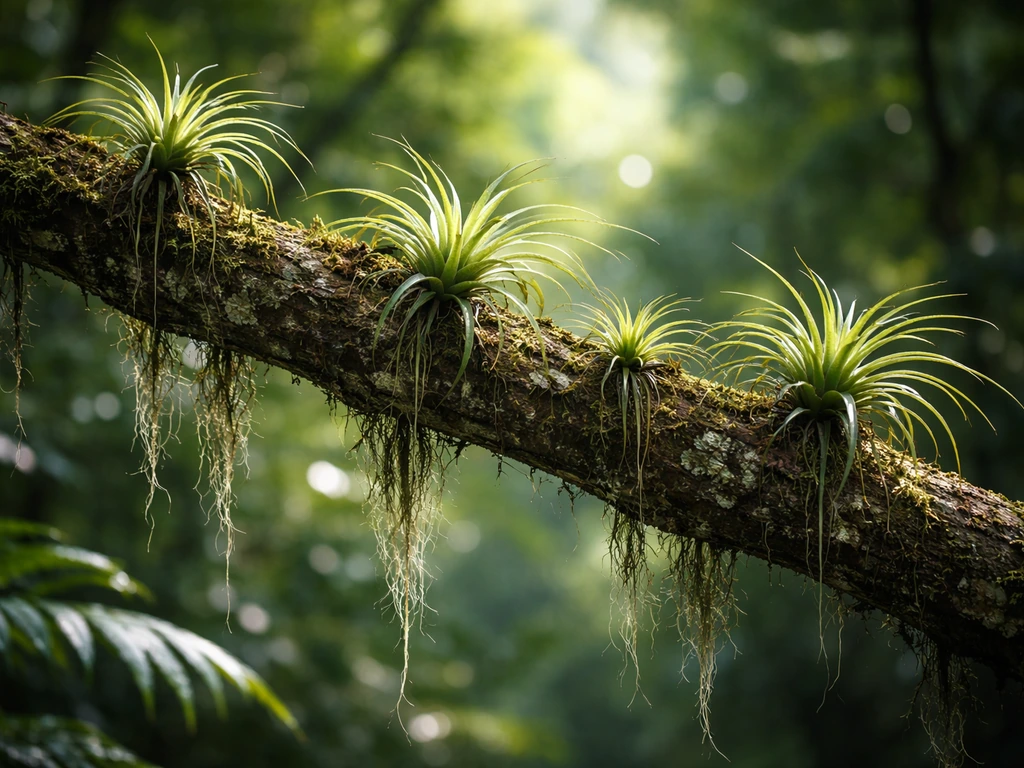
Aerial plants grow on other plants, rocks, cliffs, and even telephone wires, anywhere they can anchor themselves above the ground without pushing roots into soil. In the wild, you find them clinging to tree bark in subtropical swamps, draping from cypress limbs in Florida's Big Cypress, carpeting the misty branches of Andean cloud forests, and wedging into rocky crevices on sun-baked hillsides. What they all share is an ability to pull moisture and nutrients directly from the air, rain, and windblown debris rather than from soil.
Where Do Aerial Plants Grow? Natural Habitats and How to Spot Them

Dr. Marcus Weatherby
18 May 2026
What people usually mean by "aerial plants"
The term gets used loosely, so it helps to sort it out before going further. In ecology, the correct word is epiphyte: a plant that grows on another plant (or sometimes a rock) purely for physical support, without taking any nutrients from its host. The host is just scaffolding. Epiphytes include orchids, ferns, mosses, lichens, bromeliads, and more. When most gardeners and plant enthusiasts say "air plant," they usually mean Tillandsia, a genus of bromeliads that takes the epiphyte strategy to an extreme by often being completely rootless or using roots only to grip a surface rather than to feed.
It's worth noting that not all bromeliads are epiphytes. The bromeliad family includes terrestrial species that root in ground soil alongside the epiphytic ones. The epiphytic bromeliads, including most Tillandsia, rely on specialized leaf structures called trichomes, tiny surface scales that trap and absorb water and dissolved nutrients directly from the air. Spanish moss (Tillandsia usneoides) takes this even further: it has no functional roots at all and absorbs everything through its foliage scales. That distinction matters when you're trying to replicate its natural conditions at home.
Where they actually live in the wild
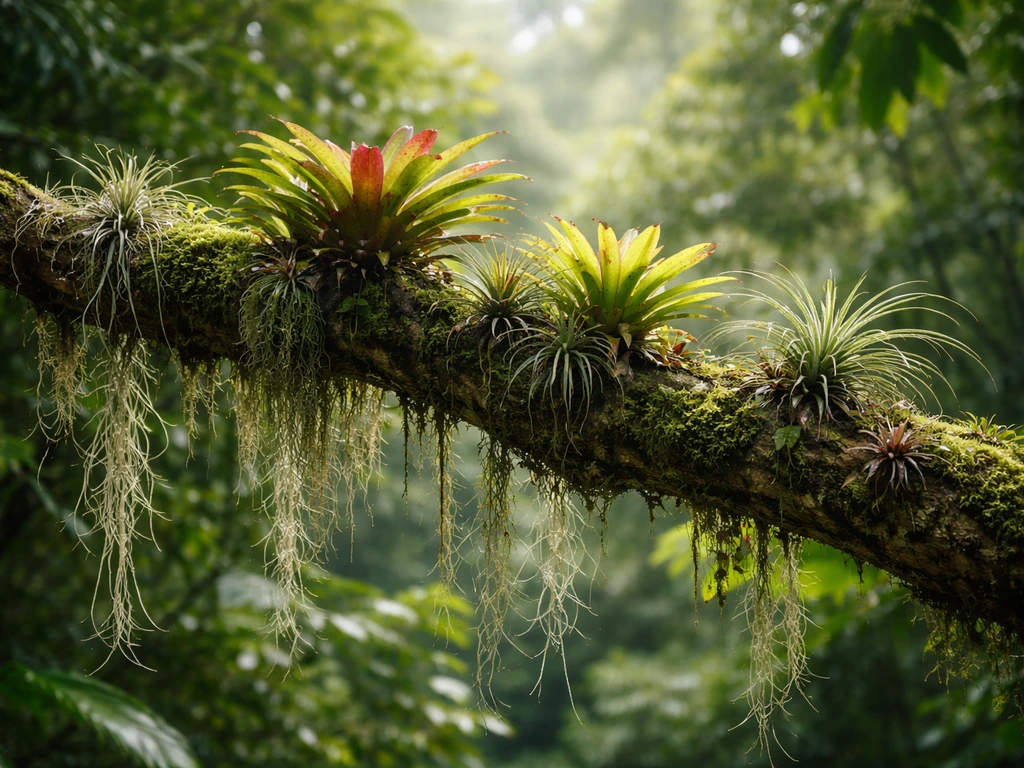
The natural range of epiphytes is broader than most people expect. Tillandsia alone colonizes rainforests, high-elevation Andean mountains, Louisiana swamps, subtropical Florida hammocks, and rocky desert outcrops. Here are the main habitat types you'll encounter:
- Tropical and subtropical forest canopies: Epiphytic bromeliads often live high above the forest floor on branches and trunks, catching rain, falling leaf debris, and windblown dust for water and nutrients. In Florida's Everglades and Big Cypress, Tillandsia species perch on cypress trunks and dense swamp-forest hammock trees.
- Cloud forests: Persistent mist and fog at vegetation level create near-constant moisture. This promotes exceptional epiphyte diversity, with bromeliads, orchids, ferns, and mosses stacked on every available surface. A meaningful share of a cloud-forest plant's water budget arrives as fog drip condensing on leaves.
- Subtropical swamps and coastal forests: Spanish moss drapes from tree limbs across the southeastern United States, thriving on rain, fog, and airborne dust. These habitats alternate between warm, humid spells and short drier periods.
- Rocky outcrops and cliffs (saxicolous habitats): Some Tillandsia species are rock-dwellers, wedging into crevices on bare stone faces where soil never accumulates. Airflow is high and drying is fast.
- Desert and semi-arid scrub: A surprising number of Tillandsia species grow in dry, high-light environments, relying on coastal fog, dew, or infrequent rainfall rather than persistent humidity.
- Man-made surfaces: Tillandsia's grip-and-absorb strategy is indifferent to the host material — wild plants colonize telephone wires, fence posts, and bare rock faces just as readily as tree bark.
The climate conditions those habitats share (and where they differ)
Humidity and light are the two variables that vary most between epiphyte habitats, and they're also the two that trip up most growers. Here's how to think about them by habitat type.
Humidity and moisture rhythm
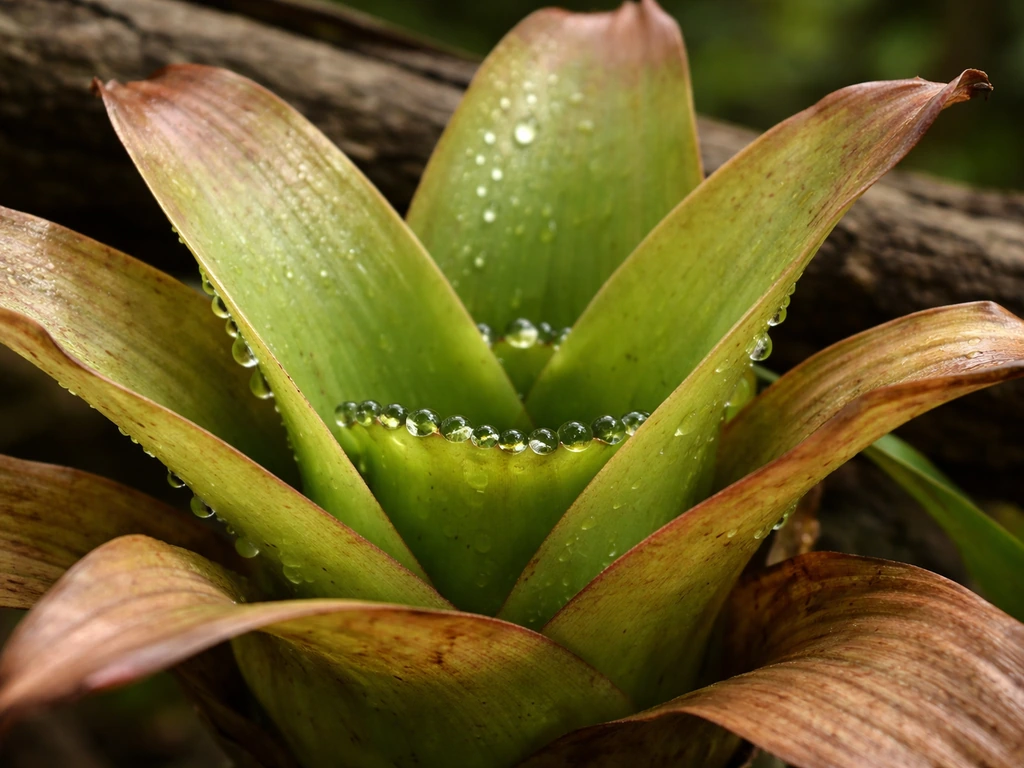
The key insight from watching epiphytes in the field is that they evolved for wet-then-dry cycles, not constant saturation. In Big Cypress and Everglades habitats, epiphyte stems and roots are adapted to collect and store water during rain events, then dry out between them. Even in cloud forests, the mist comes and goes. The practical rule derived from this: after watering, Tillandsia and most epiphytic bromeliads need enough airflow to dry completely within about four hours. Sitting wet for longer than that invites rot. Indoor humidity in most homes is too low to substitute for misting, so you need to actively manage both wetting and drying.
Light: canopy shade vs. open cliff face
Light requirements split sharply by species and native habitat. Forest-canopy species are filtered-light plants, they evolved under a broken tree canopy, not in direct sun. Rock-dwelling or desert-adjacent Tillandsia tolerate and often need much brighter light. A rough field cue: gray-leaved Tillandsia species tend to have denser trichomes and come from higher-light, lower-humidity habitats. Green-leaved species generally come from shadier, moister environments and scorch more easily in direct sun.
Temperature ranges
Most epiphytic bromeliads perform well in daytime temperatures between 70 and 90°F, with nights in the 50 to 65°F range across much of the growing season. Cold tolerance varies significantly by species and origin: tropical canopy species can be damaged by any frost, while some Tillandsia from higher Andean elevations handle cooler nights. Spanish moss survives across a wide subtropical range but struggles with prolonged hard freezes. Always check species-level cold minimums rather than assuming all air plants are equally hardy.
What they attach to: bark, rock, moss, and open air
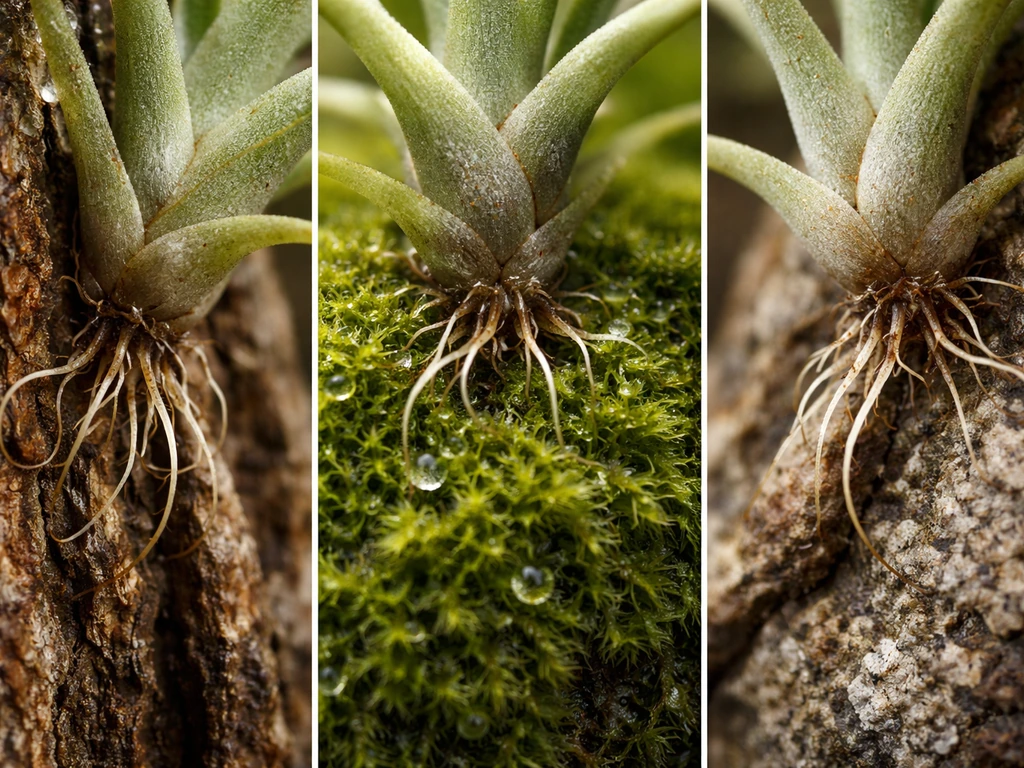
Because epiphytes don't feed through their roots, the substrate they attach to is mainly structural. In the wild, the most common surfaces are rough tree bark (which holds moisture briefly and gives roots something to grip), bare rock faces and cliff ledges, and occasionally mossy mats. Spanish moss skips attachment altogether, simply draping and hanging from whatever it contacts. What all these surfaces have in common is good airflow around the plant and rapid drainage, no standing water pooling at the base.
The specific bark texture matters more than the tree species. Rough, furrowed bark like that of cypress trees offers more surface area for grip and momentarily holds a film of moisture after rain. Smooth bark sheds water too fast for attachment but is still colonized by hanging species like Spanish moss that don't need to grip tightly. Rocks work for saxicolous species because the thermal mass of stone can moderate temperature swings, and rock faces often catch fog or dew even in otherwise dry environments.
Replicating these conditions at home
The goal is to match the wet-dry rhythm, airflow, light, and attachment surface of the plant's native habitat. Here's how that translates to real setups.
Mounting options indoors
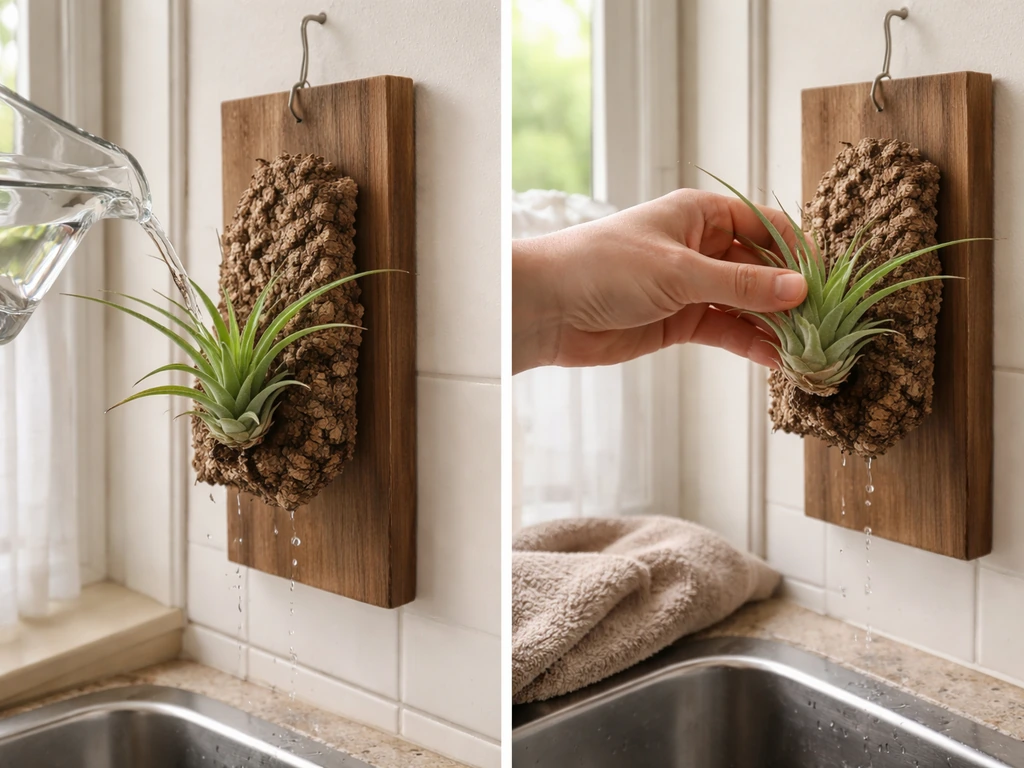
Epiphytic bromeliads can be mounted on wooden boards, cork bark slabs, driftwood branches, or shells. The mounting surface should be porous enough to hold a brief moisture film without staying waterlogged. Avoid glazed ceramic or smooth plastic, they don't breathe and trap moisture against the plant base. Attach plants with non-copper wire (copper is toxic to bromeliads), fishing line, or waterproof adhesive, and orient them so water drains away from the center rather than pooling. Indoors, place mounts near a window where air circulates, a ceiling fan running on low is genuinely useful here.
Watering and misting rhythm
For Tillandsia indoors, the standard approach is soaking the plant in room-temperature water for 20 to 30 minutes, then shaking off excess water and placing it in a spot with good airflow to dry within four hours. Misting helps bridge the gap between soaks but doesn't replace them in low-humidity interiors. Tank-type bromeliads (those with a central cup that holds water) should have their cup kept filled with fresh water, flushed regularly to prevent stagnation. Indoor air conditioning and heating both drop humidity significantly, so mist more frequently in climate-controlled rooms.
Outdoor and greenhouse setups
Outdoors in warm climates, you can mount Tillandsia and epiphytic bromeliads directly on tree branches or a wooden structure in a spot that gets bright indirect light and natural rainfall. The natural wet-dry cycle often handles watering for you in humid regions. In drier climates, you'll need to supplement with regular soaks or a misting system. Greenhouses give you the most control, letting you dial in humidity with a fogger while maintaining airflow with vents or fans, essentially recreating the cloud-forest microclimate that many species evolved in.
Indoor light placement
Bright, indirect light near a south- or east-facing window suits most forest-canopy species. Direct afternoon sun through glass amplifies intensity well beyond what a canopy-dwelling plant ever experiences in nature and will bleach or burn leaves. If your only available light is a north-facing window, supplement with a grow light positioned 6 to 12 inches above the plant. Rock-dwelling and desert-adjacent Tillandsia can handle more direct light, including some morning sun, as long as airflow is good.
Matching species to your climate zone and local weather
Species choice matters more than technique. A tropical cloud-forest orchid and a high-light Andean Tillandsia need fundamentally different conditions, even though both are technically epiphytes. Before you buy, identify whether your plant is a gray-leaved or green-leaved Tillandsia (a quick field cue for its native moisture and light regime), whether it's a tank bromeliad or a trichome-absorbing type, and what its cold minimum is.
| Species / Type | Native Habitat | Light Needs | Humidity / Moisture | Cold Tolerance |
|---|---|---|---|---|
| Tillandsia usneoides (Spanish moss) | Subtropical swamps, coastal forest (southeastern US, Central/South America) | Bright indirect to partial shade | Moderate; tolerates drier periods, benefits from misting | Handles brief light frost; damaged by hard freezes |
| Gray-leaved Tillandsia (e.g., T. xerographica) | Semi-arid, high-light rocky habitats | Bright direct to strong indirect light | Lower; dry between thorough soaks | Frost-sensitive; keep above 50°F |
| Green-leaved Tillandsia (e.g., T. ionantha forest forms) | Shady tropical forest canopy | Bright indirect, avoid direct sun | Higher; soak more frequently | Frost-sensitive; above 55°F preferred |
| Epiphytic bromeliads (tank types) | Tropical and subtropical forest canopies | Medium to bright indirect | High; keep cup filled with fresh water | Most frost-sensitive; above 60°F safest |
| Saxicolous / rock-dwelling Tillandsia | Cliff faces, rocky outcrops | High light, can take morning sun | Low to moderate; good drainage and airflow critical | Varies; check species minimum |
If you're in USDA zones 9 to 11, many epiphytic species can live outdoors year-round attached to trees or structures, essentially recreating their natural habitat. In zones 8 and colder, treat them as container or mounted plants that come inside when temperatures drop below species minimums. Zone alone isn't the whole picture, though: local humidity, whether you're in a coastal fog belt or an inland dry climate, matters as much as average temperature when choosing which species will thrive without constant intervention. If you want a step-by-step plan tailored to your region, see where to grow air plants next for climate-specific guidance.
If you're exploring beyond Tillandsia, related groups worth comparing include pitcher plants (which use a very different moisture-trapping strategy and mostly root in waterlogged, nutrient-poor soil) and spider plants (which are terrestrial and soil-dependent despite being easy to confuse with hanging air plants at a glance). Spider plants, unlike air plants, come from different native regions and grow in soil rather than on tree bark or rock. Pitcher plants have a very different range from air plants, and many species grow in bogs or wet, acidic habitats. The plants most closely related to the aerial habit covered here are the ones grouped under air plants and Tillandsia specifically, where natural distribution across cloud forest, swamp, desert, and rock face habitats gives you the clearest map of what conditions each type genuinely needs. Ghost plants (and other epiphytes) mainly grow in humid, sheltered habitats where they can attach and get moisture from the air. For plants that grow in air, examples like Tillandsia show how attachment and moisture absorption from mist and rain can work without traditional soil feeding.
The practical next step: identify your species by leaf color and root structure, check its native habitat against the table above, pick a mounting surface with good airflow, and set a watering rhythm based on how quickly your indoor or outdoor environment dries out. Match those three things, attachment, light, and wet-dry rhythm, and you've replicated what the plant's natural habitat actually provides.
FAQ
If aerial plants grow on other plants, does that mean they are parasitic like mistletoe?
No. Most “aerial plants” sold for home growing are epiphytes that use the host only for physical support, they do not take nutrients from the host’s tissues. They can still indirectly stress a host if they grow so densely that they shade it, but they are not true nutrient parasites.
Why do my air plants look fine after misting, but rot later?
Usually the wet-dry cycle is too slow. If the plant stays wet longer than the natural drying rhythm (often cited as about four hours for many Tillandsia), trapped moisture at the base can trigger rot. Improve airflow, and make sure any mount or board setup drains quickly rather than holding water around the base.
Can I grow air plants in standing water to keep them hydrated longer?
For most Tillandsia and epiphytic bromeliads, constant submersion is risky. The plants evolved for cycles of wetting and drying, not continuous saturation. Use soak-and-dry timing (soak, shake off, then dry with airflow) rather than keeping them wet or in a water tray.
Do gray-leaved versus green-leaved air plants need different watering schedules?
They often do, because gray-leaved types generally come from higher-light, lower-humidity habitats with faster drying. Green-leaved plants are typically more forgiving of slightly higher ambient moisture but still need complete drying after wetting. The safest approach is to adjust frequency based on how quickly your specific setup dries, not just leaf color.
What should I do if the base of my mounted air plant is staying wet after rain or watering?
Re-orient and remount it so water drains away from the center, and ensure the mount material is porous. Also check whether the mount is touching a non-breathable surface, like glazed ceramic or tightly wrapped plastic, which can trap moisture against the plant base.
Is it okay to use copper wire or copper staples when mounting?
Avoid copper. Copper can be toxic to bromeliads over time. Use non-copper wire, fishing line, or a waterproof adhesive appropriate for plants, and keep the plant positioned so water does not pool at the base.
How can I tell whether my plant is actually a tank bromeliad or a trichome-absorbing type?
Tank bromeliads have a central cup that can collect water and should be flushed regularly to prevent stagnation. Trichome-absorbing Tillandsia usually lacks a functional central cup, it primarily absorbs moisture through leaf scales. Mixing care methods can lead to either dryness or stagnation.
Do aerial plants need direct sunlight at all?
Most forest-canopy epiphytes prefer filtered or bright indirect light and can burn in strong afternoon sun through windows. Rock- and desert-adjacent Tillandsia usually tolerate more direct light, including some morning sun, but still need airflow and a drying rhythm. If leaves bleach or scorch, reduce intensity and increase airflow.
Will soaking in cold water or hot water change how well air plants recover?
Yes. Use room-temperature water for routine soaks, very cold or very hot water can stress tissue, especially if your plant is already drying slowly or is near a temperature swing. After soaking, shake off excess and place it where it dries quickly.
How do I winterize air plants outdoors in borderline zones?
Don’t rely on zone averages alone. Check your plant’s species-specific cold minimum, then plan for the lowest nighttime temperatures and any frost duration. In areas where frost is intermittent, bring mounted plants inside before hard freezes, or protect them from wind and direct exposure while still allowing airflow.
What mounting surface is best, and does tree species matter?
Texture and breathability matter more than the host tree species. Rough, furrowed bark helps grip and holds a brief moisture film after rain, while smooth surfaces shed water too fast for attachment-based species. For your home mounts, prioritize porous, fast-draining materials and avoid non-breathable surfaces that trap moisture.