
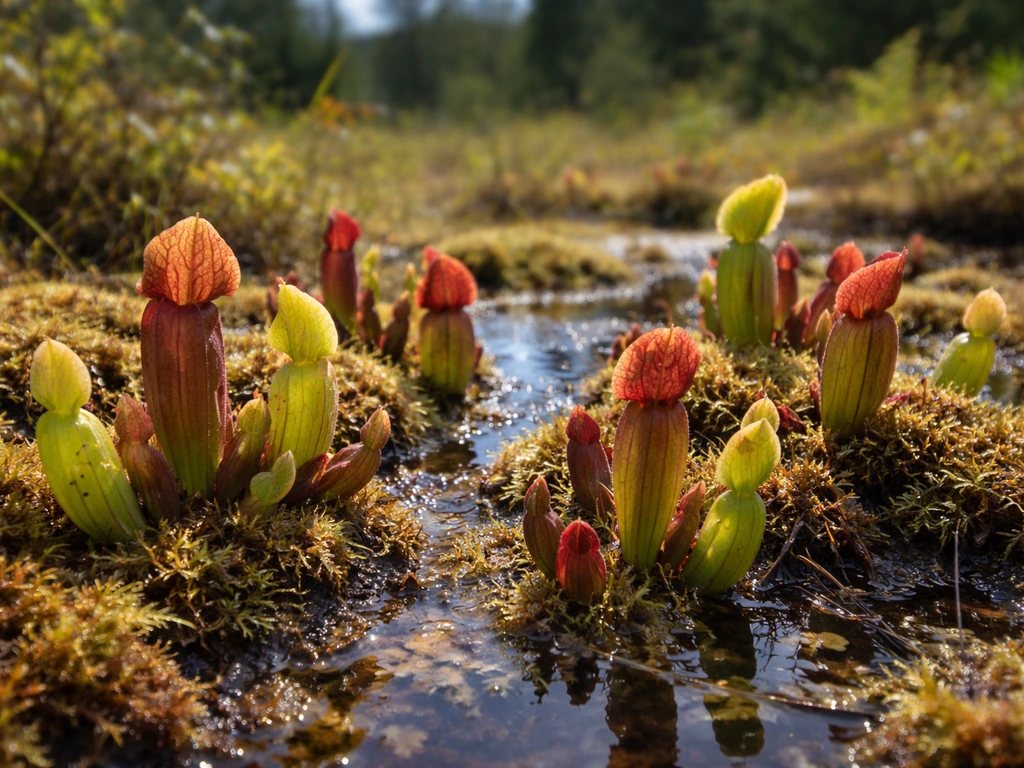
Pitcher plants grow in nutrient-poor, waterlogged, acidic habitats: bogs, fens, wet meadows, seeps, and swampy coastal plains. That single sentence covers most of their natural distribution worldwide. If you strip away the dramatic carnivorous reputation, what you're really looking at is a plant that evolved to exploit the one niche most plants avoid: soggy, nearly sterile ground where there's almost nothing to eat from the soil. That's the core of where and why they grow where they do.
Where Do Pitcher Plants Grow? Habitats and Growing Tips

Dr. Marcus Weatherby
17 Apr 2026
Natural habitats and global distribution
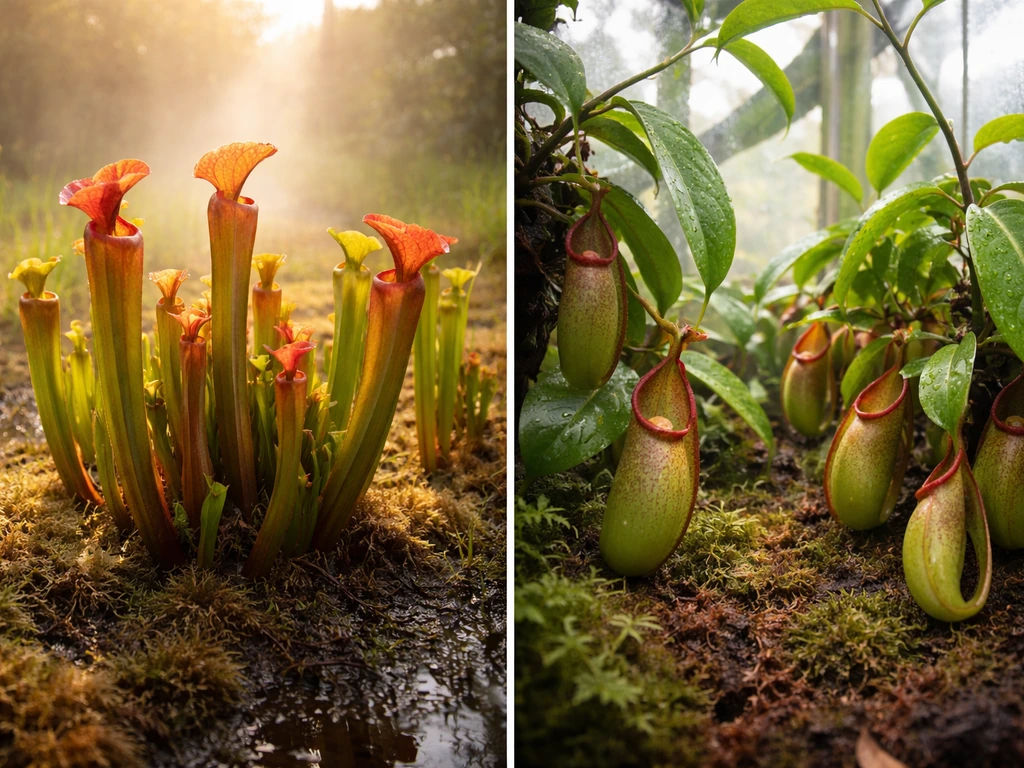
Pitcher plants aren't one single group. There are three major lineages spread across very different parts of the world, and each has its own habitat fingerprint. Understanding which group you're dealing with immediately tells you what kind of environment to picture.
Sarracenia, the North American pitcher plants, are native to bogs, fens, and seasonally wet grasslands across the warm-temperate eastern United States and a small slice of southeastern Canada. Think coastal plain bogs from the Florida panhandle up through the Carolinas, and wet pine savannas in the Gulf Coast states. These plants need a real winter, not just a cool season, so their range is tied to regions that have distinct summer and winter seasons. You won't find wild Sarracenia in tropical climates.
Nepenthes, the tropical pitcher plants, are the opposite in almost every way. Their native range spans from the Seychelles and Madagascar through tropical Asia, covering an enormous territory that includes Borneo, Sumatra, the Philippines, Sri Lanka, parts of southern China (Guangdong, Hainan), and even extends south to Queensland in Australia. Nepenthes mirabilis alone covers more ground than most plant species on Earth, stretching from mainland Southeast Asia and the Malay Archipelago all the way down to Cape York Peninsula. These are plants of humid tropical lowlands, montane rainforests, and forest margins where warmth and moisture are year-round constants.
Darlingtonia californica, the cobra lily, is the oddball North American pitcher plant with one of the most specific ranges of any carnivorous plant. It's confined to perennially wet meadows, seeps, and fens in northern California and southwestern Oregon. The Darlingtonia State Natural Site near Florence, Oregon is one of the most accessible places to see it in the wild, where it grows directly in sphagnum fens and wet sands. It's also strongly associated with serpentine soils, which adds another layer of specificity to its already narrow range.
Then there's Cephalotus follicularis, the Albany pitcher plant, which is in its own category entirely. It's endemic to a single corner of Western Australia, recorded in the Warren region, the southern Jarrah Forest, and the Esperance Plains. Cephalotus follicularis is endemic to the Warren region, the southern Jarrah Forest, and the Esperance Plains in southwestern Western Australia. It grows in peaty swamps and damp sandy soils near rivers and swamps in the southwest of the continent. That's it. Nowhere else on Earth. If you want to see it in the wild, you're booking a trip to the southwestern tip of Australia.
What pitcher plants actually need to grow
Climate and temperature
Climate requirements split almost entirely along the Sarracenia-versus-Nepenthes divide. Sarracenia are warm-temperate plants. They thrive in hot, humid summers and tolerate genuine winters with temperatures dropping close to or below freezing. That dormancy period isn't optional for them, it's physiologically necessary. Nepenthes, on the other hand, are tropical. They want warmth year-round, high humidity, and no frost ever. Darlingtonia is interesting because it specifically prefers cold, oxygen-rich water flowing through its root zone, even while the air temperature above is warm, which is part of why it's found in cold mountain seeps rather than warm coastal bogs.
Light
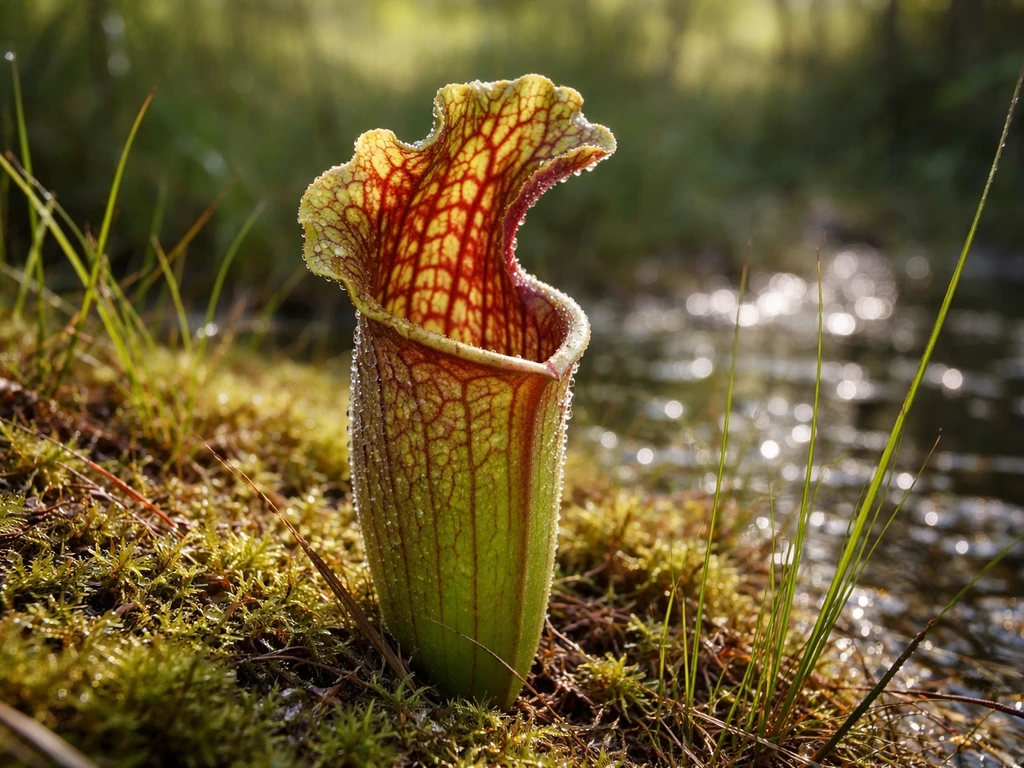
All pitcher plants are sun-lovers in the wild. Sarracenia in particular grow in open, exposed habitats like pine savannas and coastal plain bogs where the tree canopy is thin or absent. Six or more hours of direct sun per day is the norm. Nepenthes show more range here because the genus spans lowland species that get blasted by full tropical sun and highland species that grow in montane cloud forests with more diffuse light. But even the shadier Nepenthes are in bright, open environments by forest standards.
Water and humidity
Consistent moisture is non-negotiable. Pitcher plants in the wild are almost never found in places that dry out seasonally. Sarracenia habitats are water-saturated for most of the year. Darlingtonia grows in perennially wet meadows and seeps where cold water moves continuously through the substrate. Nepenthes habitats in tropical Asia get heavy rainfall distributed across the year, and even the highland species live in environments with near-constant cloud cover and humidity. For context, some Nepenthes habitats in Borneo receive over 3,000 mm of rain annually.
Why pitcher plants love terrible soil
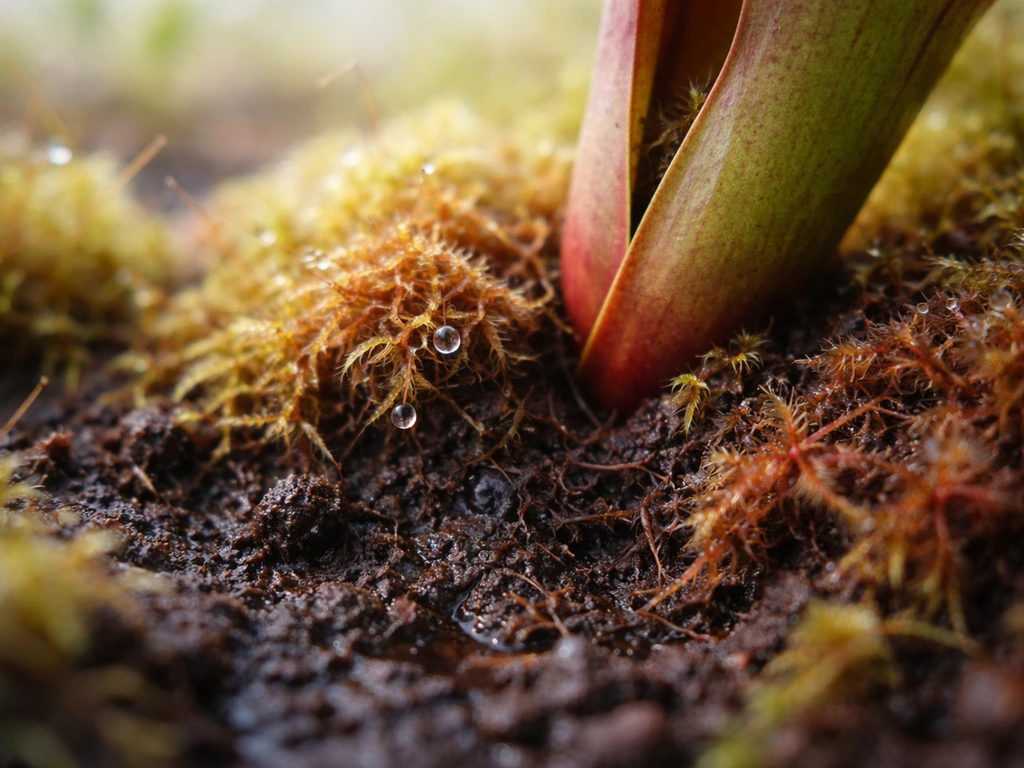
This is the part that surprises most people. Pitcher plants don't just tolerate poor soil, they depend on it. Members of Sarraceniaceae commonly inhabit water-saturated, acidic, nitrogen- or phosphorus-deficient habitats: bogs, swamps, wet sandy meadows, and savannas. Wikipedia similarly describes Sarracenia habitats as acidic, nutrient-free, and constantly moist to wet, often with sandy soil and Sphagnum moss. The reason carnivory evolved in the first place is that these substrates offer almost nothing nutritionally. A plant that can catch and digest insects doesn't need to compete for soil nutrients it can't get anyway.
The soil chemistry that creates these conditions is very specific. Sphagnum moss, which dominates bog habitats, acidifies the surrounding water as it decomposes. Bog pH typically runs between 3.5 and 5.5, which is acidic enough to limit decomposition and nutrient cycling. Nutrients that do exist get locked up or leached away by the constant movement of water through sandy or peaty substrates. Darlingtonia's association with serpentine soils takes this even further: serpentine is naturally low in calcium and high in magnesium and heavy metals, making it hostile to most plant life.
The practical implication is that if you put a pitcher plant in rich garden soil, you're doing the opposite of what it needs. Fertilized, nutrient-rich soil actively harms them. Their roots are adapted to near-sterile conditions, and the traps are how they supplement their diet. This is also why restoring or recreating their habitat is so difficult: you can't just add water to a field and expect the right conditions to appear.
Where to find them in the wild by region and ecosystem
| Genus | Primary Regions | Key Ecosystem Types | Soil/Substrate |
|---|---|---|---|
| Sarracenia | Eastern USA, SE Canada | Coastal plain bogs, pine savannas, wet meadows, fens | Acidic peat/sand, waterlogged, nutrient-poor |
| Nepenthes | Tropical Asia, Borneo, Philippines, Sumatra, Queensland, Seychelles | Lowland rainforest margins, montane cloud forests, heath forests | Acidic, sandy, or peaty; often shallow over rock |
| Darlingtonia | Northern California, SW Oregon | Mountain seeps, perennially wet meadows, sphagnum fens, serpentine sites | Cold, wet sand or sphagnum over serpentine or coastal plain |
| Cephalotus | SW Western Australia only | Peaty swamps near rivers, damp sandy soils | Peaty, damp, sandy, near freshwater |
In North America, the best wild Sarracenia habitat is concentrated along the Gulf Coastal Plain, particularly in Mississippi, Alabama, Georgia, and the Florida panhandle. The Green Swamp in North Carolina and the Croatan National Forest are well-documented sites. For Darlingtonia, the Oregon coast near Florence is the most accessible option, and the Klamath-Siskiyou region of northern California has numerous documented populations in mountain bogs and seeps.
In Southeast Asia, documented Nepenthes populations are widespread across Borneo (especially Sabah and Sarawak), the highlands of Sumatra, and the Philippines. Many of the most species-rich areas are in protected montane forests where disturbance is limited. Just as where aerial plants grow is often tied to specific canopy structures and moisture gradients, Nepenthes distribution in the highlands is closely linked to ridge-top exposure and cloud-belt elevation, typically between 1,000 and 2,500 meters for many highland species.
How to evaluate a spot for growing pitcher plants at home
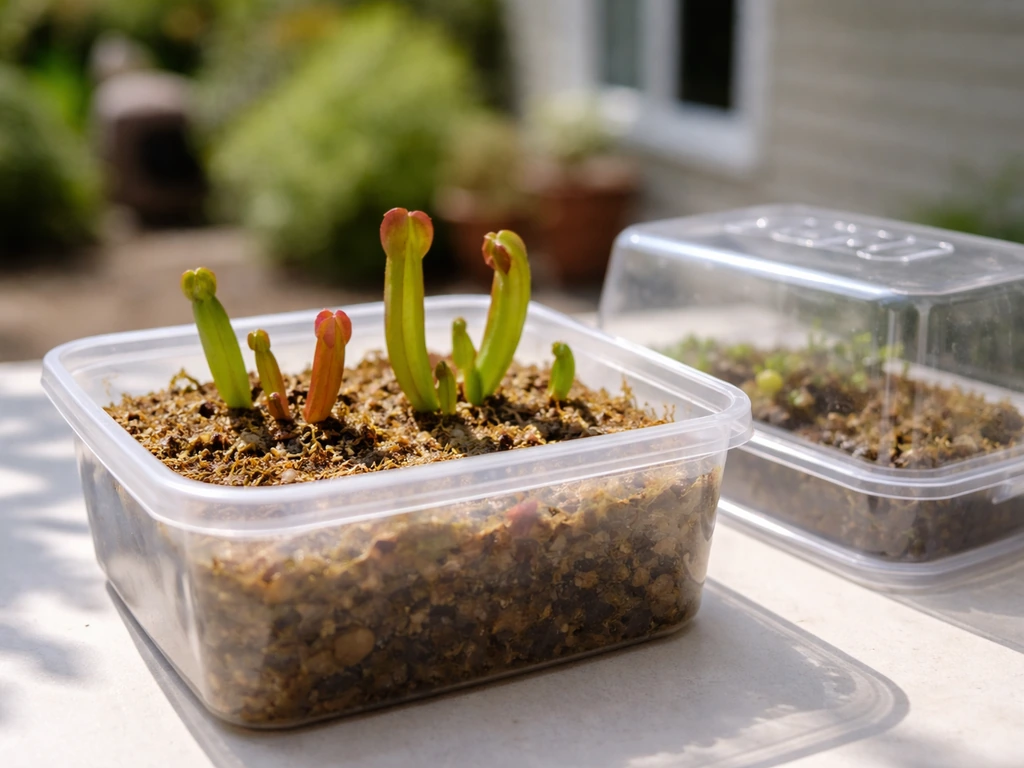
If you want to grow Sarracenia outdoors, the core question is whether you can provide a wet, sunny, acidic, nutrient-free root environment. A container filled with a 1:1 mix of pure sphagnum peat (not potting compost) and perlite or coarse silica sand, kept sitting in a tray of rainwater or distilled water, gets you most of the way there. Tap water is often too alkaline and too mineral-rich, so water quality matters. Location should be full sun, at least six hours a day. Unlike where to grow air plants, which involves bright indirect light and airflow, Sarracenia want direct sun and consistent wetness, two conditions that seem extreme but exactly mirror their bog habitat.
For Nepenthes, the setup is completely different. You're trying to replicate tropical humidity rather than bog wetness. Lowland species need temperatures above 18°C at night, high humidity (above 60%, ideally above 70%), and bright filtered or direct light. Highland species want cooler nights (10–15°C), which is harder to achieve without a temperature-controlled space. Neither type should sit in standing water the way Sarracenia do. The roots need moisture and airflow, not saturation.
One way to think about this: pitcher plants occupy an extreme end of the plant-habitat spectrum. While spider plants grow naturally across a wide range of tropical African habitats and tolerate significant variation in soil quality and moisture, pitcher plants are the opposite: specialists, not generalists. Any deviation from their specific conditions in the wild, whether in nutrients, pH, water quality, or moisture, pushes them out of their comfort zone fast.
What to look for when searching for pitcher plants in the field
If you're trying to find pitcher plants in the wild, train your eye for the habitat first, not the plant. You're looking for open, sunny, boggy ground with sphagnum moss, standing or slowly moving water, and few or no large trees overhead. Coastal plain bogs often have a very specific look: low shrubby vegetation, patches of bare wet sand, an unusual density of sundews and other carnivorous plants alongside the pitchers. Where one carnivorous plant grows, others usually do too, because the habitat is what's rare, not the individual species.
For Darlingtonia specifically, look for cold seeps on mountain slopes where water percolates through the ground and keeps the substrate consistently chilled. These sites often have a distinct visual signature: pale greenish-yellow vegetation in the seep zone contrasting with darker surrounding forest. The cobra-shaped pitchers are unmistakable once you know what you're looking for, but the cold seep habitat is the giveaway before you even get close.
It's worth noting that habitat loss is the biggest threat to wild pitcher plant populations. Drainage of wetlands, fire suppression (which allows shrubs to shade out bog openings), and groundwater extraction all degrade the specific conditions these plants need. Documented populations in places like the Croatan National Forest are actively managed with prescribed burns to maintain the open, sunny bog structure. When you're planning a site visit, check with local native plant societies or conservation databases for current, verified locations rather than older records, since some historic sites no longer support populations.
Pitcher plants compared to other unusual habitat specialists
Pitcher plants sit in interesting company when you look at other plants that have evolved to exploit specific, challenging habitats. Air plants grow naturally by anchoring to surfaces rather than soil, which is their version of bypassing conventional nutrient sources. Ghost plants, succulents in the genus Graptopetalum, take yet another approach: where ghost plants grow is defined by rocky, arid cliffs in Mexico where most plants can't get a foothold. These are all plants shaped by their habitats into specialists, but pitcher plants are arguably the most dramatic example because their entire feeding strategy evolved in direct response to soil chemistry.
Some plants that grow in air as epiphytes share one characteristic with Nepenthes: both have evolved to get nutrients from sources other than soil. But where epiphytes harvest nutrients from rainfall, dust, and decaying leaf litter on tree branches, Nepenthes does it by drowning insects in its pitcher-shaped leaves. The convergence is fascinating from a habitat ecology perspective.
Understanding what plants grow in air or on bare rock tells you a lot about how far evolution can push a plant's relationship with its environment. Pitcher plants are the bog version of that same story: maximum adaptation to a single, extreme set of conditions.
Your practical next steps
If you want to see pitcher plants in the wild in North America, the Gulf Coast states (especially Mississippi and the Florida panhandle) and the Oregon coast near Florence are your best bets. Search for nature preserves and national forests with documented bog habitats, and visit in late spring through summer when the pitchers are fully developed. Bring waterproof boots.
If you want to grow them, start with Sarracenia if you live in a temperate climate with cold winters and hot summers. They're the most forgiving of the major groups and the easiest to source from reputable carnivorous plant nurseries. Get the water right first (rainwater or distilled only), use nutrient-free peat and perlite mix, and give them full sun. Everything else follows from those three conditions.
If you're in a warm, humid climate without a real winter, lowland Nepenthes are more appropriate. They'll grow outdoors in the tropics or subtropics without any special setup, as long as humidity is consistently high and temperatures stay warm. Highland Nepenthes are a project for experienced growers with climate-controlled setups.
Either way, the key insight is this: match the habitat, not just the care instructions. Pitcher plants grow where they grow because of a very specific combination of light, water, and soil chemistry. Replicate those conditions and the plants do the rest.
FAQ
Can pitcher plants grow in regular garden beds if I keep them wet?
Usually no. They depend on nutrient-poor, acidic, low-decomposition substrates, so rich soil and fertilizers rapidly push them out of their adapted range. If you try, you would need a dedicated container or a controlled bog-style bed using nutrient-free peat and very pure water, not amended topsoil.
What water is safest for pitcher plants, and how do I tell if my water is too mineral-heavy?
Rainwater or distilled water is the default because tap water is often higher in dissolved minerals and alkalinity. A practical check is to monitor hardness or pH (if you have test strips or a meter), and use lower-mineral water when pitchers show slow growth, crusty residue, or declining trap size.
How important is it that the soil stays acidic, and can I “fix” pH with products?
Acidity is important because it limits nutrient cycling in bogs. Do not rely on pH-adjusting chemicals or frequent soil amendments, they can create nutrient spikes or unstable chemistry. Instead, use sphagnum peat and nutrient-free media, and keep water quality consistent.
Why do Sarracenia rot or decline if they are supposed to like water?
They need consistently wet roots, but not unmanaged, oxygen-poor conditions. The most common causes are stagnant water, overly fine peat that compacts, or poor drainage in the container. Use a suitable peat-sand or perlite-coarse silica texture so the root zone remains wet but not anaerobic.
Do pitcher plants require a winter dormancy even if it is not that cold where I live?
For Sarracenia, dormancy is physiologically necessary, and “cool nights” without a real cold period often leads to weak growth or failed pitchers. If you cannot provide a true winter chill, it is usually better to choose a species appropriate for your climate or use a controlled cold period rather than keeping them warm year-round.
Can Nepenthes be grown outdoors in a place that rarely freezes?
Yes for many lowland species in tropical or subtropical climates, but the key is frost risk and night temperatures, not just average highs. If your nights drop near the species threshold, pitchers can stall. Also avoid siting them where they get soggy roots in standing water, most need moist but ventilated media.
What light do pitcher plants need if I only have partial sun or a bright window?
In the wild they are sun-lovers, with at least about six hours of direct sun being the typical benchmark for many growers with Sarracenia. Nepenthes tolerate a wider range, including brighter filtered light, but window light can be inconsistent. If you see leggy growth or small traps, add direct outdoor sun gradually rather than switching suddenly.
How do I prevent overfeeding or fertilizer burn when growing pitcher plants?
Do not fertilize, and avoid compost, potting mixes, and “plant food” products. Even small nutrient additions can overwhelm their nutrient-poor adaptation. If you want to encourage insects as food, rely on natural prey in the habitat, rather than trying to supplement with high-nutrient practices.
Are pitcher plants safe for pets, and are the traps actually dangerous to animals?
Pitcher plants are not designed to act like dangerous animal traps, and they generally are not toxic in the way many people fear. However, they can still cause harm indirectly if pets chew or ingest large amounts of plant material. The practical approach is to keep them out of reach from chewing pets, especially indoors.
What is the easiest way to identify pitcher plant habitat in the wild without disturbing it?
Look for the habitat features first: open sunny ground, sphagnum or boggy, peaty substrate, and consistently wet or slowly moving water, often with few large trees overhead. Use boots and stay on paths when possible, because crushing sphagnum and disturbing the wet soil can damage the microhabitat for years.
Can I grow Cephalotus or Darlingtonia outside where I live if the weather seems close?
Closely matching climate is not enough. Cephalotus is restricted to a very narrow region in Western Australia and can be sensitive to humidity and winter conditions, while Darlingtonia relies on cold, oxygen-rich, moving root-zone water. If you cannot replicate the root-zone water quality and temperatures, success often drops sharply.
Why do my pitcher plants stop making new pitchers even though the plant looks alive?
Common causes are mismatch in one of the core habitat drivers: insufficient direct light, overly mineral or alkaline water, nutrient-rich media, or incorrect dormancy timing. Check those four first, then confirm your media does not compact and remain poorly oxygenated.