The plants that need the least water to grow are those that evolved in dry places: cacti and succulents from desert floors, native bunchgrasses from arid steppes, shrubby sages and manzanitas from Mediterranean hillsides, and deep-rooted perennials from dry prairies. Match any of those plants to a climate and soil type similar to their natural habitat and you will water them far less than a conventional garden, often only during a short establishment window and rarely or never afterward.
Plants Which Need Less Water to Grow: Choose and Care

Dr. Marcus Weatherby
30 May 2026
What 'low-water' actually means (and why it matters)
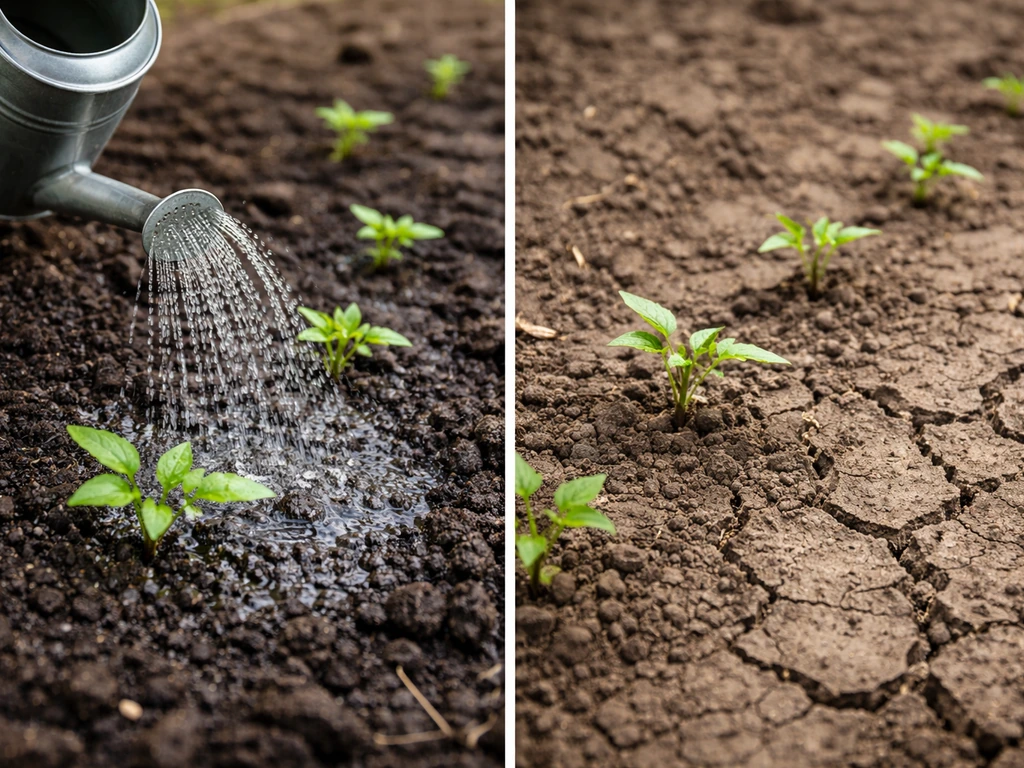
The gardening world uses 'drought-tolerant' and 'low-water' interchangeably, but they describe slightly different things. A drought-tolerant plant can survive dry spells without dying, but it may stop growing and look rough while it waits out the stress. A genuinely low-water plant, by contrast, is adapted to a permanently dry baseline: it grows, flowers, and seeds under conditions that would kill most garden plants. In simple terms for class 5, these are the plants which grow without seeds because they do not rely on frequent watering to survive low-water plant. The University of Nebraska's water research program notes that drought-tolerant plants typically have deeper root systems that allow them to go longer between irrigation events, but drought still halts active growth. The University of Nebraska's water research program explains that drought-tolerant plants typically have deeper root systems that can go longer between irrigation events, but drought still halts active growth blank" rel="noopener noreferrer">drought-tolerant plants typically have deeper root systems that allow them to go longer between irrigation events. The distinction matters because 'tolerant' means 'survives stress' while 'low-water' means 'thrives on very little.'
Oregon State University Extension also makes an important point: being native to a region does not automatically make a plant drought-tolerant. A native fern from a shaded, moist creek bank in the Pacific Northwest needs consistent moisture even though it is native. Regionally native plants are often the best starting point, but you still have to match them to the specific moisture conditions of their wild habitat, not just their general geography.
For practical planning, the EPA's WaterSense program recommends anchoring plant selection to your USDA Plant Hardiness Zone and then choosing species that appear on published low-water-use or drought-tolerant lists for that zone. Some states and regions formalize this further: blank" rel="noopener noreferrer">Arizona's Tucson Active Management Area, for instance, maintains an official Low Water Use and Drought Tolerant Plant List used in regulatory water-management planning. Checking whether your state or county has a similar list is one of the fastest ways to narrow down species that are proven in your specific climate.
How to pick low-water plants for your climate, season, and sun
The single most reliable way to choose a low-water plant is to think in terms of habitat analogs: find out what biome the plant comes from and compare it to where you live. A plant from a dry Mediterranean scrubland needs hot, dry summers and mild, wet winters. If you live in coastal California or parts of the Pacific Northwest with that same rainfall pattern, it will thrive with virtually no irrigation once established. If you live in a humid Gulf Coast climate with summer rain, it may rot.
Beyond climate pattern, you need to account for three practical variables before you buy anything: sun exposure, seasonal rainfall timing, and winter low temperatures. A full-sun xeric plant planted in part shade will be weakened, more susceptible to root rot, and far less drought-tolerant than it would be in its preferred conditions. Seasonal rainfall timing is equally critical: many Mediterranean and desert-adapted plants are dormant in summer and grow in cooler, wetter seasons, so they handle summer drought naturally. Plant them in a climate where rain arrives in summer and they may never go fully dormant, which can actually stress them.
A practical framework for choosing:
- Find your USDA Hardiness Zone and your Koppen climate type (arid, semi-arid, Mediterranean, continental dry, etc.).
- Identify whether your summer is wet or dry, because that single factor splits plant compatibility more than almost anything else.
- Look up the native range of any plant you are considering and check whether that range has a similar summer precipitation pattern to your location.
- Check your state's cooperative extension office or water authority for a regional low-water plant list vetted for your area.
- Note your soil drainage: xeric plants almost universally require fast-draining soil and fail in heavy clay that stays wet.
Low-water plant picks by habitat type
Rather than a flat list, it helps to think by habitat category. Plants from the same biome share similar water strategies and will usually succeed under similar garden conditions.
Xeric desert plants (under 10 inches annual rainfall)
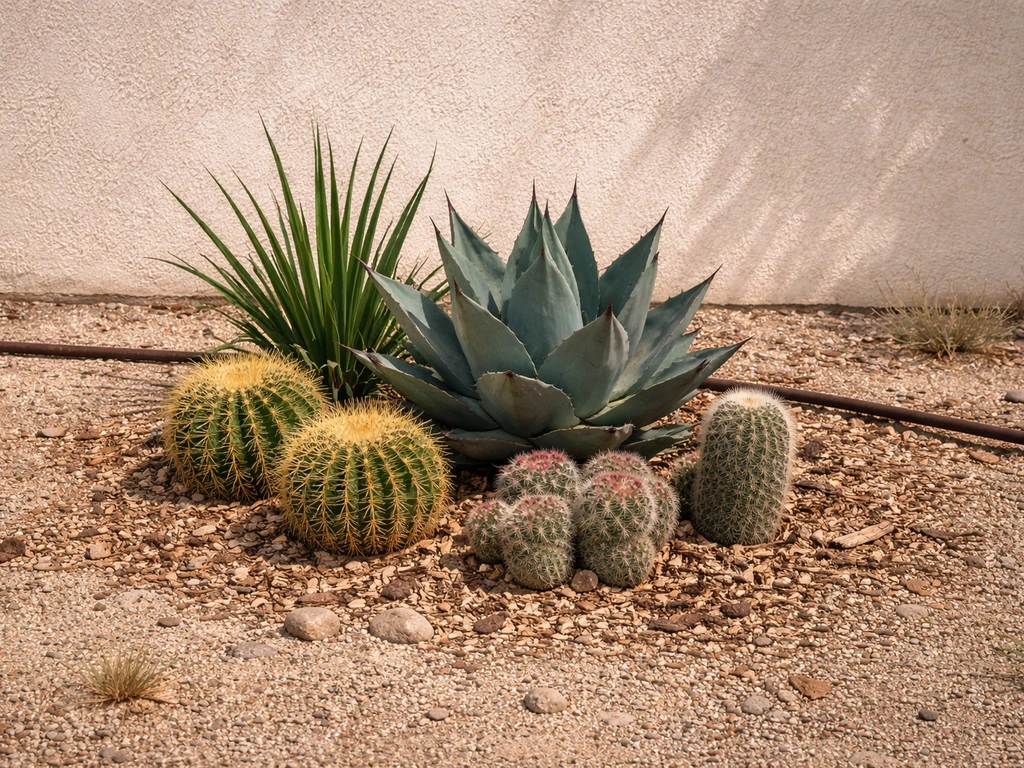
These are the true water misers. Cacti (Opuntia, Saguaro, Cylindropuntia), Agave species, and Yucca are the most widely recognized. Examples include cacti like saguaro and agave, which are often grown from offsets or cuttings rather than seeds. They store water in their tissues, have waxy or spiny surfaces to reduce evaporation, and can go months without rain. Desert shrubs like Brittlebush (Encelia farinosa), Creosote bush (Larrea tridentata), and Desert Marigold (Baileya multiradiata) are slightly less extreme but still thrive on annual rainfall well under 10 inches. In the ground in appropriate climates, these plants may need zero supplemental irrigation after a 6 to 12 month establishment period.
Mediterranean climate plants (10 to 20 inches, dry summers)
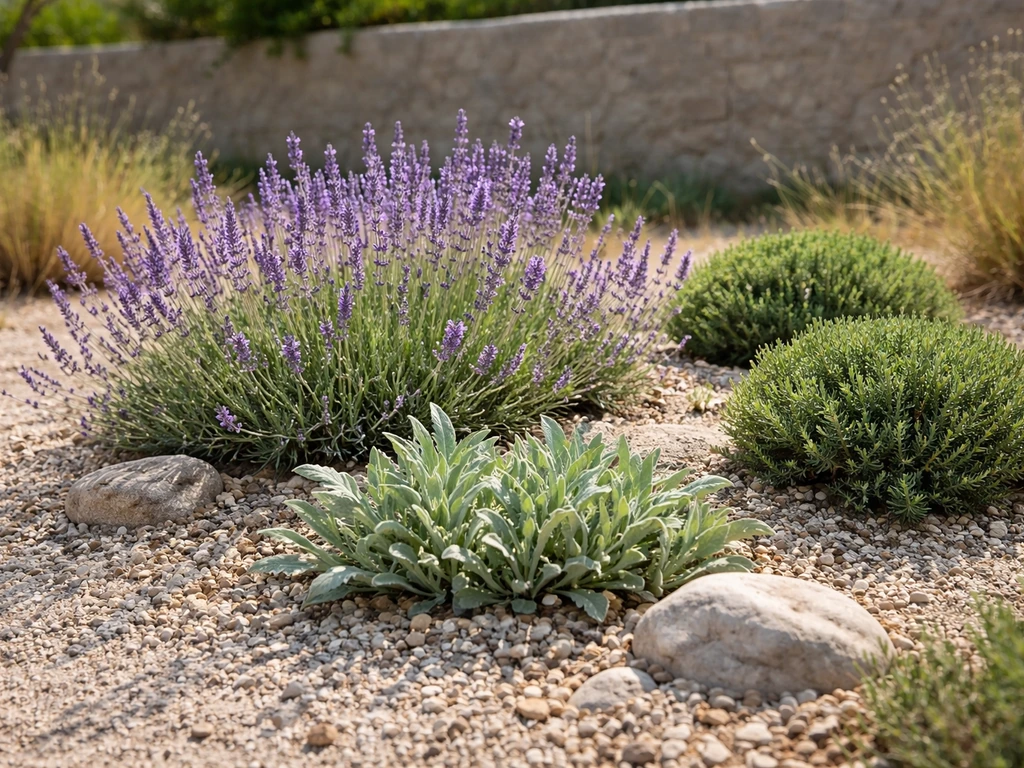
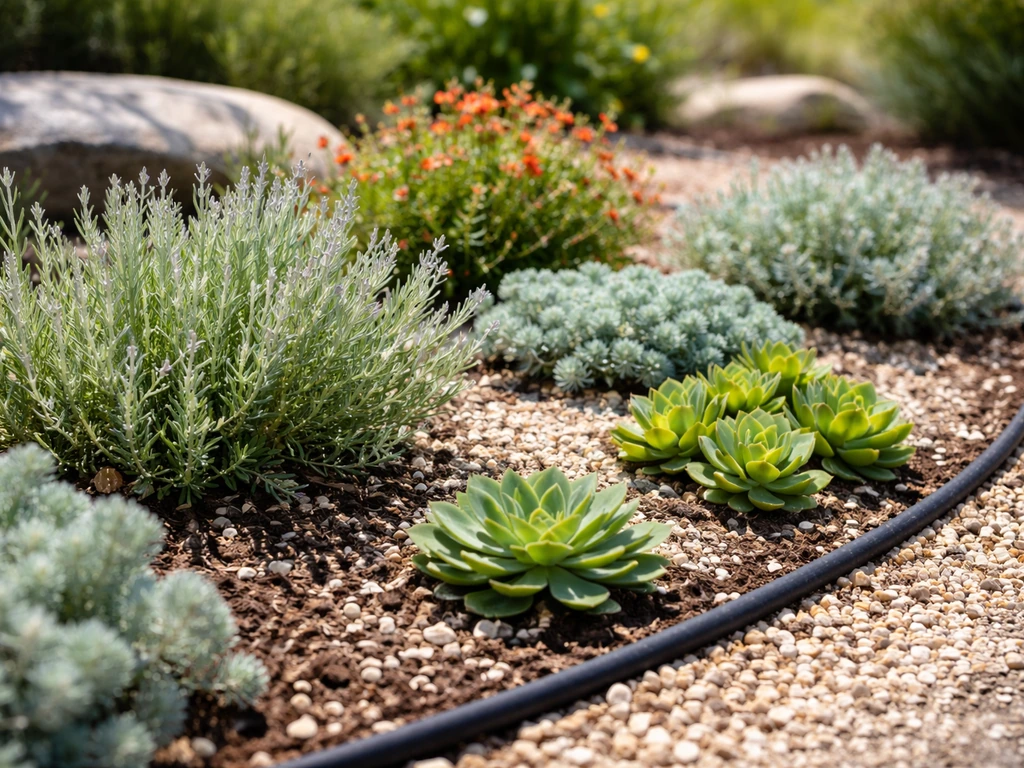
Mediterranean-adapted plants evolved with cool, wet winters and hot, dry summers. This is one of the richest categories for ornamental and functional low-water gardening. Lavender (Lavandula angustifolia), Rosemary (Salvia rosmarinus), Rockrose (Cistus spp.), and Manzanita (Arctostaphylos spp.) are iconic examples. Olive trees, most ornamental sages, and the California native Toyon (Heteromeles arbutifolia) also fall here. These plants grow actively in the mild, moist season and tolerate summer drought through near-dormancy. They perform best in USDA zones 7 to 10 with fast-draining soil and full sun.
Dry steppe and prairie plants (10 to 20 inches, variable timing)
The interior grasslands of North America, Central Asia, and Patagonia produced some of the most garden-useful low-water perennials. Native bunchgrasses like Blue Grama (Bouteloua gracilis), Buffalo Grass (Bouteloua dactyloides), and Little Bluestem (Schizachyrium scoparium) are deep-rooted, tolerant of summer heat and drought, and provide year-round structure. Perennial forbs from the same habitats include Purple Coneflower (Echinacea purpurea), Prairie Dropseed, Black-eyed Susan (Rudbeckia hirta), and Penstemon species. These plants are excellent choices for continental climates in the central US where Mediterranean species would not survive cold winters.
Dry woodland and chaparral shrubs
For larger structure and screening, look to shrubs from dry woodland and chaparral biomes. Ceanothus (California lilac) can grow 8 to 12 feet tall and needs almost no summer water in the right climate. Fremontodendron (Flannel Bush) is stunning but genuinely dislikes summer irrigation once established. In drier parts of the Southwest and intermountain West, native shrubs like Apache Plume (Fallugia paradoxa), Four-wing Saltbush (Atriplex canescens), and Desert Willow (Chilopsis linearis) fill the same structural role with very low water needs.
| Plant | Habitat Origin | Annual Water Need | USDA Zones | Best Climate Match |
|---|---|---|---|---|
| Agave (Agave spp.) | Chihuahuan/Sonoran desert | Very low (under 10 in.) | 5–11 (varies) | Hot desert, Mediterranean |
| Lavender (Lavandula angustifolia) | Mediterranean scrub | Low (10–15 in.) | 5–9 | Mediterranean, semi-arid |
| Blue Grama Grass (Bouteloua gracilis) | Dry steppe / shortgrass prairie | Low (10–18 in.) | 3–9 | Continental, semi-arid |
| Creosote Bush (Larrea tridentata) | Mojave/Chihuahuan desert | Very low (under 8 in.) | 7–11 | Hot arid desert |
| Little Bluestem (Schizachyrium scoparium) | Tallgrass/mixed prairie | Low-moderate (15–20 in.) | 3–9 | Continental, semi-arid |
| Manzanita (Arctostaphylos spp.) | California chaparral | Low (12–20 in.) | 6–10 | Mediterranean, coastal dry |
| Purple Coneflower (Echinacea purpurea) | Dry prairie/open woodland | Low-moderate | 3–9 | Continental, semi-arid |
| Desert Willow (Chilopsis linearis) | Desert washes/dry stream banks | Low (8–14 in.) | 6–11 | Hot semi-arid, desert |
Soil and site conditions that make low-water plants succeed
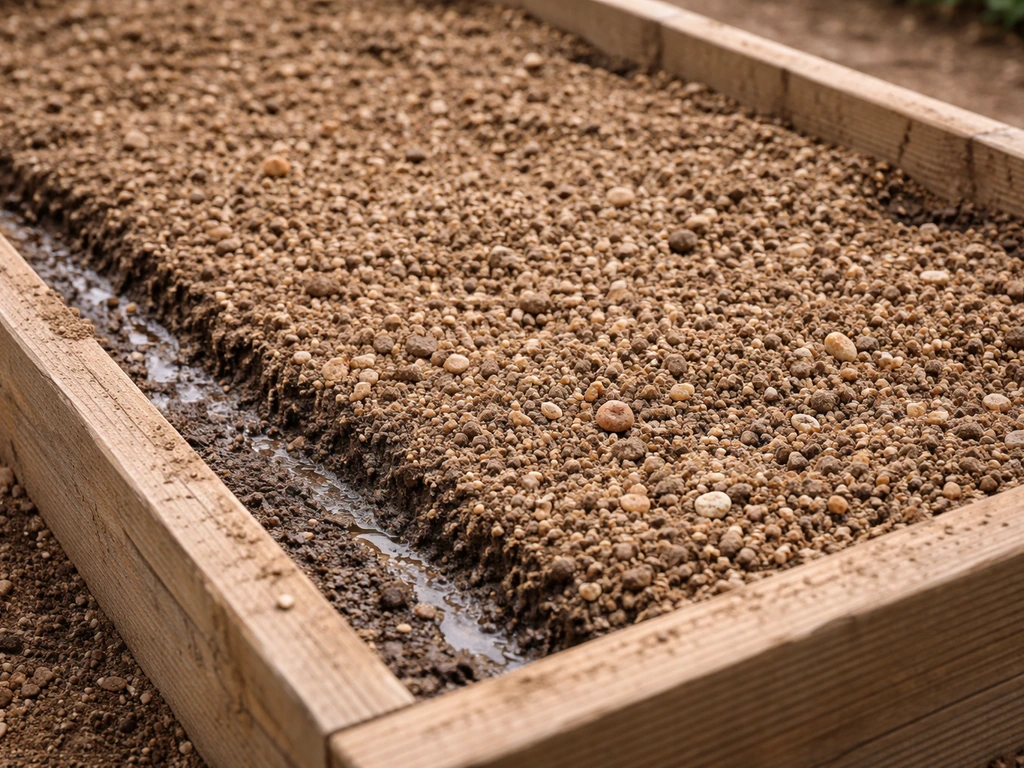
The fastest way to kill a drought-tolerant plant is to put it in heavy, poorly drained soil. Almost every desert and Mediterranean plant evolved in rocky, sandy, or gravelly soil that drains almost instantly. When those roots sit in wet, compacted clay, they suffocate and rot, often within a single wet season. Before you plant anything from an arid habitat, assess your drainage: dig a hole 12 inches deep and fill it with water. If it drains in under an hour, you are in good shape. If water is still sitting there four hours later, you need to either amend the soil, build a raised bed, or choose different plants.
Soil amendment for xeric plants usually means adding grit, coarse sand, or decomposed granite rather than compost. Compost improves water retention, which is the opposite of what you want. A 30 to 50 percent grit-to-soil ratio by volume is appropriate for desert-adapted species. For steppe and prairie perennials, lean soil is also preferred: overly rich soil often produces floppy growth and shorter plant lifespans in species like Echinacea and Penstemon.
Sun exposure is equally non-negotiable. Most xeric and Mediterranean plants need at least 6 hours of direct sun per day. In shadier conditions, they grow weakly, stay damp longer after rain, and lose much of their drought resistance. South and west-facing slopes accelerate drainage and increase heat load, which is actually beneficial for desert and chaparral plants. If you have a hot, dry, rocky slope that nothing seems to grow on, that is prime real estate for low-water natives from arid habitats.
Planting and establishing drought-tolerant plants with minimal irrigation
Even the toughest low-water plant needs reliable moisture during its first growing season to develop the deep root system that makes it drought-tolerant later. This establishment period is where most low-water gardening goes wrong: people plant in spring, water through summer, then stop in fall thinking the plant is established, and lose it the following summer when the roots still have not gone deep enough. A realistic establishment window is 1 to 2 growing seasons for perennials and small shrubs, and 2 to 3 years for large shrubs and trees.
Timing your planting makes a big difference. In Mediterranean and desert climates, fall planting is far superior to spring. The plant gets the entire cool, moist season to develop roots with minimal irrigation, then faces its first summer stress with a much more developed root system than a spring-planted specimen would have. In continental climates, early spring planting gives the plant a full season before its first hard winter.
During establishment, water deeply and infrequently rather than shallowly and often. Deep watering pushes roots downward toward more stable soil moisture. Shallow, frequent watering keeps roots near the surface, where they are most vulnerable to drought. A good rule for the establishment year: water deeply once a week in the absence of rain, tapering to once every two weeks in the second season, then stopping supplemental irrigation in year three except during exceptional drought.
Watering strategy after establishment
Once established, most true low-water plants should be watered rarely, if at all, in climates that match their native range. The goal shifts from keeping the plant alive to giving it just enough water to stay healthy and look good without reverting to a high-water plant. Overwatering established xeric plants is one of the most common ways to kill them: too much water in summer encourages fungal root diseases and can stimulate soft, sappy growth that is more vulnerable to heat stress.
Drip irrigation is far better than overhead sprinklers for low-water landscapes. Drip delivers water directly to the root zone, minimizes evaporation, keeps foliage dry (which reduces fungal disease on plants like Lavender and Cistus), and makes it easier to set accurate, infrequent schedules. A well-designed drip system for an established xeric bed might run once every 10 to 21 days during a dry season, or simply turn off completely from fall through spring in a Mediterranean climate.
Mulch is the most underused tool in low-water gardening. A 2 to 3 inch layer of gravel, decomposed granite, or coarse bark over the root zone reduces soil temperature by several degrees, slows evaporation dramatically, and suppresses weeds that would compete for moisture. For desert and Mediterranean plants, inorganic mulches like decomposed granite are often the better choice because they do not retain moisture against the crown the way organic mulches can. For steppe and prairie perennials, a light layer of coarse wood chip mulch works well.
- Group plants with similar water needs together so no zone is over- or under-watered.
- Use a soil moisture meter or simply check 4 inches below the soil surface before irrigating.
- Water in the early morning to minimize evaporation and reduce disease pressure on foliage.
- Adjust drip schedules seasonally: more frequent in peak summer heat, off or minimal in cool and rainy months.
- In windy sites, wind breaks or strategic placement behind structures can reduce plant moisture stress significantly.
Common mistakes and how to fix them
The number one mistake in low-water gardening is misreading a plant label. 'Drought tolerant' on a nursery tag does not mean 'plant it and forget it.' It usually means the plant can survive periodic dry spells once established in appropriate conditions. It tells you nothing about whether the plant suits your specific climate, soil, or sun. Always cross-check the plant's native habitat before buying.
The second most common issue is overwatering established plants, especially in the summer. Many Mediterranean and desert plants are semi-dormant in summer and do not need or want irrigation during that period. Watering them out of habit or because they look stressed by heat can actually make things worse. If a Lavender or Salvia looks ratty in July, check whether it needs water or whether it is simply resting during its natural dry season.
Poor drainage kills more low-water plants than actual drought. If you are losing plants that are supposed to be drought-tolerant, check your drainage before anything else. A raised bed or a berm as little as 8 inches high can make a heavy clay site perfectly suitable for plants that would otherwise fail.
Planting too large also causes problems. A 5-gallon shrub planted in summer heat with poor aftercare often performs worse than a 1-gallon plant set in fall and watered through one full season. Smaller plants establish faster, develop roots relative to their shoot size more efficiently, and usually catch up to and surpass larger transplants within two growing seasons.
Finally, watch out for the 'natives are always low-water' assumption that Oregon State's extension team flags repeatedly. A plant native to your state or region might still have evolved in a moist microhabitat: a riparian corridor, a north-facing forest slope, or a high-elevation snowmelt zone. Native status is a useful starting point for plant selection, but always look at where within the native range the plant naturally grows. The same species can span very different moisture conditions across its range, so matching the specific ecotype to your site conditions matters more than the species label alone.
If you are exploring related plant-environment questions, the same habitat-matching logic applies in other interesting directions: some plants grow without soil at all by attaching to tree branches and drawing moisture from air, while others are adapted to grow without conventional root drainage systems. These adaptations are all part of the same broader story of how plants solve for water in extreme environments. Some plants are true epiphytes, meaning they grow on tree branches without forming roots in soil.
FAQ
How do I know if a plant is truly “low-water” for my yard, not just “drought-tolerant” in general?
Check whether the plant comes from a habitat with the same baseline dryness you have, especially summer rainfall patterns. If your summers are wet (or your soil stays moist), a plant that only survives drought may look bad or rot because it still needs seasonal dry-down to stay healthy.
Can I use a native plant as a low-water plant if I’m planting in a more moist spot than where it naturally grows?
Yes, but only if you match the microhabitat. A species can be native and still require consistent moisture if it evolved on creek banks, shaded slopes, or snowmelt-fed areas. Choose native plants based on where within the wild landscape they grow, not just the species name.
What should I do if my soil stays wet for days after rain, even if I have “sun and space”?
Treat drainage as the limiting factor before choosing plants. Use the drainage test described in the article, and if slow, consider a raised bed or berm sized for at least a full wet cycle, then reselect species that tolerate those conditions or fix drainage with grit and amendments that do not increase water retention.
Is it okay to plant low-water plants in spring if I really want them sooner?
It’s possible, but it raises your risk because you may start the plant without a full cool, moist rooting window. If you plant in spring, be strict about deep, infrequent watering through the first growing season and expect that some plants may need closer monitoring through the first dry summer to establish deep roots.
When can I stop watering during the establishment period without losing the plant?
Stop supplemental irrigation only when the plant has passed at least one full growing season (and ideally two for shrubs), and when new growth and root establishment are clear. If your site gets unusually hot or dry, taper more slowly and treat “exceptional drought” as a reason to water longer into year two rather than stopping on a fixed date.
How much water is “deeply once a week” if I don’t use drip?
Deep watering means wetting the root zone, not just the surface. A practical check is to water long enough that the soil is moist down several inches, then wait until that zone begins to dry before watering again. If you cannot reliably reach that depth, switch to drip or adjust to longer intervals with longer soak times.
Do low-water plants still need mulch, or will it keep the crown too wet?
Mulch is still helpful, but choice matters. In desert and Mediterranean setups, inorganic mulches like coarse gravel or decomposed granite usually reduce crown moisture problems compared with organic mulch, which can trap moisture near the crown if you keep the soil too humid.
Why does my lavender or sage look stressed in midsummer even though I’m not overwatering?
Many Mediterranean plants go into near-dormancy during summer heat and may look rough while they wait out the dry season. Before adding water, confirm soil moisture and drainage, check for signs of rot (soft stems, foul soil odor), and ensure they have enough sun, since low light can keep soil damp longer and reduce drought resistance.
What’s the best way to avoid killing low-water plants with a drip system that runs too often?
Set the controller to match the plant’s seasonal dormancy. For xeric beds, use longer intervals (or shutoff) during fall through spring in Mediterranean climates, and verify coverage by checking the soil moisture where emitters apply, since layout mistakes can create constantly wet pockets.
Can low-water plants grow in containers if I want less irrigation than a typical patio garden?
They can, but containers often dry out faster and can also stay too wet depending on potting mix and drainage. Use fast-draining, low-organic media, ensure strong drainage holes, and plan for less frequent but deeper watering, since even drought-adapted species can suffer from waterlogging in the bottom of containers.
Are there low-water plants that handle shade, or do I need full sun to succeed?
Some tolerate part shade, but most “true low-water” options perform best with at least several hours of direct sun. If your yard is mostly shade, prioritize plants adapted to dry, open woodland or accept that the reduced sun will require more careful drainage and a more conservative watering schedule.