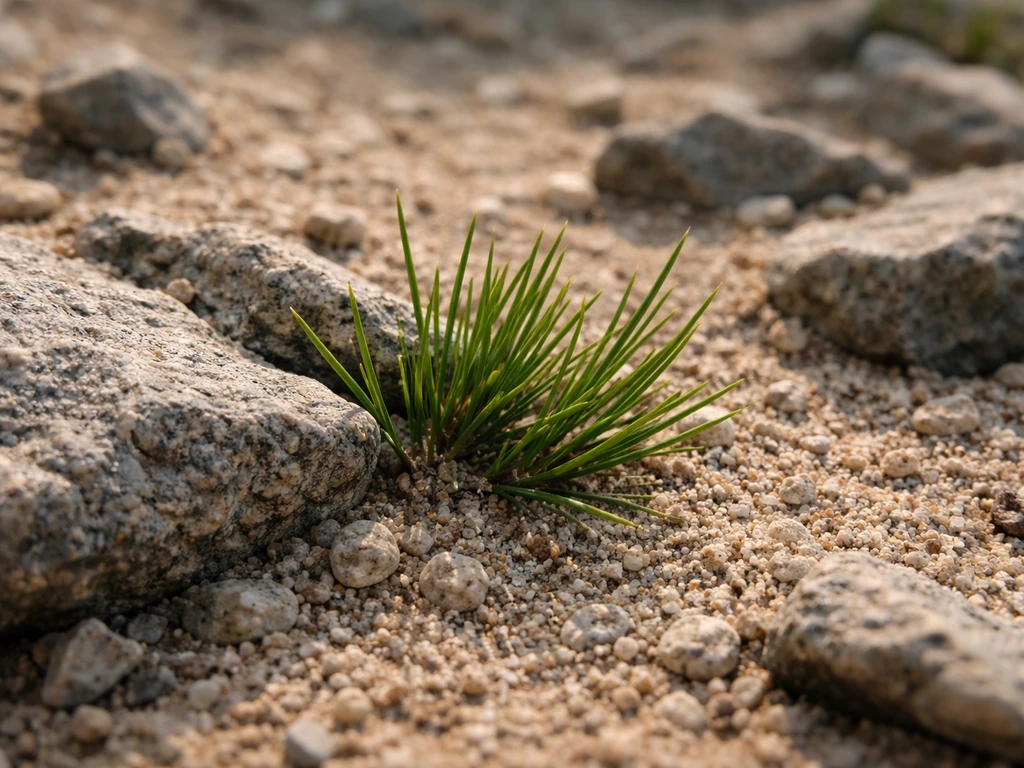
Needle-like leaves are most commonly found on conifers, plants that grow on a remarkably wide range of substrates including rocky mountain slopes, sandy coastal soils, frozen tundra edges, desert-adjacent dry ground, and shaded forest floors. The needle shape itself is an ecological adaptation, not a coincidence. Thin, waxy, often rolled leaves reduce surface area and water loss, which is why you see them on plants coping with cold, drought, wind, or nutrient-poor soils. So if your clue is 'needle-like leaves on a plant growing on __,' the habitat is already telling you a lot about which plant group you're dealing with.
Needle-Like Leaves Found in Plants That Grow on Rocks, Sand

Dr. Marcus Weatherby
4 Jun 2026
What needle-like leaves usually mean (and a few lookalikes)
In plant ecology, needle-like leaves almost always point you toward conifers, the gymnosperms that include pines, spruces, firs, larches, and their relatives. These plants evolved needle, scale, or awl-shaped leaves rather than the broad flat blades you see on most flowering plants. In conifers (gymnosperms), leaves are commonly needle-like, scale-like, or awl-shaped rather than broad angiosperm blades needle, scale, or awl-shaped leaves. The needle form is a direct response to environmental stress: it minimizes water loss in cold winters, resists snow loading, and survives in soils where nutrients and moisture are scarce.
That said, a few non-conifers can fool you at first glance. Some flowering plants in dry or coastal habitats also produce narrow, almost needle-like leaves as a moisture-conservation strategy. Rosemary and lavender have narrow linear leaves that look needle-like from a distance. Heath and heather family plants (Ericaceae), including species of Erica and Calluna, produce tiny needle-like leaves on woody stems in moorland and alpine zones. Asparagus fern produces cladodes (modified stems) that look like needles. None of these are true conifers, but they occupy some of the same stressful habitats, which is why the leaf shape converges.
Spines are another common lookalike. Cacti and many desert shrubs have spines that are actually modified leaves or stipules, not photosynthetic needles. They are hard, sharp, and often grow from areoles or stipule positions rather than as standard leaves on a shoot. True conifer needles are soft to firm but not weaponized the way spines are, and they photosynthesize. If the 'needle' on your plant is piercing your skin rather than bending slightly, you are probably looking at a spine, not a leaf.
Match the habitat first: what grows where
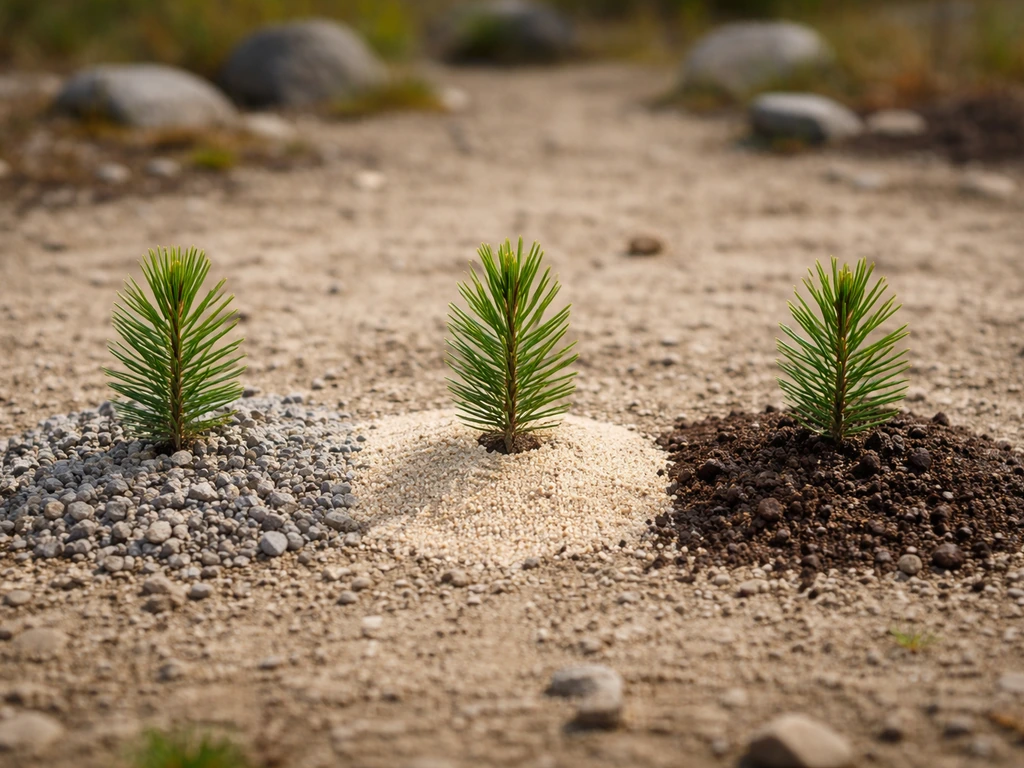
Before you look closely at the leaf itself, look at where the plant is growing. The substrate and climate zone narrow your list dramatically. Here is how needle-leaved plants sort out by habitat.
Arctic and tundra ground
Plants growing on Arctic or subarctic tundra face permafrost, short growing seasons, and wind exposure. Dwarf conifers and prostrate shrubs dominate here. You will find low-growing junipers hugging the ground, and heaths like crowberry (Empetrum nigrum) with tiny needle-like leaves that look superficially coniferous. True conifers rarely grow directly on open tundra but appear at the forest-tundra transition known as the taiga edge. Black spruce (Picea mariana) is the quintessential cold-climate conifer here, colonizing boggy, nutrient-poor soils right up to the treeline.
Alpine and mountain slopes
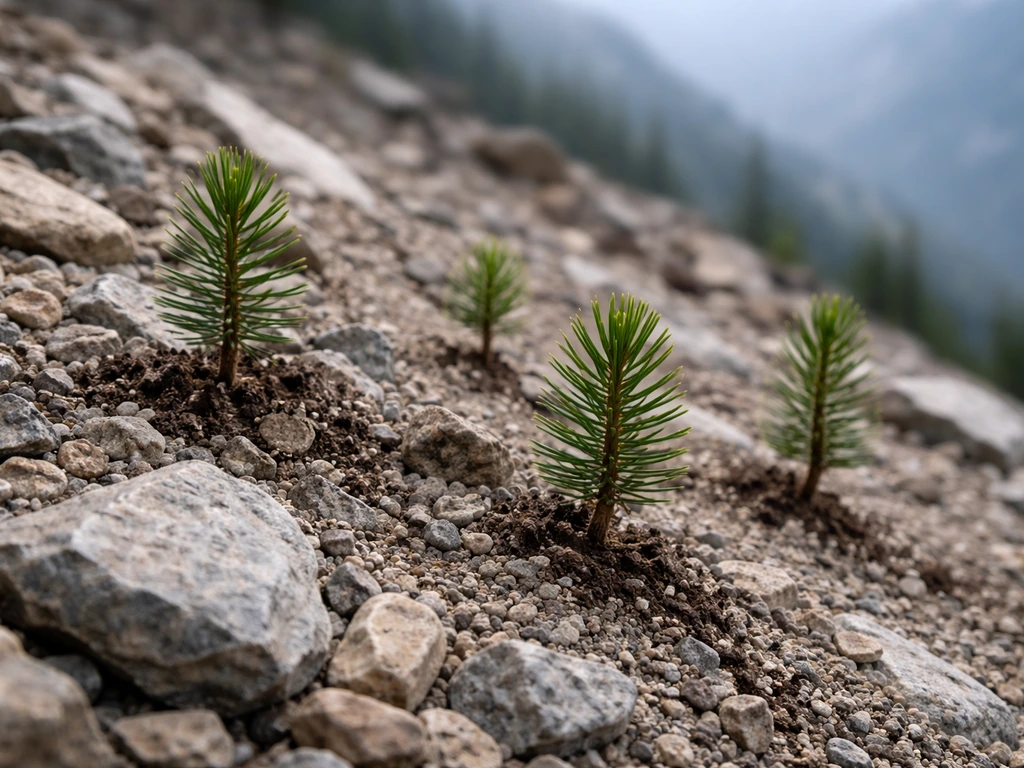
Mountain environments are where needle-leaved conifers really dominate. Subalpine fir (Abies lasiocarpa), Engelmann spruce (Picea engelmannii), and limber pine (Pinus flexilis) all grow on rocky, thin-soiled alpine slopes. Above treeline, you again see dwarf shrubs with narrow leaves. The combination of high UV radiation, freeze-thaw cycles, and shallow rocky soils strongly selects for the needle form. If your plant is growing on exposed rocky alpine terrain, a conifer or an Ericaceae shrub is almost certainly what you are looking at.
Desert and sandy substrates
Desert plants with needle-like features are more likely to be spiny succulents or narrow-leaved shrubs than true conifers, but there are exceptions. Pinyon pines (Pinus edulis and relatives) grow on dry, rocky, desert-edge soils in the American Southwest at elevations between roughly 1,500 and 2,300 meters. Their short, stiff needles in bundles of two reflect the water-stress adaptation. In sandy coastal dunes, shore pine (Pinus contorta var. contorta) and maritime pines (Pinus pinaster) stabilize loose sand, tolerating salt spray and drought. Sandy soil with a conifer? Bundle count on the needles is your first question.
Forest floors and shaded understory
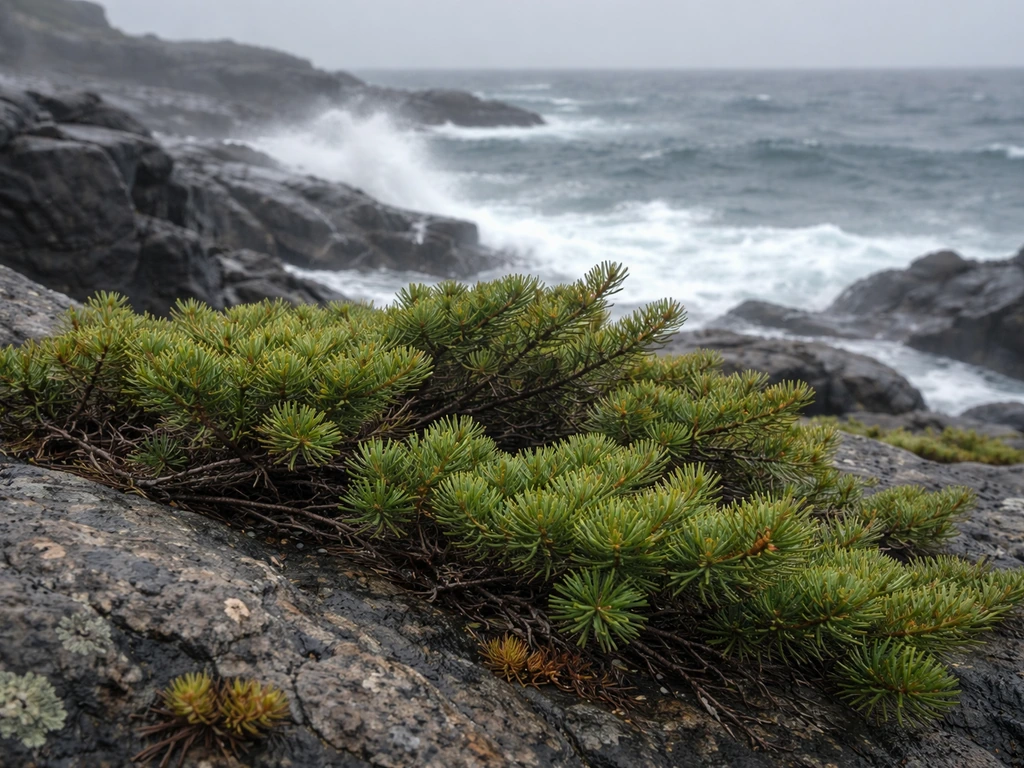
On the forest floor under a canopy of conifers, needle-like leaves show up on regenerating conifer seedlings, on prostrate junipers, and on shade-tolerant shrubs. Pacific yew (Taxus brevifolia) grows in the understory of Pacific Northwest forests and has flat, two-ranked needles with a distinctive red aril rather than a woody cone. Hemlock species (Tsuga) also prefer shaded, moist forest floors with their short, flat needles of unequal length. If your plant is on a dim forest floor with soft needle-like leaves and no cones visible, hemlock or yew are strong candidates.
Coastal and salt-exposed sites
Coastal exposure brings salt, wind, and often sandy or rocky substrate. Conifers adapted here include shore pine, Torrey pine (Pinus torreyana, which grows only on a very small coastal strip in California), and various junipers. Non-conifer narrow-leaved plants common in coastal zones include sea heath (Frankenia) and certain Erica species. The narrow leaf reduces salt uptake and wind damage simultaneously.
Needles vs. spines vs. narrow leaves: how to tell them apart
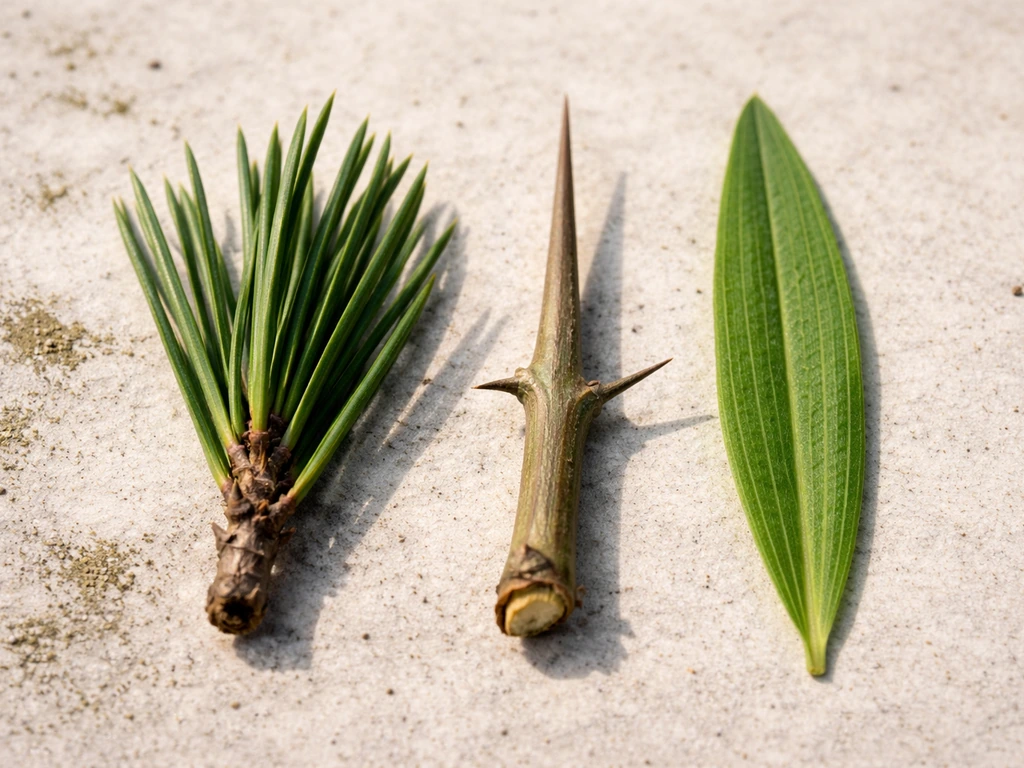
This is the most practically important distinction you can make in the field, and it only takes about two minutes with your hands.
| Trait | True Needle (Conifer) | Spine | Narrow Angiosperm Leaf |
|---|---|---|---|
| Origin | Modified leaf attached to shoot | Modified leaf, stipule, or stem | True leaf on stem node |
| Texture | Firm, flexible, waxy coating | Hard, rigid, sharp point | Variable, often softer |
| Tip | Pointed but not always sharp | Very sharp, piercing | Pointed or rounded |
| Function | Photosynthesis | Defense, not photosynthetic | Photosynthesis |
| Arrangement | Fascicles (pines), singly (spruce/fir) | From areoles or stipule nodes | Alternate, opposite, or whorled |
| Associated structures | Cones, resinous bark | Areoles (cacti), thorny stems | Flowers, fruits, seeds |
| Example plants | Pine, spruce, fir, hemlock | Cactus, hawthorn, barberry | Rosemary, heather, lavender |
Run your fingers carefully along the stem. If what looks like needles draws blood, those are spines. If the narrow leaves come off at clear leaf nodes and the stem has visible buds, you have a narrow-leaved flowering plant. If the leaves are grouped in tight bundles at a single point on the stem, or are individually attached along a woody shoot with resinous sap, you are almost certainly holding a conifer.
Plant examples by biome where needle-like leaves are common
Pines are the most widespread and most recognizable needle-leaved genus worldwide. The single most useful field character for pines: needles come in bundles called fascicles, bound at the base with a small papery sheath. Pines are also distinguishable by long, narrow needles bound in bundles, along with large woody cones and characteristic whorls of branches blank" rel="noopener noreferrer">needles bound in bundles called fascicles. Two needles per bundle, three, or five, that number tells you the species group immediately. Eastern white pine (Pinus strobus) has five needles per bundle and grows in moist, well-drained sandy or loamy forest soils across eastern North America. Scots pine (Pinus sylvestris) has two needles per bundle and grows across an enormous range of soils from sandy heathland to rocky hillsides across Europe and Asia. Ponderosa pine (Pinus ponderosa) has three needles per bundle and is the signature tree of dry, rocky western North American slopes.
Spruces (Picea) grow singly attached needles that are four-sided and roll between your fingers. They prefer cool to cold, moist soils and are classic mountain and boreal forest trees. Firs (Abies) have flat, blunt needles that leave a smooth round scar when pulled off, unlike the small raised peg left by spruce needles. Firs often grow on moist, high-elevation slopes. Larches (Larix) are deciduous conifers with soft needles in dense clusters on short spurs, found in cold continental climates and subalpine zones. Junipers (Juniperus) are highly variable, with either scale-like or needle-like (awl-shaped) leaves depending on species and age, and they colonize rocky, thin, alkaline soils that other conifers avoid.
- Arctic/tundra edge: Black spruce (Picea mariana), prostrate juniper (Juniperus communis var. depressa), crowberry (Empetrum nigrum)
- Alpine/mountain rocky slopes: Subalpine fir (Abies lasiocarpa), Engelmann spruce (Picea engelmannii), limber pine (Pinus flexilis), alpine larch (Larix lyallii)
- Desert-edge and dry rocky ground: Pinyon pine (Pinus edulis), one-seed juniper (Juniperus monosperma), Utah juniper (Juniperus osteosperma)
- Sandy coastal soils: Shore pine (Pinus contorta), maritime pine (Pinus pinaster), Torrey pine (Pinus torreyana)
- Moist forest floors and understory: Pacific yew (Taxus brevifolia), western hemlock (Tsuga heterophylla), eastern hemlock (Tsuga canadensis)
- Heathland and moorland (non-conifer): Heather (Calluna vulgaris), bell heather (Erica cinerea), cross-leaved heath (Erica tetralix)
How to narrow it down fast
You can get to genus level in under five minutes using only your eyes and hands. Work through these checks in order.
- Are the needles in bundles? If yes, you have a pine (Pinus). Count the needles per bundle: 2, 3, or 5. That alone gets you to a species group.
- Are the needles attached singly? Roll one between your fingers. Four-sided and rolls easily = spruce. Flat and does not roll = fir or hemlock. Check the scar: smooth circular scar = fir, raised woody peg = spruce.
- Are the needles in dense clusters on a short stubby spur shoot? If the tree is deciduous (needles drop in fall), it is a larch. If evergreen in tight rosettes on spurs, consider cedar (Cedrus).
- Are the 'needles' actually scale-like or awl-shaped, overlapping on the twig like fish scales? You are likely looking at a juniper, cypress, or arborvitae.
- Measure needle length. Very short needles under 2 cm on flat sprays often mean hemlock or yew. Long needles over 10 cm in bundles point to a pine like ponderosa or long-leaf pine.
- Look for cones or seed structures. Large woody cones with thick scales = pine. Papery thin-scaled upright cones = fir. Hanging cylindrical cones = spruce or hemlock. Fleshy red berry-like arils = yew. Small blue-grey berry-like cones = juniper.
- Take a photo of the needle attachment point, a full branch, the bark, and any cones. These four images will let any local botanist or plant ID app confirm your identification the same day.
Growth form matters too. A sprawling mat-forming plant under 30 cm tall on exposed rocky ground is almost certainly a prostrate juniper or a heathland shrub, not a tree conifer. A single-stemmed tree with whorled branches and resinous bark is a classic conifer. Knowing the growth form before you look at the leaf saves you from chasing the wrong genus entirely.
It is also worth noting that needle-like leaves show up in plants with very different reproductive strategies. If you are interested in how some plants propagate vegetatively through leaf structures, the contrast with conifers (which reproduce via seeds in cones) is a useful distinction. Conifers do not grow from leaves the way some flowering succulents and tropical species do. Some flowering succulents, such as bryophyllum, can also propagate new plants from their leaves. Conifers and other true needle-leaved plants form needles on their stems rather than producing new plants directly from leaf tissue Conifers do not grow from leaves. If you are trying to identify a plant that truly grows from a leaf, look for leaf-propagation habits rather than relying on needle-leaf traits alone grow from leaves. If you are looking for examples of plants that grow from leaves, the easiest place to start is leaf-propagating flowering succulents and tropical species Conifers do not grow from leaves. Plants which grow from leaves are different from conifers, which reproduce via seeds in cones. That reproductive difference reflects a deep evolutionary divide, and it reinforces why needle-leaf plants are almost always in their own ecological niche rather than sharing it with leaf-propagating species.
Confirm your ID and understand what these plants need
Once you have a genus in mind, confirm it with a regional plant key or your local cooperative extension service. In the US, university extension forestry programs (many available free online) publish illustrated keys specifically for conifers by state or region. iNaturalist is also genuinely reliable for conifers if you upload clear photos of needles, cones, bark, and overall form together, not just a single needle shot. For alpine or tundra species, regional herbarium databases and national park plant lists are your best resource.
For conditions, here is what most needle-leaved plants are actually asking for based on the habitat signals that brought you to them in the first place:
| Plant Group | Light | Moisture | Soil Type | Exposure Tolerance |
|---|---|---|---|---|
| Pines (Pinus) | Full sun | Low to moderate, well-drained | Sandy, rocky, acidic to neutral | High wind and drought tolerance |
| Spruces (Picea) | Full sun to part shade | Moderate to high, consistent moisture | Cool, moist, acidic | Cold-hardy, moderate wind |
| Firs (Abies) | Full sun to part shade | Moderate to high | Moist, well-drained, acidic | Cold-hardy, less drought-tolerant |
| Junipers (Juniperus) | Full sun | Very low, excellent drainage essential | Rocky, alkaline to neutral, thin | Extreme drought and wind |
| Hemlocks (Tsuga) | Part shade to full shade | Moderate to high, consistent | Moist, acidic, rich organic layer | Low drought tolerance |
| Heathland shrubs (Erica/Calluna) | Full sun | Low to moderate, free-draining | Acidic, peaty, nutrient-poor | Wind-exposed, frost-hardy |
If you are a gardener trying to recreate the conditions, the table above gives you your planting requirements directly from the ecology. If you are a student or researcher trying to understand why needle-like leaves appear in a given location, the key insight is this: wherever you see needle-like leaves, the environment is pushing for water conservation, cold hardiness, or both. The substrate (rocky, sandy, frozen, thin) is usually the limiting factor, and the needle form is the plant's answer to that constraint. Once you understand that relationship, the clue 'needle-like leaves on plants growing on _' becomes a reliable indicator, not just a visual oddity. If you want a quick starting point, see these 10 examples of plants that grow from leaves and compare their leaf-propagation traits to conifers.
FAQ
How can I tell if needle-like leaves are from a true conifer versus a narrow-leaved flowering plant?
Yes, but use additional checks. Some narrow-leaved flowering plants (like rosemary and heather relatives) can look needle-like from a distance. Confirm by checking whether the “needles” are true leaves attached at leaf nodes versus spines, and whether needles form in bundles (a strong pine clue) or as a single attachment pattern (spruce, fir, hemlock, and yew patterns).
Do all conifers keep their needle-like leaves year-round?
Not always. Many conifers keep evergreen needles, but larches (Larix) are deciduous, losing needles seasonally. If your plant looks “needle-less” at certain times of year, check whether it dropped needles rather than dying back, and compare with the growth form (larch has clusters on short spurs).
What if the “needles” feel sharp like thorns, could they still be leaves?
Yes, needle-like structures can be deceptive because some spines are modified leaves or stipules, and some “needle” stems are actually photosynthetic structures. When in doubt, run the hands test: if the point is sharp enough to puncture skin easily and it does not bend like a leaf, treat it as a spine or spiny outgrowth, not a conifer needle.
How do I correctly count pine needles per bundle without misidentifying the plant?
Bundle count is most reliable for pines, but don’t skip the context. Needles can appear single if you only notice one needle, or you may miscount when needles are aged and shed. Gently separate a small cluster and look for the base binding (a papery sheath is a key pine sign) before concluding species group.
Can the substrate (rock vs sand) mislead me when identifying needle-leaved plants?
Soil type can help, but moisture regime often matters more than sand or rock alone. For example, the same substrate (rocky ground) can support different conifers depending on whether the site is constantly dry, periodically wet, or sits near boggy conditions. If the ground stays wet or mossy, prioritize cold-moist conifer candidates (like spruce or other boreal types) rather than strictly “desert-edge” pines.
What should I check if I can’t find cones, because they aren’t on the plant?
If you only see needles, you can still narrow it down, but you need at least one additional feature. Look for cone presence or absence, needle attachment type (singly attached versus bundles), and whether the needle scars on branches are peg-like or smooth when needles are removed. For yew and hemlock, cone visibility alone may not be the best cue because they differ in reproductive structure.
Are pines always easy to identify in coastal or sandy environments?
For pines, yes, but also watch for exceptional coastal or unusual populations. Shore pine and maritime-type pines can grow near salt spray and wind, but exact species may depend on your region. Use habitat plus bundle count and needle thickness or stiffness, then confirm with a local key because closely related pines can swap ranges.
Can the needle-like appearance change as a plant grows, and how does that affect identification?
Some plants change needle appearance with age or species variation. Junipers, for example, can have scale-like leaves when young and more needle-like (awl-shaped) foliage at other stages, and growth habit can vary from shrub to creeping forms. If leaf type shifts along the plant, treat it as a juniper likelihood and verify with branching and bark cues.
What are common mistakes when identifying needle-leaved plants that have been drought-stressed or recently transplanted?
It can. If you propagate or transplant, needle-leaf traits remain, but stress from drought, heat, or poor drainage can cause needles to curl, discolor, or drop, making them look “less needle-like.” Before concluding it’s not the same plant, check whether new growth is returning with normal form and whether the overall shoot architecture matches your original identification.
If I use a plant ID app or community help, what photos give the best chance of a correct ID?
Photo uploads can be misleading if you capture only one needle. For reliable help, include at least four angles: whole plant or growth form (tree, shrub, mat), a close-up of needle attachment, a close-up of bark or twig, and any reproductive structures you can find (cones, arils, or seed-bearing parts). A single macro shot often cannot distinguish pine bundles from singly attached needles.