Plants that grow in lakes and ponds are called aquatic plants, and the more precise scientific term is hydrophytes. A hydrophyte is any plant that lives partly or entirely in water, whether it's rooted in the muddy bottom of a lake or drifting freely across the surface of a backyard pond. Both terms are correct and widely used, but if you're filling in a blank for a biology class or ecology textbook, 'aquatic plant' is the common answer and 'hydrophyte' is the technical one.
Plants Which Grow in Lakes and Ponds Are Called

Dr. Marcus Weatherby
8 Jun 2026
What exactly qualifies as a lake or pond plant
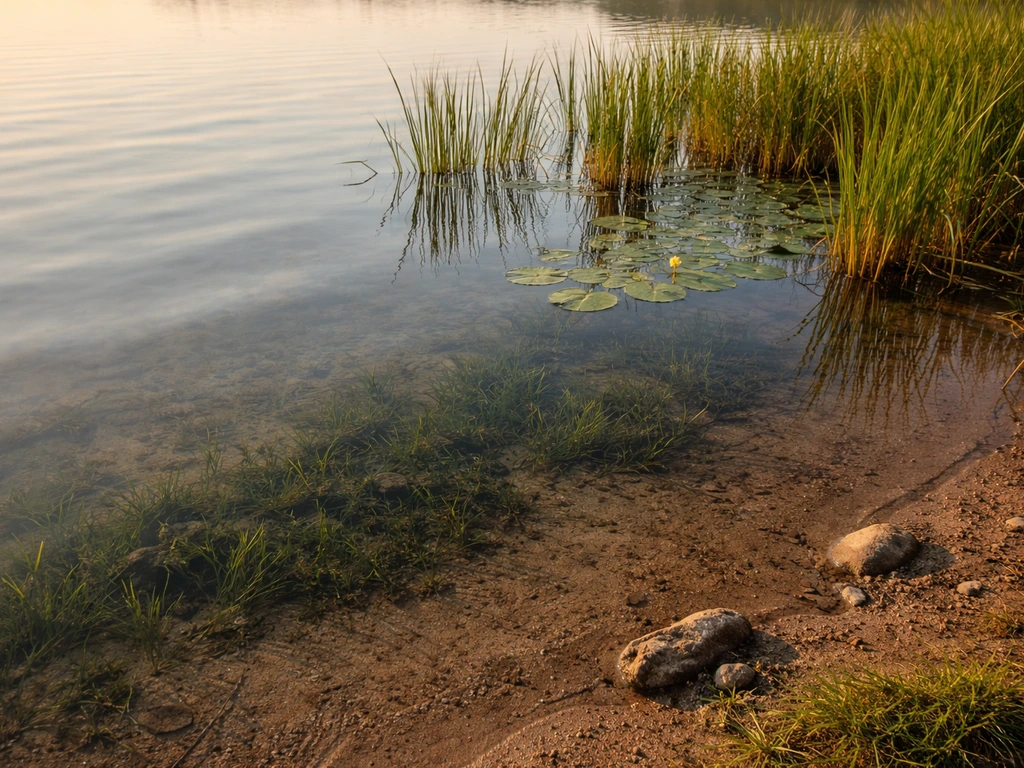
Not every plant near water counts. A willow tree growing on a muddy bank is not an aquatic plant. Aquatic plants are specifically adapted to live with their roots, stems, or leaves in the water itself, and they have structural features that let them survive conditions most land plants can't handle: waterlogged soil, low oxygen at the root zone, and fluctuating water levels.
The defining feature is water as the primary habitat, not just proximity to it. Hydrophytes typically have shallower, less developed root systems than land plants, and many develop adventitious roots (roots that grow from the stem rather than a main taproot) to compensate for the low-oxygen environment. Some species even show heterophylly, meaning the same plant produces different leaf shapes depending on whether those leaves are submerged or above the waterline. Spatterdock (Nuphar sp.) is a great example: it has thin, translucent leaves attached to rhizomes underwater, but its flowers and tougher surface leaves extend right up through the water column.
It's also worth noting that aquatic plants sit in a broader category of water-tolerant plants. If you've read about plants that grow in wet areas or plants that grow in marshy zones, hydrophytes overlap with those discussions but are specifically adapted to open-water conditions rather than just saturated soils. Marshmallow plants are a different kind of plant than the lake-and-pond hydrophytes described here, and their growth is tied to drier, sunny habitats rather than open water. Wetland vegetation on the fringes of a pond might include species that can handle seasonal flooding, but a true aquatic plant lives in the water itself, not just beside it.
Aquatic plant habitat types in lakes and ponds
Lakes and ponds aren't uniform environments. If you walk from the shore toward the deeper center, you move through distinct zones, and each one supports a different community of aquatic plants.
- Shallow littoral zone (0 to about 6 feet deep): This is where most aquatic plant diversity lives. You'll find emergent plants standing upright at the edges, rooted floating-leaf plants a little further out, and submerged plants scattered across the bottom wherever light penetrates.
- Mid-depth transition zone: Submerged plants dominate here. The water is deep enough that surface conditions matter less, but light still reaches the bottom. Species like hydrilla and coontail thrive in this range.
- Open water and surface: Free-floating plants like duckweed and watermeal don't care about depth at all. They sit at the surface wherever the wind and currents take them.
- Bottom substrate: Whether the bottom is sandy, silty, or thick with organic muck influences which rooted species can anchor themselves. Lotus and spatterdock prefer soft, muddy bottoms with their thick rhizomes.
Temperature also plays a role. Warmer, shallower ponds in temperate regions tend to have denser aquatic plant communities than cold, deep lakes where light can't penetrate far enough to support rooted vegetation. In high-altitude or northern lakes, you might find a narrow fringe of emergent plants around the edge and very little else.
Quick classification: submerged vs floating vs emergent
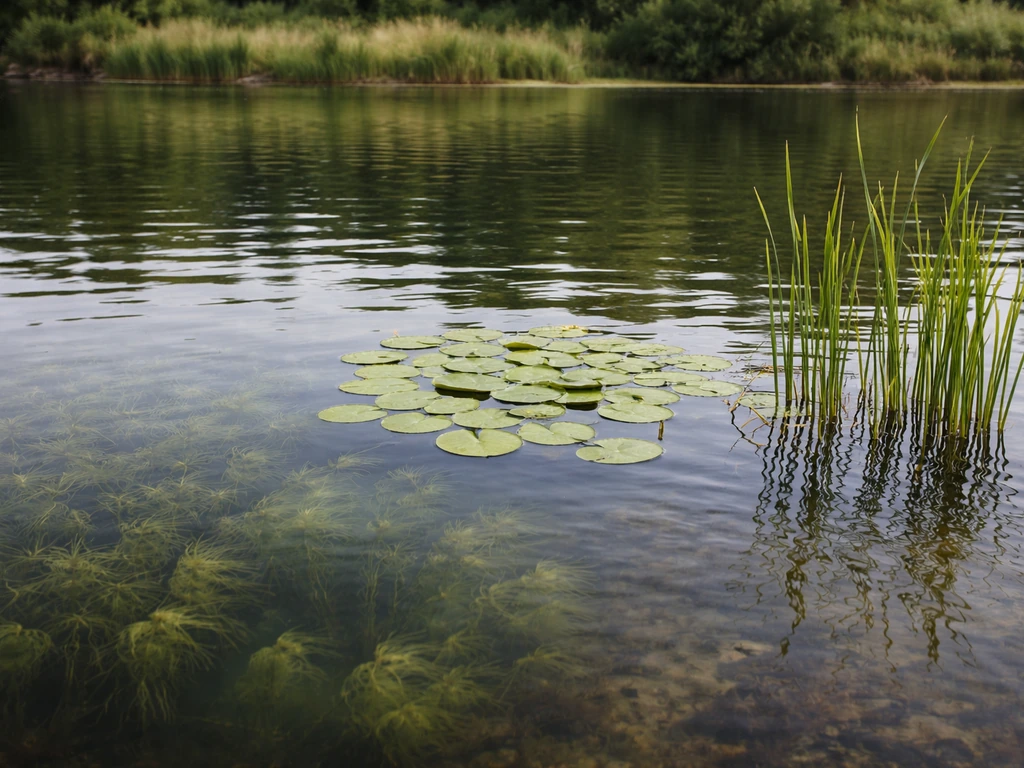
The three main categories of aquatic plants describe where the plant physically sits in relation to the water surface. Getting comfortable with this classification makes it much easier to identify what you're looking at in the field.
| Type | Where it lives | Rooting strategy | Recognizable example |
|---|---|---|---|
| Submerged | Entirely underwater, growing up through the water column | Rooted in bottom sediment | Hydrilla, coontail, elodea |
| Floating-leaved (rooted) | Roots anchored in bottom, leaves and flowers float on the surface | Rooted in bottom sediment via rhizomes | Water lily, lotus, spatterdock |
| Free-floating | Drifting at or just below the surface, no bottom attachment | No true rooting or minimal trailing roots | Duckweed, watermeal, water hyacinth |
| Emergent | Rooted in bottom, stems and leaves extend above the water surface | Rooted in bottom sediment in shallow water | Cattail, bulrush, pickerelweed |
The dividing line between floating-leaved and free-floating trips up a lot of people. The key distinction is whether the plant has roots connected to the pond bottom. A water lily looks like it's floating, but it's actually anchored by thick rhizomes in the mud below. Duckweed, on the other hand, has tiny hair-like roots that just dangle in the water and never touch bottom. Both are aquatic plants, but they interact with their habitat very differently.
Common confusions and how to avoid them
Aquatic plants vs algae
This is the most common mistake beginners make, especially when looking at a pond covered in green. Algae are not true plants. They lack a real root system, true stems, and they don't produce flowers or seeds. What you're seeing when a pond turns bright green is either single-celled algae suspended in the water column, or filamentous algae forming stringy clumps and mats.
Filamentous algae often starts on the bottom and floats up to form surface mats, which is why it can look like a plant at a distance. Climbers that grow in rainforest are called vines. True aquatic vascular plants have genuine roots, stems, and in most cases they produce flowers and seeds. If you pull something out of the water and it has distinct leaves, a stem you can trace, and roots with actual structure, it's a plant.
If it's just a slimy tangle with no discernible structure, it's almost certainly algae.
Duckweed mistaken for algae
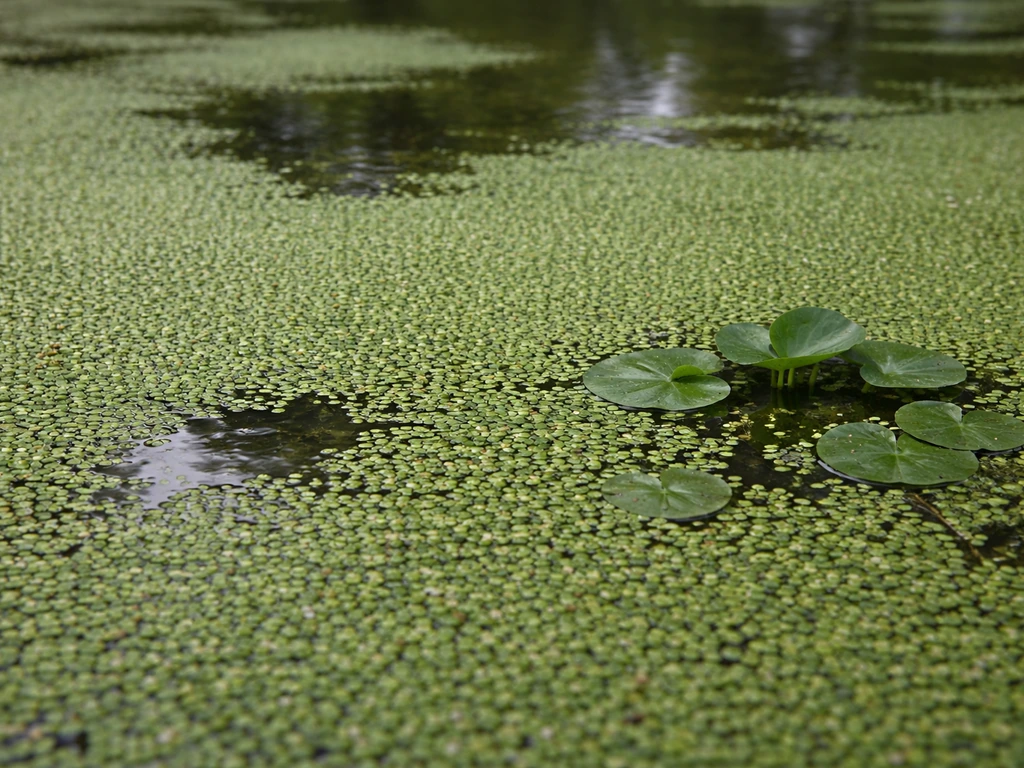
Duckweed and watermeal deserve their own mention here because they fool even experienced pond managers at a distance. Both are true aquatic plants, not algae, but they cover the surface in a dense green layer that looks like algae scum from across a pond. Up close, duckweed consists of tiny individual leaf-like fronds (usually 1 to 3 mm wide) with hair-like roots trailing beneath. Watermeal is even smaller, about the size of a sesame seed, and has no visible roots at all. If you scoop some up and see individual distinct pieces rather than a continuous slimy mass, you're looking at a plant.
Aquatic plants vs wetland/shoreline plants
Hydrophytes technically include plants adapted to saturated and flooded soils, so the term can blur into discussions of marshy vegetation and wetland plants. For practical purposes, lake and pond plants are those whose primary growing habitat is within the water itself. A cattail standing in 6 inches of water at a pond's edge qualifies. A sedge growing in wet soil two feet from the water's edge is more of a wetland or marginal plant. The distinction matters when you're trying to categorize what you're observing or studying.
Examples you can recognize in real ponds and lakes
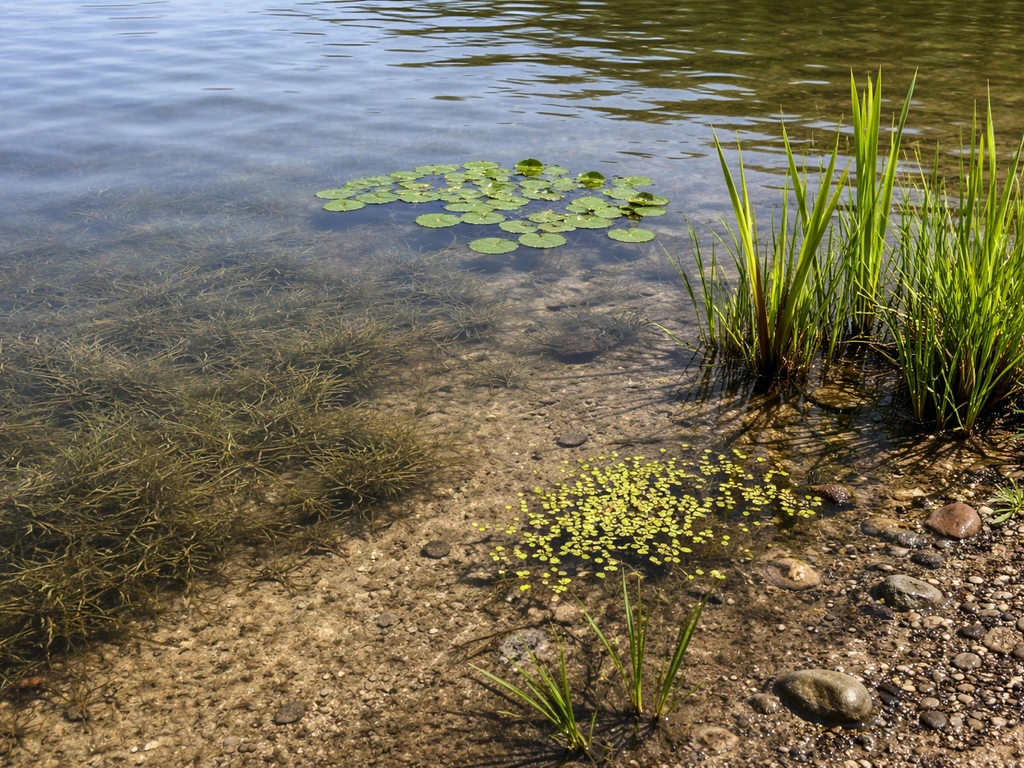
The best way to make these categories stick is to connect them to plants you can actually find. Here are representative examples from each group that appear in temperate freshwater ponds and lakes across North America.
Submerged plants
- Hydrilla (Hydrilla verticillata): Dense underwater stems with whorled, toothed leaves. Often the dominant submerged plant in warmer ponds, and a notorious invasive in the southeastern US.
- Coontail (Ceratophyllum demersum): Looks like a feathery bottle brush, free-floating in the water column without true roots. Common in nutrient-rich ponds.
- Elodea (Elodea canadensis): The classic aquarium plant that also grows wild. Dense, branching stems with small oval leaves, rooted in bottom sediment.
Floating-leaved plants
- White water lily (Nymphaea odorata): Large round leaves and white flowers floating at the surface, with thick rhizomes anchored in muddy bottoms. Leaves can reach 30 cm across.
- Lotus (Nelumbo lutea, American lotus): Massive leaves that can rise above the surface as well as float on it. Seeds and seed pods are highly distinctive.
- Spatterdock (Nuphar variegata): Heart-shaped, leathery leaves floating on the surface, yellow globe-shaped flowers, common in slow-moving or still water.
Free-floating plants
- Common duckweed (Lemna minor): Tiny oval fronds 1 to 3 mm wide, light green, with a single root trailing below. Forms dense mats in still, sheltered water.
- Watermeal (Wolffia spp.): The smallest flowering plant in the world. Granular, seedlike fronds with no visible root. Pale green, often mixed with duckweed.
- Water hyacinth (Eichhornia crassipes): A larger free-floater with inflated, bulbous leaf stalks that act as floats, and showy purple flowers. A significant invasive in warm climates.
Emergent plants
- Common cattail (Typha latifolia): The most recognizable pond plant in North America. Brown, sausage-shaped seed heads on tall stems, rooted in shallow water or saturated soil at pond edges.
- Bulrush (Schoenoplectus acutus): Round, reed-like stems with small brown flower clusters near the top. Often grows in dense stands in 1 to 3 feet of water.
- Pickerelweed (Pontederia cordata): Spear-shaped leaves rising above the water with blue-purple flower spikes. A common and attractive native emergent in eastern North American ponds.
How to identify lake and pond plants using simple field cues
You don't need a lab or a field guide to start sorting what you see in a pond. A simple visual check using four questions will get you most of the way there.
- Is it above the water, at the surface, or underwater? Emergent plants are clearly standing above the waterline. Floating plants sit right at the surface. Submerged plants are visible below the surface, sometimes all the way to the bottom in clear water.
- Can you see distinct structure: leaves, stems, roots? If yes, it's a true plant. If it's a formless, slimy mass with no individual structure, suspect algae. If it's tiny separate pieces covering the surface, suspect duckweed or watermeal rather than algae.
- Are the leaves attached to something anchored below? Pull gently (without disturbing the habitat too much). Rooted plants will resist. Free-floating plants come free immediately with no tension. If the leaves are floating but there's a stem going down to a thick rhizome, you've got a floating-leaved rooted plant like a water lily.
- What do the leaves look like at the water surface versus below? Some plants like spatterdock show completely different leaf forms above and below water. This heterophylly is a strong clue that you're dealing with a complex aquatic vascular plant rather than algae or a simple emergent species.
- What's the water depth where it's growing? Emergent plants almost always grow in shallow zones (under 3 to 4 feet). Submerged plants can grow deeper as long as light reaches them. Free-floating plants ignore depth entirely and go wherever the surface takes them.
- Are there flowers or seed structures? True aquatic plants produce flowers and seeds. Algae never does. Even tiny duckweed produces microscopic flowers, though you'll rarely see them in the field.
One practical habit: when you visit a pond or lake, start at the edge and work outward mentally. The emergent zone at the margin transitions into the floating-leaved zone a few feet out, which gives way to submerged plants in deeper open water. [Mississippi State University Extension](https://extension. msstate.
edu/natural-resources/fisheries/pond-and-lake-management/weed-control/aquatic-plant-identification) also defines emergent plants as rooted in bottom soil with leaves, stems, or flowers extending above the water surface, while floating plants include both free-floating plants and floating-leaf plants with roots attached to the bottom. Free-floating plants can appear anywhere but tend to cluster in sheltered bays and calm inlets where wind doesn't break up the mats. Once you train your eye to look for that layered pattern, identifying aquatic plants gets much faster.
If you're exploring related habitats beyond open water, the same hydrophyte concept applies in marshy areas and consistently wet ground, though the specific plant communities shift. Plants that grow in marshy areas are called hydrophytes when they’re adapted to live with their roots, stems, or leaves in saturated waterlogged conditions. Moist, shaded ground supports a different set of small moisture-loving plants compared to open lake surfaces, and trees adapted to waterlogged soils have their own distinct ecology.
Trees that grow in marshy areas are called swamp trees. Tiny plants that grow in moist places are called moisture-loving plants, and they’re shaped by the same wet habitat conditions as hydrophytes. The lake and pond community is one part of a broader water-habitat story, but it's the most visually dramatic and the easiest place to start learning aquatic plant ecology firsthand.
FAQ
Is a plant that grows at the edge of a pond always considered an aquatic plant?
Use “aquatic plant” or “hydrophyte” only when the plant is adapted to live with its roots, stems, or leaves in water, not when it merely grows right at the shoreline. A shrub rooted in wet mud can be water-tolerant, but if its primary habitat is on land and it survives mainly by tolerating occasional flooding, it is usually classified as a marginal or wetland plant instead.
Which term should I use for a homework question, aquatic plants or hydrophytes?
If you are looking for a biology-class fill-in-the-blank, “aquatic plants” is the safer common term. “Hydrophytes” is the more technical label, but the question is usually testing everyday vocabulary, so expect “aquatic plants” as the standard answer unless the prompt specifically asks for the scientific term.
How do I classify a plant that seems like it could be both aquatic and wetland?
If the plant can be placed in more than one category, decide based on where it primarily lives. A plant standing in inches of water with underwater rhizomes is typically treated as an aquatic plant, while the same or similar plant rooted in saturated mud well above the waterline is more often treated as marginal or wetland vegetation.
My pond looks covered in green, how can I tell algae from true aquatic plants?
When the surface is covered with green, check for structure. Algae typically lacks true roots, stems, and flowers, and it forms suspended color (single-celled) or stringy mats (filamentous). Duckweed and watermeal are true aquatic plants, but they look like algae at a distance because they form dense surface layers.
What is the practical difference between a “floating” water lily and a plant like duckweed?
Distinguish floating-leaved from free-floating by checking whether it has connection to the bottom. Water lilies are anchored by rhizomes in sediment even though the leaves sit above water, while duckweed’s tiny roots dangle in the water and do not reach the bottom.
Can the same aquatic plant look different depending on water level?
Yes, but the category depends on how it grows. Some species are adapted to partial submergence, with different leaf shapes depending on whether leaves are underwater or above water (heterophylly). If you see the same plant showing two distinct leaf types in one season, it is a clue that it is well adapted to changing water depth.
If I pull a plant out of the water, what clues help confirm it is a real aquatic vascular plant?
For identification, a simple field check is whether you can find a real root system and a traceable stem, and whether it produces flowers or seeds. If what you pull out is a slimy tangle with no obvious structure, it is far more likely algae than a vascular aquatic plant.
Why do aquatic plants seem to appear in zones across the pond?
Look for habitat zoning and water movement cues. Calm, sheltered areas tend to support more free-floating plants, while deeper or more light-limited open water supports submerged vegetation rather than dense surface cover. Even in the same pond, the plant community often changes from shore to center.
How do depth, temperature, and light affect the types of aquatic plants I see?
Temperature and light penetration can limit which aquatic plants can root and how dense they become. In warmer, shallower waters you often get more rooted growth because light reaches the bottom, while in colder or deeper lakes light may not penetrate far enough for many submerged plants to establish.
Does “hydrophyte” include marsh plants, or is it only for plants fully in open water?
If you are studying “plants in water,” hydrophytes can include species adapted to flooded or waterlogged soils too, which overlaps with marsh and wetland categories. For pond and lake work, focus on whether the primary habitat is actually within the water, such as plants rooted in sediment under a few inches to full submersion.