Rubber plants grow naturally in the tropical rainforests of northern South America, specifically the Amazon Basin and surrounding regions covering parts of Brazil, the Guianas, Venezuela, Colombia, Peru, and Bolivia. That is the native territory of Hevea brasiliensis, the true rubber tree, which evolved in humid lowland tropical conditions roughly between 6°N and 6°S latitude. If you have a glossy-leaved houseplant someone is calling a "rubber plant," that is almost certainly a different species altogether, Ficus elastica, which is native to South and Southeast Asia, not South America.
Rubber Plants Grow Naturally in Which Region? Native Range
Dr. Marcus Weatherby
5 Jun 2026
Two plants, one confusing name
Before going further, it is worth clearing up the naming problem, because it trips up almost everyone who searches this question. The common name "rubber plant" or "rubber tree" gets applied to at least two completely unrelated species. Knowing which one you are dealing with changes everything about where it naturally grows and how to care for it.
| Common name | Scientific name | Native region | Primary use |
|---|---|---|---|
| Rubber tree | Hevea brasiliensis | Amazon Basin, northern South America | Commercial natural rubber production |
| Rubber plant (houseplant) | Ficus elastica | Nepal to Indonesia (South/Southeast Asia) | Ornamental houseplant, some latex |
Hevea brasiliensis is the species the rubber industry is built on. It is a large canopy tree reaching 30 meters or more in the wild, and almost all of the world's natural rubber comes from plantations of this species. Ficus elastica, on the other hand, is the plant you find in garden centers and living rooms with broad, dark, waxy leaves. It also produces a milky latex when cut, which is how it earned the "rubber" label, but it is not related to Hevea and grows on the other side of the world. Keep that distinction in mind as you read on.
Where Hevea brasiliensis actually comes from
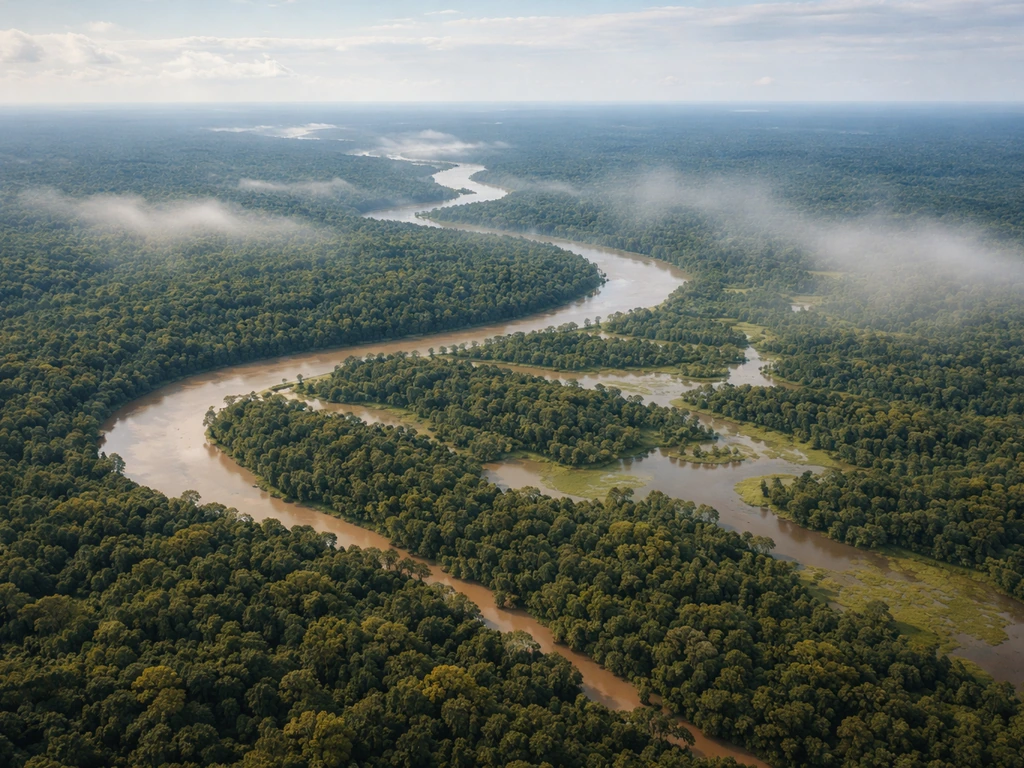
The native range of Hevea brasiliensis is centered on the Amazon Basin in Brazil, including what is now the state of Mato Grosso and the broader Amazonian lowlands, plus the Guianas to the northeast. From that Amazonian core, wild and semi-wild populations extend outward into a broad arc across northern South America: north into Venezuela, west into Colombia and Peru, and south into Bolivia. This is not a plant with a narrow, fragile range, it spans a significant sweep of tropical South America, but every part of that range shares the same fundamental character: hot, wet, and low-elevation.
The Amazon Basin is one of the most thoroughly studied tropical ecosystems on the planet, and Hevea brasiliensis is part of its mixed canopy forest. It does not grow in isolation. In the wild, it shares the forest with hundreds of other large tropical trees, and it benefits from the structural shelter those forests provide. That ecological context matters when you are trying to replicate conditions outside the native range.
What the native habitat actually looks like
Rainfall
The rubber tree's native range receives roughly 1,600 to 4,000 mm of rainfall per year, and parts of the Amazon regularly exceed that upper threshold. There can be a dry season of up to three or four months in some parts of the range, so the species is not exclusively limited to always-wet rainforest, it can handle a short dry period. But the baseline is high annual rainfall, and consistently moist air is the norm. Think of it this way: the Amazon does not do extended drought, and neither does Hevea brasiliensis.
Temperature
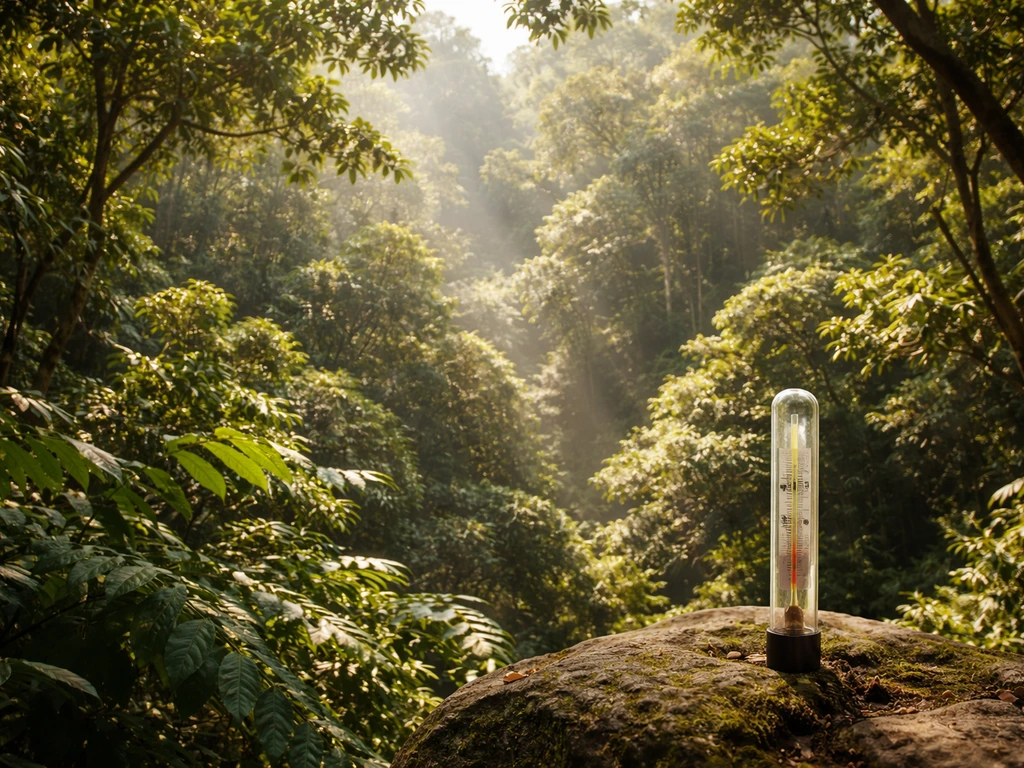
The native range sits almost entirely within the equatorial belt, staying warm year-round. The lowland Amazon rarely dips below 18°C even at night, and daytime highs run consistently in the 28–34°C range. There is no frost in the natural habitat, none whatsoever. This is a plant that has never evolved any cold tolerance, which has serious implications for growing it outside the tropics.
Soil
Amazonian soils are often highly acidic, and Hevea brasiliensis is well-adapted to that. It tolerates a wide pH range of roughly 4 to 8, but it does best in acid soils, which is what much of the Amazon Basin actually has. Here is the counterintuitive part: despite growing in one of the wettest environments on Earth, the species needs good internal drainage. It can handle periodic flooding, and wild stands sometimes grow in seasonally inundated areas, but stagnant waterlogging around the roots is a problem. The native soils tend to drain reasonably well even when rainfall is intense.
Translating the native region into climate zones
If you use the Köppen climate classification system, Hevea brasiliensis's native range falls primarily into the blank" rel="noopener noreferrer">Af zone (tropical rainforest, no meaningful dry season) and extends into Aw (tropical savanna or wet-and-dry tropical, with a distinct dry season). The Af zones are concentrated in the central Amazon; the Aw zones appear at the edges of the range in Venezuela, parts of Colombia, and Bolivia. This Af-to-Aw span is useful because it tells you the species can tolerate a bit of seasonality, but it cannot handle anything approaching a temperate climate.
For practical growing purposes, Hevea brasiliensis is suited to USDA hardiness zones 10b through 12, which correspond to the frost-free tropical and subtropical regions. C4 plants grow in warm, bright environments like open grasslands, deserts, and sunny tropical areas where they can photosynthesize efficiently where do c4 plants grow. In the United States, that means the southernmost tip of Florida, parts of Hawaii, and sheltered coastal areas of Southern California at best. Anywhere that sees frost, even occasional light frost, is outside the viable outdoor range for this tree.
Outside that narrow tropical band, growing Hevea brasiliensis as an outdoor tree is essentially not realistic. It is not the kind of plant you can mulch heavily and coax through a cold winter the way you might with a marginally hardy fig. A single frost event can kill it outright. If you are in a temperate climate and determined to grow one, container culture with indoor overwintering is the only workable path, and even then you are dealing with a tree that wants to become enormous.
Where Ficus elastica grows naturally (if that is your plant)
If the plant you are researching is actually the glossy-leaved houseplant rather than the commercial rubber tree, the native geography shifts entirely. Ficus elastica is native to South and Southeast Asia, with a natural range running from Nepal and northeastern India through Bhutan, Bangladesh, Myanmar, Thailand, Yunnan in southern China, and into Malaysia and Indonesia. That is a range of tropical and subtropical humid forests stretching across monsoon Asia, not South America.
In its native Asian habitat, Ficus elastica grows in tropical and subtropical moist forests, often at varying elevations. Its climate tolerance is somewhat broader than Hevea brasiliensis, it can handle slightly cooler and drier conditions, which is part of why it adapted so well to life as a houseplant in temperate regions. Its native range spans Köppen Af, Aw, and even some drier subtropical zones, so it is more flexible. Köppen climate classification defines tropical rainforest (Af) using temperature and precipitation thresholds, including the driest-month precipitation criterion its native range spans Köppen Af, Aw, and even some drier subtropical zones. That said, it is still fundamentally a tropical plant, and outdoors it only thrives in frost-free climates.
The soil preferences of Ficus elastica in cultivation echo what we see with other tropical plants: it does not want to sit in waterlogged conditions. Leaf yellowing from overly wet soil is one of the most common problems people run into when growing it indoors. Despite being from humid tropical forests, it needs a root zone that drains between waterings, not one that stays continuously saturated.
How to figure out which rubber plant you actually have
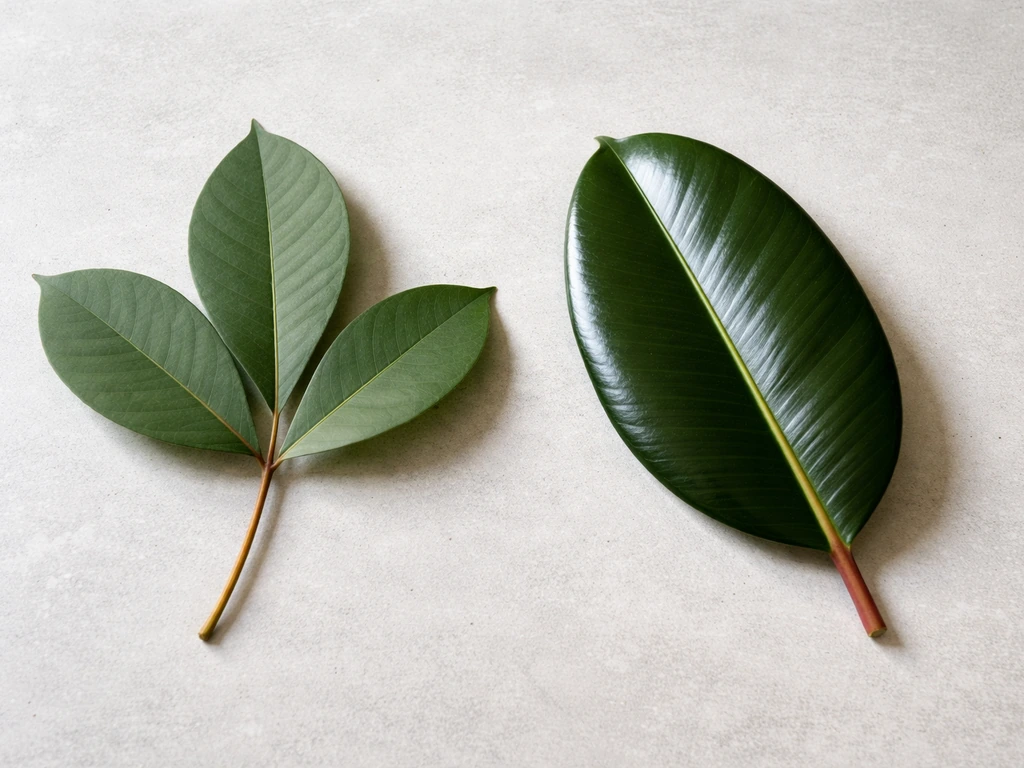
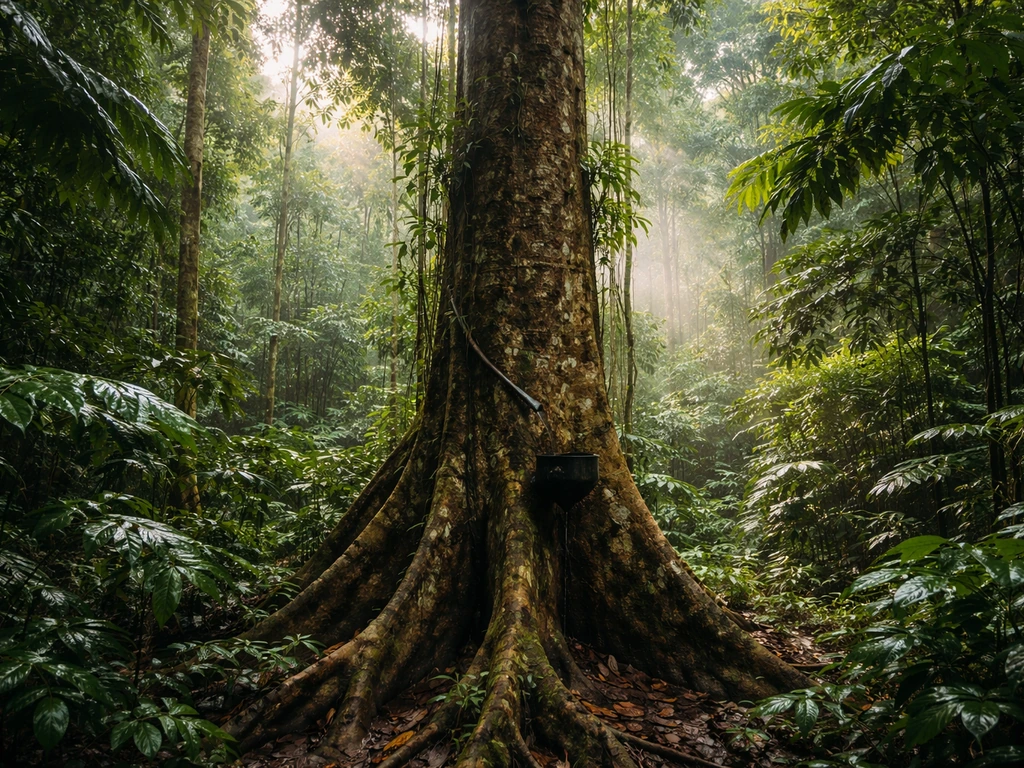
If you are looking at a plant in front of you and trying to identify it, a few quick checks will tell you which one you have. Hevea brasiliensis is a large outdoor tree found in tropical agricultural or wild settings. If your "rubber plant" is a potted houseplant with broad, shiny, dark green or burgundy leaves, it is almost certainly Ficus elastica. If it is a tall tree producing tapped latex from bark wounds in a tropical agricultural setting, it is almost certainly Hevea brasiliensis.
- Ficus elastica: broad, leathery, very glossy leaves, often deep green or reddish-purple in cultivars, available in garden centers worldwide, commonly grown indoors
- Hevea brasiliensis: tall tropical canopy tree, compound leaves with three oval leaflets per stem, not sold as a houseplant, commercially tapped for latex
- Both plants exude white milky latex when cut, so latex alone does not distinguish them
- Leaf shape is the clearest visual cue: Ficus has simple, single broad leaves; Hevea has trifoliate (three-part) compound leaves
Your best growth strategy based on where you live
Once you know which plant you have, matching it to your climate gets much more straightforward. For Hevea brasiliensis, the honest answer is that unless you live in a genuinely tropical climate, it is not going to thrive outdoors. The species is adapted to humid lowland tropics between roughly 6°N and 6°S, and stretching that range requires either living in a very warm subtropical climate or committing to container culture.
If you are in a tropical climate (think southern Florida, Hawaii, coastal regions of Central America, or similar), you can grow Hevea brasiliensis outdoors with attention to drainage. It wants consistent rainfall or irrigation in the 1,600 mm-plus range annually, warm temperatures year-round, and soil that drains well rather than staying boggy. Slightly acidic soil is preferred but it tolerates a wide pH range.
If you are outside the tropics and want to grow Hevea in a container, understand what you are committing to: this tree grows fast and large. Container growing stunts it somewhat, but you will still need a substantial pot, a warm sheltered spot outdoors in summer, and reliable indoor space in winter well above freezing. A south-facing indoor location with high humidity will keep it alive, but it will never reach anything close to its natural potential.
For Ficus elastica growers in temperate climates, the situation is more forgiving. This plant tolerates indoor conditions remarkably well, handles lower humidity than Hevea would, and grows successfully in containers for many years. The main failure mode is overwatering rather than cold, so if you are keeping it indoors, let the soil surface dry between waterings, ensure the pot drains freely, and give it as much indirect light as you can. In subtropical outdoor climates (USDA zones 10 and above), it can grow outdoors year-round and eventually becomes a very large tree.
If you are interested in how other tropical plants map to their native habitats, the same principles that govern where rubber trees grow apply broadly to the tropical plant world. Where do flowering plants grow? It depends on the species, but most thrive in climates and habitats that match their temperature, rainfall, and soil needs. If you are curious where tropical plants grow beyond rubber trees, their native ranges typically cluster in warm, humid regions with consistent rainfall. And the same idea helps you figure out where decorative plants grow naturally by matching their native climate and soil needs where rubber trees grow. Those same climate-mapping principles help explain where endemic plants are those which grow in their native habitats grows in. The relationship between rainfall totals, dry season length, and soil drainage explains a lot about why certain plants thrive in some climates and fail in others, it is the same logic that connects insectivorous plants to their nutrient-poor wetland habitats, or century plants to their semi-arid ranges. The rubber tree's Amazonian origin is just one of the clearest examples of a plant so precisely matched to its native conditions that replicating them outside that region requires real deliberate effort. If you are instead wondering where do century plants grow, the same climate-matching idea applies: know the plant’s native temperature, rainfall, and soil so you can replicate the right conditions. The same idea applies when you research where other sensitive plants grow, since native climate and growing conditions determine what they can handle where sensitive plants grow.
FAQ
How can I tell which “rubber plant” people mean when they ask where rubber plants grow naturally?
If you mean the commercial rubber tree used for latex, its natural region is the Amazon Basin and surrounding lowland tropics in northern South America (centered on Brazil and extending into the Guianas, Venezuela, Colombia, Peru, and Bolivia). If you mean the common “rubber plant” sold as a glossy houseplant, that is usually Ficus elastica, native to South and Southeast Asia, not South America.
Can rubber trees grow outdoors outside the tropics if they get only a light frost sometimes?
Hevea brasiliensis is mainly adapted to frost-free conditions, even if it has a short dry season sometimes. In practice, it can survive outdoors only in reliably warm areas (roughly USDA 10b to 12), because a single frost event can be lethal.
What is the biggest mistake people make when trying to recreate the rubber tree’s natural conditions?
For Hevea brasiliensis, matching rainfall amount is not the only factor, soil drainage matters just as much. Even though the native habitat is very wet, stagnant water at the roots is harmful, so consistently waterlogged pot or garden soil is a common reason for failure.
Does the native habitat of the rubber tree have a dry season?
Yes, it can handle some seasonal change, but it is not a temperate-climate plant. Hevea’s native range includes both Af (very little dry season) and Aw (a distinct dry season), so a short, predictable dry period can be tolerated when temperatures stay warm year-round.
What should I watch for when overwintering a rubber tree in a container?
If you bring a “rubber tree” indoors, treat cold exposure as the primary risk, but also watch watering. Plants often decline after being moved indoors because cooler indoor nights reduce evaporation while roots are still active, increasing the chance of root rot in poorly draining containers.
Is soil pH critical for growing the true rubber tree (Hevea brasiliensis)?
Hevea brasiliensis may tolerate a broad soil pH range (about 4 to 8), but it generally performs best with the acidic, nutrient-and-microbe conditions typical of Amazon soils. Using heavy alkaline garden soil without amending drainage often leads to slower growth even when temperatures are adequate.
If I’m growing the indoor rubber plant (Ficus elastica), what problem usually causes yellow leaves?
Ficus elastica can be more forgiving indoors because it is accustomed to monsoon and humid forest conditions but does not need constant saturation. The most common issue for houseplant growers is overwatering, leading to leaf yellowing even when temperatures are warm.
Is there a simple way to confirm whether my “rubber plant” is Hevea brasiliensis or Ficus elastica?
If your plant is latex-producing like commercial rubber trees, that points to Hevea brasiliensis, but houseplants in pots usually are not latex-tapped plantation trees. A quick practical check is scale and context: Hevea is a large outdoor tree in tropical agriculture, while Ficus elastica is the potted, glossy-leaf indoor species.
What climate details matter most beyond average temperature for growing rubber trees successfully?
When choosing where to plant outdoors, focus on the whole annual pattern: warm temperatures, year-round high humidity or irrigation, and drainage. Areas that are only “hot in summer” but have cool winters do not replicate the native temperature consistency.
Does water availability alone determine whether a rubber tree will thrive in cultivation?
In cultivation, you generally cannot rely on soil alone to prevent issues, you also need a pot or planting setup that prevents root-zone stagnation. For tropical plants like Hevea, use containers or beds with drainage-focused media, and avoid keeping trays filled with water.