Tropical plants naturally grow in the band of Earth that sits between the Tropic of Cancer (roughly 23. 5°N) and the Tropic of Capricorn (roughly 23. 5°S). Within that belt, they thrive wherever temperatures stay consistently warm year-round, typically never dropping below 18°C (64°F) even in the coldest month, and where rainfall is generous enough to keep the ground from drying out for extended periods.
Where Do Tropical Plants Grow? Key Regions and Habitats
Dr. Marcus Weatherby
27 May 2026
That covers a wide sweep of Central and South America, equatorial Africa, South and Southeast Asia, northern Australia, and countless Pacific and Indian Ocean islands. Insectivorous plants can also be found in these tropical regions, especially where nutrient-poor soils limit plant growth and favor unique adaptations where insectivorous plants grow.
But the details matter a lot: not all tropical locations are steamy rainforests, and the specific spot within a tropical ecosystem, whether canopy, riverbank, or cloud-wrapped hillside, shapes which plants grow there just as much as latitude does.
What actually makes a plant "tropical"
The defining characteristic isn't heat in the extreme sense. It's temperature stability. Tropical plants evolved in places where the thermometer doesn't swing wildly between seasons. Under the Köppen climate classification, a climate qualifies as tropical (the A-group) when the mean temperature of even the coldest month stays at or above 18°C (64°F). There's no real "winter" in terms of cold. What varies instead is rainfall, and that difference drives the whole spectrum of tropical plant life, from dense rainforest to thorny dry woodland.
A true tropical rainforest climate (Köppen Af) goes further: every single month receives at least 60 mm (about 2. 4 inches) of rain, with annual totals typically above 1,500 mm. On the UC Davis tropical-wet climate page, that Köppen-related “tropical wet” grouping is defined using a mean monthly temperature of at least 18°C for all 12 months plus annual precipitation of at least 1500 mm [annual precipitation typically above 1,500 mm](https://soilhealth. ucdavis.
edu/climatic-zones/tropical-wet). That constant moisture supply is what allows the layered, multi-canopy structure that most people picture when they think "tropical. " Strip away some of that rainfall or introduce a dry season, and you get a different set of plants adapted to periodic water stress. So when someone asks where tropical plants grow, the answer branches quickly depending on which kind of tropical plant they mean.
For decorative plants, the same tropical rules apply, but you also need to match the plant to its habitat layer, like canopy, understory, or coasts where tropical plants grow.
The main tropical regions on a world map
Zoom out and the core tropical zones are easy to spot. The Amazon Basin in South America is the single largest block of tropical rainforest on Earth, stretching across Brazil, Peru, Colombia, Ecuador, and Bolivia. Central America and the Caribbean islands extend the tropical zone northward, blending into subtropical conditions near the Florida Keys and the Yucatán coast.
Moving east across the Atlantic, the Congo Basin in Central Africa holds the second-largest block of tropical forest, flanked by the forests of West Africa along the Gulf of Guinea coast. Across the Indian Ocean, South Asia's Western Ghats, Sri Lanka, and the lowlands of Bangladesh and Myanmar host rich tropical floras. Then Southeast Asia delivers arguably the most biodiverse tropical region on the planet: the islands of Borneo, Sumatra, Java, the Philippines, and the Malaysian and Indonesian archipelago.
Northern Queensland in Australia and the islands of Melanesia and Polynesia round out the picture.
Coastal and island locations deserve a special mention. Many Pacific and Indian Ocean islands sit squarely in the tropics and experience consistent warmth and humidity driven by surrounding ocean temperatures. These are often where you find species that have evolved in geographic isolation, producing the kind of endemic flora that makes each island group botanically distinct. If you're curious about plants found only in particular places, that's the broader concept of endemic plants at work.
Where within tropical ecosystems plants actually grow
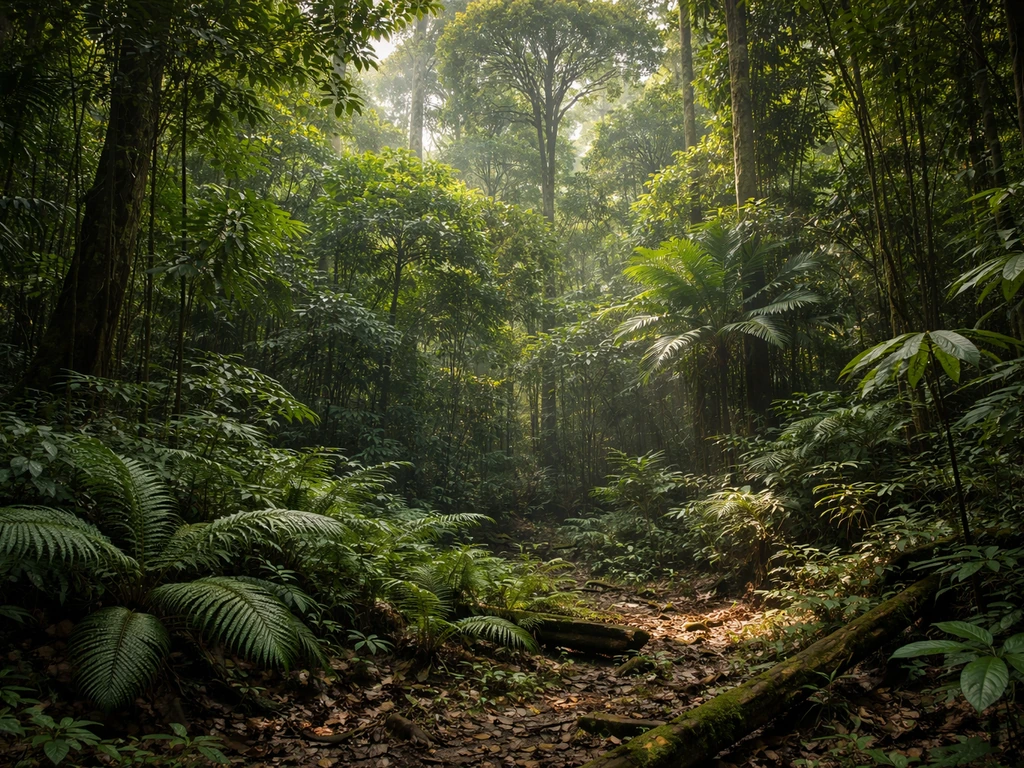
The tropics aren't one uniform environment. Within a single tropical region, you can walk from dense forest to open savanna to flooded swamp in a day, and the plant life shifts completely each time. Understanding those habitat layers helps explain why some tropical plants need deep shade and others demand full sun.
Rainforest canopy and emergent layer
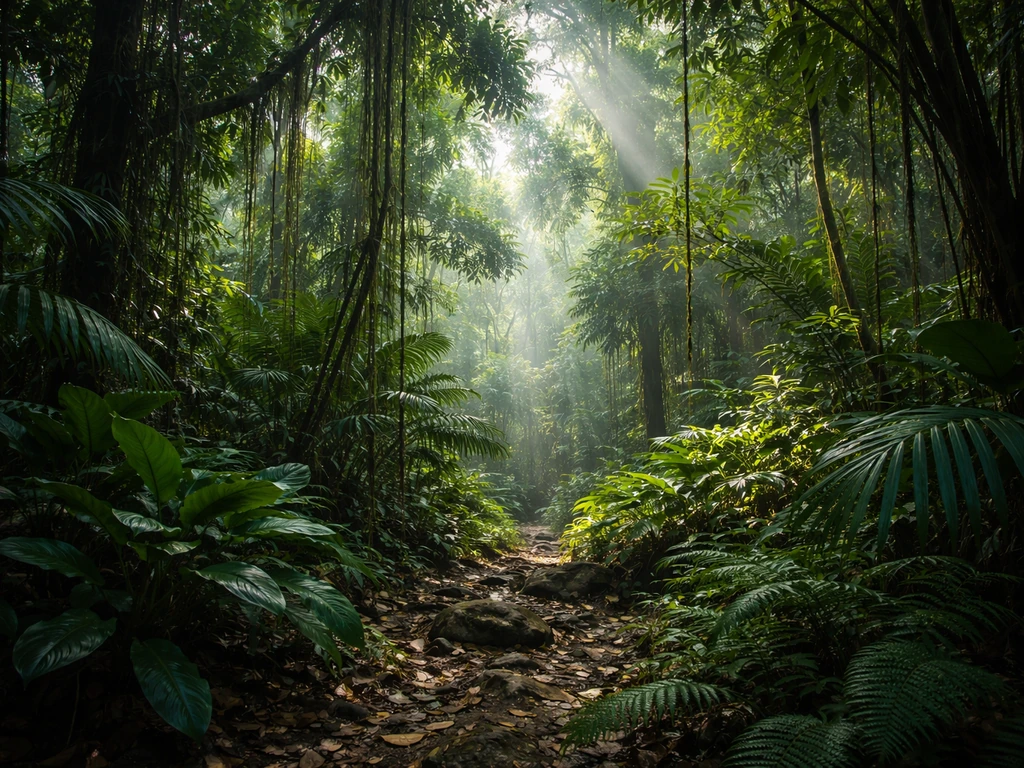
The tallest trees, called emergents, punch through the main canopy and sit fully exposed to direct sun, heavy rain, and wind. Below them, the closed canopy forms at roughly 25 to 40 meters, where crowns interlock and light becomes a competitive resource. Plants here, including epiphytic orchids, bromeliads, and ferns, have adapted to anchor themselves on branches and intercept whatever light filters through. The competition for light at this level is intense, which is why so many canopy species produce large, dark-green leaves designed to capture every available photon.
The understory and forest floor
Below the canopy, light levels drop dramatically. The understory, which sits between roughly 5 and 20 meters, is where you find the plants most familiar to indoor gardeners: philodendrons, monsteras, calatheas, and many palms. These species evolved to thrive on dappled, indirect light. The forest floor itself receives as little as 1 to 2 percent of the light hitting the canopy top, so plants there, like many ferns and ground-level aroids, are masters of low-light efficiency. They're also surrounded by decaying leaf litter, which keeps the soil layer relatively thin but nutrient-rich and fast-draining.
Riverbanks, floodplains, and wetlands
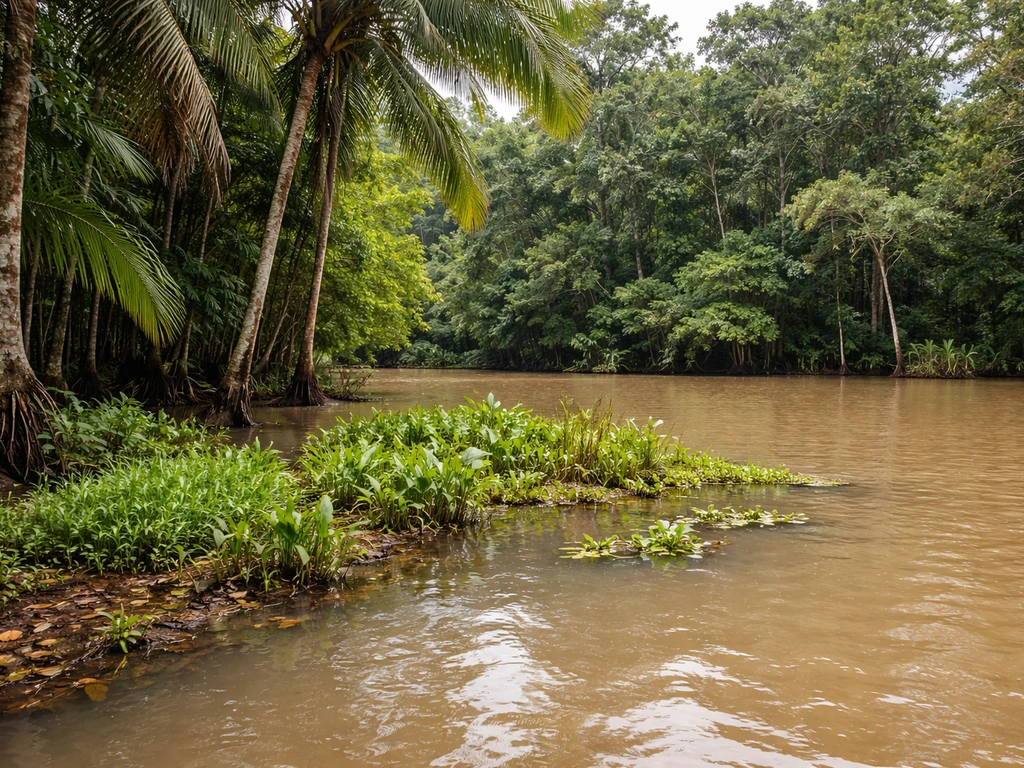
Tropical rivers create their own plant zones. Along the banks and in seasonally flooded várzea forest (common in the Amazon), you find species that tolerate weeks or months of root inundation. Giant Victoria water lilies, riparian palms, and various Heliconia species grow here, benefiting from the nutrient deposits carried by floodwaters. These are open-gap environments with more light than the closed forest interior, which is part of why some of the most visually striking tropical flowering plants are found along water.
Mangroves and tropical coasts
Mangrove forests line tropical coastlines where saltwater and freshwater meet. These are extraordinarily specialized ecosystems. Mangrove trees have evolved prop roots, pneumatophores (breathing roots that stick up through the sediment), and salt-filtering mechanisms that no typical tropical plant possesses. They grow in the intertidal zone across roughly 25 degrees of latitude on both sides of the equator, from Florida's southern tip down through the Caribbean and along the coasts of West Africa, South Asia, and Southeast Asia. Nothing else grows in the same conditions.
Tropical dry forests and savannas
Not all tropical ecosystems are wet. The tropical dry forest biome, found in places like Mexico's Pacific coast, the Brazilian cerrado, parts of East Africa, and the dry zones of India and Sri Lanka, supports plants adapted to a pronounced dry season. Trees here tend to be deciduous, dropping leaves when water stress peaks. Grasses dominate the ground layer in tropical savannas like the African Serengeti and South American llanos. These plants are technically tropical because temperatures remain high year-round, but their adaptations look more like desert or Mediterranean plants than rainforest species.
Elevation changes everything: lowland vs montane tropics
One of the most common misconceptions about the tropics is that they're uniformly hot and humid from sea level to the mountaintop. They're not. Temperature drops by roughly 6°C for every 1,000 meters of elevation gained (the standard environmental lapse rate). So while the Amazon lowlands at 100 meters above sea level might average 28°C, the Andean cloud forest at 2,000 meters is closer to 16°C and draped in mist for most of the day. These are completely different plant communities despite being separated by just a few hours of hiking.
| Elevation Zone | Typical Temperature Range | Key Characteristics | Example Plant Types |
|---|---|---|---|
| Lowland tropics (0–1,000 m) | 24–32°C | High heat, consistent rain or strong seasonality, maximum biodiversity | Dipterocarps, palms, lianas, aroids, giant figs |
| Premontane / submontane (1,000–1,800 m) | 18–24°C | Slightly cooler, frequent mist, high moisture, epiphyte-rich | Tree ferns, orchids, mossy forest species, Heliconia |
| Montane / cloud forest (1,800–3,000 m) | 12–18°C | Near-constant cloud cover, saturated air, poor drainage, slow decomposition | Rhododendrons, dwarf forest trees, sphagnum moss, many endemic ferns |
| High-altitude paramo / afroalpine (above 3,000 m) | Below 12°C | Frost possible at night, intense UV, adapted giant rosette plants | Giant lobelias, frailejones (Espeletia), alpine sedges |
Cloud forests, in particular, are botanical treasure troves. Places like the Monteverde region of Costa Rica, the eastern Andes of Ecuador and Peru, Mount Kinabalu in Borneo, and the Rwenzori Mountains in Central Africa host species found absolutely nowhere else. The combination of mild temperatures, near-100% relative humidity, and consistent cloud immersion creates conditions that even lowland tropical species can't tolerate. If you're tracking down where specific groups like orchids or bromeliads have their highest diversity, cloud forests often win.
Seasonality inside the tropics: wet seasons, dry seasons, and what that means for plants
The tropics have seasons. They just aren't defined by temperature the way temperate seasons are. Instead, the key variable is rainfall, and specifically the arrival and departure of the Inter-Tropical Convergence Zone (ITCZ), the belt of rising moist air that migrates north and south of the equator over the course of the year. Where the ITCZ passes, you get a wet season. Where it retreats, you get a dry season.
Locations right on the equator, like Borneo's interior, the Congo Basin, and the western Amazon, often receive rainfall so consistently that there's no meaningful dry season at all. Move a few degrees north or south and you start to see a pronounced seasonal pattern. Mumbai, India, gets almost no rain from October through May, then receives nearly all of its annual rainfall in the June-to-September monsoon window. The plants there have adapted to that pulse: many flush new growth and flower right at the onset of the monsoon, then go semi-dormant through the dry months.
This matters if you're trying to identify tropical plants or understand their natural behavior. A rubber tree (Hevea brasiliensis) from the Amazon, where rain is year-round, behaves differently from a teak tree (Tectona grandis) from the seasonal tropics of mainland Southeast Asia, where teak is adapted to shed its leaves during a dry season. Rubber plants (often grown as houseplants) originate in the Amazon region, where conditions match their native tropical habitat. Both are tropical, but their rainfall environments are opposite. Rubber plants in particular have a fascinating native range story tied to equatorial Amazonian conditions.
How to tell if a location can support tropical plants
Whether you're assessing a real-world location or figuring out if your own garden can support tropical species, there are four conditions to check. Get these right and you're working with the plant instead of against it.
Minimum temperature: the cold tolerance question
This is the single biggest limiting factor outside the true tropics. Most tropical plants can't tolerate sustained temperatures below 10°C, and many show damage below 15°C. The Köppen A-group threshold of 18°C as a minimum monthly mean is a useful baseline: if a location regularly drops below that even briefly, you're dealing with a plant that will either need protection or won't make it. Check the absolute minimum temperatures for your location, not just the averages. A single overnight frost will kill most tropical species that haven't evolved any cold hardiness.
Rainfall and humidity: how much and when
Annual rainfall above 1,500 mm distributed across most of the year supports the broadest range of tropical plants. If you are wondering where century plants grow specifically, they come from arid regions and are most at home in warm, dry climates with excellent drainage. If your location gets heavy rainfall but it's concentrated in a short rainy season, you're in seasonal tropical territory: plants there need to handle periodic drought. Relative humidity matters separately from rainfall. Tropical forest species, especially epiphytes and understory plants, evolved in air that's typically 80 to 100% relative humidity. In dry or arid climates, even with irrigation, those plants struggle because it's not just soil moisture they need but atmospheric moisture around their leaves.
Light: more complex than just "full sun"
Tropical regions receive consistent daylength year-round, roughly 11 to 13 hours of daylight regardless of season. That constancy matters for plants that use daylength as a cue. Beyond that, light requirements split sharply by habitat origin. Canopy and savanna species want full, intense sun. Understory species like many aroids, ferns, and shade-adapted palms want bright indirect light or filtered sun for most of the day. Placing an understory species in full tropical sun will scorch it; giving a canopy tree permanent shade will starve it. Knowing the plant's native habitat layer tells you what light regime it actually needs.
Soil and drainage: what the forest floor actually looks like
Tropical soils are often paradoxical: they sit under the most productive forests on Earth, yet many are naturally low in nutrients. Heavy rainfall leaches nutrients from the upper soil layers rapidly, which is why most of the nutrient cycle in tropical forests operates above ground, in the living biomass and decomposing litter rather than in the mineral soil. For most tropical plants, the key soil requirements are fast drainage (they don't want waterlogged roots, mangroves aside), slightly acidic to neutral pH, and organic matter in the surface layer. Dense clay that holds water, or alkaline soils common in arid regions, are poor matches for the majority of tropical species.
A quick checklist before calling a location "tropical-plant friendly"
- Cold-month average stays at or above 18°C, and no frost risk at all
- Annual rainfall of at least 1,000–1,500 mm, or supplemental irrigation can compensate
- Relative humidity consistently above 60–70% during the growing period
- Daylength of at least 10–12 hours for most of the year
- Soil that drains freely but retains some organic moisture, ideally slightly acidic (pH 5.5–6.5)
- No prolonged dry season unless you're specifically growing dry-tropical or savanna-adapted species
If a location checks most of those boxes, it can support a broad community of tropical plants. If it fails on temperature, that's a hard wall that can only be addressed with greenhouses or heated indoor spaces. If it fails on humidity, many rainforest species will struggle even with the other conditions met. The more of these factors align with the plant's native habitat, the better its chances of not just surviving but actually behaving the way it does in the wild, including flowering, fruiting, and reproducing on its natural schedule.
One practical step worth taking: look up the native range of a specific species and then pull the climate data for that range. If you're in Borneo asking why your local ficus is thriving while your neighbor's orchid is failing, the answer almost always comes down to one of these four variables being slightly off for that particular species. The tropics aren't a monolith, and neither are tropical plants.
Matching the plant to its specific ecological niche, whether lowland rainforest, dry deciduous forest, cloud forest, or mangrove fringe, is the real key to understanding where tropical plants grow and why. Sensitive plants have their own preferred habitats within the tropics, so the best place to look is the species' native range and moisture conditions where tropical plants grow.
If you mean C4 plants specifically, their preferred climate, light, and water conditions point to particular tropical and subtropical regions.
FAQ
Do tropical plants grow only between the Tropic of Cancer and Tropic of Capricorn?
Many do, but “tropical” is really about climate stability. If a place outside that latitude still has no meaningful cold season and stays warm year-round, some tropical plants can survive there, especially in protected microclimates (heated courtyards, south-facing walls, frost-free valleys). Cold snaps are usually what limit them.
Why do some tropical plants fail in places that are warm all year?
Warmth alone is not enough. The most common misses are humidity and light mismatch, plus the wrong drainage or soil pH. A rainforest understory plant can struggle in a hot but dry city even if temperatures are high, because air moisture around the leaves is a major requirement.
Can tropical plants grow at high elevation in the tropics?
Yes, but you will often get different plant communities. Temperature drops with elevation, so “tropical by latitude” does not mean “tropical by temperature.” Cloud forest areas, in particular, support species that need cooler, very humid conditions that lowland tropical plants cannot handle.
How much of a dry season can tropical plants tolerate?
It depends on which tropical biome the species comes from. Plants from evergreen wet forests usually need consistently moist air and soil, while species from seasonal dry forests and savannas are adapted to periods of water stress, often by shedding leaves or slowing growth during the dry months.
Is the rainfall total the only thing that matters for tropical growth?
No, timing and distribution matter as much as totals. Two locations with the same annual rainfall can be very different if one has rain spread out monthly and the other has a short wet season followed by long dryness. Many plants respond by flowering and flushing growth right at the onset of the wet period.
How do I know if my location’s temperatures are “safe” for tropical plants?
Check the absolute minimum temperatures, not only averages. A single overnight frost can kill tropical plants that otherwise would be fine. Also consider wind exposure and whether cold air pools in your garden, which can make lows colder than nearby weather station readings.
Why do tropical plants sometimes burn even when I water them correctly?
Light intensity and leaf type matter. Understory-adapted species often scorch in harsh full sun, even with adequate irrigation, because their leaves evolved for filtered light. Move plants gradually or provide shade, and use the plant’s native habitat layer as your guide.
What’s special about mangrove plants compared with other tropical plants?
Mangroves are not just “salt-tolerant.” They are adapted to intertidal life with fluctuating saltwater exposure, low oxygen in saturated sediments, and specialized roots for gas exchange. Regular garden soil, even if warm and humid, typically cannot replicate these conditions.
Do tropical plants have different needs depending on their forest layer?
Yes. Emergent, canopy, understory, and forest floor plants differ sharply in light levels, airflow, and even how often they experience saturated conditions. If you buy a plant labeled “tropical” without knowing its native habitat layer, you can easily choose the wrong light and scorch or starve it.
Can tropical plants be grown successfully in non-tropical climates indoors?
Often, but you must recreate the key limiting factors: temperature stability, humidity, correct light level, and fast drainage. Many household failures come from low humidity and weak light rather than from temperature. Grouping plants, using a humidifier for humidity-demanding species, and using a well-draining mix are common fixes.
What’s the best way to narrow down “where” a specific tropical plant grows?
Use the species’ native range, then compare climate variables from that region to your location, especially minimum temperatures, humidity pattern, rainfall seasonality, and light conditions. If you know whether it comes from lowland rainforest, cloud forest, dry forest, or mangrove fringe, you can predict likely success much more accurately.